XXXVI.--THE HULA HOO-NA-NÁ
The hula hoo-na-ná--to quiet, amuse--was an informal dance, such as was performed without the usual restrictions of tabu that hedged about the set dances of the halau. The occasion of an outdoor festival, an ahaaina or luau, was made the opportunity for the exhibition of this dance. It seems to have been an expression of pure sportiveness and mirth-making, and was therefore performed without sacrifice or religious ceremony. While the king, chiefs, and aialo--courtiers who ate in the king's presence--are sitting with the guests about the festal board, two or three dancers of graceful carriage make a circuit of the place, ambling, capering, gesturing as they go in time to the words of a gay song.A performance of this sort was witnessed by the author's informant in Honolulu many years ago; the occasion was the giving of a royal luau. There was no musical instrument, the performers were men, and the mele they cantillated went as follows:
A pili, a pili.
A pili ka’u manu
Ke kepau a o ka ulu-laau.
Poai a puni,
5 Noho ana i muli-wa’a; b
Hoonu’u ka momona a ke alii.
Eli-eli c ke kapu; ua noa.
Noa ia wai?
Noa ia ka lani.
10 Kau lilua, d kaohi ka maku’u
E ai ana ka ai a ke alii!
Hoonu’u, hoonu’u hoonu’u
I ka i’a a ke alii!
A pili ka’u manu
Ke kepau a o ka ulu-laau.
Poai a puni,
5 Noho ana i muli-wa’a; b
Hoonu’u ka momona a ke alii.
Eli-eli c ke kapu; ua noa.
Noa ia wai?
Noa ia ka lani.
10 Kau lilua, d kaohi ka maku’u
E ai ana ka ai a ke alii!
Hoonu’u, hoonu’u hoonu’u
I ka i’a a ke alii!
p. 245
[Translation]
She is limed, she is limed,
My bird is limed,
With the gum of the forest.
We make a great circuit,
5 Outskirting the feast.
You shall feast on king's bounty:
No fear of the tabu, all's free.
Free! and by whom?
Free by the word of the king.
10 Then a free rein to mirth!
Banish the kill-joy
Who eats the king's dainties!
Feast then till replete
With the good king's meat!
My bird is limed,
With the gum of the forest.
We make a great circuit,
5 Outskirting the feast.
You shall feast on king's bounty:
No fear of the tabu, all's free.
Free! and by whom?
Free by the word of the king.
10 Then a free rein to mirth!
Banish the kill-joy
Who eats the king's dainties!
Feast then till replete
With the good king's meat!
Footnotes
244:a Kepáu. Gum, the bird-lime of the fowler, which was obtained from forest trees, but especially from the ulu, the breadfruit.244:b Muli-wa’a (muli, a term applied to a younger brother). The idea involved is that of separation by an interval, as a younger brother is separated from his older brother by an interval. Muliwai is an interval of water, a stream. Wa’a, the last part of the above compound word, literally a canoe, is here used tropically to mean the tables, or the dishes, on which the food was spread, they being long and narrow, in the shape of a canoe. The whole term, consequently, refers to the people and the table about which they are seated.
244:c Eli-eli. A word that is found in ancient prayers to emphasize the word kapu or the word noa.
244:d Lilua. To stand erect and act without the restraint usually prescribed in the presence of royalty.
XXXVII.--THE HULA ULILI
The hula ulili, also called by the descriptive name kolili--to wave or flutter, as a pennant--was a hula that was not at all times confined to the tabu restrictions of the halau. Like a truant schoolboy, it delighted to break loose from restraint and join the informal pleasurings of the people. Imagine an assembly of men and women in the picturesque illumination given by flaring kukui torches, the men on one side, the women on the other. Husbands and wives, smothering the jealousy instinctive to the human heart, are there by mutual consent--their daughters they leave at home--each one ready to play his part to the finish, with no thought of future recrimination. It was a game of love-forfeits, on the same lines as kilu and ume.Two men, armed with wands furnished with tufts of gay feathers, pass up and down the files of men and women, waving their decorated staffs, ever and anon indicating with a touch of the wand persons of the opposite sea, who under the rules must pay the forfeit demanded of them. The kissing, of course, goes by favor. The wand-bearers, as they move along, troll an amorous ditty:
Oli
Kii na ka ipo * * *
Mahele-hele i ka la o Kona! a
O Kona, kai a ke Akua. b
Elua la, huli ka Wai-opua, c
5 Nehe i ke kula,
Leha iluna o Wai-aloha. d
Kani ka aka a ka ua i ka laau,
Hoolaau ana i ke aloha ilaila.
Pili la, a pili i ka’u manu--
10 O pili o ka La-hiki-ola.
Ola ke kini o-lalo.
Hana i ka mea he ipo.
A hui e hui la!
Hui Koolau-wahine e o Pua-ke-í! f
Mahele-hele i ka la o Kona! a
O Kona, kai a ke Akua. b
Elua la, huli ka Wai-opua, c
5 Nehe i ke kula,
Leha iluna o Wai-aloha. d
Kani ka aka a ka ua i ka laau,
Hoolaau ana i ke aloha ilaila.
Pili la, a pili i ka’u manu--
10 O pili o ka La-hiki-ola.
Ola ke kini o-lalo.
Hana i ka mea he ipo.
A hui e hui la!
Hui Koolau-wahine e o Pua-ke-í! f
p. 247
[Translation]
Song
A search for a sweetheart * * *
Sport for a Kona day!
Kona, calm sea of the gods.
Two days the wind surges;
5 Then, magic of cloud!
It veers to the plain,
Drinks up the water of love.
How gleesome the sound
Of rain on the trees,
10 A balm to love's wound!
The wand touches, heart-ease!
It touches my bird--
Touch-of life from the sun!
Brings health to the million.
15 Ho, now comes the fun!
A meeting, a union--
The nymph, Koo-lau,
And the hero, Ke-í.
Sport for a Kona day!
Kona, calm sea of the gods.
Two days the wind surges;
5 Then, magic of cloud!
It veers to the plain,
Drinks up the water of love.
How gleesome the sound
Of rain on the trees,
10 A balm to love's wound!
The wand touches, heart-ease!
It touches my bird--
Touch-of life from the sun!
Brings health to the million.
15 Ho, now comes the fun!
A meeting, a union--
The nymph, Koo-lau,
And the hero, Ke-í.
Footnotes
246:a La o Kona. A day of Kona. i.e., of fine weather.246:b Kai a he Akua. Sea of the gods, because calm.
246:c Wai-opua. A wind which changed its direction after blowing for a few days from one quarter.
246:d Wai-aloha. The name of a hill. In the translation the author has followed its meaning ("water of love").
246:e Koolau-wahine. The name of a refreshing wind, often mentioned in Hawaiian poetry; here used as a symbol of female affection.
246:f Pua-ke-i. The name of a sharp, bracing wind felt on the windward side of Molokai; used here apparently as a symbol of strong masculine passion.
XXXVIII.--THE HULA O-NIU
The so-called hula o-niu is not to be classed with the regular dances of the halau. It was rather a popular sport, in which men and women capered about in an informal dance while the players engaged in a competitive game of top-spinning. The instrument of sport was made from the lower pointed half of an oval coconut shell, or from the corresponding part of a small gourd. The sport was conducted in the presence of a mixed gathering of people amid the enthusiasm and boisterous effervescence which betting always greatly stimulated in Hawaii.The players were divided into two sides of equal number, and each player had before him a plank, slightly hollowed in the center--like the board on which the Hawaiians pounded their poi--to be used as the bed for spinning his top. The naked hand, unaided by whip or string, was used to impart to the rude top a spinning motion and at the same time the necessary projectile force--a balancing of forces that called for nice adjustment, lest the whirling thing reel too far to one side or run wild and fly its smooth bed. Victory was declared and the wager given to the player whose top spun the longest.
The feature that most interests us is the singing, or cantillation, of the oli. In a dance and game of this sort, which the author's inform-ant witnessed at Kahuku, Oahu, in 1844, one contestant on each side, in turn, cantillated an oli during the performance of the game and the dance.
Oli
Ke pohá nei; u’ína la!
Kani óle-oléi, hau-walaau!
Ke wawa Pu’u-hina-hina; a
Kani ka aka, he-hene na pali,
5 Na pali o Ka-iwi-ku’i. b
Hanohano, makana i ka Wai-opua. c
Malihini ka hale, ua hiki mai;
Kani ka pahu a Lohiau,
A Lohiau-ipo d i Haena la.
10 Enaena ke aloha, ke hiki mai;
Kani óle-oléi, hau-walaau!
Ke wawa Pu’u-hina-hina; a
Kani ka aka, he-hene na pali,
5 Na pali o Ka-iwi-ku’i. b
Hanohano, makana i ka Wai-opua. c
Malihini ka hale, ua hiki mai;
Kani ka pahu a Lohiau,
A Lohiau-ipo d i Haena la.
10 Enaena ke aloha, ke hiki mai;
p. 249
[Translation]
Song
The rustle and hum of spinning top,
Wild laughter and babel of sound--
Hear the roar of the waves at Pu’u-hina!
Bursts of derision echoed from cliffs,
5 The cliffs of Ka-iwi-ku’i;
And the day is stirred by a breeze.
The house swarms with women and men.
List! the drum-beat of Lohiau,
Lohiau, the lover, prince of Haena--
10 Love glows like an oven at his coming;
Then to bathe in the lake of the God.
Let us look at the vale Lima-huli, look!
Now turn we and study the spinning--
That trick we must catch to be winning.
Wild laughter and babel of sound--
Hear the roar of the waves at Pu’u-hina!
Bursts of derision echoed from cliffs,
5 The cliffs of Ka-iwi-ku’i;
And the day is stirred by a breeze.
The house swarms with women and men.
List! the drum-beat of Lohiau,
Lohiau, the lover, prince of Haena--
10 Love glows like an oven at his coming;
Then to bathe in the lake of the God.
Let us look at the vale Lima-huli, look!
Now turn we and study the spinning--
That trick we must catch to be winning.
This fragment from antiquity, as the local coloring indicates, finds its setting at Haena, the home of the famous mythological Prince Lohiau, of whom Pele became enamored in her spirit journey. Study of the mele suggests the occasion to have been the feast that was given in celebration of Lohiau's restoration to life and health through the persevering incantations of Hiiaka, Pele's beloved sister. The feast was also Lohiau's farewell to his friends at Haena. At its conclusion Hiiaka started with her charge on the journey which ended with the tragic death of Lohiau at the brink of the volcano. Pele in her jealousy poured out her fire and consumed the man whom she had loved.
Footnotes
248:a Pu’u-hina-hina. A precipitous place on the coast near Haena.248:b Ka-iwi-ku’i. A high cliff against which the waves dash.
248:c Wai-opua. The name of a pleasant breeze.
248:d Lohiau-ipo. The epithet ipo, sweetheart, dear one, was often affixed to the name of Lohiau, in token, no doubt, of his being distinguished as the object of Pele's passionate regard.
249:a Kanaloa. There is a deep basin of clear water, almost fluorescent in its sparkle, in one of the arched caves of Haena, which is called the water of Kanaloa--the name of the great God. This is a favorite bathing place.
249:b Limu-huli. The name of a beautiful valley that lies back of Haena.
XXXIX.--THE HULA KU'I
The account of the Hawaiian hulas would be incomplete if without mention of the hula ku’i. This was an invention, or introduction, of the last quarter of the nineteenth century. Its formal, public, appearance dates from the coronation ceremonies of the late King Kalakaua, 1883, when it filled an important place in the programme. Of the 262 hula performances listed for exhibition, some 30 were of the hula ku’i. This is perhaps the most democratic of the hulas, and from the date of its introduction it sprang at once into public favor. Not many years ago one could witness its extemporaneous performance by nonprofessionals at many an entertainment and festive gathering. Even the school-children took it up and might frequently be seen innocently footing its measures on the streets. (Pl. xxiv.)The steps and motions of the hula ku’i to the eyes of the author resemble those of some Spanish dances. The rhythm is in common, or double, time. One observes the following motions:
Figure A.--1. A step obliquely forward with the left foot, arms pointing the same way, body inclining to the right. 2. The ball of the left foot (still advanced) gently pressed on the floor; the heel swings back and forth, describing an arc of some 30 or 40 degrees. 3. The left foot is set firmly in the last position, the body inclining to it as the base of support; the right foot is advanced obliquely, and 4, performs the heel-swinging motions above described, arms pointing obliquely to the right.
Figure B.--Hands pressed to the waist, fingers directed forward, thumbs backward, elbows well away from the body; left foot advanced as in figure A, 1, body inclining to the right. 2. The left foot performs the heel-waving motions, as above. 3. Hands in same position, right foot advanced as previously described. 4. The right foot performs the swinging motions previously described--the body inclined to the left.
Figure C.--In this figure, while the hands are pressed as before against the waist, with the elbows thrown well away from the body, the performer sways the pelvis and central axis of the trunk in a circular or elliptical orbit, a movement, which, carried to the extreme, is termed ami.
There are other figures and modifications, which the ingenuity and fancy of performers have introduced into this dance; but this account must suffice.
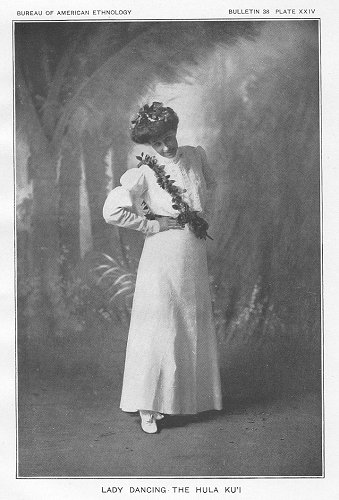
Click to enlarge
PLATE XXIV
LADY DANCING THE HULA KU'I
p. 251
Given a demand for a pas seul, some pleasing dance combining grace with dexterity, a shake of the foot, a twist of the body, and a wave of the hands, the hula ku’i filled the bill to perfection. The very fact that it belonged by name to the genus hula, giving it, as it were, the smack of forbidden fruit, only added to its attractiveness. It became all the rage among dancing folk, attaining such a vogue as almost to cause a panic among the tribunes and censors of society. Even to one who cares nothing for the hula per se, save as it might be a spectacle out of old Hawaii, or a setting for an old-time song, the innocent grace and Delsartian flexibility of this solo dance, which one can not find in its Keltic or African congeners, associate it in mind with the joy and light-heartedness of man's Arcadian period.
The instruments generally used in the musical accompaniment of the hula ku’i are the guitar, the uku-lele, a the taro-patch fiddle, or the mandolin; the piano also lends itself effectively for this purpose; or a combination of these may be used.
The songs that are sung to this dance as a rule belong naturally to later productions of the Hawaiian muse, or to modifications of old poetical compositions. The following mele was originally a name-song (mele-inoa). It was appropriated by the late Princess Kino-iki; and by her it was passed on to Kalani-ana-ole, a fact which should not prejudice our appreciation of its beauty.
Mele
I aloha i ke ko a ka wai,
I ka i mai, e, anu kaua.
Ua anu ha pua o ka laina, b
Ka wahine noho anu o ke kula.
5 A luna au a o Poli-ahu; c
Ahu wale kai a o Wai-lua.
Lua-ole ka hana a ka makani,
A ke Kiu-ke’e d a o na pali,
Pa iho i ke kai a o Puna--
10 Ko Puna mea ma’a mau ia.
Pau ai ko’u lihi hoihoi
I ka wai awili me he kai.
Ke ono hou nei ku’u pu’u
I ha wai hu’iliu’i o ka uka,
I ka i mai, e, anu kaua.
Ua anu ha pua o ka laina, b
Ka wahine noho anu o ke kula.
5 A luna au a o Poli-ahu; c
Ahu wale kai a o Wai-lua.
Lua-ole ka hana a ka makani,
A ke Kiu-ke’e d a o na pali,
Pa iho i ke kai a o Puna--
10 Ko Puna mea ma’a mau ia.
Pau ai ko’u lihi hoihoi
I ka wai awili me he kai.
Ke ono hou nei ku’u pu’u
I ha wai hu’iliu’i o ka uka,
p. 252
15 Wai hone i ke kumu o ka pali,
I malu i ka lau kui-kui. a
Ke kuhi nei au a he pono
Ka ilima lei a ke aloha,
Au i kau nui aku ai,
20 I ka nani oi a oia pua.
I malu i ka lau kui-kui. a
Ke kuhi nei au a he pono
Ka ilima lei a ke aloha,
Au i kau nui aku ai,
20 I ka nani oi a oia pua.
[Translation]
Song
How pleasing, when borne by the tide,
One says, you and I are a-cold.
The buds of the center are chilled
Of the woman who shivers on shore.
5 I stood on the height Poli-ahu;
The ocean enrobed Wai-lua.
Ah, strange are the pranks of the wind,
The Kiu-ke’e wind of the pali!
It smites now the ocean at Puna--
10 That's always the fashion at Puna.
Gone, gone is the last of my love,
At this mixture of brine in my drink!
My mouth is a-thirst for a draught
Of the cold mountain-water,
15 That plays at the foot of the cliff,
In the shade of the kui-kui tree.
I thought our love-flower, ilima--
Oft worn as a garland by you--
Still held its color most true.
20 You'd exchange its beauty for rue!
One says, you and I are a-cold.
The buds of the center are chilled
Of the woman who shivers on shore.
5 I stood on the height Poli-ahu;
The ocean enrobed Wai-lua.
Ah, strange are the pranks of the wind,
The Kiu-ke’e wind of the pali!
It smites now the ocean at Puna--
10 That's always the fashion at Puna.
Gone, gone is the last of my love,
At this mixture of brine in my drink!
My mouth is a-thirst for a draught
Of the cold mountain-water,
15 That plays at the foot of the cliff,
In the shade of the kui-kui tree.
I thought our love-flower, ilima--
Oft worn as a garland by you--
Still held its color most true.
20 You'd exchange its beauty for rue!
Mele
Kaulana mai nei Pua Lanakila;
Olali oe o ke aupuni hui,
Nana i koké aku ke kahua,
Na ale o ka Pakipika.
5 Lilo i mea ole na enemi;
Punwai hao-kila, he manao paa;
Na Ka nupepa la i hoike mai.
Ua kau Lanakila i ka hanohano,
O ka u’i mapela la o Aina-hau;
10 O ko’u hoa ia la e pili ai--
I hoa kaana i ka puuwai,
I na kohi kelekele i ka Pu’ukolu.
Ina ilaila Pua Komela,
Ka u’i kaulana o Aina-pua!
15 O ka pua o ka Lehua me ka Ilima
I lei kahiko no ko’u kino,
Ka Palai lau-lii me ka Maile,
Ke ala e hoene i kou poli.
Olali oe o ke aupuni hui,
Nana i koké aku ke kahua,
Na ale o ka Pakipika.
5 Lilo i mea ole na enemi;
Punwai hao-kila, he manao paa;
Na Ka nupepa la i hoike mai.
Ua kau Lanakila i ka hanohano,
O ka u’i mapela la o Aina-hau;
10 O ko’u hoa ia la e pili ai--
I hoa kaana i ka puuwai,
I na kohi kelekele i ka Pu’ukolu.
Ina ilaila Pua Komela,
Ka u’i kaulana o Aina-pua!
15 O ka pua o ka Lehua me ka Ilima
I lei kahiko no ko’u kino,
Ka Palai lau-lii me ka Maile,
Ke ala e hoene i kou poli.
p. 253
[Translation]
Song
Fame trumpets your conquests each day,
Brave Lily Victoria!
Your scepter finds new hearts to sway,
Subdues the Pacific's wild waves,
5 Your foes are left stranded ashore,
Firm heart as of steel!
Dame Rumor tells us with glee
Your fortunes wax evermore,
Beauty of Aina-hau,
10 Comrade dear to my heart.
And what of the hyacinth maid,
Nymph of the Flowery Land?
I choose the lehua, ilima,
As my wreath and emblem of love,
15 The small-leafed fern and the maile--
What fragrance exhales from thy breast!
Brave Lily Victoria!
Your scepter finds new hearts to sway,
Subdues the Pacific's wild waves,
5 Your foes are left stranded ashore,
Firm heart as of steel!
Dame Rumor tells us with glee
Your fortunes wax evermore,
Beauty of Aina-hau,
10 Comrade dear to my heart.
And what of the hyacinth maid,
Nymph of the Flowery Land?
I choose the lehua, ilima,
As my wreath and emblem of love,
15 The small-leafed fern and the maile--
What fragrance exhales from thy breast!
The story that might explain this modern lyric belongs to the gossip of half a century ago. The action hinges about one who is styled Pua Lanakila--literally Flower of Victory. Now there is no flower, indigenous or imported, known by this name to the Hawaiians. It is an allegorical invention of the poet. A study of the name and of its interpretation, Victory, at once suggested to me the probability that it was meant for the Princess Victoria Kamamalu.
As I interpret the story, the lover seems at first to be in a condition of unstable equilibrium, but finally concludes to cleave to the flowers of the soil, the lehua and the ilima (verse 15), the palai and the maile (verse 17), the meaning of which is clear.
Footnotes
251:a The uku-lele and the taro-patch fiddle are stringed instruments resembling in general appearance the fiddle. They seem to have been introduced into these islands by the Portuguese immigrants who have come in within the last twenty-five years. As with the guitar, the four strings of the uku-lele or the five strings of the taro-patch fiddle are plucked with the finger or thumb.251:b Na pua o ka laina. The intent of this expression, which seems to have an erotic meaning, may perhaps be inferred from its literal rendering in the translation. It requires a tropical imagination to follow a Hawaiian poem.
251:c Poli-ahu. A place or region on Mauna-kea.
251:d Kiu-ke’e. The name of a wind felt at Nawiliwili, Kauai. The local names for winds differed on the various islands and were multiplied almost without measure; as given in the mythical story of Kama-pua’a, or in the semihistoric tale of Kú-a-Paka’a, they taxed the memories of raconteurs.
252:a Kui-kui. The older name-form of the tree (Aleurites triloba), popularly known by some as the candle-nut tree, from the fact that its oily nuts were used in making torches. Kukui, or tutui, is the name now applied to the tree, also to a torch or lamp. The Samoan language still retains the archaic name tuitui. This is one of the few instances in which the original etymology of a word is retained in Hawaiian poetry.
XL.--THE OLI
The Hawaiian word mele included all forms of poetical composition. The fact that the mele, in whatever form, was intended for cantillation, or some sort of rhythmical utterance addressed to the ear, has given to this word in modern times a special meaning that covers the idea of song or of singing, thus making it overlap ambiguously into the territory that more properly belongs to the word oli. The oli was in strict sense the lyric utterance of the Hawaiians.In its most familiar form the Hawaiians--many of whom possessed the gift of improvisation in a remarkable degree--used the oli not only for the songful expression of joy and affection, but as the vehicle of humorous or sarcastic narrative in the entertainment of their comrades. The traveler, as he trudged along under his swaying burden, or as he rested by the wayside, would solace himself and his companions with a pensive improvisation in the form of an oli. Or, sitting about the camp-fire of an evening, without the consolation of the social pipe or bowl, the people of the olden time would keep warm the fire of good-fellowship and cheer by the sing-song chanting of the oli, in which the extemporaneous bard recounted the events of the day and won the laughter and applause of his audience by witty, ofttimes exaggerated, allusions to many a humorous incident that had marked the journey. If a traveler, not knowing the language of the country, noticed his Hawaiian guide and baggage-carriers indulging in mirth while listening to an oli by one of their number, he would probably be right in suspecting himself to be the innocent butt of their merriment.
The lover poured into the ears of his mistress his gentle fancies: the mother stilled her child with some bizarre allegory as she rocked it in her arms; the bard favored by royalty--the poet laureate--amused the idle moments of his chief with some witty improvisation; the alii himself, gifted with the poetic fire, would air his humor or his didactic comments in rhythmic shape--all in the form of the oli.
The dividing line, then. between the oli and those other weightier forms of the mele, the inoa, the kanikau (threnody), the pule, and that unnamed variety of mele in which the poet dealt with historic or mythologic subjects, is to be found almost wholly in the mood of the singer. In truth, the Hawaiians not unfrequently applied the term pule to compositions which we moderns find it hard to bring within our definitions of prayer. For to our understanding the
p. 255
[paragraph continues] Hawaiian pule often contains neither petition, nor entreaty, nor aspiration, as we measure such things.
The oli from its very name (oli-oli, joyful) conveys the notion of gladness, and therefore of song. It does not often run to such length as the more formal varieties of the mele; it is more likely to be pitched to the key of lyric and unconventional delight, and, as it seems to the writer, more often than other forms attains a gratifying unity by reason of closer adherence to some central thought or mood; albeit, when not so labeled, one might well be at a loss whether in any given case he should term the composition mele or oli.
It may not be entirely without significance that the first and second examples here given come from Kauai, the island which most vividly has retained a memory of the southern lands that were the homes of the people until they came as emigrants to Hawaii.
The story on which this song is founded relates that the comely Pamaho’a was so fond of her husband during his life that at his death she was unwilling to part with his bones. Having cleaned and wrapped them in a bundle, she carried them with her wherever she went. In the indiscretion begotten of her ill-balanced state of mind she committed the mortal offense of entering the royal residence while thus encumbered, where was Kaahumanu, favorite wife of Kamehameha I. The king detailed two constables (ilamuku) to remove the woman and put her to death. When they had reached a safe distance, moved with pity, the men said: "Our orders were to slay; but what hinders you to escape?" The woman took the hint and fled hot-foot.
Oli
Ka wai opua-makani o Wailua, a
I hulihia e ke kai;
Awahia ka lau hau,
Ai pála-ka-há, ka ai o Maká'u-kiu.
5 He kiu ka pua kukui,
He elele hooholo na ke Koolau; b
Ke kipaku mai la i ka wa’a-- c
"E holo oe!"
Holo newa ka lau maia me ka pua hau,
10 I pili aloha me ka mokila ula i ka wai;
Maalo pulelo i ka wai o Malu-aka.
He aka kaua makani kaili-hoa;
Kaili ino ka lau Malua-kele,
Lalau, hopu hewa i ka hoa kanáka; d
I hulihia e ke kai;
Awahia ka lau hau,
Ai pála-ka-há, ka ai o Maká'u-kiu.
5 He kiu ka pua kukui,
He elele hooholo na ke Koolau; b
Ke kipaku mai la i ka wa’a-- c
"E holo oe!"
Holo newa ka lau maia me ka pua hau,
10 I pili aloha me ka mokila ula i ka wai;
Maalo pulelo i ka wai o Malu-aka.
He aka kaua makani kaili-hoa;
Kaili ino ka lau Malua-kele,
Lalau, hopu hewa i ka hoa kanáka; d
p. 256
15 Koe a kau me ka manao iloko.
Ke apo wale la no i ke one,
I ka uwe wale iho no i Mo’o-mo’o-iki, a e!
He ike moolelo na ke kuhi wale,
Aole ma ka waha mai o kánaka.
20 Hewa, pono ai la hoi au, e ka hoa;
Nou ka ke aloha,
I lua-ai-ele b ai i o, i anei;
Ua kuewa i ke ala me ka wai-maka.
Aohe wa, ua uku i kou hale--
25 Hewa au, e!
Ke apo wale la no i ke one,
I ka uwe wale iho no i Mo’o-mo’o-iki, a e!
He ike moolelo na ke kuhi wale,
Aole ma ka waha mai o kánaka.
20 Hewa, pono ai la hoi au, e ka hoa;
Nou ka ke aloha,
I lua-ai-ele b ai i o, i anei;
Ua kuewa i ke ala me ka wai-maka.
Aohe wa, ua uku i kou hale--
25 Hewa au, e!
[Translation]
Song
The wind-beaten stream of Wailua
Is tossed into waves from the sea;
Salt-drenched are the leaves of the hau,
The stalks of the taro all rotted--
5 ’Twas the crop of Maka’u-kiu.
The flowers of kukui are a telltale,
A messenger sped by the gale
To warn the canoe to depart.
Pray you depart!
10 Hot-foot, she's off with her pack--
A bundle red-stained with the mud--
And ghost-swift she breasts Malu-aka.
Quest follows like smoke--lost is her companion;
Fierce the wind plucks at the leaves,
15 Grabs--by mistake--her burden, the man.
Despairing, she falls to the earth.
And, hugging the hillock of sand,
Sobs out her soul on the beach Mo-mo-iki.
A tale this wrung from my heart,
20 Not told by the tongue of man.
Wrong! yet right, was I. my friend;
My love after all was for you,
While I lived a vagabond life there and here,
Sowing my vagrom tears in all roads--
25 Prompt my payment of debt to your house--
Yes, truly, I'm wrong!
Is tossed into waves from the sea;
Salt-drenched are the leaves of the hau,
The stalks of the taro all rotted--
5 ’Twas the crop of Maka’u-kiu.
The flowers of kukui are a telltale,
A messenger sped by the gale
To warn the canoe to depart.
Pray you depart!
10 Hot-foot, she's off with her pack--
A bundle red-stained with the mud--
And ghost-swift she breasts Malu-aka.
Quest follows like smoke--lost is her companion;
Fierce the wind plucks at the leaves,
15 Grabs--by mistake--her burden, the man.
Despairing, she falls to the earth.
And, hugging the hillock of sand,
Sobs out her soul on the beach Mo-mo-iki.
A tale this wrung from my heart,
20 Not told by the tongue of man.
Wrong! yet right, was I. my friend;
My love after all was for you,
While I lived a vagabond life there and here,
Sowing my vagrom tears in all roads--
25 Prompt my payment of debt to your house--
Yes, truly, I'm wrong!
Footnotes
255:a The scene is laid in the region about the Wailua, a river on Kauai. This stream, tossed with waves driven up from the sea, represents figuratively the disturbance of the woman's mind at the coming of the officers.255:b Koolau, The name of a wind; stands for the messengers of the king, whose instructions were to expel (kipaku, verse 7) and then to slay.
255:c Wa’a. Literally canoe; stands for the woman herself.
255:d Hoa kanáka. Human companion: is an allusion to the bundle of her husband's bones which she carries with her, but which are torn away and lost in the flood.
256:a Mo’o-mo’o-iki. A land at Wailua. Kauai.
256:b Lua-ai-ele. To carry about with one a sorrow.
XLI.--THE WATER OF KANE
If one were asked what, to the English-speaking mind, constitutes the most representative romantico-mystical aspiration that has been embodied in song and story, doubtless he would be compelled to answer the legend and myth of the Holy Grail. To the Hawaiian mind the aspiration and conception that most nearly approximates to this is that embodied in the words placed at the head of this chapter, The Water of Kane. One finds suggestions and hints of this conception in many passages of Hawaiian song and story, sometimes a phosphorescent flash, answering to the dip of the poet's blade, sometimes crystallized into a set form; but nowhere else than in the following mele have I found this jewel deliberately wrought into shape, faceted, and fixed in a distinct form of speech.This mele comes from Kauai, the island which more than any other of the Hawaiian group retains a tight hold on the mystical and imaginative features that mark the mythology of Polynesia; the island also which less than any other of the group was dazzled by the glamour of royalty and enslaved by the theory of the divine birth of kings.
He Mele no Kane
He ú-i, he ninau:
E ú-i aku ana au ia oe,
Ala i-he’a ka wai a Kane?
Aia i ka hikina a ka La,
5 Puka i Hae-hae; a
Aia i-laila ka Wai a Kane.
E ú-i aku ana au ia oe,
Aia i-hea ka Wai a Kane?
Aia i Kau-lana-ka-la, b
10 I ka pae opua i ke kai, c
Ea mai ana ma Nihoa, d
E ú-i aku ana au ia oe,
Ala i-he’a ka wai a Kane?
Aia i ka hikina a ka La,
5 Puka i Hae-hae; a
Aia i-laila ka Wai a Kane.
E ú-i aku ana au ia oe,
Aia i-hea ka Wai a Kane?
Aia i Kau-lana-ka-la, b
10 I ka pae opua i ke kai, c
Ea mai ana ma Nihoa, d
p. 258
Ma ka mole mai o Lehua;
Aia i-laila ka Wai a Kane.
E ú-i aku ana au ia oe,
15 Aia i-hea ka Wai a Kane?
Aia i ke kua-hiwi, i ke kua-lono,
I ke awáwa, i ke kaha-wai;
Aia i-laila ka Wai a Kane.
E ú-i aku ana au ia oe,
20 Aia i-hea ka Wai a Kane?
Aia i-kai, i ka moana,
I ke Kua-lau, i ke anuenue,
I ka punohu, a i ka ua-koko, b
I ka alewa-lewa:
25 Aia i-laila ka Wai a Kane.
E ú-i aku ana au ia oe,
Aia i-hea ka Wai a Kane?
Aia i-luna ka Wai a Kane,
I ke ouli, i ke ao eleele,
30 I ke ao pano-pano,
I ke ao popolo-hua mea a Kane la, e!
Aia i-laila ka Wai a Kane.
E ú-i aku ana au ia oe.
Aia i-hea ka Wai a Kane?
35 Aia i-lalo, i ka honua, i ka Wai hu,
I ka wai kau a Kane me Kanaloa-- c
He wai-puna, he wai e inu,
He wai e mana, he wai e ola.
E ola no, e-a!
Aia i-laila ka Wai a Kane.
E ú-i aku ana au ia oe,
15 Aia i-hea ka Wai a Kane?
Aia i ke kua-hiwi, i ke kua-lono,
I ke awáwa, i ke kaha-wai;
Aia i-laila ka Wai a Kane.
E ú-i aku ana au ia oe,
20 Aia i-hea ka Wai a Kane?
Aia i-kai, i ka moana,
I ke Kua-lau, i ke anuenue,
I ka punohu, a i ka ua-koko, b
I ka alewa-lewa:
25 Aia i-laila ka Wai a Kane.
E ú-i aku ana au ia oe,
Aia i-hea ka Wai a Kane?
Aia i-luna ka Wai a Kane,
I ke ouli, i ke ao eleele,
30 I ke ao pano-pano,
I ke ao popolo-hua mea a Kane la, e!
Aia i-laila ka Wai a Kane.
E ú-i aku ana au ia oe.
Aia i-hea ka Wai a Kane?
35 Aia i-lalo, i ka honua, i ka Wai hu,
I ka wai kau a Kane me Kanaloa-- c
He wai-puna, he wai e inu,
He wai e mana, he wai e ola.
E ola no, e-a!
[Translation]
The Water of Kane
A query, a question,
I put to you:
Where is the water of Kane?
At the Eastern Gate
5 Where the Sun comes in at Haehae;
There is the water of Kane.
A question I ask of you:
Where is the water of Kane?
Out there with the floating Sun,
I put to you:
Where is the water of Kane?
At the Eastern Gate
5 Where the Sun comes in at Haehae;
There is the water of Kane.
A question I ask of you:
Where is the water of Kane?
Out there with the floating Sun,
p. 259
10 Where cloud-forms rest on Ocean's breast.
Uplifting their forms at Nihoa,
This side the base of Lehua;
There is the water of Kane.
One question I put to you:
15 Where is the water of Kane?
Yonder on mountain peak,
On the ridges steep,
In the valleys deep,
Where the rivers sweep;
20 There is the water of Kane.
This question I ask of you:
Where, pray, is the water of Kane?
Yonder, at sea, on the ocean,
In the driving rain,
25 In the heavenly bow,
In the piled-up mist-wraith,
In the blood-red rainfall,
In the ghost-pale cloud-form;
There is the water of Kane.
30 One question I put to you:
Where, where is the water of Kane?
Up on high is the water of Kane,
In the heavenly blue,
In the black piled cloud,
35 In the black-black cloud.
In the black-mottled sacred cloud of the gods;
There is the water of Kane.
One question I ask of you:
Where flows the water of Kane?
40 Deep in the ground. in the gushing spring,
In the ducts of Kane and Loa,
A well-spring of water, to quaff,
A water of magic power--
The water of life!
45 Life! O give us this life!
Uplifting their forms at Nihoa,
This side the base of Lehua;
There is the water of Kane.
One question I put to you:
15 Where is the water of Kane?
Yonder on mountain peak,
On the ridges steep,
In the valleys deep,
Where the rivers sweep;
20 There is the water of Kane.
This question I ask of you:
Where, pray, is the water of Kane?
Yonder, at sea, on the ocean,
In the driving rain,
25 In the heavenly bow,
In the piled-up mist-wraith,
In the blood-red rainfall,
In the ghost-pale cloud-form;
There is the water of Kane.
30 One question I put to you:
Where, where is the water of Kane?
Up on high is the water of Kane,
In the heavenly blue,
In the black piled cloud,
35 In the black-black cloud.
In the black-mottled sacred cloud of the gods;
There is the water of Kane.
One question I ask of you:
Where flows the water of Kane?
40 Deep in the ground. in the gushing spring,
In the ducts of Kane and Loa,
A well-spring of water, to quaff,
A water of magic power--
The water of life!
45 Life! O give us this life!
Footnotes
257:a Hae-hae. Heaven's eastern gate; the portal in the solid walls that supported the heavenly dome, through which the sun entered in the morning.257:b Kau-Lana-ka-la. When the setting sun, perhaps by an optical illusion drawn out into a boatlike form, appeared to be floating on the surface of the ocean, the Hawaiians named the phenomenon Kau-lana-ka-la--the floating of the sun. Their fondness for personification showed itself in the final conversion of this phrase into something like a proper name, which they applied to the locality of the phenomenon.
257:c Pae opua i ke kai. Another instance of name-giving, applied to the bright clouds that seem to rest on the horizon, especially to the west.
257:d Nihoa (Bird Island). This small rock to the northwest of Kauai, though far below the horizon, is here spoken of as if it were in sight.
258:a Punohu. A red luminous cloud, or a halo, regarded as an omen portending some sacred and important event.
258:b Ua-koko. Literally bloody rain, a term applied to a rainbow when lying near the ground, or to a freshet-stream swollen with the red muddy water from the wash of the hillsides. These were important omens, claimed as marking the birth of tabu chiefs.
258:c Wai kau a Kane me Kanaloa. Once when Kane and Kanaloa were journeying together Kanaloa complained of thirst. Kane thrust his staff into the pali near at hand, and out flowed a stream of pure water that has continued to the present day. The place is at Keanae, Maui.
XLII.--GENERAL REVIEW
In this preliminary excursion into the wilderness of Hawaiian literature we have covered but a small part of the field; we have reached no definite boundaries; followed no stream to its fountain head; gained no high point of vantage, from which to survey the whole. It was indeed outside the purpose of this book to make a delimitation of the whole field of Hawaiian literature and to mark out its relations to the formulated thoughts of the world.Certain provisional conclusions, however, are clearly indicated: that this unwritten speech-literature is but a peninsula, a semidetached, outlying division of the Polynesian, with which it has much in common, the whole running back through the same lines of ancestry to the people of Asia. There still lurk in the subliminal consciousness of the race, as it were, vague memories of things that long ago passed from sight and knowledge. Such, for instance, was the mo’o; a word that to the Hawaiian meant a nondescript reptile, which his imagination vaguely pictured, sometimes as a dragonlike monster belching fire like a chimera of mythology, or swimming the ocean like a sea-serpent, or multiplied into a manifold pestilential swarm infesting the wilderness, conceived of as gifted with superhuman powers and always as the malignant foe of mankind. Now the only Hawaiian representatives of the reptilian class were two species of harmless lizards, so that it is not conceivable that the Hawaiian notion of a mo’o was derived from objects present in his island home. The word mo’o may have been a coinage of the Hawaiian speech-center, but the thing it stood for must have been an actual existence, like the python and cobra of India, or the pterodactyl of a past geologic period. May we not think of it as an ancestral memory, an impress, of Asiatic sights and experiences?
In this connection, it will not, perhaps, lead us too far afield, to remark that in the Hawaiian speech we find the chisel-marks of Hindu and of Aryan scoring deep-graven. For instance, the Hawaiian word pali, cliff or precipice, is the very word that Younghusband--following, no doubt, the native speech of the region, the Pamirs--applies to the mountain-walls that buttress off Tibet and the central plateaus of Asia from northern India. Again the Hawaiian word merle, which we have used so often in these chapters as to make it seem almost like a household word, corresponds in form, in sound, and in meaning to the Greek μέλος: τα μέλη, lyric
p. 261
poetry (Liddell and Scott). Again, take the Hawaiian word i’a, fish--Maori, ika; Malay, ikan; Java, iwa; Bouton, ikani (Edward Tregear: The Maori-Polynesian Comparative Dictionary). Do not these words form a chain that links the Hawaiian form to the ιχθύς of classic Greece? The subject is fascinating, but it would soon lead us astray. These examples must suffice.
If we can not give a full account of the tangled woodland of Hawaiian literature, it is something to be able to report on its fruits and the manner of men and beasts that dwelt therein. Are its fruits good for food, or does the land we have explored bring forth only poisonous reptiles and the deadly upas? Is it a land in which the very principles of art and of human nature are turned upside down? Its language the babble of Bander-log?
This excursion into the jungle of Hawaiian literature should at least impress us with the oneness of humanity; that its roots and springs of action, and ours, draw their sustenance from one and the same primeval mold; that, however far back one may travel, he will never come to a point where he can say this is "common or unclean;" so that he may without defilement "kill and eat" of what the jungle provides. The wonder is that they in Hawaii of the centuries past, shut off by vast spaces of sea and land from our world, yet accomplished so much.
Test the ancient Hawaiians by our own weights and measures. The result will not be to their discredit. In practical science, in domestic arts, in religion, in morals, in the raw material of literature, even in the finished article--though unwritten--the showing would not be such as to give the superior race cause for self-gratulation.
Another lesson--a corollary to the above--is the debt of recognition we owe to the virtues and essential qualities of untutored human nature itself. Imagine a portion of our own race cut off from the thought-currents of the great world and stranded on the island-specks of the great ocean, as the Polynesians have been for a period of centuries that would count back to the times of William the Conqueror or Charlemagne, with only such outfit of he world's goods as might survive a 3,000-mile voyage in frail canoes, reenforced by such flotsam of the world's metallic stores as the tides of ocean might chance to bring them--and, with such limited capital to start with in life, what, should we judge, would have been the outcome of the experiment in religion, in morals, in art, in mechanics, in civilization, or in the production of materials for literature, as compared with what the white man found in Hawaii at its discovery in the last quarter of the eighteenth century?
It were well to come to the study of primitive and savage people, of nature-folk, with a mind purged of the thanks-to-the-goodness-and-the-grace spirit.
p. 262
It will not do for us to brush aside contemptuously the notions held by the Hawaiians in religion, cosmogony, and mythology as mere heathen superstitions. If they were heathen, there was nothing else for them to be. But even the heathen can claim the right to be judged by their deeds, not by their creeds. Measured by this standard, the average heathen would not make a bad showing in comparison with the average denizen of Christian lands. As to beliefs, how much more defensible were the superstitions of our own race two or three centuries ago, or of to-day, than those of the Hawaiians? How much less absurd and illogical were our notions of cosmogony, of natural history; how much less beneficent, humane, lovable the theology of the pagan Hawaiians than of our Christian ancestors a few centuries ago if looked at from an ethical or practical point of view. At the worst, the Hawaiian sacrificed the enemy he took in battle on the altar of his gods; the Christian put to death with exquisite torture those who disagreed with him in points of doctrine. And when it comes to morals, have not the heathen time and again demonstrated their ability to give lessons in self-restraint to their Christian invaders?
It is a matter of no small importance in the rating of a people to take account of their disposition toward nature. If there has been a failure to appreciate truly the mental attitude of the "savage," and especially of the Polynesian savage, the Hawaiian, toward the book of truth that was open to him in nature, it is always in order to correct it. That such a mistake has been made needs no further proof than the perusal of the following passage in a book entitled "History of the Sandwich Islands:"
To the heathen the book of nature is a sealed book. Where the word of God is not, the works of God fail either to excite admiration or to impart instruction. The Sandwich Islands present some of the sublimest scenery on earth, but to an ignorant native--to the great mass of the people in entire heathenism--it has no meaning. As one crested billow after another of the heaving ocean rolls in and dashes upon the unyielding rocks of an iron-bound coast, which seems to say, "Hitherto shalt thou come and no farther," the low-minded heathen is merely thinking of the shellfish on the shore. As he looks up to the everlasting mountains, girt with clouds and capped with snow, he betrays no emotion. As he climbs a towering cliff, looks down a yawning precipice, or abroad upon a forest of deep ravines, immense rocks, and spiral mountains thrown together in the utmost wildness and confusion by the might of God's volcanoes, he is only thinking of some roots in the wilderness that may be good for food.
There is hardly a poem in this volume that does not show the utter falsity of this view. The writer of the words quoted above, now in his grave for more than sixty years, was a man for whose purity and moral character one must entertain the highest esteem. He enjoyed the very best opportunity to study the minds of the "heathen" about him, to discern their thoughts, to learn at first hand their emotions
p. 263
toward the natural world, whether of admiration, awe, reverence, or whether their attitude was that of blank indifference and absorption in selfish things. But he utterly failed to penetrate the mystery, the "truth and poetry," of the Hawaiian mind and heart. Was it because he was tied to a false theology and a false theory of human nature? We are not called upon to answer this question. Let others say what was wrong in his standpoint. The object of this book is not controversial; but when a palpable injustice has been done, and is persisted in by people of the purest motives, as to the thoughts, emotions, and mental operations of the "savage," and as to the finer workings within that constitute the furniture and sanctuary of heart and soul, it is imperative to correct so grave a mistake; and we may be sure that he whose words have just been quoted, were he living to-day, would acknowledge his error.
Though it is not the purpose of these pages to set forth in order a treatise on the human nature of the "savage," or to make unneeded apology for the primitive and uncultured races of mankind in general, or for the Hawaiian in particular, yet it is no small satisfaction to be able to set in array evidence from the life and thoughts of the savages themselves that shall at least have a modifying influence upon our views on these points.
The poetry of ancient Hawaii evinces a deep and genuine love of nature, and a minute, affectionate, and untiring observation of her moods, which it would be hard to find surpassed in any literature. Her poets never tired of depicting nature; sometimes, indeed, their art seems heaven-born. The mystery, beauty, and magnificence of the island world appealed profoundly to their souls; in them the ancient Hawaiian found the image of man the embodiment of Deity; and their myriad moods and phases were for him an inexhaustible spring of joy, refreshment, and delight.
GLOSSARY
The study of Hawaiian pronunciation is mainly a study of vowel sounds and of accent. Each written vowel represents at least two related sounds.A (ah) has the Italian sound found in father, as in ha-le or in La-ka; also a short sound like that of a in liable, as in ke-a-ke-a, to contradict, or in a-ha, an assembly.
E (a) has the sound of long a in fate, or of e in prey, without the i-glide that follows, as in the first syllable of Pé-le, or of mé-a, a thing; also the short sound of e in net, as in é-ha, hurt, or in péa, a sail.
I (ee) has the long sound of i in pique, or in police, as in i-li, skin, or in hí-la-hí-la, shame; also the short sound of i in hill, as in lí-hi, border, and in í-ki, small.
O (oh) has the long sound of o in note or in old, without the u-glide, as in ló-a, long, or as in the first syllable of Ló-no; also a short sound, which approximates to that sometimes erroneously given to the vowel in coat, as in pó-po, rotten, or as in ló-ko, a lake.
U (oo) has the long sound of u in rule, as in hú-la, to dance; and a short sound approximating to that of u in full, as in mú-ku, cut off.
Every Hawaiian syllable ends in a vowel. No attempt has been made to indicate these differences of vowel sound. The only diacritical marks here employed are the acute accent for stressed syllables and the apostrophe between two vowels to indicate the glottic closure or interruption of sound (improperly sometimes called a guttural) that prevents the two from coalescing.
In the seven diphthongs ae, ai, ao, au, ei, ia, and ua a delicate ear will not fail to detect a coalescence of at least two sounds, thus proving them not to be mere digraphs.
In animated description or pathetic narrative, or in the effort to convey the idea of length, or height, or depth, or immensity, the Hawaiian had a way of prolonging the vowel sounds of a word, as if by so doing he could intimate the amplitude of his thought.
The letter w (way) represents two sounds, corresponding to our w and our v. At the beginning of a word it has the sound of w (way), retaining this even when the word has become compounded. This is illustrated in Wái-a-lú-a (geographical name), and wá-ha mouth. In the middle of a word, or after the first syllable, it
p. 266
almost always has the sound of v (vay), as in hé-wa (wrong), and in E-wá (geographical name). In há-wa-wá (awkward), the compound word ha-wái (water-pipe), and several others the w takes the way sound.
The great majority of Hawaiian words are accented on the penult, and in simple words of four or more syllables there is, as a rule, an accent on the fourth and on the sixth syllables, counting back from the final syllable, as in lá-na-kí-la (victorious) and as in hó-o-kó-lo-kó-lo (to try at law).
Aha (á-ha)--a braided cord of sinet; an assembly; a prayer or religious service (note a, p. 20).
Ahaaina (á-ha-ái-na)--a feast.
Ai (ai, as in aisle)--vegetable food; to eat; an event in a game or contest (p. 93).
Ai-á-lo (to eat in the presence of)--the persons privileged to eat at an alii's table.
Aiha’a (ai-ha’a)--a strained, bombastic, guttural tone of voice in reciting a mele, in contrast to the style termed ko’i-honua (pp. 89, 90).
Ailolo (ai-ló-lo = to eat brains)--a critical, ceremonial sacrifice, the conditions of which must be met before a novitiate can be admitted as a practitioner of the hula as well as of other skilled professions (pp. 15, 31, 34).
Aina (aí-na)--the land; a meal (of food).
Alii (a-li’i)--chief; a person of rank; a king.
Aloha (a-ló-ha)--good will; affection; love; a word of salutation.
Ami (á-mi)--to bend: a bodily motion used in the hula (note, p. 202).
Anuenue (a-nú-e-nú-e)--a rainbow; a waterfall in Hilo (p. 61, verse 13).
Ao (á-o)--dawn; daytime: the world; a cloud (p. 196, verse 7).
Aumakua (aú-ma-kú-a)--an ancestral god (p. 23).
Awa (á-va)--bitter; sour; the soporific root of the Piper methysticum (p. 130).
Ekaha (e-káha)--the nidus fern, by the Hawaiians sometimes called ka hoe a Mawi, Mawi's paddle, from the shape of its leaves (p. 19).
Haena (Ha-é-na)--a village on the windward coast of Kauai, the home of Lohiau, for whom Pele conceived a passion in her dreams (p. 186).
Hala (há-la)--a sin; a variety of the "screw-pine" (Pandanus odoratissimus, Hillebrand). Its drupe was used in decoration, its leaves were braided into mats, hats, bags, etc.
Halapepe (há-la-pé-pe)--a tree used in decorating the kuahu (Dracæna aurea, Hillebrand) (p. 24).
Halau (ha-láu--made of leaves)--a canoe-shed; a hall consecrated to the hula; a sort of school of manual arts or the art of combat (p. 14).
Hale (há-le)--a house.
Hanai-kuahu (ha-nái-ku-á-hu--altar-feeder)--the daily renewal of the offerings laid on the kuahu; the officer who performed this work (p. 29).
Hanohano (há-no-há-no)--having dignity and wealth.
Hau (how)--a tree whose light, tough wood. strong fibrous bark, and mucilaginous flowers have many uses (Hibiscus tiliaceus).
Haumea (Hau-mé-a)--a mythological character, the same as Papa (note c. p. 126).
Heiau (hei-aú)--a temple.
Hiiaka (Hi’i-á-ka)--the youngest sister of Pele (p. 186).
Hilo (Hí-lo)--to twist as in making string; the first day in the month when the new moon appears; a town and district in Hawaii (pp. 60, 61).
Holoku (hó-lo-kú)--a loose gown resembling a "Mother Hubbard," much worn by the women of Hawaii.
p. 267
Hoonoa (ho’o-nó-a)--to remove a tabu; to make ceremonially free (p. 126).
Hooulu (ho’o-ú-lu)--to cause to grow; to inspire. (Verse 3, Pule Kuahu, p. 20, and verse 1, Pule Kuahu, p. 21.)
Hoopaa (ho’o-pá’a)--the members of a hula company who, as instrumentalists, remained stationary, not moving in the dance (p. 28).
Huikala (hú-i-ká-la)--to cleanse ceremonially; to pardon (p. 15).
Hula (hú-la), or int. húlahúla--to dance, to make sport, to the accompaniment of music and song.
I’a (i’a)--fish; a general term for animal food or whatever relish serves for the time in its place.
Ieie (í-e-í-e)--a tall woody climber found in the wild woods, much used in decoration (Freycinetia arnotti, p. 19).
Ilamuka (í-la-mú-ku)--a constable.
Ilima (i-lí-ma)--a woody shrub (Sida fallax, Hillebrand) whose chrome-yellow flowers were much used in making wreaths (p. 56).
Ilio (í-lí-o)--a dog; a variety of hula (p. 223).
Imu (í-mu), sometimes umu (ú-mu)--a native oven, made by lining a hole in the ground and arching it over with stones (verse 3, Oli Paú, p. 51).
Inoa (i-nó-a)--a name. (see Mele inoa.)
Ipo (í-po)--a lover; a sweetheart.
Ipoipo (í-po-í-po), hoipo (ho-í-po), or hoipoipo (ho-í-po-í-po)--to make love; to play the lover; sexual dalliance.
Ipu (í-pu)-a general name for the Cucurbitaceæ, and the dishes made from them, as well as dishes of coconut shell, wood, and stone; the drum-like musical Instrument made from joining two calabashes (p. 73).
Iwa (í-wa, pr. í-va)--the number nine; a large black sea-bird, probably a gull (p. 76).
Kahiki (Ka-hí-ki)--Tahiti; any foreign country (p. 17).
Kahiko (ka-hí-ko)--ancient; to array; to adorn.
Kahuna (ka-hú-na)--a priest; a skilled craftsman. Every sort of kahuna was at bottom and in some regard a priest, his special department being indicated by a qualifying word, as kahuna anaana, sorcerer, kahuna kalai wa’a, canoe-maker.
Kai (pr. kye)--the ocean; salty. I-kai, to the ocean; ma-kai, at the ocean.
Kakaolelo (ka-ká-o-lé-lo)--One skilled in language; a rhetorician; a councilor (p. 98).
Kamapua’a (Ká-ma-pu-a’a)--literally the bog-child; the mythological swine-god, whose story is connected with that of Pele (p. 231).
Kanaka (ka-ná-ka)--a man; a commoner as opposed to the alii. Kanaka (ká-na-ka), men in general; the human race. (Notice the different accents.)
Kanaenae (ká-nae-naé)--a propitiatory sacrifice; an intercession; a part of a prayer (pp. 16, 20).
Kanaloa (Ká-na-ló-a)--one of the four major gods, represented as of a dark complexion and of a malignant disposition (p. 24).
Kane (Ká-ne)--male; a husband; one of the four major gods, represented as being a tall blond and of a benevolent disposition (p. 24).
Kapa (ká-pa)--the paper-cloth of the Polynesians, made from the fibrous bark of many plants by pounding with wooden beaters while kept moist.
Kapo (Ká-po)--a goddess and patron of the hula, sister of the poison-god, Kalai-pahoa, and said to be mother of Laka (pp. 25, 45).
Kapu (ká-pu)--a tabu; a religious prohibition (pp. 30, 57).
Kau (Ka-ú)--"the milk;" a district on the island of Hawaii.
Kawele (ka-wé-le)--a manner of cantillating In a distinct and natural tone of voice; about the same as ko’i-honua (p. 58).
Kihei (ki-héi)--a robe of kapa worn after the fashion of the Roman toga,
p. 268
Kii (kí’i)--to fetch, to go after a thing: an image, a picture, a marionette: a variety of the hula (p. 91).
Kilauea (Ki-lau-é-a)--the great active volcano of Hawaii.
Kini (kí-ni)--the number 40,000; a countless number. Kini Akua, a host of active, often mischievous, little folk in human form that peopled the deep woods. They resembled our elves and brownies, and were esteemed as having godlike powers (p. 21, note; p. 24).
Kilu (kí-lu)--a dish made by cutting off obliquely the top of a coconut or small gourd, which was used as a sort of top in the game and dance called kilu. (Hula kilu, p. 235.)
Ko--sugar-cane; performed, accomplished. With the causative prefix ho’o, as in ho’oko (ho’o-kó), to accomplish, to carry to success (p. 30).
Ko’i (kó’i)--an ax, an adz; originally a stone implement. (See mele beginning Ko’i maka nui, p. 228.)
Ko’i honua (ko’i ho-nú-a)--a compound of the causative ko, i, to utter, and honua, the earth; to recite or cantillate in a quiet distinct tone, in distinction from the stilted bombastic manner termed ai-ha’a (p. 58).
Kokua-kumu (ko-kú-a-kú-mu)--the assistant or deputy who took charge of the halau in the absence of the kumu-hula (p. 29).
Kolea (ko-lé-a)--the plover; the name of a hula (p. 219).
Kolohe (ko-ló-he)--mischievous; restless; lawless (note d, p. 194).
Kona (Kóna)--a southerly wind or storm; a district on the leeward side of many of the islands.
Koolau (Ko’o-láu)--leaf-compeller; the windward side of an island; the name of a wind. (A Koolau wau, ike i ka ua. verse 1. p. 59.)
Ku--to stand; to rise up; to fit; a division of land; one of the four major gods who had many functions, such as Ku-pulupulu, Ku-mokuhalii, Ku-kaili-moku, etc. (Mele, Ku e, nana e! p. 223.)
Kuahu (ku-á-hu)--an altar; a rustic stand constructed in the halau in honor of the hula gods (p. 15).
Kuhai-moana (Ku-hái-mo-á-na)--a shark-god (pp. 76, 77).
Ku’i (ku’i)--to smite; to beat; the name of a hula (p. 250).
Kukui (ku-kú-i)--a tree (Aleurites moluccana) from the nuts of which were made torches; a torch. (Mahana lua na kukui a Lanikaula, p. 130, note c.)
Kumu-hula (kú-mu húla)--a teacher and leader of the hula.
Kupee (ku-pe’e)--a bracelet; an anklet (Mele Kupe’e, p. 49.)
Kupua (ku-pú-a)--a superhuman being; a wonder-worker: a wizard.
Ku-pulupulu (Kú-pú-lu-pú-lú)--Ku the hairy; one of the forms of god Ku, propitiated by canoe-makers and hula folk (p. 24).
Laa (lá’a)--consecrated; holy; devoted.
Laa-mai-Kahiki--A prince who flourished some six or seven centuries ago and voyaged to Kahiki and back. He was an ardent patron of the hula (p. 103).
Lama (lá-ma)--a torch; a beautiful tree (Maba sandwicensis, Hillebrand) having fine-grained whitish wood that was much used for sacred purposes (p. 23).
Lanai (la-nái)--a shed or veranda; an open part of a house covered only by a roof.
Lanai (La-na’i)--the small island lying southwest of Maui.
Lani (lá-ni)--the sky; the heaven or the heavens; a prince or king; heaven-born (pp. 81, 82).
Lehua (le-hú-a)--a forest tree (Metrosideros polymorpha) whose beautiful scarlet or salmon-colored flowers were much used in decoration (Pule Hoo-noa, p. 126).
Lei (lei: both vowels are sounded, the i slightly)--a wreath of flowers. of leaves, feathers, beads, or shells (p. 56).
Liloa (Li-ló-a)--an ancient king of Hawaii, the father of Umi (p. 131).
p. 269
Lohiau (Ló-hi-áu)--the prince of Haena, with whom Pele became enamored in her dreams (p. 186).
Lolo (ló-lo)--the brain (p. 34).
Lono (Ló-no)--one of the four major gods of Hawaii (p. 24).
Luau (lu-aú)--greens made by cooking young taro leaves; in modern times a term applied to a Hawaiian feast.
Mahele (ma-hé-le)--to divide; a division of a mele; a canto; a part of a song-service (p. 58).
Mahiole (má-hi-ó-le)--a helmet or war-cap, a style of hair-cutting in imitation of the same (p. 91).
Mahuna (ma-hú-na)--a small particle; a fine scale; a variety of delicate kapa; the desquammation of the skin resulting from habitual awa-drinking.
Makalii (Má-ka-li’i)--small eyes; small, fine; the Pleiades (p. 216 and note on p. 218).
Malo (má-lo)--a loin-cloth worn especially by men. (Verses 4, 5, 6 of mele on p. 36).
Mano (ma-nó)--a shark; a variety of hula (p. 221).
Mauna (máu-na)--a mountain. A word possibly of Spanish origin.
Mele (mé-le)--a poem; a song; to chant; to sing.
Mele inoa--a name-song; a eulogy (pp. 27, 37).
Mele kahéa (ka-héa = to call)--a password by which one gained admission to the halau (pp. 38, 41).
Moo (mó’o)--a reptile: a dragon; a mythologic monster (p. 260).
Muumuu (mu’u-mu’u)--an under garment worn by women; a shift; a chemise; a person maimed of hand or foot; the name of a hula (p. 212).
Naulu (náu-lu)--name of the seat-breeze at Waimea. Lanai. Ua naulu=at heavy local rain (pp. 110, 112).
Noa (nó-a)--ceremonially free; unrestrained by tabu (p. 126).
Noni (nó-ni)--a dye-plant (Morinda citrifolia) whose fruit was sometimes eaten.
Nuuanu (Nu’u-á-nu) a valley back of Honolulu that leads to the "Pali."
Ohe (ó-he)--bamboo; a flute; a variety of the hula (pp. 135, 145).
Ohelo (o-hé-lo)--an edible berry that grows at high altitudes; to reach out; to stretch; a variety of the hula (p. 233).
Ohia (o-hi’a)--a name in some places applied to the lehua (q. v.), more generally the name of a fruit tree, the "mountain apple" (Eugenia malaccensis).
Olapa (o-lá-pa)--those members of a hula company who moved in the dance, as distinguished from the hoopaa, q. v., who sat and cantillated or played on some instrument (p. 28).
Oli (ó-li)--a song; a lyric; to sing or chant (p. 254).
Olioli--Joyful.
Olohe (o-ló-he)--an expert in the hula; one who has passed the ailolo test and has also had much experience (p. 32).
Oo (o-ó)--a spade; an agricultural implement, patterned after the whale spade (p. 85); a blackbird, one of those that furnished the golden-yellow feathers for the ahuula, or feather cloak.
Paepae (pae-páe)--a prop; a support; the assistant to the po’o-pua’a (p. 20).
Pahu (pá-hu)--a box; a drum; a landmark; to thrust, said of a spear (pp. 103, 138).
Pale (pá-le)--a division; a canto of a mele; a division of the song service in a hula performance (pp. 58, 89).
Pali (pá-li)--a precipice; a mountain wall cut up with steep ravines. (Mele on pp. 51-53, verses 4, 5, 8, 16, 17, 27, 49.)
Papa (pá-pa)--a board; the plane of the earth's surface: a mythological character, the wife of Wakea.
Pa-u (pa-ú)--a skirt; a garment worn by women reaching from the waist to about the knees (p. 50). The dress of the hula performer (p. 49), Oli Pa-ú (p. 51),
p. 270
Pele (Pé-le)--the goddess of the volcano and of volcanoes generally, who held court at the crater of Kilauea, on Hawaii; a variety of the hula (p. 186).
Pikai (pi-kái)--to asperse with sea-water mixed, perhaps, with turmeric, etc., as in ceremonial cleansing (p. 31).
Poo-puaa (po’o-pu-a’a)--Boar's head; the one selected by the pupils in a school of the hula to be their agent and mouthpiece (p. 29).
Pua’a (pu-a’a)--a pig; the name of a hula (p. 228).
Puka (pú-ka)--a hole, a doorway, to pass through.
Pule (pú-le)--a prayer; an incantation; to pray.
Pulou (pu-lo’u)--to muffle; to cover the head and face (p. 31).
Puniu (pu-ní-u)--a coconut shell; a small drum made from the coconut shell (p. 141): a derisive epithet for the human headpiece.
Ti, or ki--a plant (Dracaena terminalis) that has large smooth green leaves used for wrapping food and in decoration. Its fleshy root becomes syrupy when cooked (p. 44).
Uka (ú-ka)--landward or mountainward.
Ulu-lele (ú-ku-lé-le)--a flea; a sort of guitar introduced by the Portuguese.
Uniki (u-ní-ki)--the debut or the first public performance of a hula actor. (Verse 21 of mele on p. 17.)
Waa (wa’a)--a canoe.
Wahine (wa-hí-ne)--a female; a woman; a wife.
Wai--water.
Waialeale (Wai-á-le-á-le)--billowy water; the central mountain on the island of Kauai (p. 106).

No comments:
Post a Comment