III.--THE GODS OF THE HULA
Of what nature were the gods of the old times, and how did the ancient Hawaiians conceive of them? As of beings having the form, the powers, and the passions of humanity, yet standing above and somewhat apart from men. One sees, as through a mist, darkly, a figure, standing, moving; in shape a plant, a tree or vine-clad stump, a bird, a taloned monster, a rock carved by the fire-queen, a human form, a puff of vapor--and now it has given place to vacancy. It was a goddess, perhaps of the hula. In the solitude of the wilderness one meets a youthful being of pleasing address, of godlike wit, of elusive beauty; the charm of her countenance unspoken authority, her gesture command. She seems one with nature, yet commanding it. Food placed before her remains untasted; the oven, imu, a in which the fascinated host has heaped his abundance, preparing for a feast, when opened is found empty; the guest of an hour has disappeared. Again it was a goddess, perhaps of the hula. Or, again, a traveler meets a creature of divine beauty, all smiles and loveliness. The infatuated mortal, smitten with hopeless passion, offers blandishments; he finds himself by the roadside embracing a rock. It was a goddess of the hula.The gods, great and small, superior and inferior, whom the devotees and practitioners of the hula worshiped and sought to placate were many; but the goddess Laka was the one to whom they offered special prayers and sacrifices and to whom they looked as the patron, the au-makua, b of that institution. It was for her benefit and in her honor that the kuahu was set up, and the wealth of flower and leaf used in its decoration was emblematic of her beauty and glory, a pledge of her bodily presence, the very forms that she, a sylvan deity, was wont to assume when she pleased to manifest herself.
As an additional crutch to the imagination and to emphasize the fact of her real presence on the altar which she had been invoked to occupy as her abode, she was symbolized by an uncarved block of wood from the sacred lama c tree. This was wrapped in a robe of choice yellow tapa, scented with turmeric, and set conspicuously upon the altar.
p. 24
Laka was invoked as the god of the maile, the ie-ie, and other wildwood growths before mentioned (pl. II). She was hailed as the "sister, wife, of god Lono," as "the one who by striving attained favor with the gods of the upper ether;" as "the kumu a hula"--head teacher of the Terpsichorean art; "the fount of joy;" "the prophet who brings health to the sick;" "the one whose presence gives life." In one of the prayers to Laka she is besought to come and take possession of the worshiper, to dwell in him as in a temple, to inspire him in all his parts and faculties--voice, hands, feet, the whole body.
Laka seems to have been a friend, but not a relative, of the numerous Pele family. So far as the author has observed, the fiery goddess is never invited to grace the altar with her presence, nor is her name so much as mentioned in any prayer met with.
To compare the gods of the Hawaiian pantheon with those of classic Greece, the sphere occupied by Laka corresponds most nearly to that filled by Terpsichore and Euterpe, the muses, respectively, of dance and of song. Lono, in one song spoken of as the husband of Laka, had features in common with Apollo.
That other gods, Kane, Ku, Kanaloa, b with Lono, Ku-pulupulu, c and the whole swarm of godlings that peopled the wildwood, were also invited to favor the performances with their presence can be satisfactorily explained on the ground, first, that all the gods were in a sense members of one family, related to each other by intermarriage, if not by the ties of kinship; and, second, by the patent fact of that great underlying cause of bitterness and strife among immortals as well as mortals, jealousy. It would have been an eruptive occasion of heart-burning and scandal if by any mischance a privileged one should have had occasion to feel slighted; and to have failed in courtesy to that countless host of wilderness imps and godlings, the Kini Akua, d mischievous and irreverent as the monkeys of India, would indeed have been to tempt a disaster.
While it is true that the testimony of the various kumu-hula, teachers of the hula, and devotees of the art of the hula, so far as the author has talked with them, has been overwhelmingly to the effect that Laka was the one and only divine patron of the art known to them, there has been a small number equally ready to assert that there were those who observed the cult of the goddess Kapo and worshiped
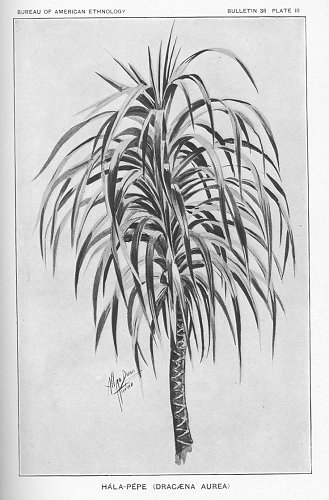
Click to enlarge
PLATE III
HÁLA-PÉPE (DRACÆNA AUREA)
p. 25
her as the patron of the hula. The positive testimony of these witnesses must be reckoned as of more weight than the negative testimony of a much larger number, who either have not seen or will not look at the other side of the shield. At any rate, among the prayers before the kuahu, of which there are others yet to be presented, will be found several addressed to Kapo as the divine patron of the hula.
Kapo was sister of Pele and the daughter of Haumea a. Among other rôles played by her, like Laka she was at times a sylvan deity, and it was in the garb of woodland representations that she, was worshiped by hula folk. Her forms of activity, corresponding to her different metamorphoses, were numerous, in one of which she was at times "employed by the kahuna b as a messenger in their black arts, and she is claimed by many as an aumakua," c said to be the sister of Kalai-pahoa, the poison god.
Unfortunately Kapo had an evil name on account of a propensity which led her at times to commit actions that seem worthy only of a demon of lewdness. This was, however, only the hysteria of a moment, not the settled habit of her life. On one notable occasion, by diverting the attention of the bestial pig-god Kama-pua’a, and by vividly presenting to him a temptation well adapted to his gross nature, she succeeded in enticing him away at a critical moment, and thus rescued her sister Pele at a time when the latter's life was imperiled by an unclean and violent assault from the swine-god.
Like Catherine of Russia, who in one mood was the patron of literature and of the arts and sciences and in another mood a very satyr, so the Hawaiian goddess Kapo seems to have lived a double life whose aims were at cross purposes with one another--now an angel of grace and beauty, now a demon of darkness and lust.
Do we not find in this the counterpart of nature's twofold aspect, who presents herself to dependent humanity at one time as an alma mater, the food-giver, a divinity of joy and comfort, at another time as the demon of the storm and earthquake, a plowshare of fiery destruction?
The name of Hiiaka, the sister of Pele, is one often mentioned in the prayers of the hula.
Footnotes
23:a Imu. The Hawaiian oven, which was a hole in the ground lined and arched over with stones.23:b Au-makua. An ancestral god.
23:c Lama. A beautiful tree having firm, fine-grained, white wood; used in making sacred inclosures and for other tabu purposes.
24:a Kumu-hula. The teacher, a leader and priest of the hula. The modern school-master is called kumu-kula.
24:b Kanaloa. Kane, Ku, Kanaloa, and Lono were the major gods of the Hawaiian pantheon.
24:c Ku-pulupulu. A god of the canoe-makers.
24:d Kini Akua. A general expression--often used together with the ones that follow--meaning the countless swarms of brownies, elfs, kobolds, sprites, and other godlings (mischievous Imps) that peopled the wilderness. Kini means literally 40,000, lehu 400,000, and mano 4,000. See the Pule Kuahu--altar-prayer--on page 21. The Hawaiians, curiously enough, did not put the words mano, kini, and lehu in the order of their numerical value.
25:a Haumea. The ancient goddess, or ancestor, the sixth in line of descent from Wakea.
25:b Kahuna. A sorcerer; with a qualifying adjective it meant a skilled craftsman; Kahuna-kalai-wa’a was a canoe-builder; kahuna lapaau was a medicine-man, a doctor, etc.
25:c The Lesser Gods of Hawaii, a paper by Joseph S. Emerson, read before the Hawaiian Historical Society, April 7, 1892.
IV.--SUPPORT AND ORGANIZATION OF THE HULA
In ancient times the hula to a large extent was a creature of royal support, and for good reason. The actors in this institution were not producers of life's necessaries. To the alii belonged the land and the sea and all the useful products thereof. Even the jetsam whale-tooth and wreckage scraps of iron that ocean cast up on the shore were claimed by the lord of the land. Everything was the king's. Thus it followed of necessity that the support of the hula must in the end rest upon the alii. As in ancient Rome it was a senator or general, enriched by the spoil of a province, who promoted the sports of the arena, so in ancient Hawaii it was the chief, or headman of the district who took the initiative in the promotion of the people's communistic sports and of the hula.We must not imagine that the hula was a thing only of kings' courts and chiefish residences. It had another and democratic side. The passion for the hula was broadspread. If other agencies failed to meet the demand, there was nothing to prevent a company of enthusiasts from joining themselves together in the pleasures and, it might be, the profits of the hula. Their spokesman--designated as the po’o-puaa, from the fact that a pig, or a boar's head, was required of him as an offering at the kuahu--was authorized to secure the services of some expert to be their kumu. But with the hula all roads lead to the king's court.
Let us imagine a scene at the king's residence. The alii, rousing from his sloth and rubbing his eyes, rheumy with debauch and awa, overhears remark on the doings of a new company of hula dancers who have come into the neighborhood. He summons his chief steward.
"What is this new thing of which they babble?" he demands.
"It is nothing, son of heaven," answers the kneeling steward.
"They spoke of a hula. Tell me, what is it?"
"Ah, thou heaven-born (lani), it was but a trifle--a new company, young graduates of the halau, have set themselves up as great ones; mere rustics; they have no proper acquaintance with the traditions of the art as taught by the bards of * * * your majesty's father. They mouth and twist the old songs all awry, thou son of heaven."
"Enough. I will hear them to-morrow. Send a messenger for this new kumu. Fill again my bowl with awa."
p. 27
Thus it comes about that the new hula company gains audience at court and walks the road that, perchance, leads to fortune. Success to the men and women of the hula means not merely applause, in return for the incense of flattery, it means also a shower of substantial favors--food, garments, the smile of royalty, perhaps land--things that make life a festival. If welcome grows cold and it becomes evident that the harvest has been reaped, they move on to fresh woods and pastures new.
To return from this apparent digression, it was at the king's court--if we may extend the courtesy of this phrase to a group of thatched houses--that were gathered the bards and those skilled in song, those in whose memories were stored the mythologies, traditions, genealogies, proverbial wisdom, and poetry that, warmed by emotion, was the stuff from which was spun the songs of the hula. As fire is produced by friction, so it was often by the congress of wits rather than by the flashing of genius that the songs of the hula were evolved.
The composition and criticism of a poetical passage were a matter of high importance, often requiring many suggestions and much consultation. If the poem was to be a mele-inoa, a name-song to eulogize some royal or princely scion, it must contain no word of ill-omen. The fate-compelling power of such a word, once shot from the mouth, was beyond recall. Like the incantation of the sorcerer, the kahuna ánaaná, it meant death to the eulogized one. If not, it recoiled on the life of the singer.
The verbal form once settled, it remained only to stereotype it on the memories of the men and women who constituted the literary court or conclave. Think not that only thus were poems produced in ancient Hawaii. The great majority of songs were probably the fruit of solitary inspiration, in which the bard poured out his heart like a song-bird, or uttered his lone vision as a seer. The method of poem production in conclave may be termed the official method. It was often done at the command of an alii. So much for the fabrication, the weaving, of a song.
If the composition was intended as a eulogy, it was cantillated ceremoniously before the one it honored, if in anticipation of a prince yet unborn, it was daily recited before the mother until the hour of tier delivery; and this cantillation published it abroad. If the song was for production in the hula, it lay warm in the mind of the kumu, the master and teacher of the hula, until such time as he had organized his company.
The court of the alii was a vortex that drew in not only the bards and men of lore, but the gay and fashionable rout of pleasure-seekers, the young men and women of shapely form and gracious presence, the sons and daughters of the king's henchmen and favorites; among
p. 28
them, perhaps, the offspring of the king's morganatic alliances and amour--the flower and pick of Hawaii's youth. From these the kumu selected those most fitted by beauty and grace of form, as well as quickness of wit and liveliness of imagination, to take part in the hula.
The performers in the hula were divided into two classes, the olapa--agile ones-and the ho’o-paa--steadfast ones. The rôle of olapa, as was fitting, was assigned to the young men and young women who could best illustrate in their persons the grace and beauty of the human form. It was theirs, sometimes while singing, to move and pose and gesture in the dance; sometimes also to punctuate their song and action with the lighter instruments of music. The rôle of ho’o-paa, on the other hand, was given to men and women of greater experience and of more maturity. They handled the heavier instruments and played their parts mostly while sitting or kneeling, marking the time with their instrumentation. They also lent their voices to swell the chorus or utter the refrain of certain songs, sometimes taking the lead in the song or bearing its whole burden, while the light-footed olapa gave themselves entirely to the dance. The part of the ho’o-paa was indeed the heavier, the more exacting duty.
Such was the personnel of a hula troupe when first gathered by the hula-master for training and drill in the halau, now become a school for the hula. Among the pupils the kumu was sure to find some old hands at the business, whose presence, like that of veterans in a squad of recruits, was a leaven to inspire the whole company with due respect for the spirit and traditions of the historic institution and to breed in the members the patience necessary to bring them to the highest proficiency.
The instruction of the kumu, as we are informed, took a wide range. It dealt in elaborate detail on such matters as accent, inflection, and all that concerns utterance and vocalization. It naturally paid great attention to gesture and pose, attitude and bodily action. That it included comment on the meaning that lay back of the words may be gravely doubted. The average hula dancer of modern times shows great ignorance of the mele he recites, and this is true even of the kumu-hula. His work too often is largely perfunctory, a matter of sound and form, without appeal to the intellect.
It would not be legitimate, however, to conclude from this that ignorance of the meaning was the rule in old times; those were the days when the nation's traditional songs, myths, and lore formed the equipment of every alert and receptive mind, chief or commoner. There was no printed page to while away the hours of idleness. The library was stored in one's memory. The language of the mele, which now has become antiquated, then was familiar speech. For a
p. 29
kumu-hula to have given instruction in the meaning of a song would have been a superfluity, as if one at the present day were to inform a group of well-educated actors and actresses who was Pompey or Julius Cæsar.
"Speak the speech, I pray you, as I pronounced it to you, trippingly on the tongue." Hamlet's words to the players were, it may be supposed, the substance of the kumu's instructions to the pupils in his halau.
The organization of a hula company was largely democratic. The kumu--in modern sense, the teacher--was the leader and conductor, responsible for the training and discipline of the company. He was the business manager of the enterprise; the priest, kahuna, the leader in the religious exercises, the one who interpreted the will of heaven, especially of the gods whose favor determined success. He might be called to his position by the choice of the company, appointed by the command of the alii who promoted the enterprise, or self-elected in case the enterprise was his own. He had under him a kokua kumu, a deputy, who took charge during his absence.
The po’o-puaa was an officer chosen by the pupils to be their special agent and mouthpiece. He saw to the execution of the kumu's judgments and commands, collected the fines, and exacted the penalties imposed by the kumu. It fell to him to convey to the altar the presents of garlands, awa, and the like that were contributed to the halau.
The paepae, also chosen by the pupils, subject to confirmation by the kumu, acted as an assistant of the po’o-puaa. During the construction of the kuahu the po’o-puaa stood to the right, the paepae at his left. They were in a general sense guardians of the kuahu.
The ho’o-ulu was the guard stationed at the door. He sprinkled with sea-water mixed with turmeric everyone who entered the halau. He also acted as sergeant-at-arms to keep order and remove anyone who made a disturbance. It was his duty each day to place a fresh bowl of awa on the altar of the goddess (hanai kuahu), literally to feed the altar.
In addition to these officials, a hula company naturally required the services of a miscellaneous retinue of stewards, cooks, fishermen, hewers of wood, and drawers of water.
RULES OF CONDUCT AND TABUS
Without a body of rules, a strict penal code, and a firm hand to hold in check the hot bloods of both sexes, it would have been impossible to keep order and to accomplish the business purpose of the organization. The explosive force of passion would have made the gathering a signal for the breaking loose of pandemonium. That it did not always so result is a compliment alike to the self-restraint ofp. 30
the people and to the sway that artistic ideals held over their minds, but, above all, to a peculiar system of discipline wisely adapted to the necessities of human nature. It does not seem likely that a Thespian band of our own race would have held their passions under equal check if surrounded by the same temptations and given the same opportunities as these Polynesians. It may well be doubted if the bare authority of the kumu would have sufficed to maintain discipline and to keep order, had it not been reenforced by the dread powers of the spirit world in the shape of the tabu.
The awful grasp of this law, this repressive force, the tabu, held fast the student from the moment of his entrance into the halau. It denied this pleasure, shut off that innocent indulgence, curtailed liberty in this direction and in that. The tabu waved before his imagination like a flaming sword, barring approach to the Eden of his strongest propensity.
The rules and discipline of the halau, the school for the hula, from our point of view, were a mixture of shrewd common sense and whimsical superstition. Under the head of tabus certain articles of food were denied; for instance, the sugar-cane--ko--was forbidden. The reason assigned was that if one indulged in it his work as a practitioner would amount to nothing; in the language of the kumu, aohe e ko ana kana mau hana, his work will be a failure. The argument turned on the double meaning of the word ko, the first meaning being sugar cane, the second, accomplishment. The Hawaiians were much impressed by such whimsical nominalisms. Yet there is a backing of good sense to the rule. Anyone who has chewed the sweet stalk can testify that for some time thereafter his voice is rough, ill-fitted for singing or elocution.
The strictest propriety and decorum were exacted of the pupils; there must be no license whatever. Even married people during the weeks preceding graduation must observe abstinence toward their partners. The whole power of one's being must be devoted to the pursuit of art.
The rules demanded also the most punctilious personal cleanliness. Above all things, one must avoid contact with a corpse. Such defilement barred one from entrance to the halau until ceremonial cleansing had been performed. The offender must bathe in the ocean; the kumu then aspersed him with holy water, uttered a prayer, ordered a penalty, an offering to the kuahu, and declared the offender clean. This done, he was again received into fellowship at the halau.
The ordinary penalty for a breach of ceremony or an offense against sexual morality was the offering of a baked porkling with awa. Since the introduction of money the penalty has generally been reckoned on a commercial basis; a money fine is imposed. The offering of pork and awa is retained as a concession to tradition.
V.--CEREMONIES OF GRADUATION; DÉBUT OF A HULA DANCER
CEREMONIES OF GRADUATION
The ai-lolo rite and ceremony marked the consummation of a pupil's readiness for graduation from the school of the halau and his formal entrance into the guild of hula dancers. As the time drew near, the kumu tightened the reins of discipline, and for a few days before that event no pupil might leave the halau save for the most stringent necessity, and then only with the head muffled (pulo’u) to avoid recognition, and he might engage in no conversation whatever outside the halau.The night preceding the day of ai-lolo was devoted to special services of dance and song. Some time after midnight the whole company went forth to plunge into the ocean, thus to purge themselves of any lurking ceremonial impurity. The progress to the ocean and the return they made in complete nudity. "Nakedness is the garb of the gods." On their way to and from the bath they must not look back, they must not turn to the right hand or to the left.
The kumu, as the priest, remained at the halau, and as the procession returned from the ocean he met it at the door and sprinkled each one (pikai) with holy water. Then came another period of dance and song; and then, having cantillated a pule hoonoa, to lift the tabu, the kumu went forth to his own ceremonial cleansing bath in the sea. During his absence his deputy, the kokua kumu, took charge of the halau. When the kumu reached the door on his return, he made himself known by reciting a mele wehe puka, the conventional password.
Still another exercise of song and dance, and the wearied pupils are glad to seek repose. Some will not even remove the short dancing skirts that are girded about them, so eager are they to snatch an hour of rest; and some lie down with bracelets and anklets yet unclasped.
At daybreak the kumu rouses the company with the tap of the drum. After ablutions, before partaking of their simple breakfast, the company stand before the altar and recite a tabu-removing prayer, accompanying the cantillation with a rhythmic tapping of feet and clapping of hands:
Pule Hoonoa
Pupu we’uwe’u e, Laka e!
O kona we’uwe’u ke ku nei. p. 32
Kaumaha a’e la ia Laka.
O Laka ke akua pule ikaika.
5 Ua ku ka maile a Laka a imua;
Ua lu ka hua a o ka maile.
Noa, noa ia’u, ia Kahaula--
Papalua noa.
Noa, a ua noa.
10 Eli-eli kapu! eli-eli noa!
Kapu oukou, ke akua!
Noa makou, ke kanaka´.
O kona we’uwe’u ke ku nei. p. 32
Kaumaha a’e la ia Laka.
O Laka ke akua pule ikaika.
5 Ua ku ka maile a Laka a imua;
Ua lu ka hua a o ka maile.
Noa, noa ia’u, ia Kahaula--
Papalua noa.
Noa, a ua noa.
10 Eli-eli kapu! eli-eli noa!
Kapu oukou, ke akua!
Noa makou, ke kanaka´.
[Translation]
Tabu-lifting Prayer
Oh wildwood bouquet, oh Laka!
Hers are the growths that stand here.
Suppliants we to Laka.
The prayer to Laka has power;
5 The maile of Laka stands to the fore.
The maile vine casts now its seeds.
Freedom, there's freedom to me, Kahaula--
A freedom twofold.
10 Freedom, aye freedom!
A tabu profound, a freedom complete.
Ye gods are still tabu;
We mortals are free.
Hers are the growths that stand here.
Suppliants we to Laka.
The prayer to Laka has power;
5 The maile of Laka stands to the fore.
The maile vine casts now its seeds.
Freedom, there's freedom to me, Kahaula--
A freedom twofold.
10 Freedom, aye freedom!
A tabu profound, a freedom complete.
Ye gods are still tabu;
We mortals are free.
At the much-needed repast to which the company now sit down there may be present a gathering of friends and relatives and of hula experts, called olóhe. Soon the porkling chosen to be the ai-lólo offering is brought in--a black suckling without spot or blemish. The kumu holds it down while all the pupils gather and lay their hands upon his hands; and he expounds to them the significance of the ceremony. If they consecrate themselves to the work in hand in sincerity and with true hearts, memory will be strong and the training, the knowledge, and the songs that have been intrusted to the memory will stay. If they are heedless, regardless of their vows, the songs they have learned will fly away.
The ceremony is long and impressive; many songs are used. Sometimes, it was claimed, the prayers of the kumu at this laying on of hands availed to cause the death of the little animal. On the completion of the ceremony the offering is taken out and made ready for the oven.
One of the first duties of the day is the dismantling of the old kuahu, the shrine, and the construction of another from new materials as a residence for the goddess. While night yet shadows the earth the attendants and friends of the pupils have gone up into the
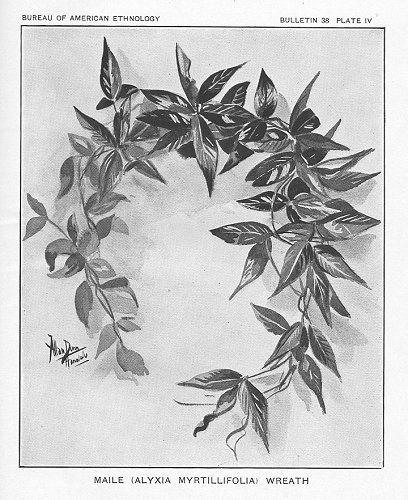
Click to enlarge
PLATE IV
MAILE (ALYXIA MYRTILLIFOLIA) WREATH
p. 33
mountains to collect the material for the new shrine. The rustic artists, while engaged in this loving work of building and weaving the new kuahu, cheer and inspire one another with joyful songs vociferous with the praise of Laka. The halau also they decorate afresh, strewing the floor with clean rushes, until the whole place enthralls the senses like a bright and fragrant temple.
The kumu now grants special dispensation to the, pupils to go forth that they may make good the results of the neglect of the person incident to long confinement in the halau. For days, for weeks, perhaps for months, they have not had full opportunity to trim hair, nails, or heard, to anoint and groom themselves. They use this short absence from the hall also to supply themselves with wreaths of fragrant maile, crocus-yellow ilima, scarlet-flaming lehua, fern, and what not.
At the appointed hour the pupils, wreathed and attired like nymphs and dryads, assemble in the halau, sweet with woodsy perfumes. At the door they receive aspersion with consecrated water.
The ai-lolo offering, cooked to a turn--no part raw, no part cracked or scorched--is brought in from the imu, its bearer sprinkled by the guard at the entrance. The kumu, having inspected the roast offering and having declared it ceremonially perfect, gives the signal, and the company break forth in songs of joy and of adulation to goddess Laka:
Mele Kuahu
Noho ana Laka i ka ulu wehi-wehi,
Ku ana iluna i Mo’o-helaia, a
Ohia-Ku b iluna o Mauna-loa. c
Aloha mai Kaulana-ula d ia’u.
5 Eia ka ula la, he ula leo, e
He uku, he modai, he kanaenae,
He alana na’u ia oe.
E Laka e, e maliu mai;
E maliu mai oe, i pono au,
10 A pono au, a pono kaua.
Ku ana iluna i Mo’o-helaia, a
Ohia-Ku b iluna o Mauna-loa. c
Aloha mai Kaulana-ula d ia’u.
5 Eia ka ula la, he ula leo, e
He uku, he modai, he kanaenae,
He alana na’u ia oe.
E Laka e, e maliu mai;
E maliu mai oe, i pono au,
10 A pono au, a pono kaua.
p. 34
[Translation]
Altar-Prayer
Laka sits in her shady grove,
Stands on her terrace, at Mo’o-helaia;
Like the tree of God Ku on Mauna-loa.
Kaulana-ula trills in my ear;
5 A whispered suggestion to me,
Lo, an offering, a payment,
A eulogy give I to thee.
O Laka, incline to me!
Have compassion, let it be well--
10 Well with me, well with us both.
Stands on her terrace, at Mo’o-helaia;
Like the tree of God Ku on Mauna-loa.
Kaulana-ula trills in my ear;
5 A whispered suggestion to me,
Lo, an offering, a payment,
A eulogy give I to thee.
O Laka, incline to me!
Have compassion, let it be well--
10 Well with me, well with us both.
There is no stint of prayer-song. While the offering rests on the kuahu, the joyful service continues:
Mele Kuahu
E Laka, e!
Pupu we’uwe’u e, Laka e!
E Laka i ka leo;
E laka i ka loaa:
5 E Laka i ka waiwai;
E Laka i na mea a pau!
Pupu we’uwe’u e, Laka e!
E Laka i ka leo;
E laka i ka loaa:
5 E Laka i ka waiwai;
E Laka i na mea a pau!
[Translation]
Altar-Prayer
O goddess Laka!
O wildwood bouquet, O Laka!
O Laka, queen of the voice!
O Laka, giver of gifts!
5 O Laka, giver of bounty!
O Laka, giver of all things!
O wildwood bouquet, O Laka!
O Laka, queen of the voice!
O Laka, giver of gifts!
5 O Laka, giver of bounty!
O Laka, giver of all things!
At the conclusion of this loving service of worship and song each member of the troupe removes from his head and neck the wreaths that had bedecked him, and with them crowns the image of the goddess until her altar is heaped with the offerings.
Now comes the pith of the ceremony: the novitiates sit down to the feast of ai-lolo, theirs the place of honor, at the head of the table, next the kuahu. The ho’o-pa’a, acting as carver, selects the typical parts--snout, ear-tips, tail, feet, portions of the vital organs, especially the brain (lolo). This last it is which gives name to the ceremony. He sets an equal portion before each novitiate. Each one must eat all that is set before him. It is a mystical rite, a sacrament; as he eats he consciously partakes of the virtue of the goddess that is transmitted to himself.
p. 35
Meantime the olohe and friends of the novitiates, inspired with the proper enthusiasm of the occasion, lift their voices in joyful cantillations, in honor of the goddess, accompanied with the clapping of hands.
The ceremony now reaches a new stage. The kumu lifts the tabu by uttering a prayer--always a song--and declares the place and the feast free, and the whole assembly sit down to enjoy the bounty that is spread up and down the halau. On this occasion men and women may eat in common. The only articles excluded from this feast are luau--a food much like spinach, made by cooking the young and delicate taro leaf--and the drupe of the hala, the pandanus (pl. XVIII).
The company sit down to eat and to drink; presently they rise to dance and sing. The kumu leads in a tabu-lifting, freedom-giving song and the ceremony of ai-lolo is over. The pupils have been graduated from the school of the halau; they are now members of the great guild of hula dancers. The time has come for them to make their bow to the waiting public outside, to bid for the favor of the world. This is to be their "little go;" they will spread their wings for a greater flight on the morrow.
The kumu with his big drum, and the musicians, the ho’o-pa’a, pass through the door and take their places outside in the lanai, where sit the waiting multitude. At the tap of the drum the group of waiting olapa plume themselves like fine birds eager to show their feathers; and, as they pass out the halau door and present themselves to the breathless audience, into every pose and motion of their gliding, swaying figures they pour a full tide of emotion in studied and unstudied effort to captivate the public.
DÉBUT OF A HULA DANCER
The occasion is that of a lifetime; it is their uniki, their début. The song chosen must rise to the dignity of the occasion. Let us listen to the song that enthralls the audience seated in the rush-strown lanai, that we may judge of its worthiness.He Mele-Inoa (no Naihe) a
p. 36
O kakai a malo hoaka, b
5 O ka malo kai, c malo o ke alii.
E ku, e hume a paa i ka malo.
E ka’ika’i d ka la i ka papa o Halepó; e
A pae o Halepó i ka nalu.
Ho-e’e i ka nalu mai Kahiki; f
10 He nalu Wakea, g nalu ho’ohua. h
Haki opu’u i ka nalu, haki kua-pá. j
Ea mai ka makakai k he’e-nalu,
Kai he’e kakala l o ka moku,
Kai-ká o ka nalu nui,
15 Ka hu’a o ka nalu o Hiki-au. m
Kai he’e-nalu i ke awakea.
Ku ka puna, ke ko’a i-uka.
Ka makahá o ka nalu o Kuhihewa. n
Ua o ia, o nohá ka papa!
20 Nohá Maui, nauweuwe,
Nauweuwe, nakelekele.
Nakele ka ili o ka i he’e-kai.
Lalilali ole ka ili o ke akamai;
Kahilihili ke kai a ka he’e-nalu.
25 Ike’a ka nalu nui o Puna, o Hilo.
* * * * *
5 O ka malo kai, c malo o ke alii.
E ku, e hume a paa i ka malo.
E ka’ika’i d ka la i ka papa o Halepó; e
A pae o Halepó i ka nalu.
Ho-e’e i ka nalu mai Kahiki; f
10 He nalu Wakea, g nalu ho’ohua. h
Haki opu’u i ka nalu, haki kua-pá. j
Ea mai ka makakai k he’e-nalu,
Kai he’e kakala l o ka moku,
Kai-ká o ka nalu nui,
15 Ka hu’a o ka nalu o Hiki-au. m
Kai he’e-nalu i ke awakea.
Ku ka puna, ke ko’a i-uka.
Ka makahá o ka nalu o Kuhihewa. n
Ua o ia, o nohá ka papa!
20 Nohá Maui, nauweuwe,
Nauweuwe, nakelekele.
Nakele ka ili o ka i he’e-kai.
Lalilali ole ka ili o ke akamai;
Kahilihili ke kai a ka he’e-nalu.
25 Ike’a ka nalu nui o Puna, o Hilo.
* * * * *
[Translation]
A Name-Song, a Eulogy (for Naihe)
The huge roller, roller that surges from Kona,
Makes loin-cloth fit for a lord;
Far-reaching swell, my malo streams in the wind:
Shape the crescent malo to the loins--
5 The loin-cloth the sea, cloth for king's girding.
Stand, gird fast the loin-cloth!
Makes loin-cloth fit for a lord;
Far-reaching swell, my malo streams in the wind:
Shape the crescent malo to the loins--
5 The loin-cloth the sea, cloth for king's girding.
Stand, gird fast the loin-cloth!
p. 37
Let the sun guide the board Halepó,
Till Halepó lifts on the swell.
It mounts the swell that rolls from Kahiki,
10 From Wakea's age onrolling.
The roller plumes and ruffles its crest.
Here comes the champion surf-man,
While wave-ridden wave beats the island,
A fringe of mountain-high waves.
15 Spume lashes the Hiki-au altar--
A surf this to ride at noontide.
The coral, horned coral, it sweeps far ashore.
We gaze at the surf of Ka-kuhi-hewa.
The surf-board snags, is shivered;
20 Maui splits with a crash,
Trembles, dissolves into slime.
Glossy the skin of the surf-man;
Undrenched the skin of the expert;
Wave-feathers fan the wave-rider.
25 You've seen the grand surf of Puna, of Hilo.
* * * * *
Till Halepó lifts on the swell.
It mounts the swell that rolls from Kahiki,
10 From Wakea's age onrolling.
The roller plumes and ruffles its crest.
Here comes the champion surf-man,
While wave-ridden wave beats the island,
A fringe of mountain-high waves.
15 Spume lashes the Hiki-au altar--
A surf this to ride at noontide.
The coral, horned coral, it sweeps far ashore.
We gaze at the surf of Ka-kuhi-hewa.
The surf-board snags, is shivered;
20 Maui splits with a crash,
Trembles, dissolves into slime.
Glossy the skin of the surf-man;
Undrenched the skin of the expert;
Wave-feathers fan the wave-rider.
25 You've seen the grand surf of Puna, of Hilo.
* * * * *
This spirited song, while not a full description of a surf-riding scene, gives a vivid picture of that noble sport. The last nine verses have been omitted, as they add neither to the action nor to the interest.
It seems surprising that the accident spoken of in line 19 should be mentioned; for it is in glaring opposition to the canons that were usually observed in the composition of a mele-inoa. In the construction of a eulogy the Hawaiians were not only punctiliously careful to avoid mention of anything susceptible of sinister interpretation, but they were superstitiously sensitive to any such unintentional happening. As already mentioned (p. 27), they believed that the fate-compelling power of a word of ill-omen was inevitable. If it did not result in the death of the one eulogized, retributive justice turned the evil influence back on him who uttered it.
Footnotes
32:a Lu ka hua. Casts now its seeds. The maile vine (pl. IV), one of the goddess's emblems, casts its seeds, meaning that the goddess gives the pupils skill and inspires them.33:a Mo’o-helaia. A female deity, a kupua, who at death became one of the divinities, au-makua, of the hula. Her name was conferred on the place claimed as her residence, on Mauna-loa, island of Molokai.
33:b Ohia-Ku. Full name ohia-ku-makua; a variety of the this, or lehua (pl. XIII), whose wood was used in making temple gods. A rough stem of this tree stood on each side near the hala-pepe. (See pl. III, also pp. 19-20.)
33:c Mauna-loa. Said to be the mountain of that name on Molokai, not that on Hawaii.
33:d Kaulana-ula. Full form Kaulana-a-ula; the name of a deity belonging to the order, papa, of the hula. Its meaning is explained in the expression ula leo, in the next line.
33:e Ula leo. A singing or trilling sound, a tinnitus aurium, a sign that the deity Kaulana-ula was making some communication to the one who heard it.
"By the pricking of my thumbs
Something wicked this way comes."
Something wicked this way comes."
35:a Naihe. A man of strong character, but not a high chief. He was born in Kona and resided at Napoopoo. His mother was Ululani, his father Keawe-a-heulu, who was a celebrated general and strategist under Kamehameha I.
35:b Mahiehie. A term conferring dignity and distinction.
35:c Onaulu-loa. A roller of great length and endurance, one that reaches the shore, in contrast to a kakala.
36:a Kakai. An archaic word meaning forty.
36:b Hoaka. A crescent; the name of the second day of the month. The allusion is to the curve (downward) of a large number (kakai) of malo when hung on a line, the usual way of keeping such articles.
36:c Malo kai. The ocean is sometimes poetically termed the malo or pa-ú of the naked swimmer, or bather. It covers his nakedness.
36:d Ka’ika’i. To lead or to carry; a tropical use of the word. The sun is described as leading the board.
36:e Hale-pó. In the opinion of the author it is the name of the board. A skilled Hawaiian says it is the name given the surf of a place at Napoopoo, in Kona, Hawaii. The action is not located there, but in Puna, it seems to the author.
36:f Kahiki. Tahiti, or any foreign country; a term of grandiloquence.
36:g Wakea. A mythical name, coming early in Hawaiian genealogies; here used in exaggeration to show the age of the roller.
36:h Ho’ohua. Applied to a roller, one that rolls on and swells higher.
36:i Opu’u. Said of a roller that completes its run to shore.
36:j Kua-pá, Said of a roller as above that dies at the shore.
36:k Maka-kai. The springing-up of the surf after an interval of quiet.
36:l Kakála. Rough, heaped up, one wave overriding another, a chop sea.
36:m Hiki-aú. Said to be the name of a temple.
36:n Kuhihewa. Full name Ka-kuhi-hewa, a distinguished king of Oahu.
36:o O ia. Meaning that the board dug its nose into the reef or sand.
VI.--THE PASSWORD--THE SONG OF ADMISSION
There prevailed among the practitioners of the hula from one end of the group to the other a mutual understanding, amounting almost to a sort of freemasonry, which gave to any member of the guild the right of free entrance at all times to the hall, or halau, where a performance was under way. Admission was conditioned, however, on the utterance of a password at the door. A snatch of song, an oli, denominated mele kahea, or mele wehe puka, was chanted, which, on being recognized by those within, was answered in the same language of hyperbole, and the door was opened.The verbal accuracy of any mele kahea that may be adduced is at the present day one of the vexed questions among hula authorities, each hula-master being inclined to maintain that the version given by another is incorrect. This remark applies, though in smaller measure, to the whole body of mele, pule, and oli that makes up the songs and liturgy of the hula as well as to the traditions that guided the maestro, or kumu-hula, in the training of his company. The reasons for these differences of opinion and of text, now that there is to be a written text, are explained by the following facts: The devotees and practitioners of the hula were divided into groups that were separated from one another by wide intervals of sea and land. They belonged quite likely to more than one cult, for indeed there were many gods and au-makua to whom they sacrificed and offered prayers. The passwords adopted by one generation or by the group of practitioners on one island might suffer verbal changes in transmission to a later generation or to a remote island.
Again, it should be remembered that the entire body of material forming the repertory of the hula--pule, mele, and oli--was intrusted to the keeping of the memory, without the aid of letters or, so far as known, of any mnemonic device; and the human mind, even under the most athletic discipline, is at best an imperfect conservator of literary form. The result was what might be expected: as the imagination and emotions of the minstrel warmed under the inspiration of his trust, glosses and amendments crept in. These, however, caused but slight variations in the text. The substance remains substantially the same.
After carefully weighing the matter, the author can not avoid the conclusion that jealousy had much to do with the slight differences now manifest, that one version is as authoritative as another, and
p. 39
that it would be well for each kumu-hula to have kept in mind the wise adage that shines among the sayings of his nation: Aohe pau ka ike i kau halau a--"Think not that all of wisdom resides in your halau." b
Mele Kahea
Li’u-li’u aloha ia’u,
Ka uka o Koholá-lele,
Ka nahele mauka o Ka-papala c la.
Komo, e komo aku hoi au maloko.
5 Mai ho’ohewahewa mai oe ia’u; oau no ia,
Ke ka-nae-nae a ka mea hele,
He leo, e-e,
A he leo wale no, e-e!
Eia ka pu’u nui owaho nei la,
10 He ua, he ino, he anu, he ko’e-ko’e.
E ku’u aloha, e,
Maloko aku au.
Ka uka o Koholá-lele,
Ka nahele mauka o Ka-papala c la.
Komo, e komo aku hoi au maloko.
5 Mai ho’ohewahewa mai oe ia’u; oau no ia,
Ke ka-nae-nae a ka mea hele,
He leo, e-e,
A he leo wale no, e-e!
Eia ka pu’u nui owaho nei la,
10 He ua, he ino, he anu, he ko’e-ko’e.
E ku’u aloha, e,
Maloko aku au.
[Translation]
Password
Long, long have I tarried with love
In the uplands of Koholá-lele,
The wildwood above Ka-papala.
To enter, permit me to enter, I pray;
5 Refuse me not recognition; I am he,
A traveler offering mead of praise,
Just a voice,
Only a human voice.
Oh, what I suffer out here,
10 Rain, storm, cold, and wet.
O sweetheart of mine,
Let me come in to you.
In the uplands of Koholá-lele,
The wildwood above Ka-papala.
To enter, permit me to enter, I pray;
5 Refuse me not recognition; I am he,
A traveler offering mead of praise,
Just a voice,
Only a human voice.
Oh, what I suffer out here,
10 Rain, storm, cold, and wet.
O sweetheart of mine,
Let me come in to you.
Hear now the answer chanted by voices from within:
Mele Komo
Aloha na hale o makou i maka-maka ole,
Ke alanui hele mauka o Pu’u-kahea la, e-e!
Ka-he-a!
E Kahea aku ka pono e komo mai oe iloko nei.
Eia ka pu’u nui o waho nei, he anu.
Ke alanui hele mauka o Pu’u-kahea la, e-e!
Ka-he-a!
E Kahea aku ka pono e komo mai oe iloko nei.
Eia ka pu’u nui o waho nei, he anu.
p. 40
[Translation]
Song of Welcome
What love to our cottage-homes, now vacant,
As one climbs the mount of Entreaty!
We call,
We voice the welcome, invite you to enter.
The hill of Affliction out there is the cold.
As one climbs the mount of Entreaty!
We call,
We voice the welcome, invite you to enter.
The hill of Affliction out there is the cold.
Another fragment that was sometimes used as a password is the following bit of song taken from the story of Hiiaka, sister of Pele. She is journeying with the beautiful Hopoe to fetch prince Lohiau to the court of Pele. They have come by a steep and narrow path to the brink of the Wai-lua river, Kauai, at this point spanned by a single plank. But the bridge is gone, removed by an ill-tempered naiad (witch) said to have come from Kahiki, whose name, Wai-lua, is the same as that of the stream. Hiiaka calls out, demanding that the plank be restored to its place. Wai-lua does not recognize the deity in Hiiaka and, sullen, makes no response. At this the goddess puts forth her strength, and Wai-lua, stripped of her power and reduced to her true station, that of a mo’o, a reptile, seeks refuge in the caverns beneath the river. Hiiaka betters the condition of the crossing by sowing it with stepping stones. The stones remain in evidence to this day.
Mele Kahea
Kunihi ka mauna i ka la’i e,
O Wai-ale-ale a la i Wai-lua,
Huki a’e la i ka lani
Ka papa au-wai o ka Wai-kini;
5 Alai ia a’e la e Nou-nou,
Nalo ka Ipu-ha’a,
Ka laula mauka o Kapa’a, e!
Mai pa’a i ka leo!
He ole ka hea mai, e!
O Wai-ale-ale a la i Wai-lua,
Huki a’e la i ka lani
Ka papa au-wai o ka Wai-kini;
5 Alai ia a’e la e Nou-nou,
Nalo ka Ipu-ha’a,
Ka laula mauka o Kapa’a, e!
Mai pa’a i ka leo!
He ole ka hea mai, e!
[Translation]
Password--Song
Steep stands the mountain in calm,
Profile of Wai-ale-ale at Wai-lua.
Gone the stream-spanning plank of Wai-kini,
Filched away by Nou-nou;
5 Shut off the view of the hill Ipu-ha’a,
And the upland expanse of Ka-pa’a.
Give voice and make answer.
Dead silence--no voice in reply.
Profile of Wai-ale-ale at Wai-lua.
Gone the stream-spanning plank of Wai-kini,
Filched away by Nou-nou;
5 Shut off the view of the hill Ipu-ha’a,
And the upland expanse of Ka-pa’a.
Give voice and make answer.
Dead silence--no voice in reply.
In later, in historic times, this visitor, whom we have kept long waiting at the door, might have voiced his appeal in the passionate words of this comparatively modern song:
p. 41
Mele Kahea a
Ka uka holo-kia ahi-manu o La’a, b
I po-ele i ka uahi, noe ka nahele,
Nohe-nohea i ka makani luhau-pua.
He pua oni ke kanaka--
5 He mea laha ole ia oe.
Mai kaua e hea nei;
E hea i ke kanaka e komo maloko,
E hanai ai a hewa c ka wa’ha.
Eia no ka uku la, o ka wa’a. d
I po-ele i ka uahi, noe ka nahele,
Nohe-nohea i ka makani luhau-pua.
He pua oni ke kanaka--
5 He mea laha ole ia oe.
Mai kaua e hea nei;
E hea i ke kanaka e komo maloko,
E hanai ai a hewa c ka wa’ha.
Eia no ka uku la, o ka wa’a. d
[Translation]
Password--Song
In the uplands, the darting flame-bird of La’a,
While smoke and mist blur the woodland,
Is keen for the breath of frost-bitten flowers.
A fickle flower is man--
5 A trick this not native to you.
Come thou with her who is calling to thee;
A call to the man to come in
And eat till the month is awry.
Lo, this the reward--the canoe.
While smoke and mist blur the woodland,
Is keen for the breath of frost-bitten flowers.
A fickle flower is man--
5 A trick this not native to you.
Come thou with her who is calling to thee;
A call to the man to come in
And eat till the month is awry.
Lo, this the reward--the canoe.
The answer to this appeal for admission was in these words:
Mele Komo
E hea i ke kanaka e komo maloko,
E hanai ai a hewa waha;
Eia no ka uku la, o ka leo,
A he leo wale no, e!
E hanai ai a hewa waha;
Eia no ka uku la, o ka leo,
A he leo wale no, e!
[Translation]
Welcoming-Song
Call to the man to come in,
And eat till the mouth is estopt;
And this the reward, the voice,
Simply the voice.
And eat till the mouth is estopt;
And this the reward, the voice,
Simply the voice.
The cantillation of the mele komo, in answer to the visitor's petition, meant not only the opening to him of the halau door, but also his welcome to the life of the halau as a heart-guest of honor, trebly welcome as the bringer of fresh tidings from the outside world.
Footnotes
39:a Sophocles (Antigone, 705) had said the same thing: μη νυν ἒν ἧθος μο̃υνον ἐν σαυτῳ᾽ φόρει, ὡς φῂς σὺ, κοὺδὲν ἄλλο, τοῦτ᾽ ὀρθῶσ ἔχειν--Don't get this idea fixed in your head, that what you say, and nothing else, is right."39:b Halau. As previously explained, In this connection halau has a meaning similar to word "school," or "academy," a place where some art was taught, as wrestling, boxing, or the hula.
39:c Ka-papala. A verdant region on the southeastern flank of Mauna-Loa.
40:a Wai-ale-ale (Leaping-water). The central mountain-mass of Kauai.
41:a This utterance of passion is said to have been the composition of the Princess Kamamalu, as an address to Prince William Lunalilo, to whom she was at one time affianced and would have married, but that King Lihohho (Kamehameha IV) would not allow the marriage. Thereby hangs a tragedy.
41:b La’a. The region In Hawaii now known as Ola’a was originally called La’a. The particle o has become fused with the word.
41:c Hewa ka waha. This expression, here tortured into "(till) the mouth awry," is difficult of translation. A skilled Hawaiian scholar suggests it may mean to change one from an enemy to a friend by stopping his month with food.
41:d Wa’a. Literally a canoe. This is a euphemism for the human body, a gift often too freely granted. It will be noted that in the answering mele komo, the song of admission, the reward promised is more modestly measured--"Simply the voice."
VII.--WORSHIP AT THE ALTAR OF THE HALAU
The first duty of a visitor on being admitted to the halau while the tabu was on--that is, during the conduct of a regular hula--was to do reverence at the kuahu. The obligations of religion took precedence of all social etiquette. He reverently approaches the altar, to which all eyes are turned, and with outstretched hands pours out a supplication that breathes the aroma of ancient prayer:Pule Kuahu (no Laka)
O Laka oe,
O ke akua i ke a’a-lii a nui.
O Laka mai uka!
E Laka mai kai!
5 O hoo-ulu b o Lono,
O ka ilio nana e haehae ke aha,
O ka ie-ie ku i ka wao,
O ka maile hihi i ka nahele,
O ka lau ki-ele c ula o ke akua,
10 O na ku’i d o Hauoli,
O Ha’i-ka-malama, e
Wahine o Kina’u. f
Kapo ula g o Kina’u.
O Laka oe,
15 O ke akua i ke kuahu nei la, e!
E ho’i, e ho’i a noho i kou kuahu.
Hoo-ulu ia!
O ke akua i ke a’a-lii a nui.
O Laka mai uka!
E Laka mai kai!
5 O hoo-ulu b o Lono,
O ka ilio nana e haehae ke aha,
O ka ie-ie ku i ka wao,
O ka maile hihi i ka nahele,
O ka lau ki-ele c ula o ke akua,
10 O na ku’i d o Hauoli,
O Ha’i-ka-malama, e
Wahine o Kina’u. f
Kapo ula g o Kina’u.
O Laka oe,
15 O ke akua i ke kuahu nei la, e!
E ho’i, e ho’i a noho i kou kuahu.
Hoo-ulu ia!
[Translation]
Altar-Prayer (to Laka)
Thou art Laka,
God of the deep-rooted a’a-lii.
O Laka from the mountains,
O Laka from the ocean!
God of the deep-rooted a’a-lii.
O Laka from the mountains,
O Laka from the ocean!
p. 43
5 Let Lono bless the service,
Shutting the mouth of the dog,
That breaks the charm with his barking.
Bring the i-e that grows in the wilds.
The maile that twines in the thicket,
10 Red-beaked kiele, leaf of the goddess,
The joyous pulse of the dance
In honor of Ha’i-ka-malama,
Friend of Kina’u,
Red-robed friend of Kina’u.
15 Thou art Laka,
God of this altar here.
Return, return and reside at your altar!
Bring it good luck!
Shutting the mouth of the dog,
That breaks the charm with his barking.
Bring the i-e that grows in the wilds.
The maile that twines in the thicket,
10 Red-beaked kiele, leaf of the goddess,
The joyous pulse of the dance
In honor of Ha’i-ka-malama,
Friend of Kina’u,
Red-robed friend of Kina’u.
15 Thou art Laka,
God of this altar here.
Return, return and reside at your altar!
Bring it good luck!
A single prayer may not suffice as the offering at Laka's altar. His repertory is full; the visitor begins anew, this time on a different tack:
Pule Kuahu (no Laka)
Ela ke kuko, ka li’a;
I ka manawa he hiamoe ko’u,
Hoala ana oe,
Ooe o Halau-lani,
5 O Hoa-lani,
O Puoho-lani,
Me he manu e hea ana i ka maha lehua
Ku moho kiekie la i-uka.
I-uka ho’i au me Laka
10 A Lea, a a Wahie-loa, b i ka nahelehele;
He hoa kaana ia no’u,
No kela kuahiwi, kualono hoi.
E Laka, e Laka, e!
E maliu mai!
15 A maliu mai oe pono au,
A a’e mai oe pono au!
I ka manawa he hiamoe ko’u,
Hoala ana oe,
Ooe o Halau-lani,
5 O Hoa-lani,
O Puoho-lani,
Me he manu e hea ana i ka maha lehua
Ku moho kiekie la i-uka.
I-uka ho’i au me Laka
10 A Lea, a a Wahie-loa, b i ka nahelehele;
He hoa kaana ia no’u,
No kela kuahiwi, kualono hoi.
E Laka, e Laka, e!
E maliu mai!
15 A maliu mai oe pono au,
A a’e mai oe pono au!
[Translation]
Altar-Prayer (to Laka)
This my wish, my burning desire,
That in the season of slumber
Thy spirit my soul may inspire,
Altar-dweller,
5 Heaven-guest,
Soul-awakener,
Bird from covert calling,
Where forest champions stand.
There roamed I too with Laka,
That in the season of slumber
Thy spirit my soul may inspire,
Altar-dweller,
5 Heaven-guest,
Soul-awakener,
Bird from covert calling,
Where forest champions stand.
There roamed I too with Laka,
p. 44
10 Of Lea and Loa a wilderness-child;
On ridge, in forest boon companion she
To the heart that throbbed in me.
O Laka, O Laka,
Hark to my call!
15 You approach, it is well;
You possess me, I am blest!
On ridge, in forest boon companion she
To the heart that throbbed in me.
O Laka, O Laka,
Hark to my call!
15 You approach, it is well;
You possess me, I am blest!
In the translation of this pule the author has found it necessary to depart from the verse arrangement that obtains in the Hawaiian text.
The religious services of the halau, though inspired by one motive, were not tied to a single ritual or to one set of prayers. Prayer marked the beginning and the ending of every play--that is, of every dance--and of every important event in the programme of the halau; but there were many prayers from which the priest might select. After the prayer specially addressed to Laka the visitor might use a petition of more general scope. Such is the one now to be given:
He Pule Kuahu (ia Kane ame Kapo); a he Pule Hoolei
Kane, hiki a’e, he maláma a ia luna;
Ha’aha’a, he maláma ia lalo;
Oni-oni, b he maláma ia ka’u;
He wahine c lei, maláma ia Kapo;
5 E Kapo nui, hala-hala d a i’a;
E Kapo nui, hala-hala e a mea,
Ka alihi f luna, ka alihi lalo;
E ka poha-kú. g
Noho ana Kapo i ka ulu wehi-wehi;
10 Ku ana i Moo-helaia, h
Ka ohi’a-Ku iluna, o Mauna-loa.
Aloha mai Kaulana-a-ula i ia’u;
Eia ka ula la, he ula leo, j
He uku, he mohai, he alana,
Ha’aha’a, he maláma ia lalo;
Oni-oni, b he maláma ia ka’u;
He wahine c lei, maláma ia Kapo;
5 E Kapo nui, hala-hala d a i’a;
E Kapo nui, hala-hala e a mea,
Ka alihi f luna, ka alihi lalo;
E ka poha-kú. g
Noho ana Kapo i ka ulu wehi-wehi;
10 Ku ana i Moo-helaia, h
Ka ohi’a-Ku iluna, o Mauna-loa.
Aloha mai Kaulana-a-ula i ia’u;
Eia ka ula la, he ula leo, j
He uku, he mohai, he alana,
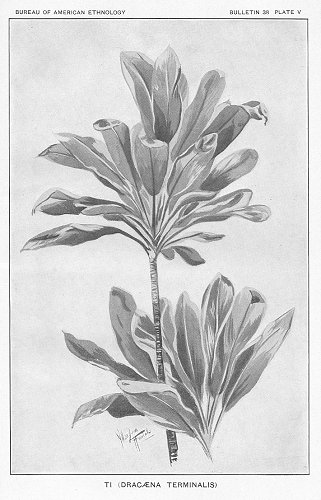
Click to enlarge
PLATE V
TI (DRACÆNA TERMINALIS)
p. 45
15 He kanaenae na’u ia oe, e Kapo ku-lani.
E moe hauna-ike, e hea au, e o mai oe.
Aia la na lehua o Kaana, a
Ke kui ia mai la e na wahine a lawa
I lei no Kapo--
20 O Kapo, alii nui no ia moku,
Ki’e-ki’e, ha’a-ha’a;
Ka la o ka ike e ike aku ai:
He ike kumu, he ike lono,
He ike pu-awa b hiwa,
25 He ike a ke Akua, e!
E Kapo, ho’i!
E hoi a noho i kou kuahu.
Ho’ulu ia!
Ela ka wai, c la,
30 He wai e ola.
E ola nou, e!
E moe hauna-ike, e hea au, e o mai oe.
Aia la na lehua o Kaana, a
Ke kui ia mai la e na wahine a lawa
I lei no Kapo--
20 O Kapo, alii nui no ia moku,
Ki’e-ki’e, ha’a-ha’a;
Ka la o ka ike e ike aku ai:
He ike kumu, he ike lono,
He ike pu-awa b hiwa,
25 He ike a ke Akua, e!
E Kapo, ho’i!
E hoi a noho i kou kuahu.
Ho’ulu ia!
Ela ka wai, c la,
30 He wai e ola.
E ola nou, e!
Verses 9 to 15, inclusive, are almost identical in form with the first seven verses in the Mele Kuahu addressed to Laka, given on page 33.
[Translation]
An Altar-Prayer (to Kane and Kapo); also a Garland-Prayer, used while decorating the altar
Now, Kane, approach, illumine the altar;
Stoop, and enlighten mortals below;
Rejoice in the gifts I have brought.
Wreathed goddess fostered by Kapo--
5 Hail Kapo, of beauty resplendent!
Great Kapo, of sea and land,
The topmost stay of the net,
Its lower stay and anchoring line.
Kapo sits in her darksome covert;
10 On the terrace, at Mo’o-he-laia,
Stands the god-tree of Ku, on Mauna-loa.
God Kaulana-ula twigs now mine ear,
His whispered suggestion to me is
This payment, sacrifice, offering,
15 Tribute of praise to thee, O Kapo divine.
Inspiring spirit in sleep, answer my call.
Behold, of lehua bloom of Kaana
The women are stringing enough
To enwreath goddess Kapo;
20 Kapo, great queen of that island,
Of the high and the low.
The day of revealing shall see what it sees:
Stoop, and enlighten mortals below;
Rejoice in the gifts I have brought.
Wreathed goddess fostered by Kapo--
5 Hail Kapo, of beauty resplendent!
Great Kapo, of sea and land,
The topmost stay of the net,
Its lower stay and anchoring line.
Kapo sits in her darksome covert;
10 On the terrace, at Mo’o-he-laia,
Stands the god-tree of Ku, on Mauna-loa.
God Kaulana-ula twigs now mine ear,
His whispered suggestion to me is
This payment, sacrifice, offering,
15 Tribute of praise to thee, O Kapo divine.
Inspiring spirit in sleep, answer my call.
Behold, of lehua bloom of Kaana
The women are stringing enough
To enwreath goddess Kapo;
20 Kapo, great queen of that island,
Of the high and the low.
The day of revealing shall see what it sees:
p. 46
A seeing of facts, a sifting of rumors,
An insight won by the black sacred awa,
25 A vision like that of a god!
O Kapo, return!
Return and abide in your altar!
Make it fruitful!
Lo, here is the water,
30 The water of life!
Hail, now, to thee!
An insight won by the black sacred awa,
25 A vision like that of a god!
O Kapo, return!
Return and abide in your altar!
Make it fruitful!
Lo, here is the water,
30 The water of life!
Hail, now, to thee!
The little god-folk, whom the ancients called Kini Akua--myriads of gods--and who made the wildwoods and wilderness their playground, must also be placated. They were a lawless set of imps; the elfins, brownies, and kobolds of our fairy world were not "up to them" in wanton deviltry. If there is to be any luck in the house, it can only be when they are dissuaded from outbreaking mischief.
The pule next given is a polite invitation to these little brown men of the woods to honor the occasion with their presence and to bring good luck at their coming. It is such a prayer as the visitor might choose to repeat at this time, or it might be used on other occasions, as at the consecration of the kuahu:
He Pule Kuahu (no Kini Akua)
E ulu, e ulu, Kini o ke Akua
Ulu Kane me Kanaloa!
Ulu Ohi’a-lau-koa, me ka Ie-ie!
A’e mai a noho i kou kuahu!
5 Eia ka wai ia, he wai e ola.
E ola no, e-e!
Ulu Kane me Kanaloa!
Ulu Ohi’a-lau-koa, me ka Ie-ie!
A’e mai a noho i kou kuahu!
5 Eia ka wai ia, he wai e ola.
E ola no, e-e!
[Translation]
An Altar-Prayer (to the Kini Akua)
Gather, oh gather, ye hosts of godlings!
Come Kane with Kanaloa!
Come leafy Ohi’a and I-e!
Possess me and dwell in your altar!
5 Here's water, water of life!
Life, give us life!
Come Kane with Kanaloa!
Come leafy Ohi’a and I-e!
Possess me and dwell in your altar!
5 Here's water, water of life!
Life, give us life!
The visitor, having satisfied his sense of what the occasion demands, changes his tone from that of cantillation to ordinary speech, and concludes his worship with a petition conceived in the spirit of the following prayer:
E ola ia’u, i ka malihini; a pela hoi na kamaaina, ke kumu, na haumana, ia oe, e Laka. E Laka ia Pohaku i ka wawae. E Laka i ke kupe’e. E Laka ia Luukia i ka pa-u; e Laka i ke kuhi; e Laka i ka leo; e Laka i ka lei. E Laka i ke ku ana imua o ke anaina.
p. 47
[Translation]
Thy blessing, O Laka, on me the stranger, and on the residents, teacher and pupils. O Laka, give grace to the feet of Pohaku; and to her bracelets and anklets; comeliness to the figure and skirt of Luukia. To (each one) give gesture and voice. O Laka, make beautiful the lei; inspire the dancers when they stand before the assembly.At the close of this service of song and prayer the visitor will turn from the kuahu and exchange salutations and greetings with his friends in the halau.
The song-prayer "Now, Kane, approach, illumine the altar" (p. 45) calls for remark. It brings up again the question, previously discussed, whether there were not two distinct cults of worshipers, the one devoted to Laka, the other to Kapo. The following facts will throw light on the question. On either side of the approach to the altar stood, sentinel-like, a tall stem of hala-pepe, a graceful, slender column, its head of green sword-leaves and scarlet drupes making a beautiful picture. (See p. 24.) These are said to have been the special emblems of the goddess Kapo.
The following account of a conversation the author had with an old woman, whose youthful days were spent as a hula dancer, will also help to disentangle the subject and explain the relation of Kapo to the hula:
"Will you not recite again the prayer you just now uttered, and slowly, that it may be written down?" the author asked of her. "Many prayers for the kuahu have been collected, but this one differs from them all."
"We Hawaiians," she answered, "have been taught that, these matters are sacred (kapu) and must not be bandied about from month to mouth."
"Aye, but the time of the tabus has passed. Then, too, in a sense having been initiated into hula matters, there can be no impropriety in my dealing with them in a kindly spirit."
"No harm, of course, will come to you, a haole (foreigner). The question is how it will affect us."
"Tell me, were there two different classes of worshipers, one class devoted to the worship of Laka and another class devoted to the worship of Kapo?"
"No," she answered, "Kapo and Laka were one in spirit, though their names were two."
"Haumea was the mother of Kapo. Who was her father?"
"Yes, Haumea was the mother, and Kua-ha-ilo a was the father."
"How about Laka?"
p. 48
"Laka was the daughter of Kapo. Yet as a patron of the hula Laka stands first; she was worshiped at an earlier date than Kapo; but they are really one."
Further questioning brought out the explanation that Laka was not begotten in ordinary generation; she was a sort of emanation from Kapo. It was as if the goddess should sneeze and a deity should issue with the breath from her nostrils; or should wink, and thereby beget spiritual offspring from the eye, or as if a spirit should issue forth at some movement of the ear or mouth.
When the old woman's scruples had been laid to rest, she repeated slowly for the author's benefit the pule given on pages 45 and 46, "Now, Kane, approach," * * * of which the first eight lines and much of the last part, to him, were new.
Footnotes
42:a A’a-lii. A deep-rooted tree, sacred to Laka or to Kapo.42:b Hoo-ulu. Literally to make grow; secondarily, to inspire, to prosper, to bring good luck. This is the meaning most in mind in modern times, since the hula has become a commercial venture.
42:c Ki-ele. A flowering plant native to the Hawaiian woods, also cultivated, sacred to Laka, and perhaps to Kapo. The leaves are said to be pointed and curved like the beak of the bird i-iwi, and the flower has the gorgeous yellow-red color of that bird.
42:d It has been proposed to amend this verse by substituting akua for ku’i, thus making the idea the gods of the hula.
42:e Ha’i-ka-malama. An epithet applied to Laka.
42:f Kina’u. Said to mean Hiiaka, the sister of Pele.
42:g Kapo ula. Red, ula, was the favorite color of Kapo. The kahuna anaana, high priests of sorcery, of the black art, and of murder, to whom Kapo was at times procuress, made themselves known as such by the display of a red flag and the wearing of a red malo.
43:a Lea. The same as Laia, or probably Haumea.
43:b Wahie loa. This must be a mistake. Laka the son of Wahie-loa was a great voyager. His canoe (kau-méli-éli) was built for him by the gods. In it he sailed to the South to rescue his father's bones from the witch who had murdered him. This Laka had his home at Kipahulu, Maui, and is not to be confounded with Laka, goddess of the hula.
44:a Maláma. Accented on the penult, as here, the word means to enlighten or a light (same in second verse). In the third and fourth verses the accent is changed to the first syllable, and the word here means to preserve, to foster. These words furnish an example of poetical word-repetition.
44:b Onioni. To squirm, to dodge, to move. The meaning here seems to be to move with delight.
44:c Wahine lei. A reference to Laka, the child of Kapo, who was symbolized by a block of wood on the altar. (See p. 23.)
44:d Hala-hala a i’a. Said to he a certain kind of fish that was ornamented about its tail-end with a band of bright color; therefore an object of admiration and desire.
44:e Hala-hala a mea. The ending mea is perhaps taken from the last half of the proper name Hau-mea who was Kapo's mother. It belongs to the land, in contrast to the sea, and seems to be intended to intensify and extend the meaning of the term previously used. The passage is difficult. Expert Hawaiians profess their inability to fathom its meaning.
44:f Alihi luna. The line or "stretching cord," that runs the length of a net at its top, the a lalo being the corresponding line at the bottom of the net. The exact significance of the language complimentary to Kapo can not be phrased compactly.
44:g Poha-kú. The line that runs up and down at the end of a long net, by which it may be anchored.
44:h Moo-helaia. See note a, p. 33.
44:i Kaulana-a-ula. See note d, p. 33.
44:j Ula leo. See note c, p. 33.
45:a Kaana. A place on Mauna-loa, Molokai, where the lehua greatly flourished. The body of Kapo, it is said, now lies there in appearance a rock. The same claim is made for a rock at Wailua, Hana, Maui.
45:b Pu-awa hiwa (hiwa, black). A kind of strong awa. The gentle exhilaration, as well a the deep sleep, of awa were benefits ascribed to the gods. Awa was an essential to most complete sacrifices.
45:c Wai. Literally water, refers to the bowl of awa, replenished each day, which set on the altar of the goddess.
47:a Kua-ha-ilo. A god of the kahuna anaana; meaning literally to breed maggots in the back.
UNWRITTEN LITERATURE OF HAWAII
By NATHANIEL B. EMERSON
I.--THE HULA
One turns from the study of old genealogies, myths, and traditions of the Hawaiians with a hungry despair at finding in them means so small for picturing the people themselves, their human interests and passions; but when it comes to the hula and the whole train of feelings and sentiments that made their entrances and exits in the halau (the hall of the hula) one perceives that in this he has found the door to the heart of the people. So intimate and of so simple confidence are the revelations the people make of themselves in their songs and prattlings that when one undertakes to report what he has heard and to translate into the terms of modern speech what he has received in confidence, as it were, he almost blushes, as if he had been guilty of spying on Adam and Eve in their nuptial bower. Alas, if one could but muffle his speech with the unconscious lisp of infancy, or veil and tone his picture to correspond to the perspective of antiquity, he might feel at least that, like Watteau, he had dealt worthily, if not truly, with that ideal age which we ever think of as the world's garden period.The Hawaiians, it is true, were many removes from being primitives; their dreams, however, harked back to a period that was close to the world's infancy. Their remote ancestry was, perhaps, akin to ours--Aryan, at least Asiatic--but the orbit of their evolution seems to have led them away from the strenuous discipline that has whipped the Anglo-Saxon branch into fighting shape with fortune.
If one comes to the study of the hula and its songs in the spirit of a censorious moralist he will find nothing for him; if as a pure. ethnologist, he will take pleasure in pointing out the physical resemblances of the Hawaiian dance to the languorous grace of the Nautch girls, of the geisha, and other oriental dancers. But if he comes as a student and lover of human nature, back of the sensuous posturings, in the emotional language of the songs he will find himself entering the playground of the human race.
The hula was a religious service, in which poetry, music, pantomime, and the dance lent themselves, under the forms of dramatic
p. 12
art, to the refreshment of men's minds. Its view of life was idyllic, and it gave itself to the celebration of those mythical times when gods and goddesses moved on the earth as men and women and when men and women were as gods. As to subject-matter, its warp was spun largely from the bowels of the old-time mythology into cords through which the race maintained vital connection with its mysterious past. Interwoven with these, forming the woof, were threads of a thousand hues and of many fabrics, representing the imaginations of the poet, the speculations of the philosopher, the aspirations of many a thirsty soul, as well as the ravings and flame-colored pictures of the sensualist, the mutterings and incantations of the kahuna, the mysteries and paraphernalia of Polynesian mythology, the annals of the nation's history--the material, in fact, which in another nation and under different circumstances would have gone to the making of its poetry, its drama, its opera, its literature.
The people were superstitiously religious; one finds their drama saturated with religious feeling, hedged about with tabu, loaded down with prayer and sacrifice. They were poetical; nature was full of voices for their ears; their thoughts came to them as images; nature was to them an allegory; all this found expression in their dramatic art. They were musical; their drama must needs be cast in forms to suit their ideas of rhythm, of melody, and of poetic harmony. They were, moreover, the children of passion, sensuous, worshipful of whatever lends itself to pleasure. How, then, could the dramatic efforts of this primitive people, still in the bonds of animalism, escape the note of passion? The songs and other poetic pieces Which have come down to us from the remotest antiquity are generally inspired with a purer sentiment and a loftier purpose than the modern; and it may be said of them all that when they do step into the mud it is not to tarry and wallow in it; it is rather with the unconscious naiveté of a child thinking no evil.
On the principle of "the terminal conversion of opposites," which the author once heard an old philosopher expound, the most advanced modern is better able to hark back to the sweetness and light and music of the primeval world than the veriest wigwam-dweller that ever chipped an arrowhead. It is not so much what the primitive man can give us as what we can find in him that is worth our while. The light that a Goethe, a Thoreau, or a Kipling can project into Arcadia is mirrored in his own nature.
If one mistakes not the temper and mind of this generation, we are living in an age that is not content to let perish one seed of thought or one single phase of life that can be rescued from the drift of time. We mourn the extinction of the buffalo of the plains and of the birds of the islands, rightly thinking that life is somewhat
p. 13
less rich and full without them. What of the people of the plains and of the islands of the sea? Is their contribution so nothingless that one can affirm that the orbit of man's mind is complete without it?
Comparison is unavoidable between the, place held by the dance in ancient Hawaii and that occupied by the dance in our modern society. The ancient Hawaiians did not personally and informally indulge in the dance for their own amusement, as does pleasure-loving society at the present time. Like the Shah of Persia, but for very different reasons, Hawaiians of the old time left it to be done for them by a body of trained and paid performers. This was not because the art and practice of the hula were held in disrepute--quite the reverse--but because the hula was an accomplishment requiring special education and arduous training in both song and dance, and more especially because it was a religious matter, to be guarded against profanation by the observance of tabus and the performance of priestly rites.
This fact, which we find paralleled in every form of communal amusement, sport, and entertainment in ancient Hawaii, sheds a strong light on the genius of the Hawaiian. We are wont to think of the old-time Hawaiians as light-hearted children of nature, given to spontaneous outbursts of song and dance as the mood seized them; quite as the rustics of "merrie England" joined hands and tripped "the light fantastic toe" in the joyous month of May or shouted the harvest home at a later season. The genius of the Hawaiian was different. With him the dance was an affair of premeditation, an organized effort, guarded by the traditions of a somber religion. And this characteristic, with qualifications, will be found to belong to popular Hawaiian sport and amusement of every variety. Exception must be made, of course, of the unorganized sports of childhood. One is almost inclined to generalize and to say that those children of nature, as we are wont to call them, in this regard were less free and spontaneous than the more advanced race to which we are proud to belong. But if the approaches to the temple of Terpsichore with them were more guarded, we may confidently assert that their enjoyment therein was deeper and more, abandoned.
VIII.--COSTUME OF THE HULA DANCER
The costume of the hula dancer was much the same for both sexes, its chief article a simple short skirt about the waist, the pa-ú. (Pl. I.)When the time has come for a dance, the halau becomes one common dressing room. At a signal from the kumu the work begins. The putting on of each article of costume is accompanied by a special song.
First come the ku-pe’e, anklets of whale teeth, bone, shell-work, dog-teeth, fiber-stuffs, and what not. While all stoop in unison they chant the song of the anklet:
Mele Ku-pe’e
Aala kupukupu a ka uka o Kane-hoa. b
E ho-a! c
Hoa na lima o ka makani, he Wai-kaloa. d
He Wai-kaloa ka makani anu Lihue.
5 Alina e lehua i kau ka opua--
Ku’u pua,
Ku’u pua i’ini e ku-i a lei.
Ina ia oe ke lei ’a mai la.
E ho-a! c
Hoa na lima o ka makani, he Wai-kaloa. d
He Wai-kaloa ka makani anu Lihue.
5 Alina e lehua i kau ka opua--
Ku’u pua,
Ku’u pua i’ini e ku-i a lei.
Ina ia oe ke lei ’a mai la.
[Translation]
Anklet-Song
Fragrant the grasses of high Kane-hoa.
Bind on the anklets, bind!
Bind with finger deft as the wind
That cools the air of this bower.
5 Lehua bloom pales at my flower,
O sweetheart of mine,
Bud that I'd pluck and wear in my wreath,
If thou wert but a flower!
Bind on the anklets, bind!
Bind with finger deft as the wind
That cools the air of this bower.
5 Lehua bloom pales at my flower,
O sweetheart of mine,
Bud that I'd pluck and wear in my wreath,
If thou wert but a flower!
The short skirt, pa-ú, was the most important piece of attire worn by the Hawaiian female. As an article of daily wear it represented many stages of evolution beyond the primitive fig-leaf, being fabricated from a great variety of materials furnished by the garden of
p. 50
nature. In its simplest terms the pa-ú was a mere fringe of vegetable fibers. When placed as the shield of modesty about the loins of a woman of rank, or when used as the full-dress costume of a dancing girl on a ceremonious occasion, it took on more elaborate forms, and was frequently of tapa, a fabric the finest specimens of which would not have shamed the wardrobe of an empress.
In the costuming of the hula girl the same variety obtained as in the dress of a woman of rank. Sometimes her pa-ú would be only a close-set fringe of ribbons stripped from the bark of the hibiscus (hau), the ti leaf or banana fiber, or a fine rush, strung upon a thong to encircle the waist. In its most elaborate and formal style the pa-ú consisted of a strip of fine tapa, several yards long and of width to reach nearly to the knees. It was often delicately tinted or printed. as to its outer part, with stamped figures. The part of the tapa skirt thus printed, like the outer, decorative one in a set of tapa bed-sheets, was termed the kilohana.
The pa-ú worn by the danseuse, when of tapa, was often of such volume as to balloon like the skirt of a coryphée. To put it on was quite an art, and on that account, if not on the score of modesty, a portion of the halau was screened off and devoted to the use of the females as a dressing room, being known as the unu-lau-koa, and to this place they repaired as soon as the kumu gave the signal for dressing.
The hula pa-ú of the women was worn in addition to that of daily life; the hula pa-ú of the men, a less pretentious affair, was worn outside the malo, and in addition to it.
The method of girding on the pa-ú was peculiar. Beginning at the right hip--some say the left--a free end was allowed to hang quite to the knee; then, passing across the back, rounding the left hip, and returning by way of the abdomen to the starting point, another circuit of the waist was accomplished; and, a reverse being made, the garment was secured by passing the bight of the tapa beneath the hanging folds of the pa-ú from below upward until it slightly protruded above the border of the garment at the waist. This second end was thus brought to hang down the hip alongside of the first free end; an arrangement that produced a most decorative effect.
The Hawaiians, in their fondness for giving personal names to inanimate objects, named the two free ends (apua) of the pa-ú respectively ku-kápu-úla-ka-láni and Léle-a-mahu’i.
According to another method, which was simpler and more commonly employed, the piece was folded sidewise and, being gathered into pleats, a cord was inserted the length of the fold. The cord was passed about the waist, knotted at the hip, and thus held the garment secure.
p. 51
While the girls are making their simple toilet and donning their unique, but scanty, costume, the kumu, aided by others, soothes the impatience of the audience and stimulates their imagination by cantillating a mele that sets forth in grandiloquent imagery the praise of the pa-ú.
Oli Pa-ú
Kakua pa-ú, ahu na kikepa! a
I ka pa-ú noenoe i hooluu’a,
I hookakua ia a paa iluna o ka imu. b
Ku ka hu’a c o ka pali o ka wai kapu,
5 He kuina d pa-ú pali e no Kupe-hau,
I holo a paa ia, paa e Hono-kane. f
Málama o lilo i ka pa-ú.
Holo iho la ke ála ka Manú g i na pali;
Pali ku kahakó haka a-í,
10 I ke keiki pa-ú pali a Kau-kini, h
I hoonu’anu’a iluna o ka Auwana. i
I ka pa-ú noenoe i hooluu’a,
I hookakua ia a paa iluna o ka imu. b
Ku ka hu’a c o ka pali o ka wai kapu,
5 He kuina d pa-ú pali e no Kupe-hau,
I holo a paa ia, paa e Hono-kane. f
Málama o lilo i ka pa-ú.
Holo iho la ke ála ka Manú g i na pali;
Pali ku kahakó haka a-í,
10 I ke keiki pa-ú pali a Kau-kini, h
I hoonu’anu’a iluna o ka Auwana. i
p. 52
Akahi ke ana, ka luhi i ka pa-ú:
Ka ho-oio i ke kapa-wai,
I na kikepa wai o Apua, a
15 I hopu ’a i ka ua noe holo poo-poo,
Me he pa-ú elehiwa wale i na pali.
Ohiohi ka pali, ki ka liko o ka lama,
Mama ula b ia ka malua ula,
I hopu a omau ia e ka maino.
20 I c ka malo o Umi ku huná mai.
Ike’a ai na maawe wai oloná, d
E makili ia nei i Waihilau. e
Holo ke oloná, paa ke kapa.
Hu’a lepo ole ka pa-ú;
25 Nani ka o-iwi ma ka maka kilo-hana. f
Makalii ka ohe, g paa ke kapa.
Opua ke ahi i na pali,
I hookau kalena ia e ka makani,
I kaomi pohaku ia i Wai-manu,
30 I na alá h ki-óla-óla.
I na alá, i alá lele
Ia Kane-poha-ka’a. i
Paa ia Wai-manu, j o-oki Wai-pi’o;
Lalau o Ha’i i ka ohe,
35 In Koa’e-kea, k
I kahuihi ia ia ohe laulii, in ohe.
Oki’a a moku, mo’ ke kihi, l
Ka ho-oio i ke kapa-wai,
I na kikepa wai o Apua, a
15 I hopu ’a i ka ua noe holo poo-poo,
Me he pa-ú elehiwa wale i na pali.
Ohiohi ka pali, ki ka liko o ka lama,
Mama ula b ia ka malua ula,
I hopu a omau ia e ka maino.
20 I c ka malo o Umi ku huná mai.
Ike’a ai na maawe wai oloná, d
E makili ia nei i Waihilau. e
Holo ke oloná, paa ke kapa.
Hu’a lepo ole ka pa-ú;
25 Nani ka o-iwi ma ka maka kilo-hana. f
Makalii ka ohe, g paa ke kapa.
Opua ke ahi i na pali,
I hookau kalena ia e ka makani,
I kaomi pohaku ia i Wai-manu,
30 I na alá h ki-óla-óla.
I na alá, i alá lele
Ia Kane-poha-ka’a. i
Paa ia Wai-manu, j o-oki Wai-pi’o;
Lalau o Ha’i i ka ohe,
35 In Koa’e-kea, k
I kahuihi ia ia ohe laulii, in ohe.
Oki’a a moku, mo’ ke kihi, l
p. 53
Mo’ ke kihi, ka maláma ka Hoaka, a
I apahu ia a poe,
40 O awili b o Malu-ó.
He pola ia no ka pa-ú;
E hii ana e Ka-holo-kua-iwa,
Ke amo la e Pa-wili-wili
I ka pa-ú poo kau-poku-- c
45 Kau poku a hana ke no,
Kau iluna o Hala’a-wili,
I owili hana haawe.
Ku-ka’a, olo-ka’a wahie;
Ka’a ka opeope, ula ka pali; d
50 Uwá kamalii, hookani ka pihe,
Hookani ka a’o, e a hana pilo ka leo,
I ka mahalo i ka pa-ú,
I ka pa-ú wai-lehua a Hi’i-lawe f iluna,
Pi’o anuenue a ka ua e us nei.
I apahu ia a poe,
40 O awili b o Malu-ó.
He pola ia no ka pa-ú;
E hii ana e Ka-holo-kua-iwa,
Ke amo la e Pa-wili-wili
I ka pa-ú poo kau-poku-- c
45 Kau poku a hana ke no,
Kau iluna o Hala’a-wili,
I owili hana haawe.
Ku-ka’a, olo-ka’a wahie;
Ka’a ka opeope, ula ka pali; d
50 Uwá kamalii, hookani ka pihe,
Hookani ka a’o, e a hana pilo ka leo,
I ka mahalo i ka pa-ú,
I ka pa-ú wai-lehua a Hi’i-lawe f iluna,
Pi’o anuenue a ka ua e us nei.
This is a typical Hawaiian poem of the better sort, keyed in a highly imaginative strain. The multitude of specific allusions to topographical names make it difficult to translate it intelligently to
p. 54
a foreign mind. The poetical units are often so devised that each new division takes its clue from the last word of the previous verse, on the principle of "follow your leader," a capital feature in Hawaiian poetry.
[Translation]
Pa-ú Song
Gird on the pa-ú, garment tucked in one side,
Skirt lacelike and beauteous in staining,
That is wrapped and made fast about the oven.
Bubbly as foam of falling water it stands,
5 Quintuple skirt, sheer as the cliff Kupe-hau.
One journeyed to work on it at Honokane.
Have a care the pa-ú is not filched.
Scent from the robe Manú climbs the valley walls--
Abysses profound, heights twisting the neck.
10 A child is this steep thing of the cliff Kau-kini,
A swelling cloud on the peak of Auwana.
Wondrous the care and toll to make the pa-ú!
What haste to finish, when put a-soak
In the side-glancing stream of Apua!
15 Caught by the rain-scud that searches the glen,
The tinted gown illumines the pali--
The sheeny steep shot with buds of lama--
Outshining the comely malua-ula,
Which one may seize and gird with a strong hand.
20 Leaf of ti for his malo, Umi a stood covered.
Look at the oloná fibers inwrought,
Like the trickling brooklets of Wai-hilau.
The oloná fibers knit with strength
This dainty immaculate web, the pa-ú,
25 And the filmy weft of the kilo-hana.
With the small bamboo the tapa is finished.
A fire seems to bud on the pali.
When the tapa is spread out to dry,
Pressed down with stones at Wai-manu--
30 Stones that are shifted about and about,
Stones that are tossed here and there,
Like work of the hail-thrower Kane.
At Wai-manu finished, ’tis cut at Wai-pi’o;
Ha’i takes the bamboo Ko-a’e-kea;
Skirt lacelike and beauteous in staining,
That is wrapped and made fast about the oven.
Bubbly as foam of falling water it stands,
5 Quintuple skirt, sheer as the cliff Kupe-hau.
One journeyed to work on it at Honokane.
Have a care the pa-ú is not filched.
Scent from the robe Manú climbs the valley walls--
Abysses profound, heights twisting the neck.
10 A child is this steep thing of the cliff Kau-kini,
A swelling cloud on the peak of Auwana.
Wondrous the care and toll to make the pa-ú!
What haste to finish, when put a-soak
In the side-glancing stream of Apua!
15 Caught by the rain-scud that searches the glen,
The tinted gown illumines the pali--
The sheeny steep shot with buds of lama--
Outshining the comely malua-ula,
Which one may seize and gird with a strong hand.
20 Leaf of ti for his malo, Umi a stood covered.
Look at the oloná fibers inwrought,
Like the trickling brooklets of Wai-hilau.
The oloná fibers knit with strength
This dainty immaculate web, the pa-ú,
25 And the filmy weft of the kilo-hana.
With the small bamboo the tapa is finished.
A fire seems to bud on the pali.
When the tapa is spread out to dry,
Pressed down with stones at Wai-manu--
30 Stones that are shifted about and about,
Stones that are tossed here and there,
Like work of the hail-thrower Kane.
At Wai-manu finished, ’tis cut at Wai-pi’o;
Ha’i takes the bamboo Ko-a’e-kea;
p. 55
35 Deftly wields the knife of small-leafed bamboo;
A bamboo choice and fit for the work.
Cut, cut through, cut off the corners;
Cut round, like crescent moon of Hoaka;
Cut in scallops this shift that makes tabu:
40 A fringe is this for the pa-ú.
’Tis lifted by Ka-holo-ku-iwa,
’Tis borne by Pa-wili-wili;
A pa-ú narrow at top like a house,
That's hung on the roof-tree till morning,
45 Hung on the roof-tree Ha-la’a-wili.
Make a handle fitting the shoulder;
Lash it fast, rolled tight like a log.
The bundle falls, red shows the pali;
The children shout, they scream in derision.
50 The a’o bird shrieks itself hoarse
In wonder at the pa-ú--
Pa-ú with a sheen like Hi’i-lawe falls,
Bowed like the rainbow arch
Of the rain that's now falling.
A bamboo choice and fit for the work.
Cut, cut through, cut off the corners;
Cut round, like crescent moon of Hoaka;
Cut in scallops this shift that makes tabu:
40 A fringe is this for the pa-ú.
’Tis lifted by Ka-holo-ku-iwa,
’Tis borne by Pa-wili-wili;
A pa-ú narrow at top like a house,
That's hung on the roof-tree till morning,
45 Hung on the roof-tree Ha-la’a-wili.
Make a handle fitting the shoulder;
Lash it fast, rolled tight like a log.
The bundle falls, red shows the pali;
The children shout, they scream in derision.
50 The a’o bird shrieks itself hoarse
In wonder at the pa-ú--
Pa-ú with a sheen like Hi’i-lawe falls,
Bowed like the rainbow arch
Of the rain that's now falling.
The girls of the olapa, their work in the tiring-room completed, lift their voices in a spirited song, and with a lively motion pass out into the hall to bloom before the waiting assembly in the halau in all the glory of their natural charms and adornments:
Oli
Ku ka punohu ula i ka moana;
Hele ke ehu-kai, uhi i ka aina;
Olapa ka uila, noho i Kahiki.
Uina, nakolo,
5 Uwá ka pihe,
Lau a kánaka ka hula.
E Laka, e!
Hele ke ehu-kai, uhi i ka aina;
Olapa ka uila, noho i Kahiki.
Uina, nakolo,
5 Uwá ka pihe,
Lau a kánaka ka hula.
E Laka, e!
[Translation]
Tiring Song
The rainbow stands red o’er the ocean;
Mist crawls from the sea and covers the land;
Far as Kahiki flashes the lightning;
A reverberant roar,
5 A shout of applause
From the four hundred.
I appeal to thee, Laka!
Mist crawls from the sea and covers the land;
Far as Kahiki flashes the lightning;
A reverberant roar,
5 A shout of applause
From the four hundred.
I appeal to thee, Laka!
p. 56
The answering song, led by the kumu, is in the same flamboyant strain:
Oli
[Translation]
Song
Lift Mahu’ilani on high,
Thy palms Kauna-lewa a-waving!
Thy palms Kauna-lewa a-waving!
After the ceremony of the pa-ú came that of the lei, a wreath to crown the head and another for the neck and shoulders. It was not the custom in the old times to overwhelm the body with floral decorations and to blur the outlines of the figure to the point of disfigurement; nor was every flower that blows acceptable as an offering. The gods were jealous and nice in their tastes, pleased only with flowers indigenous to the soil--the ilima (pl. VI), the lehua, the maile, the ie-ie, and the like (see pp. 19, 20). The ceremony was quickly accomplished. As the company knotted the garlands about head or neck, they sang:
Oli Lei
Ke lei mai la o Ka-ula i ke kai, e!
Ke malamalama o Niihau, ua malie.
A maile, pa ka Inu-wai.
Ke inu mai la na hala o Naue i ke kai.
5 No Naue, ka hala, no Puna ka wahine. c
No ka lua no i Kilauea.
Ke malamalama o Niihau, ua malie.
A maile, pa ka Inu-wai.
Ke inu mai la na hala o Naue i ke kai.
5 No Naue, ka hala, no Puna ka wahine. c
No ka lua no i Kilauea.
[Translation]
Wreath Song
Ka-ula wears the ocean as a wreath;
Nii-hau shines forth in the calm.
After the calm blows the wind Inu-wai;
Naue's palms then drink in the salt.
5 From Naue the palm, from Puna the woman--
Aye, from the pit, Kilauea.
Nii-hau shines forth in the calm.
After the calm blows the wind Inu-wai;
Naue's palms then drink in the salt.
5 From Naue the palm, from Puna the woman--
Aye, from the pit, Kilauea.
Tradition tells a pathetic story (p. 212) in narrating an incident touching the occasion on which this song first was sung.

Click to enlarge
PLATE VI
ILIMA (SIDA FALLAX) LEI AND FLOWERS
Footnotes
49:a Kupukupu. Said to be a fragrant grass.49:b Kane-hoa. Said to be a hill at Kaupo, Maui. Another person says it is a hill at Lihue, on Oahu. The same name is often repeated.
49:c Hó-a. To bind. An instance of word-repetition, common in Hawaiian poetry.
49:d Wai-kaloa. A cool wind that blows at Lihue, Kauai.
49:e Alina. A scar, or other mark of disfigurement, a moral blemish. In ancient times lovers inflicted injuries on themselves to prove devotion.
51:a Kikepa. The bias, the one-sided slant given the pa-ú by tucking it in at one side, as previously described.
51:b Imu. An oven; an allusion to the heat and passion of the part covered by the pa-ú.
51:c Hu’a. Foam; figurative of the fringe at the border of the pa-ú.
51:d Kuina. A term applied to the five sheets that were stitched together (kui) to make a set of bed-clothes. Five turns also, It is said, complete a pa-ú.
51:e Pali no Kupe-hau. Throughout the poem the pa-ú is compared to a pali, a mountain wall. Kupe-hau is a precipitous part of Wai-pi’o valley.
51:f Hono-kane. A valley near Wai-pi’o. Here it is personified and said to do the work on the pa-ú.
51:g Manú. A proper name given to this pa-ú.
51:h Kau-kini. The name of a hill back of Lahaina-luna, the traditional residence of a kahuna named Lua-hoo-moe, whose two sons were celebrated for their manly beauty. Ole-pau, the king of the island Maui, ordered his retainer, Lua-hoo-moe, to fetch for his eating some young u-a’u, a sea-bird that nests and rears its young in the mountains. These young birds are esteemed a delicacy. The kahuna, who was a bird-hunter, truthfully told the king that it was not the season for the young birds; the parent birds were haunting the ocean. At this some of the king's boon companions, moved by ill-will, charged the king's mountain retainer with suppressing the truth, and in proof they brought some tough old birds caught at sea and had them served for the kings table. Thereupon the king, not discovering the fraud, ordered that Lua-hoo-moe should be put to death by fire. The following verses were communicated to the author as apropos of Kau-kini, evidently the name of a man:
Ike ia Kau-kini, he lawaia manu.
He upena ku’u i ka noe, i Poha-kahi,
Ua hoopulu ia i ka ohu ka kikepa;
Ke na’i la i ka luna a Kea-auwana;
Ka uahi i ke ka-peku e hei ai ka manu o Pu-o-alii.
O ke alii wale no ka’u i makemake
Ali’a la, ha’o, e!
He upena ku’u i ka noe, i Poha-kahi,
Ua hoopulu ia i ka ohu ka kikepa;
Ke na’i la i ka luna a Kea-auwana;
Ka uahi i ke ka-peku e hei ai ka manu o Pu-o-alii.
O ke alii wale no ka’u i makemake
Ali’a la, ha’o, e!
[Translation]
Behold Kau-kini, a fisher of birds:
Net spread in the mist of Poha-kahi,
That is soaked by file sidling fog.
It strives on the crest of Koa-auwana.
Smoke traps the birds of Pu-o-alii.
It's only the king that I wish:
But stay now--I doubt.
Net spread in the mist of Poha-kahi,
That is soaked by file sidling fog.
It strives on the crest of Koa-auwana.
Smoke traps the birds of Pu-o-alii.
It's only the king that I wish:
But stay now--I doubt.
51:i Auwana. Said to be an eminence on the flank of Haleakala, back of Ulupalakua.
52:a Apua. A place on Hawaii, on Maui, on Oahu, on Kauai. and on Molokai.
52:b Mama ula ia ka malua ula. The malua-ula was a variety of tapa that was stained with hili kukui (the root-bark of the kukui tree). The ripe kukui nut was chewed into a paste and mingled with this stain. Mama ula refers to this chewing. The malua ula is mentioned as a foil to the pa-ú, being a cheap tapa.
52:c A contracted form of ti or ki, the plant or, as in this case, the leaf of the ti, the Dracæna (pl. v). Liloa, the father of Umi, used it to cover himself after his amour with the mother of Umi, having given his malo in pledge to the woman. Umi may have used this same leaf as a substitute for the malo while in the wilderness of Laupahoehoe, hiding away from his brother, King Hakau.
52:d Oloná. A strong vegetable fiber sometimes added to tapa to give it strength. The fibers of olona in the fabric of the pa-ú are compared to the runnels and brooklets of Waihilau.
52:e Wai-hilau. Name applied to the water that drips in a cave in Puna. It is also the name of a stream in Wai-pi’o valley, Hawaii.
52:f Kilo-hana. The name given the outside, ornamented, sheet of a set (kuina) of five tapas used as bed-clothing. It was also applied to that part of a pa-ú which was decorated with figures. The word comes from kilohi, to examine critically, and hana, to work and therefore means an ornamental work.
52:g Ohe. Bamboo. In this case the stamp, made from bamboo, used to print the tapa.
52:h Alá. The hard, dark basalt of which the Hawaiian ko’i, adz, is made; any pebble, or small water-worn stone, such as would be used to hold in place the pa-ú while spread out to dry.
52:i Kane-poha-ka’a. Kane-the-hail-sender. The great god Kane was also conceived of as Kane-hekili, the thunderer; Kane-lulu-honua, the earthquake-sender, etc.
52:j Wai-manu and Wai-pi’o are neighboring valleys.
52:k Ko-a’e-kea. A land in Wai-pi’o valley.
52:l Mo’ ke kihi. Mo’ is a contracted form of moku.
53:a Hoaka. The name of the moon in its second day, or of the second day of the Hawaiian month; a crescent.
53:b O awili a Malu-ó. The most direct and evident sense of the word awili is to wrap. It probably means the wrapping of the pa-ú about the loins; or it may mean the movable, shifty action of the pa-ú caused by the lively actions of the dancer. The expression Malu-ó may be taken from the utterance of the king's ilamuku (constable or sheriff) or other official, who, in proclaiming a tabu, held an idol in his arms and at the same time called out Kapu, o-o! The meaning is that the pa-ú, when wrapped about the woman's loins, laid a tabu on the woman. The old Hawaiian consulted on the meaning of this passage quoted the following, which illustrates the fondness of his people for endless repetitions and play upon words:
Awiliwili i ka hale 1 o ka lauwili, e.
He lauwili ka makani, he Kaua-ula, 2
I hoapaapa i ka hale o ka lauwili, e:
He lauwili ka makani, he Kaua-ula, 2
I hoapaapa i ka hale o ka lauwili, e:
[Translation]
Unstable the house of the shifty man,
Pickle as the wind Kaua-ula.
Treachery lurks in the house of Unstable.
Pickle as the wind Kaua-ula.
Treachery lurks in the house of Unstable.
53:c Kaupoka. A variant of the usual form, which is kaupaku, the ridgepole of a house, its apex. The pa-ú when worn takes the shape of a grass house, which has the form of a haystack.
53:d Ula ka pali. Red shows the pali, i. e., the side hill. This is a euphemism for some accident by which the pa-ú has been displaced, and an exposure of the person has taken place, as a result of which the boys scream and even the sea-bird, the a’o, shrieks itself hoarse.
53:e A’o. A sea-bird, whose raucous voice is heard in the air at night at certain seasons.
53:f Hi’i-lawe. A celebrated waterfall in Wai-pi’o valley, Hawaii.
53:1 Primitive meaning, house; second, the body as the house of the soul.
53:2 Kaua-ula. A strong wind that shifted from one point to another, and that blew, often with great violence, at Lahaina, Maui. The above triplet was often quoted by the chiefs of olden time apropos of a person who was fickle in love or residence,. As the old book has it, "The double-minded man Is unstable in all his ways," (O ke kanáka lolilua ka manao lauwili kona mau aoao a pau.)
54:a Umi. It was Liloa, the father of Umi, who covered himself with a ti leaf instead of a malo after the amour that resulted in the birth of Umi. His malo he had given as a pledge to the woman who became the mother of Umi.
55:a Lau (archaic). Four hundred.
56:a Mahu’ilani. A poetical name for the right hand; this the olopa, the dancing girls, lifted in extension as they entered the halau from the dressing room. The left hand was termed Kaohi-lani.
56:b Kauna-lewa. The name of a celebrated grove of coconuts at Kekaha, Kauai, near the residence of the late Mr. Knudsen.
56:c Wahine. The woman, Pele.
IX.--THE HULA ALA'A-PAPA
Every formal hula was regarded by the people of the olden time as a sacred and religious performance (tabu); but all hulas were not held to be of equal dignity and rank (hanohano). Among those deemed to be of the noblest rank and honor was the ala’a-papa. In its best days this was a stately and dignified performance, comparable to the old-fashioned courtly minuet.We shall observe in this hula the division of the performers into two sets, the hoopa’a and the olapa. Attention will naturally bestow itself first on the olapa, a division of the company made up of splendid youthful figures, young men, girls, and women in the prime of life. They stand a little apart and in advance of the others, the right hand extended, the left resting upon the hip, from which hangs in swelling folds the pa-ú. The time of their waiting for the signal to begin the dance gives the eye opportunity to make deliberate survey of the forms that stand before us.
The figures of the men are more finely proportioned, more statuesque, more worthy of preservation in marble or bronze than those of the women. Only at rare intervals does one find among this branch of the Polynesian race a female shape which from crown to sole will satisfy the canons of proportion--which one carries in the eye. That is not to say, however, that the artistic eye will not often meet a shape that appeals to the sense of grace and beauty. The springtime of Hawaiian womanly beauty hastes away too soon. Would it were possible to stay that fleeting period which ushers in full womanhood!
One finds himself asking the question to what extent the responsibility for this overthickness of leg and ankle exaggerated in appearance, no doubt, by the ruffled anklets often worn--this pronounced tendency to the growth of that degenerate weed, fat, is to be explained by the standard of beauty which held sway in Hawaii's courts and for many ages acted as a principle of selection in the physical molding of the Hawaiian female.
The prevailing type of physique among the Hawaiians, even more marked in the women than in the men, is the short and thick, as opposed to the graceful and slender. One does occasionally find delicacy of modeling in the young and immature; but with adolescence fatness too often comes to blur the outline.
The hoopa’a, who act as instrumentalists, very naturally maintain a position between sitting and kneeling, the better to enable them to
p. 58
handle that strangely effective drumlike instrument, the ipu, the one musical instrument used as an accompaniment in this hula. The, ipu is made from the bodies of two large, pear-shaped calabashes of unequal sizes, which are joined together at their smaller ends in such a manner as to resemble a figure-of-eight. An opening is left at the top of the smaller calabash to increase the resonance. In moments of calm the musicians allow the body to rest upon the heels: as the action warms they lift themselves to such height as the bended knee will permit.
The ala’a-papa is a hula of comparatively moderate action. While the olapa employ hands, feet, and body in gesture and pose to illustrate the meaning and emotion of the song, the musicians mark the time by lifting and patting with the right hand the ipu each holds in the left hand. If the action of the play runs strong and stirs the emotions, each hoopa’a lifts his ipu wildly, fiercely smites it, then drops it on the padded rest in such manner as to bring out its deep mysterious tone.
At a signal from the kumu, who sits with the hoopa’a, the poo-pua’a, leader of the olapa, calls the mele (kahea i ka mele)--that is, he begins its recitation--in a tone differing but little from that of ordinary conversation, a sing-song recitation, a vocalization less stilted and less punctilious than that usually employed in the utterance of the oli or mele. The kumu, the leader of the company, now joins in, mouthing his words in full observance of the mele style. His manner of cantillation may be either what may he called the low relief, termed ko’i-honua, or a pompous alto-relievo style, termed ai-ha’a. This is the signal for the whole company to chime in, in the same style as the kumu. The result, as it seems to the untutored ear, is a confusion of sounds like that of the many-tongued roar of the ocean.
The songs cantillated for the hula ala’a-papa were many and of great variety. It seems to have been the practice for the kumu. to arrange a number of mele, or poetical pieces, for presentation in the hula in such order as pleased him. These different mele, thus arranged, were called pale, compartments, or mahele, divisions, as if they were integral parts of one whole, while in reality their relation to one another was only that of the juxtaposition imposed upon them by the kumu.
The poetical pieces first to be presented were communicated to the author as mahele, divisions--hardly cantos--in the sense above defined. They are. however, distinct poems, though there chances to run through them all a somewhat similar motive. The origin of many of these is referred to a past so remote that tradition assigns them to what the Hawaiians call the wa po, the night of tradition, or they say of them, no ke akua mai, they are from the gods. It matters not
p. 59
how faithful has been the effort to translate these poems, they will not be found easy of comprehension. The local allusions, the point of view, the atmosphere that were in the mind of the savage are not in our minds to-day, and will not again be in any mind on earth; they defy our best efforts at reproduction. To conjure up the ghostly semblance of these dead impalpable things and make them live again is a problem that must be solved by each one with such aid from the divining rod of the imagination as the reader can summon to his help.
Now for the play, the song:
Mele no ka Hula Alá’a-papa
MAHELE-HELE I
PAUKU I
A Koolau wau, ike i ka ua,
E ko-kolo la-lepo ana ka ua,
E ka’i ku ana, ka’i mai ana ka ua,
E nu mai ana ka ua i ke kuahiwi,
5 E po’i ana ka ua me he nalu la.
E puka, a puka mai ka ua la.
Waliwali ke one i ka hehi’a e ka ua;
Ua holo-wai na kaha-wai;
Ua ko-ká wale na pali.
10 Aia ka wai la i ka ilina, a he ilio,
He ilio hae, ke nahu nei e puka.
E ko-kolo la-lepo ana ka ua,
E ka’i ku ana, ka’i mai ana ka ua,
E nu mai ana ka ua i ke kuahiwi,
5 E po’i ana ka ua me he nalu la.
E puka, a puka mai ka ua la.
Waliwali ke one i ka hehi’a e ka ua;
Ua holo-wai na kaha-wai;
Ua ko-ká wale na pali.
10 Aia ka wai la i ka ilina, a he ilio,
He ilio hae, ke nahu nei e puka.
[Translation]
Song for the Hula Alá’a-papa.
CANTO I
STANZA 1
’Twas in Koolau I met with the rain:
It comes with lifting and tossing of dust,
Advancing in columns, dashing along.
The rain, it sighs in the forest;
5 The rain, it beats and whelms, like the surf;
It smites, it smites now the land.
Pasty the earth from the stamping rain;
Full run the streams, a rushing flood;
The mountain walls leap with the rain.
10 See the water climbing its bounds like a dog,
A raging dog, gnawing its way to pass out.
It comes with lifting and tossing of dust,
Advancing in columns, dashing along.
The rain, it sighs in the forest;
5 The rain, it beats and whelms, like the surf;
It smites, it smites now the land.
Pasty the earth from the stamping rain;
Full run the streams, a rushing flood;
The mountain walls leap with the rain.
10 See the water climbing its bounds like a dog,
A raging dog, gnawing its way to pass out.
This song is from the story of Hiiaka on her journey to Kauai to bring the handsome prince, Lohiau, to Pele. The region is that on the windward, Koolau, side of Oahu.
p. 60
PAUKU 2
Hoopono oe, he aina kai Waialua i ka hau;
Ke olelo a wale no la i ka lani.
Lohe ka uka o ka pehu i Ku-kani-loko. b
I-loko, i-waho kaua la, e ka hoa,
5 I kahi e pau ai o ka oni?
Oni ana i ka manawa o ka lili,
Pee oe, pee ana iloko o ka hilahila.
I hilahila wale ia no e oe;
Nou no ka hale, c komo mai maloko.
Ke olelo a wale no la i ka lani.
Lohe ka uka o ka pehu i Ku-kani-loko. b
I-loko, i-waho kaua la, e ka hoa,
5 I kahi e pau ai o ka oni?
Oni ana i ka manawa o ka lili,
Pee oe, pee ana iloko o ka hilahila.
I hilahila wale ia no e oe;
Nou no ka hale, c komo mai maloko.
The lines from the fourth to the ninth in this stanza (pauku) represent a dialogue between two lovers.
[Translation]
STANZA 2
Look now, Waialua, land clothed with ocean-mist--
Its wilderness-cries heaven's ear only hears,
The wilderness-gods of Ku-kani-loko.
Within or without shall we stay, friend,
5 Until we have stilled the motion?
To toss is a sign of impatience.
You hide, hiding as if from shame.
I am bashful because of your presence:
The house is yours, you've only to enter.
Its wilderness-cries heaven's ear only hears,
The wilderness-gods of Ku-kani-loko.
Within or without shall we stay, friend,
5 Until we have stilled the motion?
To toss is a sign of impatience.
You hide, hiding as if from shame.
I am bashful because of your presence:
The house is yours, you've only to enter.
PAUKU 3
(Ko’i-honua)
Pakú Kea-au d lulu, Wai-akea; e
Noho i ka la’i loa o Hana-kahi, f
O Hilo, i olokea g ia, i au la, e, i kai,
O Lele-iwi, h o Maka-hana-loa. i
5 Me he kaele-papa j la Hilo, i lalo ka noho.
Kaele k wale Hilo i ke alai ia e ka ua.
Oi ka niho o ka ua o Hilo i ka lani;
Kua-wa’a-wa’a Hilo i eli ’a e ka wai;
Kai-koo, haki na nalu, ka ua o Hilo;
Noho i ka la’i loa o Hana-kahi, f
O Hilo, i olokea g ia, i au la, e, i kai,
O Lele-iwi, h o Maka-hana-loa. i
5 Me he kaele-papa j la Hilo, i lalo ka noho.
Kaele k wale Hilo i ke alai ia e ka ua.
Oi ka niho o ka ua o Hilo i ka lani;
Kua-wa’a-wa’a Hilo i eli ’a e ka wai;
Kai-koo, haki na nalu, ka ua o Hilo;
p. 61
10 Ha’i lau-wili mai ka nahele.
Nanalu, kahe waikahe o Wai-luku;
Hohonu Waiau, a nalo ke poo o ka lae o Moku-pane; b
Wai ulaula o Wai-anue-nue; c
Ka-wowo nui i ka wai o Kolo-pule-pule; d
15 Halulu i ha-ku’i, ku me he uahi la
Ka puá o ka wai ua o-aka i ka lani.
Eleele Hilo e, pano e, i ka ua;
Okakala ka hulu o Hilo i ke anu;
Pili-kau e mai Hilo ia ua loa.
20 Pali-ku laau ka uka o Haili, f
Ka lae ohi’a e kope-kope,
Me he aha moa la, ka pale pa laau,
Ka nahele o Pa-ie-ie, g
Ku’u po'e lehua iwaena konu o Mo-kau-lele; h.
25 Me ka ha’i laau i pu-kaula hala’i i ka ua.
Ke nana ia la e la’i i Hanakahi.
Oni aku Hilo, oni ku’u kai lipo-lipo,
A Lele-iwi, ku’u kai ahu mimiki a ka Malua. i
Lei kahiko, lei nalu ka poai.
30 Nana Pu’u-eo, j e! makai ka iwi-honua, k e!
Puna-hoa la, ino, ku, ku wan a Wai-akea la.
Nanalu, kahe waikahe o Wai-luku;
Hohonu Waiau, a nalo ke poo o ka lae o Moku-pane; b
Wai ulaula o Wai-anue-nue; c
Ka-wowo nui i ka wai o Kolo-pule-pule; d
15 Halulu i ha-ku’i, ku me he uahi la
Ka puá o ka wai ua o-aka i ka lani.
Eleele Hilo e, pano e, i ka ua;
Okakala ka hulu o Hilo i ke anu;
Pili-kau e mai Hilo ia ua loa.
20 Pali-ku laau ka uka o Haili, f
Ka lae ohi’a e kope-kope,
Me he aha moa la, ka pale pa laau,
Ka nahele o Pa-ie-ie, g
Ku’u po'e lehua iwaena konu o Mo-kau-lele; h.
25 Me ka ha’i laau i pu-kaula hala’i i ka ua.
Ke nana ia la e la’i i Hanakahi.
Oni aku Hilo, oni ku’u kai lipo-lipo,
A Lele-iwi, ku’u kai ahu mimiki a ka Malua. i
Lei kahiko, lei nalu ka poai.
30 Nana Pu’u-eo, j e! makai ka iwi-honua, k e!
Puna-hoa la, ino, ku, ku wan a Wai-akea la.
[Translation]
STANZA 3
(With distinct utterance)
Kea-au shelters, Waiakea lies in the calm,
The deep peace of King Hana-kahi.
Hilo, of many diversions, swims in the ocean,
’Tween Point Lele-iwi and Maka-hana-loa;
5 And the village rests in the bowl,
Its border surrounded with rain--
Sharp from the sky the tooth of Hilo's rain.
Trenched is the land, scooped out by the downpour--
Tossed and like gnawing surf is Hilo's rain--
10 Beach strewn with a tangle or thicket growth;
A billowy freshet pours in Wailuku;
Swoll’n is Wai-au, flooding the point Moku-pane;
And red leaps the water of Anue-nue.
A roar to heaven sends up Kolo-pule,
The deep peace of King Hana-kahi.
Hilo, of many diversions, swims in the ocean,
’Tween Point Lele-iwi and Maka-hana-loa;
5 And the village rests in the bowl,
Its border surrounded with rain--
Sharp from the sky the tooth of Hilo's rain.
Trenched is the land, scooped out by the downpour--
Tossed and like gnawing surf is Hilo's rain--
10 Beach strewn with a tangle or thicket growth;
A billowy freshet pours in Wailuku;
Swoll’n is Wai-au, flooding the point Moku-pane;
And red leaps the water of Anue-nue.
A roar to heaven sends up Kolo-pule,
p. 62
15 Shaking like thunder, mist rising like smoke.
The rain-cloud unfolds in the heavens;
Dark grows Hilo, black with the rain.
The skirt of Hilo grows rough from the cold;
The storm-cloud hangs low o’er the land.
20 A rampart stand the woods of Haili;
Ohi’as thick-set must be brushed aside,
To tear one's way, like a covey, of fowl,
In the wilds of Pa-ie-ie--
Lehua growths mine--heart of Mokau-lele.
25 A breaking, a weaving of boughs, to shield from rain;
A look enraptured on Hana-kahi,
Sees Hilo astir, the blue ocean tossing
Wind-thrown-spray--dear sea--’gainst Point Lele-iwi--
A flute-worn foam-wreath to encircle its brow.
30 Look, Pu’u-eo! guard ’gainst the earth-rib!
It's Puna-hoa reef; halt!
At Waiakea halt!
The rain-cloud unfolds in the heavens;
Dark grows Hilo, black with the rain.
The skirt of Hilo grows rough from the cold;
The storm-cloud hangs low o’er the land.
20 A rampart stand the woods of Haili;
Ohi’as thick-set must be brushed aside,
To tear one's way, like a covey, of fowl,
In the wilds of Pa-ie-ie--
Lehua growths mine--heart of Mokau-lele.
25 A breaking, a weaving of boughs, to shield from rain;
A look enraptured on Hana-kahi,
Sees Hilo astir, the blue ocean tossing
Wind-thrown-spray--dear sea--’gainst Point Lele-iwi--
A flute-worn foam-wreath to encircle its brow.
30 Look, Pu’u-eo! guard ’gainst the earth-rib!
It's Puna-hoa reef; halt!
At Waiakea halt!
PAUKU 4
(Ai-ha' a)
Kua loloa Kea-au i ka nahele;
Hala kua lulu-hulu Pana-ewa i ka laau;
Inoino ka maha o ka ohia o La’a.
Ua ku kepakepa ka maha o ka lehua;
5 Ua po-po’o-hina i ka wela a ke Akua.
Ua u-ahi Puna i ka oloka’a pohaku,
I ka huna pa’a ia e ka wahine.
Nanahu ahi ka papa o Olu-ea;
Momoku ahi Puna hala i Apua;
10 Ulu-á ka nahele me ka laau.
Oloka’a kekahi ko’i e Papa-lau-ahi;
I eli ’a kahi ko’i e Ku-lili-kaua.
Kai-ahea a hala i Ka-li’u;
A eu e, e ka La, ka malama-lama.
15 O-na-naka ka piko o Hilo ua me ke one,
I huli i uka la, i hulihia i kai;
Ua wa-wahi ’a, ua na-ha-há,
Ua he-hele-lei!
Hala kua lulu-hulu Pana-ewa i ka laau;
Inoino ka maha o ka ohia o La’a.
Ua ku kepakepa ka maha o ka lehua;
5 Ua po-po’o-hina i ka wela a ke Akua.
Ua u-ahi Puna i ka oloka’a pohaku,
I ka huna pa’a ia e ka wahine.
Nanahu ahi ka papa o Olu-ea;
Momoku ahi Puna hala i Apua;
10 Ulu-á ka nahele me ka laau.
Oloka’a kekahi ko’i e Papa-lau-ahi;
I eli ’a kahi ko’i e Ku-lili-kaua.
Kai-ahea a hala i Ka-li’u;
A eu e, e ka La, ka malama-lama.
15 O-na-naka ka piko o Hilo ua me ke one,
I huli i uka la, i hulihia i kai;
Ua wa-wahi ’a, ua na-ha-há,
Ua he-hele-lei!
[Translation]
STANZA 4
(Bombastic style)
Ke’-au is a long strip of wildwood;
Shag of pandamus mantles Pan’-ewa;
Scraggy the branching of Laa's ohias;
The lehua limbs at sixes and sevens--
5 They are gray from the heat of the goddess. p. 63
Puna smokes mid the bowling of rocks--
Wood and rock the She-god heaps in confusion,
The plain Oluea's one bed of live coals;
Puna is strewn with fires clean to Apua,
10 Thickets and tall trees a-blazing.
Sweep on, oh fire-ax, thy flame-shooting flood!
Smit by this ax is Ku-lili-kaua.
It's a flood tide of lava clean to Kali’u,
And the Sun, the light-giver, is conquered.
15 The bones of wet Hilo rattle from drought;
She turns for comfort to mountain, to sea.
Fissured and broken, resolved into dust.
Shag of pandamus mantles Pan’-ewa;
Scraggy the branching of Laa's ohias;
The lehua limbs at sixes and sevens--
5 They are gray from the heat of the goddess. p. 63
Puna smokes mid the bowling of rocks--
Wood and rock the She-god heaps in confusion,
The plain Oluea's one bed of live coals;
Puna is strewn with fires clean to Apua,
10 Thickets and tall trees a-blazing.
Sweep on, oh fire-ax, thy flame-shooting flood!
Smit by this ax is Ku-lili-kaua.
It's a flood tide of lava clean to Kali’u,
And the Sun, the light-giver, is conquered.
15 The bones of wet Hilo rattle from drought;
She turns for comfort to mountain, to sea.
Fissured and broken, resolved into dust.
This poem is taken from the story of Hiiaka. On her return from the journey to fetch Lohiau she found that her sister Pele had treacherously ravaged with fire Puna, the district that contained her own dear woodlands. The description given in the poem is of the resulting desolation.
PAUKU 5
No-luna ka Hale-kai, a no ka ma’a-lewa, b
Nana ka maka ia Moana-nui-ka-lehua. c
Noi au i ke Kai, e mali’o. d
Ina ku a’e la he lehua e ilaila!
5 Hopoe-lehua f kiekie.
Maka’u ka lehua i ke kanáka, g
Lilo ilalo e hele ai, e-e,
A ilalo hoi.
O Kea-au h ili-ili nehe ke kai,
Nana ka maka ia Moana-nui-ka-lehua. c
Noi au i ke Kai, e mali’o. d
Ina ku a’e la he lehua e ilaila!
5 Hopoe-lehua f kiekie.
Maka’u ka lehua i ke kanáka, g
Lilo ilalo e hele ai, e-e,
A ilalo hoi.
O Kea-au h ili-ili nehe ke kai,
p. 64
10 Hoo-lono a ke kai o Puna
I ka ulu hala la, e-e,
Kai-ko’o Puna.
Ia hooneenee ia pili mai b kaua, e ke hoa.
Ke waiho e mai la oe ilaila.
15 Eia ka mea ino la, he anu,
A he anu me he mea la iwaho kaua, e ke hoa;
Me he wai la ko kaua ili.
I ka ulu hala la, e-e,
Kai-ko’o Puna.
Ia hooneenee ia pili mai b kaua, e ke hoa.
Ke waiho e mai la oe ilaila.
15 Eia ka mea ino la, he anu,
A he anu me he mea la iwaho kaua, e ke hoa;
Me he wai la ko kaua ili.
The author of this poem of venerable age is not known. It is spoken of as belonging to the wa po, the twilight of tradition. It is represented to be part of a mele taught to Hiiaka by her friend and preceptress in the hula, Hopoe. Hopoe is often called Hopoe-wahine, from internal evidence one can see that it can not be in form the same as was given to Hiiaka by Hopoe; it may have been founded on the poem of Hopoe. If so, it has been modified.
[Translation]
STANZA 5
From mountain retreat and root-woven ladder
Mine eye looks down on goddess Moana-Lehua;
I beg of the Sea, Be thou calm;
Would there might stand on thy shore a lehua--
5 Lehua-tree tall of Ho-poe.
The Lehua is fearful of man;
It leaves him to walk on the ground below,
To walk the ground far below.
The pebbles at Ke’-au grind in the surf.
10 The sea at Ke’-au shouts to Puna's palms,
"Fierce is the sea of Puna."
Move hither, snug close, companion mine;
You lie so aloof over there.
Oh what a bad fellow is cold!
15 ’Tis as if we were out on the wold;
Our bodies so clammy and chill, friend!
Mine eye looks down on goddess Moana-Lehua;
I beg of the Sea, Be thou calm;
Would there might stand on thy shore a lehua--
5 Lehua-tree tall of Ho-poe.
The Lehua is fearful of man;
It leaves him to walk on the ground below,
To walk the ground far below.
The pebbles at Ke’-au grind in the surf.
10 The sea at Ke’-au shouts to Puna's palms,
"Fierce is the sea of Puna."
Move hither, snug close, companion mine;
You lie so aloof over there.
Oh what a bad fellow is cold!
15 ’Tis as if we were out on the wold;
Our bodies so clammy and chill, friend!
The last five verses, which sound like a love song, may possibly be a modern addition to this old poem. The sentiment, they contain is comparable to that expressed in the Song of Welcome on page 39:
Eia ka pu’u nui o waho nei, he anu.
The hill of Affliction out there is the cold.
The hill of Affliction out there is the cold.
p. 65
MAHELE-HELE II
Hi’u-o-lani, a kii ka ua o Hilo b i ka lani;
Ke hookiikii mai la ke ao o Pua-lani; c
O mahele ana, d pule Hilo i ka ua--
O Hilo Hana-kahi. e
5 Ha’i ka nalu, wai kaka lepo o Pii-lani;
Hai’na ka iwi o Hilo,
I ke ku ia e ka wai.
Oni’o lele a ka ua o Hilo i ka lani.
Ke hookiikii mai la ke ao o Pua-lani,
10 Ke holuholu a’e la e puke,
Puke e nana ke kiki a ka ua,
Ka nonoho a ka ua i ka hale o Hilo.
Like Hilo me Puna ke ku a mauna-ole, f
He ole ke ku a mauna Hilo me Puna.
15 He kowa Puna mawaena Hilo me Ka-ú;
Ke pili wale la i ke kua i mauna-ole;
Pili hoohaha i ke kua o Mauna-loa.
He kuahiwi Ka-ú e pa ka makani.
Ke alai ia a’e la Ka-ú e ke A’e; g
20 Na-u ku ke ehu lepo ke A’e;
Ku ke ehu-lepo mai la Ka-ú i ka makani.
Makani Kawa hu’a-lepo Ka-ú i ke A’-e.
Ke hookiikii mai la ke ao o Pua-lani; c
O mahele ana, d pule Hilo i ka ua--
O Hilo Hana-kahi. e
5 Ha’i ka nalu, wai kaka lepo o Pii-lani;
Hai’na ka iwi o Hilo,
I ke ku ia e ka wai.
Oni’o lele a ka ua o Hilo i ka lani.
Ke hookiikii mai la ke ao o Pua-lani,
10 Ke holuholu a’e la e puke,
Puke e nana ke kiki a ka ua,
Ka nonoho a ka ua i ka hale o Hilo.
Like Hilo me Puna ke ku a mauna-ole, f
He ole ke ku a mauna Hilo me Puna.
15 He kowa Puna mawaena Hilo me Ka-ú;
Ke pili wale la i ke kua i mauna-ole;
Pili hoohaha i ke kua o Mauna-loa.
He kuahiwi Ka-ú e pa ka makani.
Ke alai ia a’e la Ka-ú e ke A’e; g
20 Na-u ku ke ehu lepo ke A’e;
Ku ke ehu-lepo mai la Ka-ú i ka makani.
Makani Kawa hu’a-lepo Ka-ú i ke A’-e.
p. 66
Kahiko mau no o Ka-ú i ka makani.
Makani ka Lae-ka-ilio i Unu-lau,
25 Kaili-ki’i a a ka lua a Kaheahea, b
I ka ha’a nawali ia ino.
Ino wa o ka makani o Kau-na.
Nana aku o ka makani ma malaila!
O Hono-malino, malino i ka la’i o Kona.
30 He inoa la!
Makani ka Lae-ka-ilio i Unu-lau,
25 Kaili-ki’i a a ka lua a Kaheahea, b
I ka ha’a nawali ia ino.
Ino wa o ka makani o Kau-na.
Nana aku o ka makani ma malaila!
O Hono-malino, malino i ka la’i o Kona.
30 He inoa la!
[Translation]
CANTO II
Heaven-magic, fetch a Hilo-pour from heaven!
Morn's cloud-buds, look! they swell in the East.
The rain-cloud parts. Hilo is deluged with rain,
The Hilo of King Hana-kahi.
5 Surf breaks, stirs the mire of Pii-lani;
The bones of Hilo are broken
By the blows of the rain.
Ghostly the rain-scud of Hilo in heaven;
The cloud-forms of Pua-lani grow and thicken.
10 The rain-priest bestirs him now to go forth,
Forth to observe the stab and thrust of the rain.
The rain that clings to the roof of Hilo.
Hilo, like Puna, stands mountainless;
Aye, mountain-free stand Hilo and Puna.
15 Puna ’s a gulf ’twixt Ka-ú and Hilo:
Just leaning her back on Mount Nothing.
She sleeps at the feet of Mount Loa.
A mountain-back is Ka-ú which the wind strikes,
Ka-ú, a land much scourged by the A’e.
20 A dust-cloud lifts in Ka-ú as one climbs.
A dust-bloom floats, the lift of the wind:
’Tis blasts from fountain-walls piles dust, the A’e.
Ka-ú was always tormented with wind.
Cape-of-the-Dog feels Unulau's blasts;
25 They turmoil the cove of Ka-hea-hea,
Defying all strength with their violence.
There's a storm when wind blows at Kau-na.
Just look at the tempest there raging!
Hono-malino sleeps sheltered by Kona.
30 A eulogy this of a name.
Morn's cloud-buds, look! they swell in the East.
The rain-cloud parts. Hilo is deluged with rain,
The Hilo of King Hana-kahi.
5 Surf breaks, stirs the mire of Pii-lani;
The bones of Hilo are broken
By the blows of the rain.
Ghostly the rain-scud of Hilo in heaven;
The cloud-forms of Pua-lani grow and thicken.
10 The rain-priest bestirs him now to go forth,
Forth to observe the stab and thrust of the rain.
The rain that clings to the roof of Hilo.
Hilo, like Puna, stands mountainless;
Aye, mountain-free stand Hilo and Puna.
15 Puna ’s a gulf ’twixt Ka-ú and Hilo:
Just leaning her back on Mount Nothing.
She sleeps at the feet of Mount Loa.
A mountain-back is Ka-ú which the wind strikes,
Ka-ú, a land much scourged by the A’e.
20 A dust-cloud lifts in Ka-ú as one climbs.
A dust-bloom floats, the lift of the wind:
’Tis blasts from fountain-walls piles dust, the A’e.
Ka-ú was always tormented with wind.
Cape-of-the-Dog feels Unulau's blasts;
25 They turmoil the cove of Ka-hea-hea,
Defying all strength with their violence.
There's a storm when wind blows at Kau-na.
Just look at the tempest there raging!
Hono-malino sleeps sheltered by Kona.
30 A eulogy this of a name.
"What name?" was asked of the old Hawaiian.
"A god," said he.
"How is that? A mele-inoa celebrates the name and glory of a king, not of a god."
p. 67
His answer was, "The gods composed the mele; men did not compose it."
Like an old-time geologist, he solved the puzzle of a novel phenomenon by ascribing it to God.
MAHELE III
(A i-ha’a)
A Koa’e-kea, a i Pueo-hulu-nui, a
Neeu a’e la ka makahiapo o ka pali;
A a’e, a a’e, a’e b la iluna
Kaholo-kua-iwa, ka pali o Ha’i. c
5 Ha’i a’e la ka pali;
Ha-nu’u ka pali;
Hala e Malu-ó;
Hala a’e la Ka-maha-la’a-wili,
Ke kaupoku hale a ka ua.
10 Me he mea i uwae’na a’e la ka pali;
Me he hale pi’o ka lei na ka manawa o ka pali Halehale-o-ú;
Me he aho i hilo ’a la ka wai o Wai-hi-lau;
Me he uahi pulehu-manu la ke kai o ka auwala hula ana.
Au ana Maka’u-kiu d iloko o ke kai;
15 Pohaku lele e o Lau-nui, Lau-pahoehoe.
Ka eku’na a ke kai i ka ala o Ka-wai-kapu--
Eku ana, me he pua’a la, ka lae Makani-lele,
Koho-lá-lele.
Neeu a’e la ka makahiapo o ka pali;
A a’e, a a’e, a’e b la iluna
Kaholo-kua-iwa, ka pali o Ha’i. c
5 Ha’i a’e la ka pali;
Ha-nu’u ka pali;
Hala e Malu-ó;
Hala a’e la Ka-maha-la’a-wili,
Ke kaupoku hale a ka ua.
10 Me he mea i uwae’na a’e la ka pali;
Me he hale pi’o ka lei na ka manawa o ka pali Halehale-o-ú;
Me he aho i hilo ’a la ka wai o Wai-hi-lau;
Me he uahi pulehu-manu la ke kai o ka auwala hula ana.
Au ana Maka’u-kiu d iloko o ke kai;
15 Pohaku lele e o Lau-nui, Lau-pahoehoe.
Ka eku’na a ke kai i ka ala o Ka-wai-kapu--
Eku ana, me he pua’a la, ka lae Makani-lele,
Koho-lá-lele.
[Translation]
CANTO III
(Bombastic style)
Haunt of white tropic-bird and big ruffled owl,
Up rises the first-born child of the pali.
He climbs, he climbs, he climbs up aloft,
Kaholo-ku’-iwa, the pali of Ha’i.
5 Accomplished now is the steep,
The ladder-like series of steps.
Malu-ó is left far below.
Up rises the first-born child of the pali.
He climbs, he climbs, he climbs up aloft,
Kaholo-ku’-iwa, the pali of Ha’i.
5 Accomplished now is the steep,
The ladder-like series of steps.
Malu-ó is left far below.
p. 68
Passed is Ka-maha-la’-wili,
The very ridge-pole of the rain--
10 It's as if the peak cut it in twain--
An arched roof the peak's crest Hale-hale-o-ú.
A twisted cord hangs the brook Wai-hilau;
Like smoke from roasting bird Ocean's wild dance;
The shark-god is swimming the sea;
15 The rocks leap down at Big-leaf a and Flat-leaf-- a
See the ocean charge ’gainst the cliffs,
Thrust snout like rooting boar against Windy-cape,
Against Koholá-lele.
The very ridge-pole of the rain--
10 It's as if the peak cut it in twain--
An arched roof the peak's crest Hale-hale-o-ú.
A twisted cord hangs the brook Wai-hilau;
Like smoke from roasting bird Ocean's wild dance;
The shark-god is swimming the sea;
15 The rocks leap down at Big-leaf a and Flat-leaf-- a
See the ocean charge ’gainst the cliffs,
Thrust snout like rooting boar against Windy-cape,
Against Koholá-lele.
MAHELE IV
Hole b Waimea i ka ihe a ka makani,
Hao mai na ale a ke Ki-pu’u-pu’u; c
He luau kala-ihi ia na ke anu,
I o’o i ka nahele o Mahiki. d
5 Ku aku la oe i ka Malanai e a ke Ki-puu-puu;
Nolu ka maka o ka oha-wai f o Uli;
Niniau, eha ka pua o Koaie, g
Eha i ke anu ka nahele o Wai-ka-é,
A he aloha, e!
10 Aloha Wai-ká ia’u me he ipo la;
Me he ipo la ka maka lena o ke Koo-lau, h
Ka pua i ka nahele o Mahule-i-a,
E lei hele i ke alo o Moo-lau. i
E lau lea huaka’i-hele i ka pali loa;
15 Hele hihiu, pili, j noho i ka nahele.
O ku’u noho wale iho no i kahua, e-e.
A he aloha, e-e!
O kou aloha ka i hiki mai i o’u nei.
Mahea la ia i nalo iho nei?
Hao mai na ale a ke Ki-pu’u-pu’u; c
He luau kala-ihi ia na ke anu,
I o’o i ka nahele o Mahiki. d
5 Ku aku la oe i ka Malanai e a ke Ki-puu-puu;
Nolu ka maka o ka oha-wai f o Uli;
Niniau, eha ka pua o Koaie, g
Eha i ke anu ka nahele o Wai-ka-é,
A he aloha, e!
10 Aloha Wai-ká ia’u me he ipo la;
Me he ipo la ka maka lena o ke Koo-lau, h
Ka pua i ka nahele o Mahule-i-a,
E lei hele i ke alo o Moo-lau. i
E lau lea huaka’i-hele i ka pali loa;
15 Hele hihiu, pili, j noho i ka nahele.
O ku’u noho wale iho no i kahua, e-e.
A he aloha, e-e!
O kou aloha ka i hiki mai i o’u nei.
Mahea la ia i nalo iho nei?
This mele, Hole Waimea, is also sung in connection with the hula ipu.
p. 69
The song above given, the translation of which is to follow, belongs to historic times, being ascribed to King Liholiho--Kamehameha II--who died in London July 13, 1824, on his visit to England. It attained great vogue and still holds its popularity with the Hawaiians. The reader will note the comparative effeminacy and sentimentality of the style and the frequent use of euphemisms and double-entendre. The double meaning in a Hawaiian mele will not always be evident to one whose acquaintance with the language is not intimate. To one who comes to it from excursions in Anglo-Saxon poetry, wandering through its "meadows trim with daisies pied," the sly intent of the Hawaiian, even when pointed out, will, no doubt, seem an inconsequential thing and the demonstration of it an impertinence, if not a fiction to the imagination. Its euphemisms in reality have no baser intent than the euphuisms of Lyly, Ben Jonson, or Shakespeare.
['Translation]
Song--Hole Waimea
PART IV
Love tousled Waimea with shafts of the wind,
While Kipuupuu puffed jealous gusts.
Love is a tree that blights in the cold,
But thrives in the woods of Mahiki.
5 Smitten art thou with the blows of love;
Luscious the water-drip in the wilds;
Wearied and bruised is the flower of Koaie;
Stung by the frost the herbage of Wai-ka-é,:
And this--it is love.
10 Wai-ka loves me like a sweetheart.
Dear as my heart Koolau's yellow eye,
My flower in the tangled wood, Hole-f-a,
A travel-wreath to lay on love's breast,
A shade to cover my journey's long climb.
15 Love-touched, distraught, mine a wilderness-home;
But still do I cherish the old spot,
For love--it is love.
Your love visits me even here:
Where has it been hiding till now?
While Kipuupuu puffed jealous gusts.
Love is a tree that blights in the cold,
But thrives in the woods of Mahiki.
5 Smitten art thou with the blows of love;
Luscious the water-drip in the wilds;
Wearied and bruised is the flower of Koaie;
Stung by the frost the herbage of Wai-ka-é,:
And this--it is love.
10 Wai-ka loves me like a sweetheart.
Dear as my heart Koolau's yellow eye,
My flower in the tangled wood, Hole-f-a,
A travel-wreath to lay on love's breast,
A shade to cover my journey's long climb.
15 Love-touched, distraught, mine a wilderness-home;
But still do I cherish the old spot,
For love--it is love.
Your love visits me even here:
Where has it been hiding till now?
PAUKU 2
Kau ka ha-é-a, kau o ka hana wa ele,
Ke ala-ula ka makani,
Kulu a e ka ua i kou wahi moe.
Palepale i na auwai o lalo;
5 Eli mawaho o ka hale o Koolau, e.
E lau Koolau, he aina ko'e-ko'e;
Maka’u i ke anu ha uka o ka Lahuloa.
Loa ia mea, na’u i waiho aku ai.
Ke ala-ula ka makani,
Kulu a e ka ua i kou wahi moe.
Palepale i na auwai o lalo;
5 Eli mawaho o ka hale o Koolau, e.
E lau Koolau, he aina ko'e-ko'e;
Maka’u i ke anu ha uka o ka Lahuloa.
Loa ia mea, na’u i waiho aku ai.
p. 70
[Translation]
STANZA 2
A mackerel sky, time for foul weather;
The wind raises the dust--
Thy couch is a-drip with the rain:
Open the door, let's trench about the house:
5 Koolau, land of rain, will shoot green leaves.
I dread the cold of the uplands.
An adventure that of long ago.
The wind raises the dust--
Thy couch is a-drip with the rain:
Open the door, let's trench about the house:
5 Koolau, land of rain, will shoot green leaves.
I dread the cold of the uplands.
An adventure that of long ago.
The poem above given from beginning to end is figurative, a piece of far-fetched, enigmatical symbolism in the lower plane of human nature.
PAUKU 3
Hoe Puna i ka wa’a po-lolo’ a a ha ino;
Ha-uke-uke i ha wa o Koolau:
Eha e! eha la!
Eha i ku’i-ku’i o ha Ulu-mano. b,
5 Hala ’e ka walu-ihe a ke A’e, c
Ku iho i ku’i-ku’i a ka Ho-li’o; d
Hana ne’e ke kikala o ko Hilo Kini.
Ho’i lu’u-lu’u i ke one o Hana-kahi. e
I ka po-lolo’ ua wahine o ka lua:
10 Mai ka lua no, e!
Ha-uke-uke i ha wa o Koolau:
Eha e! eha la!
Eha i ku’i-ku’i o ha Ulu-mano. b,
5 Hala ’e ka walu-ihe a ke A’e, c
Ku iho i ku’i-ku’i a ka Ho-li’o; d
Hana ne’e ke kikala o ko Hilo Kini.
Ho’i lu’u-lu’u i ke one o Hana-kahi. e
I ka po-lolo’ ua wahine o ka lua:
10 Mai ka lua no, e!
[Translation]
STANZA 3
Puna plies paddle night-long in the storm;
Is set back by a shift in the weather,
Feels hurt and disgruntled;
Dismayed at slap after slap of the squalls:
5 Is struck with eight blows of Typhoon;
Then smit with the lash of the North wind.
Sad, he turns back to Hilo's sand-beach:
He'll shake the town with a scandal--
The night-long storm with the hag of the pit,
10 Hag from Gehenna!
Is set back by a shift in the weather,
Feels hurt and disgruntled;
Dismayed at slap after slap of the squalls:
5 Is struck with eight blows of Typhoon;
Then smit with the lash of the North wind.
Sad, he turns back to Hilo's sand-beach:
He'll shake the town with a scandal--
The night-long storm with the hag of the pit,
10 Hag from Gehenna!
p. 71
This is not a line-for-line translation; that the author found infeasible. Line 8 of the English represents line 7 of the Hawaiian. Given more literally, it might be, "He'll shake the buttocks of Hilo's forty thousand."
The metaphor of this song is disjointed, but hot with the primeval passions of humanity.
PAUKU 4
Ho-ina-inau mea ipo i ka nahele;
Haa-kokoe ana ka maka i ka Moani,
I ka ike i na pua i hoomahie ’luna;
Ua hi-hi-hina wale i ka moe awakea.
5 Ka ino’ ua poina ia Mali’o.
Aia ka i Pua-lei o Ha’o.
I Puna no ka waihona o ka makani;
Kaela ka malama ana a ka Pu’u-lena,
I kaki mea ho-aloha-loha, e!
10 E aloha, e!
Haa-kokoe ana ka maka i ka Moani,
I ka ike i na pua i hoomahie ’luna;
Ua hi-hi-hina wale i ka moe awakea.
5 Ka ino’ ua poina ia Mali’o.
Aia ka i Pua-lei o Ha’o.
I Puna no ka waihona o ka makani;
Kaela ka malama ana a ka Pu’u-lena,
I kaki mea ho-aloha-loha, e!
10 E aloha, e!
[Translation]
STANZA 4
Love is at play in the grove,
A jealous swain glares fierce
At the flowers tying love-knots,
Lying wilted at noon-tide.
5 So you've forgotten Mali’o,
Turned to the flower of Puna--
Puna, the cave of shifty winds.
Long have I cherished this blossom,
A treasure hid in my heart!
10 Oh, sweetheart!
A jealous swain glares fierce
At the flowers tying love-knots,
Lying wilted at noon-tide.
5 So you've forgotten Mali’o,
Turned to the flower of Puna--
Puna, the cave of shifty winds.
Long have I cherished this blossom,
A treasure hid in my heart!
10 Oh, sweetheart!
The following account is taken from the Polynesian Researches of the Rev. William Ellis, the well-known English missionary, who visited these islands in the years 1822 and 1823, and whose recorded observations have been of the highest value in preserving a knowledge of the institutions of ancient Hawaii:
In the afternoon, a party of strolling musicians and dancers arrived at Kairua. About four o'clock they came, followed by crowds of people, and arranged themselves on a fine sandy beach in front of one of the governor's houses, where they exhibited a native dance, called hura araapapa.
The five musicians first seated themselves in a line on the ground, and spread a piece of folded cloth on the sand before them. Their instrument was a large calabash, or rather two, one of an oval shape about three feet high, the other perfectly round, very neatly fastened to it, having also an aperture about three inches in diameter at the top. Each musician held his instrument before him with both hands, and produced his music by striking it on the ground, where he had laid a piece of cloth, and beating it with his fingers, or the palms of his hands. As soon as they began to sound their calabashes, the dancer, a young man about the middle stature, advanced through the opening crowd.
p. 72
His jet-black hair hung in loose and flowing ringlets on his naked shoulders; his necklace was made of a vast number of strings of nicely braided human hair, tied together behind, while a paraoa (an ornament made of a whale's tooth) hung pendent from it on his breast; his wrists were ornamented with bracelets formed of polished tusks of the hog, and his ankles with loose buskins, thickly set with dog's teeth, the rattle of which, during the dance, kept time with the music of the calabash drum. A beautiful yellow tapa was tastefully fastened round his loins, reaching to his knees. He began his dance in front of the musicians, and moved forward and backwards, across the area, occasionally chanting the achievements of former kings of Hawaii. The governor sat at the end of the ring, opposite to the musicians, and appeared gratified with the performance, which continued until the evening. (Vol. IV. 100-101, London, Fisher, Son & Jackson, 1831.)
NOTE BY THE AUTHOR.--At the time of Mr. Ellis' visit to Hawaii the orthography of the Hawaiian language was still in a formative stage, and it is said that his counsels had influence in shaping it. His use of r instead of l in the words hula, alaapapa, and palaoa may, therefore, be ascribed to the fact of his previous acquaintance with the dialects of southern Polynesia, in which the sound of r to a large extent substitutes that of 1, and to the probability that for that reason his ear was already attuned to the prevailing southern fashion, and his judgment prepossessed in that direction.
Footnotes
59:a Ilina. A sink, a place where a stream sinks into the earth or sand.60:a Olelo. To speak, to converse; here used figuratively to mean that the place is lonely, has no view of the ocean, looks only to the sky. "Looks that commerce with the sky."
60:b Ku-kani-loko. A land in Waialua, Oahu, to which princesses resorted in the olden times at the time of childbirth, that their offspring might have the distinction of being an alii kapu, a chief with a tabu.
60:c Hale. House; a familiar euphemism of the human body.
60:d Kea-au. An ahu-pua’a, small division of land, in Puna adjoining Hilo, represented as sheltering Hilo on that side.
60:e Waiakea. A river in Hilo, and the land through which it flows.
60:f Hana-kahi, A land on the Hamakua side of Hilo, also a king whose name was a synonym for profound peace.
60:g Olo-kea. To be invited or pulled many ways at once; distracted.
60:h Lele-iwi. A cape on the north side of Hilo.
60:i Maka-hana-loa. A cape.
60:j Kaele-papa. A large, round, hollowed board on which to pound taro in the making of poi. The poi-board was usually long and oval.
60:k Kaele. In this connection the meaning is surrounded, encompassed by.
61:a Waiau. The name given to the stretch of Wailuku river near its month.
61:b Moku-pane. The cape between the mouth of the Wailuku river and the town of Hilo.
61:c Wai-anue-nue. Rainbow falls and the river that makes the leap.
61:d Kolo-pule-pule. Another branch of the Wailuku stream.
61:e Pili-kau. To hang low, said of a cloud.
61:f Haili. A region in the inland, woody, part of Hilo.
61:g Pa-ieie. A well-wooded part of Hilo, once much resorted to by bird-hunters; a place celebrated in Hawaiian song.
61:h Mokau-lele. A wild, woody region in the interior of Hilo.
61:i Malua. Name given to a wind from a northerly or northwesterly direction on several of the islands. The full form is Malua-lua.
61:j Pu’u-eo. A village in the Hilo district near Puna.
61:k Iwi-honua. Literally a bone of the earth: a projecting rock or a shoal; if in the water, an object to be avoided by the surf-rider. In this connection see note o, p. 36.
63:a Hale-kai. A wild mountain glen back of Hanalei valley, Kauai.
63:b Ma’alewa. An aerial root that formed a sort of ladder by which one climbed the mountain steeps; literally a shaking sling.
63:c Moana-nui-ka-lehua. A female demigod that came from the South (Ku-kulu-o-Kahiki) at about the same mythical period as that of Pele's arrival--if not in her company--and who was put in charge of a portion of the channel that lies between Kauai and Oahu. This channel was generally termed Ie-ie-waena and Ie-ie-waho. Here the name Moana-nui-ka-lehua seems to be used to indicate the sea as well as the demigoddess, whose dominion it was. Ordinarily she appeared as a powerful fish, but she was capable of assuming the form of a beautiful woman (mermaid?). The title lehua was given her on account of her womanly charms.
63:d Mali’o. Apparently another form of the word malino, calm; at any rate it has the same meaning.
63:e Lehua. An allusion to the ill-fated young woman Hopoe, who was Hiiaka's intimate friend. The allusion is amplified in the next line.
63:f Hopoe-lehua. The lehua tree was one of the forms in which Hopoe appeared, and after her death, due to the jealous rage of Pele, she was turned into a charred lehua tree which stood on the coast subject to the beating of the surf.
63:g Maka’u ka lehua i ke kanaka. Another version has it Maka’u ke kanaka i ka lehua; Man fears the lehua. The form here used is perhaps an ironical allusion to man's fondness not only to despoil the tree of its scarlet flowers, but womanhood, the woman it represented.
63:h Kea-au. Often shortened in pronunciation to Ke-au, a fishing village in Puna near Hilo town. It now has a landing place for small vessels.
64:a Hoolono. To call, to make an uproar, to spread a report.
64:b Ia hoo-nee-nee ia pili mai. A very peculiar figure of speech. It is as if the poet personified the act of two lovers snuggling up close to each other. Compare with this the expression No huli mai, used by another poet in the thirteenth line of the lyric given on p. 204. The motive is the same in each case.
65:a Hi’u-o-lani. A very blind phrase. Hawaiians disagree as to its meaning. In the author's opinion, it is a word referring to the conjurer's art.
65:b Ua o Hilo. Hilo is a very rainy country. The name Hilo seems to be used here as almost a synonym of violent rain. It calls to mind the use of the word Hilo to signify a strong wind:
[Translation]
Blow, blow, thou wind of Hilo!
Leave the little calabash,
Bring on the big one!
Leave the little calabash,
Bring on the big one!
65:c Pua-lani. The name of a deity who took the form of the rosy clouds of morning.
65:d Mahele ana. Literally the dividing; an allusion to the fact, it is said, that in Hilo a rain-cloud, or rain-squall, as it came up would often divide and a part of it turn off toward Puna at the cape named Lele-iwi, one-half watering, in the direction of the present town, the land known as Hana-kahi.
65:e Huna-kahi. Look at note f, p. 60.
65:f Mauna-ole. According to one authority this should be Mauna-Hilo. Verses 13, 14, 16, and 17 are difficult of translation. The play on the words ku a, standing at, or standing by, and kua, the back; also on the word kowa, a gulf or strait; and the repetition of the word mauna, mountain--all this is carried to such an extent as to be quite unintelligible to the Anglo-Saxon mind, though full of significance to a Hawaiian.
65:g A’e. A strong wind that prevails in Ka-u. The some word also means to step on, to climb. This double-meaning gives the poet opportunity for a euphuistic word-play that was much enjoyed by the Hawaiians. The Hawaiians of the present day are not quite up to this sort of logomachy.
65:1 Hilo, or Whiro, as in the Maori, was a great navigator.
66:a Kaili-ki’i. The promontory that shelters the cove Ka-hewa-hewa.
66:b Ka-hea-hea. The name of the cove Ka-hewa-hewa, above mentioned, is here given in a softened form obtained by the elision of the letter w.
67:a Koa’e-kea, Pueo hulu-nui. Steep declivities, pali, on the side of Waipio valley, Hawaii. Instead of inserting these names, which would be meaningless without an explanation, the author has given a literal translation of the names themselves, thus getting a closer insight into the Hawaiian thought.
67:b A’e. The precipices rise one above another like the steps of a stairway, climbing, climbing up, though the probable intent of the poet is to represent some one as climbing the ascent.
67:c Ha’i. Short for Ha’ina-kolo; a woman about whom there is a story of tragic adventure. Through eating when famished of some berries in an unceremonious way she became distraught and wandered about for many months until discovered by the persistent efforts of her husband. The pali which she climbed was named after her.
67:d Maka’u-kiu. The name of a famous huge shark that was regarded with reverential fear.
67:e Pohaku lele. In order to determine whether a shark was present, it was the custom, before going into the clear water of some of these coves, to throw rocks into the water in order to disturb the monster and make his presence known.
68:a Big-leaf. A literal translation of Lau-nui. Laupahoehoe, Flat-leaf.
68:b Hole. To rasp, to handle rudely, to caress passionately. Waimea is a district and village on Hawaii.
68:c Kipu’u-pu’u. A cold wind from Mauna-Kea that blows at Waimea.
68:d Mahiki. A woodland in Waimea, in mythological times haunted by demons and spooks.
68:e Mala-nai. The poetical name of a wind, probably the trade wind; a name much used in Hawaiian sentimental poetry.
68:f Oha-wai. A water hole that is filled by dripping; an important source of supply for drinking purposes in certain parts of Hawaii.
68:g Pua o Koaie. The koaie is a tree that grows in the wilds, the blossom of which is extremely fragrant. (Not the same as that subspecies of the koa (Acacia koa) which Hillebrand describes and wrongly spells koaia. Here a euphemism for the delicate parts.)
68:h Koolau, or, full form, Ko-koo-lau. Described by Doctor Hillebrand as Kokolau, a wrong spelling. It has a pretty yellow flower, a yellow eye--maka lena--as the song has it. Here used tropically. (This is the plant whose leaf is sometimes used as a substitute for tea.)
68:i Moolau. An expression used figuratively to mean a woman, more especially her breasts. The term huli-lau is also used, in a slang way, to signify the breasts of a woman, the primitive meaning being a calabash.
68:j Pili. To touch; touched. This was the word used in the forfeit-paying love game, kilu, when the player made a point by hitting the target of his opponent with his kilu. (For further description see p. 235.)
70:a Po-lolo. A secret word, like a cipher, made up for the occasion and compounded of two words, po, night, and loloa, long, the final a of loloa being dropped. This form of speech was called kepakepa, and was much used by the Hawaiians in old times.
70:b Ulu-mano. A violent wind which blows by night only on the western side of Hawaii. Kamehameha with a company of men was once wrecked by this wind off Nawawa; a whole village was burned to light them ashore. (Dictionary of the Hawaiian Language, by Lorrin Andrews.)
70:c Walu-ihe a ke A’e. The A’e is a violent wind that is described as blowing from different points of the compass in succession; a circular storm. Walu-ihe--eight spears--was a name applied to this same wind during a certain portion of its circuitous range, covering at least eight different points, as observed by the Hawaiians. It was well fitted, therefore, to serve as a figure descriptive of eight different lovers, who follow each other in quick succession in the favors of the same wanton.
70:d Ho-li’o. The name of a wind, but of an entirely different character from those above mentioned.
70:e Hana-kahi. (See note f, p. 60.)
X.--THE HULA PA-ÍPU, OR KUÓLO
The pa-ípu, called also the kuólo, was a hula of dignified character, in which all the performers maintained the kneeling position and accompanied their songs with the solemn tones of the ipu (The manner of treating the ípu in this hula differed somewhat from that employed in the ala’a-papa, being subdued and quiet in that, whereas in the pa-ípu it was at times marked with great vigor and demonstrativeness, so that in moments of excitement and for the expression of passion, fierce joy, or grief the ípu might be lifted on high and wildly brandished. It thus made good its title as the most important instrument of the Hawaiian orchestra.
In the pa-ípu, as in the hulas generally, while the actors were sometimes grouped according to sex, they were quite as often distributed indiscriminately, the place for the leader, the kumu, being the center.
The vigor that marks the literary style of the mele now given stamps it as belonging to the archaic period, which closed in the early part of the eighteenth century, that century which saw the white man make his advent in Hawaii. The poem deals apparently with an incident in one of the migrations such as took place during the period of intercourse between the North and the South Pacific. This was a time of great stir and contention, a time when there was much paddling and sailing about and canoe-fleets, often manned by warriors, traversed the great ocean in every direction. It was then that Hawaii received many colonists from the archipelagoes that lie to the southward.
Mele
(Ko’i-honua )
Wela Kahiki, e!
Wela Kahiki, e!
Wela aku la Kahiki;
Ua kaulu-wela ka moku;
Wela Kahiki, e!
Wela aku la Kahiki;
Ua kaulu-wela ka moku;
[Translation]
Song
(Distinct utterance)
Glowing is Kahiki, oh!
Glowing is Kahiki!
Lo, Kahiki is a-blaze,
The whole island a-burning.
5 Scorched is thy scion, Hawaii.
Kahiki shoots flame-tongues at Olopana,
That hero of yours, and priest
Of the oracle Hana-ka-ulani,
The sacred shrine of the king--
10 He is of the upper heavens,
The one inspired by Keawe,
That tabu-famous Keawe,
The king passion-fond of the sea.
Glowing is Kahiki!
Lo, Kahiki is a-blaze,
The whole island a-burning.
5 Scorched is thy scion, Hawaii.
Kahiki shoots flame-tongues at Olopana,
That hero of yours, and priest
Of the oracle Hana-ka-ulani,
The sacred shrine of the king--
10 He is of the upper heavens,
The one inspired by Keawe,
That tabu-famous Keawe,
The king passion-fond of the sea.
Mele
PALE I
Lau lehua punoni ula ke kai o Kona,
Ke kai punoni ula i oweo ia;
Wewena ula ke kai la, he kokona;
Ula ia kini i ka uka o Alaea,
5 I hili ahi ula i ke kapa a ka wahine,
I hoeu ia e ka ni’a, e ka hana,
E ka auwai lino mai la a kehau.
He hau hoomoe ka lau o ka niu,
Ke oho o ka laau, lauoho loloa.
10 E lóha ana i ka la i o Kailua la, l-u-a.
O ke ku moena ololi a ehu
O ku’u aina kai paeaea.
Ea, hoea iluna o Mauna Kilohana,
Na kaha poohiwi mau no he inoa.
15 Ua noa e, ua pii’a kou wahi kapu, e-e!
I a’e ’a mai e ha’i.
Ke kai punoni ula i oweo ia;
Wewena ula ke kai la, he kokona;
Ula ia kini i ka uka o Alaea,
5 I hili ahi ula i ke kapa a ka wahine,
I hoeu ia e ka ni’a, e ka hana,
E ka auwai lino mai la a kehau.
He hau hoomoe ka lau o ka niu,
Ke oho o ka laau, lauoho loloa.
10 E lóha ana i ka la i o Kailua la, l-u-a.
O ke ku moena ololi a ehu
O ku’u aina kai paeaea.
Ea, hoea iluna o Mauna Kilohana,
Na kaha poohiwi mau no he inoa.
15 Ua noa e, ua pii’a kou wahi kapu, e-e!
I a’e ’a mai e ha’i.
[Translation]
Song
CANTO I
Leaf of lehua and noni-tint, the Kona sea,
Iridescent saffron and red,
Changeable watered red, peculiar to Kona;
Red are the uplands Alaea;
5 Ah, ’tis the flame-red stained robes of women
Much tossed by caress or desire.
The weed-tangled water-way shines like a robe of pearls,
Dew-pearls that droop the coco leaf,
The hair of the trees, their long locks--
10 Lo, they wilt in the heat of Kailua the deep.
A mat spread out narrow and gray,
A coigne of land by the sea where the fisher drops hook.
Now looms the mount Kilohana--
Ah, ye wood-shaded heights, ever-lasting your fame!
15 Your tabu is gone! your holy of holies invaded!
Broke down by a stranger!
Iridescent saffron and red,
Changeable watered red, peculiar to Kona;
Red are the uplands Alaea;
5 Ah, ’tis the flame-red stained robes of women
Much tossed by caress or desire.
The weed-tangled water-way shines like a robe of pearls,
Dew-pearls that droop the coco leaf,
The hair of the trees, their long locks--
10 Lo, they wilt in the heat of Kailua the deep.
A mat spread out narrow and gray,
A coigne of land by the sea where the fisher drops hook.
Now looms the mount Kilohana--
Ah, ye wood-shaded heights, ever-lasting your fame!
15 Your tabu is gone! your holy of holies invaded!
Broke down by a stranger!
The intricately twisted language of this mele is allegorical, a rope whose strands are inwrought with passion, envy, detraction, and abuse. In translating it one has to choose between the poetic verbal garb and the esoteric meaning which the bard made to lurk beneath the surface.
Mele
PALE II
Kauó pu ka iwa kala-pahe’e,
Ka iwa, ka manu o Kaula i ka makani.
E ka manu o-ú pani-wai o Lehua,
O na manu kapu a Kuhai-moana,
5 Mai hele a luna o Lei-no-ai,
O kolohe, o alai mai ka Unu-lau.
Puni’a iluna o ka Halau-a-ola;
A ola aku i ka luna o Maka-iki-oleo.
I ka lulu, i ka la’i o kai maio,
10 Ma ka ha’i-wá i ka mole o Lehua in, Le-hú-a!
O na lehua o Alaka’i ka’u aloha,
O na lehua iluna o Ko’i-alana;
Ua nonoho hooipo me ke kohe-kohe;
Ua anu, maeele i ka ua noe.
15 Ua mai oe; kau a’e ka naná laua nei, e-e,
Na ’lii e o’oni mai nei, e-e!
Ka iwa, ka manu o Kaula i ka makani.
E ka manu o-ú pani-wai o Lehua,
O na manu kapu a Kuhai-moana,
5 Mai hele a luna o Lei-no-ai,
O kolohe, o alai mai ka Unu-lau.
Puni’a iluna o ka Halau-a-ola;
A ola aku i ka luna o Maka-iki-oleo.
I ka lulu, i ka la’i o kai maio,
10 Ma ka ha’i-wá i ka mole o Lehua in, Le-hú-a!
O na lehua o Alaka’i ka’u aloha,
O na lehua iluna o Ko’i-alana;
Ua nonoho hooipo me ke kohe-kohe;
Ua anu, maeele i ka ua noe.
15 Ua mai oe; kau a’e ka naná laua nei, e-e,
Na ’lii e o’oni mai nei, e-e!
['Translation]
Song
CANTO II
The iwa flies heavy to nest in the brush,
Its haunt on windy Ke-ula.
The watch-bird, that feuds off the rain from Le-hu-a--
Its haunt on windy Ke-ula.
The watch-bird, that feuds off the rain from Le-hu-a--
The scene of this mele is laid on one of the little bird-islands that lie to the northwest of Kauai. The iwa bird, flying heavily to his nesting place in the wiry grass (kala-pahee), symbolizes the flight of a man in his deep-laden pirogue, abducting the woman of his love. The screaming sea-birds that warn him off the island, represented as watch-guards of the shark-god Kuhai-moana (whose reef is still pointed out), figure the outcries of the parents and friends of the abducted woman.
After the first passionate outburst (Puni’a iluna o ka Halau-a ola) things go more smoothly (ola * * *). The flight to covert from the storm, the cove at the base of Le-hu-a, the shady groves, the scarlet pompons of the lehua--the tree and the island have the same name--all these things are to be interpreted figuratively as emblems of woman's physical charms and the delights of love-dalliance.
Mele
PALE III
(Ai-ha’a)
Ku aku la Kea-aú, lele ka makani mawaho,
Ulu-mano, ma ke kaha o Wai-o-lono.
Ua moani lehua a’e la mauka;
Kani lehua iluna o Kupa-koili,
5 I ka o ia i ka lau o ka hala,
Ke poo o ka hala o ke aku’i.
E ku’i e, e ka uwalo.
Loli ka mu’o o ka hala,
A helelei ka pua, a pili ke alanui:
10 Pu ia Pana-ewa, ona-ona i ke ala,
I ka nahele makai o Ka-unu-loa la.
Nani ke kaunu, ke kaunu a ke alii,
He puni ina’i poi na maua.
Ua hala ke Kau a me ka Hoilo,
15 Mailaila mai no ka hana ino.
Ino mai oe, noho malie aku no hoi au;
Hopo o’ ka inaina, ka wai, e-e;
Wiwo au, hopohopo iho nei, e-e!
Ulu-mano, ma ke kaha o Wai-o-lono.
Ua moani lehua a’e la mauka;
Kani lehua iluna o Kupa-koili,
5 I ka o ia i ka lau o ka hala,
Ke poo o ka hala o ke aku’i.
E ku’i e, e ka uwalo.
Loli ka mu’o o ka hala,
A helelei ka pua, a pili ke alanui:
10 Pu ia Pana-ewa, ona-ona i ke ala,
I ka nahele makai o Ka-unu-loa la.
Nani ke kaunu, ke kaunu a ke alii,
He puni ina’i poi na maua.
Ua hala ke Kau a me ka Hoilo,
15 Mailaila mai no ka hana ino.
Ino mai oe, noho malie aku no hoi au;
Hopo o’ ka inaina, ka wai, e-e;
Wiwo au, hopohopo iho nei, e-e!
[Translation]
Song
CANTO III
(In turgid style)
A storm from the sea strikes Ke-au,
Ulu-mano, sweeping across the barrens;
It sniffs the fragrance of upland lehua,
Turns back at Kupa-koili;
5 Sawed by the blows of the palm leaves,
The groves of pandanus in lava shag;
Their fruit he would string ’bout his neck;
Their fruit he finds wilted and crushed,
Mere rubbish to litter the road--
10 Ah, the perfume! Pana-ewa is drunk with the scent;
The breath of it spreads through the groves.
Vainly flares the old king's passion.
Craving a sauce for his meat and mine.
The summer has flown: winter has come:
15 All. that is the head of our troubles.
Palsied are you and helpless am I;
You shrink from a plunge in the water;
Alas, poor me! I'm a coward.
Ulu-mano, sweeping across the barrens;
It sniffs the fragrance of upland lehua,
Turns back at Kupa-koili;
5 Sawed by the blows of the palm leaves,
The groves of pandanus in lava shag;
Their fruit he would string ’bout his neck;
Their fruit he finds wilted and crushed,
Mere rubbish to litter the road--
10 Ah, the perfume! Pana-ewa is drunk with the scent;
The breath of it spreads through the groves.
Vainly flares the old king's passion.
Craving a sauce for his meat and mine.
The summer has flown: winter has come:
15 All. that is the head of our troubles.
Palsied are you and helpless am I;
You shrink from a plunge in the water;
Alas, poor me! I'm a coward.
The imagery of this mele sets forth the story of the fierce, but fruitless, love-search of a chief, who is figured by the Ulu-mano, a boisterous wind of Puna. Hawaii. The fragrance of upland lehua (moani lehua a’e la mauka, verse 3) typifies the charms of the woman he pursues. The expression haul kani lehua (verse 4), literally the sudden ending of a rain-squall, signifies the man's failure to gain his object. The lover seeks to string the golden drupe of the pandanus (hala), that he may wear them as a wreath about his neck (uwalo); the is wounded by the teeth of the sword-leaves (o ia i ka lau o ka hala, verse 5). More than this, he meets powerful, concerted resistance (ke poo o ka hala o ke aku’i, verse offered by the compact groves of pandanus that grow in the rough lava-shag (aku’i), typifying, no doubt, the resistance made by the friends and retainers of the woman. After all, he finds, or declares that he finds, the hala fruit he had sought to gather and to wear as a lei about his neck, to be spoiled, broken, fit only to litter the road (loli ka mu’o o ka hala, verse 8: A helelei ka pua, a pili ke alanui. verse 9). In spite of his repulse and his villification of the woman, his passion still feeds on the thought of the one he has lost; her charms intoxicate his imagination, even as the perfume of the hala bloom bewitches the air of Pana-ewa (Pu ia Pana-ewa, ona-ona i ke ala, verse 10).
It is difficult to interpret verses 12 to 18 in harmony with the story as above given. They may be regarded as a commentary on the
passionate episode in the life of the lover, looked at from the standpoint of old age, at a time when passion still survives but physical strength is in abeyance.
As the sugar-boiler can not extract from the stalk the last grain of sugar, so the author finds it impossible in any translation to express the full intent of these Hawaiian mele.
Mele
PALE IV
Aole au e hele ka li’u-lá o Maná,
Ia wai oupe-kanaka
Ia wai oupe-kanaka
A ua aona
[Translation]
Song
CANTO IV
I will not chase the mirage of Maná,
That man-fooling mist of god Lima-loa,
Which still deceives the stranger--
And came nigh fooling me--the tricksy water!
5 The mirage of Maná, is a fraud; it
Wantons with the witch Koolau.
A friend has turned up at Wailua,
Changeful Kawelo, with gills like a fish,
Has power to bring luck in any queer shape.
10 As a stranger now am I living,
Aye, living.
You flaunt like a person of wealth,
Yours the fish, till it comes to my hook.
I am blest at receiving from you:
15 Like fire-sticks flung at Ka-maile--
The visitor vainly chases the brand:
Fool! he burns his flesh to gain the red mark,
A sign for the girl he loves, oho!
That man-fooling mist of god Lima-loa,
Which still deceives the stranger--
And came nigh fooling me--the tricksy water!
5 The mirage of Maná, is a fraud; it
Wantons with the witch Koolau.
A friend has turned up at Wailua,
Changeful Kawelo, with gills like a fish,
Has power to bring luck in any queer shape.
10 As a stranger now am I living,
Aye, living.
You flaunt like a person of wealth,
Yours the fish, till it comes to my hook.
I am blest at receiving from you:
15 Like fire-sticks flung at Ka-maile--
The visitor vainly chases the brand:
Fool! he burns his flesh to gain the red mark,
A sign for the girl he loves, oho!
Mele
PALE V
(Ai-ha’a, a he Ko’i-honua paha)
Kauhua Ku, ka Lani, i-loli ka moku;
Hookohi ke kua-koko o ka Lani;
He kua-koko, pu-koko i ka honua;
He kua-koko kapu no ka Lani;
Hookohi ke kua-koko o ka Lani;
He kua-koko, pu-koko i ka honua;
He kua-koko kapu no ka Lani;
5 He ko’i ula ana a maku’i i ka ala,
Hoomau ku-wá mahu ia,
Ka maka o ke ahi alii e a nei.
Ko mai ke keiki koko a ka Lani,
Ke keiki he nuuhiwa ia Hitu-kolo,
10 O ke keiki hiapo anuenue, iloko o ka manawa,
O hi ka wai nui o ka nuuhiwa a Ke-opu-o-lani,
O ua alii lani alewa-lewa nei,
E u-lele, e ku nei ma ka lani;
O ka Lani o na mu’o-lau o Liliha,
15 Ka hakina, ha pu'e, ka maka o Kuhi-hewa a Lola--
Kalola, nana ke keiki laha-laha;
Ua kela, he kela ka pakela
O na pahi’a loa o ka pu likoliko i ka lani
O kakoo hula manu o o-ulu,
20 O ha hula o-ku’i lele i ka lani,
O hiapo o ka manu leina a Pokahi,
O Ka-lani-opu’u hou o ka moku,
O na kupuna koikoi o Keoua, o ka Lani Kui-apo-iwa.
Hoomau ku-wá mahu ia,
Ka maka o ke ahi alii e a nei.
Ko mai ke keiki koko a ka Lani,
Ke keiki he nuuhiwa ia Hitu-kolo,
10 O ke keiki hiapo anuenue, iloko o ka manawa,
O hi ka wai nui o ka nuuhiwa a Ke-opu-o-lani,
O ua alii lani alewa-lewa nei,
E u-lele, e ku nei ma ka lani;
O ka Lani o na mu’o-lau o Liliha,
15 Ka hakina, ha pu'e, ka maka o Kuhi-hewa a Lola--
Kalola, nana ke keiki laha-laha;
Ua kela, he kela ka pakela
O na pahi’a loa o ka pu likoliko i ka lani
O kakoo hula manu o o-ulu,
20 O ha hula o-ku’i lele i ka lani,
O hiapo o ka manu leina a Pokahi,
O Ka-lani-opu’u hou o ka moku,
O na kupuna koikoi o Keoua, o ka Lani Kui-apo-iwa.
[Translation]
Song
CANTO V
(To be recited in bombastic style, or, it may be, distinctly)
Big with child is the Princess Ku;
The whole island suffers her whimsies;
The pangs of labor are on her;
Labor that stains the land with blood,
5 Blood-clots of the heavenly born,
To preserve and guard the royal line,
The spark of king-fire now glowing:
A child is he of heavenly stock,
Like the darling of Hitu-kolo,
10 First womb-fruit born to love's rainbow.
A bath for this child of heaven's breast,
This mystical royal offspring,
Who ranks with the heavenly peers,
This tender bud of Liliha,
15 This atom, this parcel, this flame,
In the line Kuhi-hewa of Lola--
Ka-lola, who mothered a babe prodigious,
For glory and splendor renowned,
A scion most comely from heaven,
20 The finest down of the new-grown plume,
From bird whose moult floats to heaven,
Prime of the soaring birds of Pokahi,
The prince, heaven-flower of the island,
Ancestral sire of Ke-oua,
25 And of King Kui-apo-iwa.
The whole island suffers her whimsies;
The pangs of labor are on her;
Labor that stains the land with blood,
5 Blood-clots of the heavenly born,
To preserve and guard the royal line,
The spark of king-fire now glowing:
A child is he of heavenly stock,
Like the darling of Hitu-kolo,
10 First womb-fruit born to love's rainbow.
A bath for this child of heaven's breast,
This mystical royal offspring,
Who ranks with the heavenly peers,
This tender bud of Liliha,
15 This atom, this parcel, this flame,
In the line Kuhi-hewa of Lola--
Ka-lola, who mothered a babe prodigious,
For glory and splendor renowned,
A scion most comely from heaven,
20 The finest down of the new-grown plume,
From bird whose moult floats to heaven,
Prime of the soaring birds of Pokahi,
The prince, heaven-flower of the island,
Ancestral sire of Ke-oua,
25 And of King Kui-apo-iwa.
The heaping up of adulations, of which this mele is a capital instance, was not peculiar to Hawaiian poetry. The Roman Senate bestowed divinity on its emperors by vote; the Hawaiian bard laureate, careering on his Pegasus, thought to accomplish the same end by piling Ossa on Pelion with high-flown phrases; and every loyal subject added his contribution to the cairn that grew heavenward.
In Hawaii, as elsewhere, the times of royal debasement, of aristocratic degeneracy, of doubtful or disrupted succession, have always been the times of loudest poetic insistence on birth-rank and the occasion for the most frenzied utterance of high-sounding titles. This is a disease that has grown with the decay of monarchy.
Applying this criterion to the mele above given, it may be judged to be by no means a product wholly of the archaic period. While certain parts, say from the first to the tenth verses, inclusive, bear the mark of antiquity, the other parts do not ring clear. It seems as if some poet of comparatively modern times had revamped an old mele to suit his own ends. Of this last part two verses were so glaringly an interpolation that they were expunged from the text.
The effort to translate into pure Anglo-Saxon this vehement outpour of high-colored phrases has made heavy demands on the vocabulary and has strained the idioms of our speech well-nigh to the point of protest.
In lines 1, 2, 4, 8, 14, and 23 the word Lani means a prince or princess, a high chief or king, a heavenly one. In lines 12, 13, 18, and 20 the same word lani means the heavens, a concept in the Hawaiian mind that had some far-away approximation to the Olympus of classic Greece.
Mele
Ooe no paha ia, e ka lau o ke aloha,
Oia no paha ia ke kau mai nei ka hali’a.
Ke hali’a-li’a mai nei ka maka,
Manao hiki mai no paha au anei.
5 Hiki mai no la ia, na wai e uwe aku?
Ua pau kau la, kau ike iaia;
Ka manawa oi’ e ai ka manao iloko.
Ua luu iho nei au i ke kai nui;
Nui ka ukiuki, paio o ka naau.
10 Aohe kanaka eha ole i ke aloha.
A wahine e oe, kanaka e au;
He mau alualu ka ha’i e lawe.
Ike aku i ke kula i’a o Ka-wai-nui.
Nui ka opala ai o Moku-lana.
15 Lana ka limu pae hewa o Makau-wahine.
O ka wahine no oe, o ke kane no ia.
Hiki mai no la ia, na wai e uwe aku?
Hoi mai no la ia, a ia wai e uwe aku?
Oia no paha ia ke kau mai nei ka hali’a.
Ke hali’a-li’a mai nei ka maka,
Manao hiki mai no paha au anei.
5 Hiki mai no la ia, na wai e uwe aku?
Ua pau kau la, kau ike iaia;
Ka manawa oi’ e ai ka manao iloko.
Ua luu iho nei au i ke kai nui;
Nui ka ukiuki, paio o ka naau.
10 Aohe kanaka eha ole i ke aloha.
A wahine e oe, kanaka e au;
He mau alualu ka ha’i e lawe.
Ike aku i ke kula i’a o Ka-wai-nui.
Nui ka opala ai o Moku-lana.
15 Lana ka limu pae hewa o Makau-wahine.
O ka wahine no oe, o ke kane no ia.
Hiki mai no la ia, na wai e uwe aku?
Hoi mai no la ia, a ia wai e uwe aku?
[Translation]
Song
Methinks it is you, leaf plucked from Love's tree,
You mayhap, that stirs my affection.
There's a tremulous glance of the eye,
The thought she might chance yet to come:
5 But who then would greet her with song?
Your day has flown, your vision of her--
A time this for gnawing the heart.
I've plunged just now in deep waters:
Oh the strife and vexation of soul!
10 No mortal goes scathless of love.
A wife thou estranged, I a husband estranged,
Mere husks to be cast to the swine.
You mayhap, that stirs my affection.
There's a tremulous glance of the eye,
The thought she might chance yet to come:
5 But who then would greet her with song?
Your day has flown, your vision of her--
A time this for gnawing the heart.
I've plunged just now in deep waters:
Oh the strife and vexation of soul!
10 No mortal goes scathless of love.
A wife thou estranged, I a husband estranged,
Mere husks to be cast to the swine.
This song almost explains itself. It is the soliloquy of a lover estranged from his mistress. Imagination is alive in eye and ear to everything that may bring tidings of her, even of her unhoped-for return. Sometimes he speaks as if addressing the woman who has gone from him, or he addresses himself, or he personifies some one who speaks to him, as in the sixth line: "Your day has flown, * * *."
The memory of past vexation and anguish extorts the philosophic remark, "No mortal goes scathless of love." He gives over the past, seeks consolation in a new attachment--he dives, lu’u, into the great ocean, "deep waters," of love, at least in search of love. The old self (selves), the old love, he declares to be only alualu, empty husks.
He--it is evidently a man--sets forth the wealth of comfort, opulence, that surrounds him in his new-found peace. The scene, being laid in the land Kailua, Oahu--the place to which the enchanted tree Maka-léi
Mele
O Ewa, aina kai ula i ka lepo,
I ula i ka makani anu Moa’e,
Ka manu ula i ka lau ka ai,
I palahe’a ula i ke kai o Kuhi-á.
5 Mai kuhi mai oukou e, owau ke kalohe;
Aohe na’u, na lakou no a pau.
Aohe hewa kekahi keiki a ke kohe.
Ei’ a’e; oia no paha ia.
I lono oukou ia wai, e, ua moe?
10 Oia kini poai o lakou la paha?
Ike aku ia ka mau’u hina-hina--
He hina ko’u, he aka mai ko ia la.
I aka mai oe i kou la manawa le’a;
A manawa ino, nui mai ka nuku,
15 Hoomokapu, hoopale mai ka maka,
Hoolahui wale mai i a’u nei.
E, oia paha; ae, oia no paha ia.
I ula i ka makani anu Moa’e,
Ka manu ula i ka lau ka ai,
I palahe’a ula i ke kai o Kuhi-á.
5 Mai kuhi mai oukou e, owau ke kalohe;
Aohe na’u, na lakou no a pau.
Aohe hewa kekahi keiki a ke kohe.
Ei’ a’e; oia no paha ia.
I lono oukou ia wai, e, ua moe?
10 Oia kini poai o lakou la paha?
Ike aku ia ka mau’u hina-hina--
He hina ko’u, he aka mai ko ia la.
I aka mai oe i kou la manawa le’a;
A manawa ino, nui mai ka nuku,
15 Hoomokapu, hoopale mai ka maka,
Hoolahui wale mai i a’u nei.
E, oia paha; ae, oia no paha ia.
[Translation]
Song
Ewa's lagoon is red with dirt--
Dust blown by the cool Moa’e,
A plumage red on the taro leaf,
An ocherous tint in the bay.
5 Say not in your heart that I am the culprit.
Not I, but they, are at fault.
No child of the womb is to blame.
There goes, likely he is the one.
Who was it blabbed of the bed defiled?
10 It must have been one of that band.
But look at the rank grass beat down--
For my part, I tripped, the other one smiled.
You smiled in your hour of pleasure;
But now, when crossed, how you scold!
15 Avoiding the house, averting the eyes--
You make of me a mere stranger.
Yes it's probably so, he's the one.
Dust blown by the cool Moa’e,
A plumage red on the taro leaf,
An ocherous tint in the bay.
5 Say not in your heart that I am the culprit.
Not I, but they, are at fault.
No child of the womb is to blame.
There goes, likely he is the one.
Who was it blabbed of the bed defiled?
10 It must have been one of that band.
But look at the rank grass beat down--
For my part, I tripped, the other one smiled.
You smiled in your hour of pleasure;
But now, when crossed, how you scold!
15 Avoiding the house, averting the eyes--
You make of me a mere stranger.
Yes it's probably so, he's the one.
A poem this full of local color. The plot of the story, as it may be interpreted, runs somewhat as follows: While the man of the house, presumably, is away, it would seem--fishing, perhaps, in the waters of Ewa's "shamrock lagoon"--the mistress sports with a lover. The culprit impudently defends himself with chaff and dust-throwing. The hoodlums, one of whom is himself the sinner, have been blabbing, says he.
His accuser points to the beaten down hina-hina grass as evidence against him. At this the brazen-faced culprit parries the stroke with a humorous euphemistic description, in which he plays on the word hina, to fall. Such verbal tilting in ancient Hawaii was practically a defense against a charge. of moral obliquity as decisive and legitimate as was an appeal to arms in the times of chivalry. He euphemistically speaks of the beaten herbage as the result of his having tripped and fallen, at which, says he, the woman smiled, that is she fell in with his proposals. He gives himself away; but that doesn't matter.
It requires some study to make out who is the speaker in the tit-for-tat of the dialogue.
Mele
(Ai-ha’a)
He lua i ka Hikina,
Ua ena e Pele;
Ke haoloolo e la ke ao,
Ke lele la i-luna, i-lalo;
5 Kawewe ka o-ó i-lalo i akea;
A ninau o Wakea,
Owai nei akea e eli nei?
Owau no, o Pele,
Nana i eli aku ka lua i Niihau a a.
10 He lua i Niihau, ua ena e Pele.
Ke haoloolo e la ke ao,
Ke lele la i-luna, i-lalo
Kawewe ka o-ó i-lalo i akea;
A ninau o Wakea,
15 Owai nei akua e eli nei?
Owau no, o Pele,
Nana i eli aku ka lua i Kauai a a.
He lua i Kauai ua ena e Pele.
Ke haoloolo e la ke ao,
20 Ke lele la i-luna, i-lalo;
Kawewe ka o-ó i-lalo i akea;
Ninau o Wakea,
Owai nei akua e eli nei?
Owau no, o Pele,
25 Nana i eli ka lua i Oahu a a.
He lua i Oahu, ua ena e Pele.
Ke haoloolo e la ke ao,
Ke lele la i-luna, i-lalo;
Kawewe ka o-ó i-lalo i akea;
30 A ninau o Wakea.
Owai nei akua e eli nei?
Owau no, o Pele,
Nana i eli ka lua i Molokai a a.
He lua i Molokai, ua ena e Pele.
35 Ke haoloolo e la ke ao,
Ke lele la i-luna, i-lalo;
Kawewe ka o-ó i-lalo, i akea.
Ninau o Wakea,
Owai nei akua e eli nei?
40 Owau no, o Pele,
Nana i eli aku ka lua i Lanai a a.
He lua i Lanai, ua ena e Pele.
Ke haoloolo e la ke ao,
Ke lele la i-luna, i-lalo;
45 Kawewe ka o-ó i-lalo i akea.
Ninau o Wakea.
Owai nei akua e eli nei?
Owau no, o Pele,
Nana i eli aku ka lua i Maui a a.
50 He lua i Maui, ua ena e Pele.
Ke haoloolo e la ke ao,
Ke lele la i-luna, i-lalo;
Kawewe ka o-ó i-lalo, i akea.
Ninau o Wakea,
55 Owai, nei akua e eli nei?
Owau no, o Pele,
Nana i eli aku ka lua i Hu'ehu'e a a.
He lua i Hu'ehu'e, ua ena e Pele.
Ke haoloolo e la ke ao,
60 Ke lele la i-luna, i-lalo;
Kawewe ka o-ó i-lalo, i akea.
Eli-eli, kau mai!
Ua ena e Pele;
Ke haoloolo e la ke ao,
Ke lele la i-luna, i-lalo;
5 Kawewe ka o-ó i-lalo i akea;
A ninau o Wakea,
Owai nei akea e eli nei?
Owau no, o Pele,
Nana i eli aku ka lua i Niihau a a.
10 He lua i Niihau, ua ena e Pele.
Ke haoloolo e la ke ao,
Ke lele la i-luna, i-lalo
Kawewe ka o-ó i-lalo i akea;
A ninau o Wakea,
15 Owai nei akua e eli nei?
Owau no, o Pele,
Nana i eli aku ka lua i Kauai a a.
He lua i Kauai ua ena e Pele.
Ke haoloolo e la ke ao,
20 Ke lele la i-luna, i-lalo;
Kawewe ka o-ó i-lalo i akea;
Ninau o Wakea,
Owai nei akua e eli nei?
Owau no, o Pele,
25 Nana i eli ka lua i Oahu a a.
He lua i Oahu, ua ena e Pele.
Ke haoloolo e la ke ao,
Ke lele la i-luna, i-lalo;
Kawewe ka o-ó i-lalo i akea;
30 A ninau o Wakea.
Owai nei akua e eli nei?
Owau no, o Pele,
Nana i eli ka lua i Molokai a a.
He lua i Molokai, ua ena e Pele.
35 Ke haoloolo e la ke ao,
Ke lele la i-luna, i-lalo;
Kawewe ka o-ó i-lalo, i akea.
Ninau o Wakea,
Owai nei akua e eli nei?
40 Owau no, o Pele,
Nana i eli aku ka lua i Lanai a a.
He lua i Lanai, ua ena e Pele.
Ke haoloolo e la ke ao,
Ke lele la i-luna, i-lalo;
45 Kawewe ka o-ó i-lalo i akea.
Ninau o Wakea.
Owai nei akua e eli nei?
Owau no, o Pele,
Nana i eli aku ka lua i Maui a a.
50 He lua i Maui, ua ena e Pele.
Ke haoloolo e la ke ao,
Ke lele la i-luna, i-lalo;
Kawewe ka o-ó i-lalo, i akea.
Ninau o Wakea,
55 Owai, nei akua e eli nei?
Owau no, o Pele,
Nana i eli aku ka lua i Hu'ehu'e a a.
He lua i Hu'ehu'e, ua ena e Pele.
Ke haoloolo e la ke ao,
60 Ke lele la i-luna, i-lalo;
Kawewe ka o-ó i-lalo, i akea.
Eli-eli, kau mai!
[Translation]
Song
(In turgid style)
A pit lies (far) to the East,
Pit het by the Fire-queen Pele.
Heaven's dawn is lifted askew.
One edge tilts up, one down, in the sky:
5 The thud of the pick is heard in the ground.
The question is asked by Wakea,
What god ’s this a-digging?
It is I, it is Pele,
Who dug Niihau deep down till it burned,
10 Dug fire-pit red-heated by Pele.
Night's curtains are drawn to one side,
One lifts, one hangs in the tide.
Crunch of spade resounds in the earth.
Wakea ’gain urges the query,
15 What god plies the spade in the ground?
Quoth Pele, ’tis I:
20 The heavens are lifted aslant,
One border moves up and one down;
There's a stroke of o-ó ’neath the ground.
Wakea, in earnest, would know,
What demon's a-grubbing below?
25 I am the worker, says Pele:
Oahu I pierced to the quick,
A crater white-heated by Pele.
Now morn lights one edge of the sky:
The light streams up, the shadows fall down;
30 There's a clatter of tools deep down.
Wakea, in passion, demands,
What god this who digs ’neath the ground?
It is dame Pele who answers;
Hers the toil to dig down to fire,
35 To dig Molokai and reach fire.
Now morning peeps from the sky
With one eye open, one shut.
Hark, ring of the drill ’neath the plain!
Wakea asks you to explain,
40 What imp is a-drilling below?
It is I, mutters Pele:
I drilled till flame shot forth on Lanai,
A pit candescent by Pele.
The morning looks forth aslant;
45 Heaven's curtains roll up and roll down;
There's a ring of o-o ’neath the sod.
Who, asks Wakea, the god,
Who is this devil a-digging?
’Tis I, ’tis Pele, I who
50 Dug on Maui the pit to the fire:
Ah, the crater of Maui,
Red-glowing with Pele's own fire!
Heaven's painted one side by the dawn,
Her curtains half open, half drawn;
55 A rumbling is heard far below.
Wakea insists he will know
The name of the god that tremors the land.
’Tis I, grumbles Pele,
I have scooped out the pit Hu'e-hu'e,
60 A pit that reaches to fire,
A fire fresh kindled by Pele.
Now day climbs up to the East;
Morn folds the curtains of night;
The spade of sapper resounds ’neath the plain:
65 The goddess is at it again!
Pit het by the Fire-queen Pele.
Heaven's dawn is lifted askew.
One edge tilts up, one down, in the sky:
5 The thud of the pick is heard in the ground.
The question is asked by Wakea,
What god ’s this a-digging?
It is I, it is Pele,
Who dug Niihau deep down till it burned,
10 Dug fire-pit red-heated by Pele.
Night's curtains are drawn to one side,
One lifts, one hangs in the tide.
Crunch of spade resounds in the earth.
Wakea ’gain urges the query,
15 What god plies the spade in the ground?
Quoth Pele, ’tis I:
20 The heavens are lifted aslant,
One border moves up and one down;
There's a stroke of o-ó ’neath the ground.
Wakea, in earnest, would know,
What demon's a-grubbing below?
25 I am the worker, says Pele:
Oahu I pierced to the quick,
A crater white-heated by Pele.
Now morn lights one edge of the sky:
The light streams up, the shadows fall down;
30 There's a clatter of tools deep down.
Wakea, in passion, demands,
What god this who digs ’neath the ground?
It is dame Pele who answers;
Hers the toil to dig down to fire,
35 To dig Molokai and reach fire.
Now morning peeps from the sky
With one eye open, one shut.
Hark, ring of the drill ’neath the plain!
Wakea asks you to explain,
40 What imp is a-drilling below?
It is I, mutters Pele:
I drilled till flame shot forth on Lanai,
A pit candescent by Pele.
The morning looks forth aslant;
45 Heaven's curtains roll up and roll down;
There's a ring of o-o ’neath the sod.
Who, asks Wakea, the god,
Who is this devil a-digging?
’Tis I, ’tis Pele, I who
50 Dug on Maui the pit to the fire:
Ah, the crater of Maui,
Red-glowing with Pele's own fire!
Heaven's painted one side by the dawn,
Her curtains half open, half drawn;
55 A rumbling is heard far below.
Wakea insists he will know
The name of the god that tremors the land.
’Tis I, grumbles Pele,
I have scooped out the pit Hu'e-hu'e,
60 A pit that reaches to fire,
A fire fresh kindled by Pele.
Now day climbs up to the East;
Morn folds the curtains of night;
The spade of sapper resounds ’neath the plain:
65 The goddess is at it again!
This mele comes to us stamped with the hall-mark of antiquity. It is a poem of mythology, but with what story it connects itself, the author knows not.
The translation here given makes no profession of absolute, verbal literalness. One can not transfer a metaphor bodily, head and horns, from one speech to another. The European had to invent a new name for the boomerang or accept the name by which the Australian called it. The Frenchman, struggling with the English language, told a lady he was gangrened; he meant he was mortified. The cry for literalism is the cry for an impossibility; to put the chicken back into its shell, to return to the bows and arrows of the stone age.
To make the application to the mele in question: the word ha-olo-olo, for example, which is translated in several different ways in the poem, is of such generic and comprehensive meaning that one word fails to express its meaning. It is, by the way, not a word to be found in any dictionary. The author had to grope his way to its meaning by following the trail of some Hawaiian pathfinder who, after beating about the bush, finally had to acknowledge that the path had become so much overgrown since he last went that way that he could not find it.
The Arabs have a hundred or more words meaning sword--different kinds of swords. To them our word sword is very unspecific. Talk to an Arab of a sword--you may exhaust the list of special forms that our poor vocabulary compasses, straight sword, broadsword, saber, scimitar, yataghan, rapier, and what not, and yet not hit the mark of his definition.
Mele
Haku’i ka uahi o ka lua, pa i ka lani;
Ha’aha’a Hawaii, moku o Keawe i hanau ia.
Kiekie ke one o Maláma ia Lohiau,
I a’e ’a mai e ke alii o Kahiki,
5 Nana i hele kai uli, kai ele,
Kai popolo-hu’a a Kane,
Ka wa i po’i ai ke Kai-a-ka-hina-lii,
Kai nu’u, kai lewa.
Hoopua o Kane i ka la’i;
10 Pa uli-hiwa mai la ka uka o ke ahi a Laka,
Oia wahine kihene lehua o Hopoe,
Pu'e aku o na hala.
Ka hala o Panaewa,
O Panaewa nui, moku lehua;
15 Ohia kupu ha-o'e-o'e;
Lehua ula, i wili ia e ke ahi.
A po, e!
Po Puna, po Hilo!
Po i ka uahi o ku’u aina.
20 Ola ia kini!
Ke a mai la ke ahi!
Ha’aha’a Hawaii, moku o Keawe i hanau ia.
Kiekie ke one o Maláma ia Lohiau,
I a’e ’a mai e ke alii o Kahiki,
5 Nana i hele kai uli, kai ele,
Kai popolo-hu’a a Kane,
Ka wa i po’i ai ke Kai-a-ka-hina-lii,
Kai nu’u, kai lewa.
Hoopua o Kane i ka la’i;
10 Pa uli-hiwa mai la ka uka o ke ahi a Laka,
Oia wahine kihene lehua o Hopoe,
Pu'e aku o na hala.
Ka hala o Panaewa,
O Panaewa nui, moku lehua;
15 Ohia kupu ha-o'e-o'e;
Lehua ula, i wili ia e ke ahi.
A po, e!
Po Puna, po Hilo!
Po i ka uahi o ku’u aina.
20 Ola ia kini!
Ke a mai la ke ahi!
[Translation]
Song
A burst of smoke from the pit lifts to the skies;
Hawaii ’s beneath, birth-land of Keawe;
Malama's beach looms before Lohiau,
Where landed the chief from Kahiki,
5 From a voyage on the blue sea, the dark sea,
The foam-mottled sea of Kane,
What time curled waves of the king-whelming flood.
The sea up-swells, invading the land--
Lo Kane, outstretched at his ease!
10 Smoke and flame o’ershadow the uplands,
Conflagration by Laka, the woman
Hopoe wreathed with flowers of lehua,
Stringing the pandanus fruit.
Screw-palms that clash in Pan’-ewa--
15 Pan’-ewa, whose groves of lehua
Are nourished by lava shag,
Lehua that bourgeons with flame.
Night, it is night
O’er Puna and Hilo!
20 Night from the smoke of my land!
For the people salvation!
But the land is on fire!
Hawaii ’s beneath, birth-land of Keawe;
Malama's beach looms before Lohiau,
Where landed the chief from Kahiki,
5 From a voyage on the blue sea, the dark sea,
The foam-mottled sea of Kane,
What time curled waves of the king-whelming flood.
The sea up-swells, invading the land--
Lo Kane, outstretched at his ease!
10 Smoke and flame o’ershadow the uplands,
Conflagration by Laka, the woman
Hopoe wreathed with flowers of lehua,
Stringing the pandanus fruit.
Screw-palms that clash in Pan’-ewa--
15 Pan’-ewa, whose groves of lehua
Are nourished by lava shag,
Lehua that bourgeons with flame.
Night, it is night
O’er Puna and Hilo!
20 Night from the smoke of my land!
For the people salvation!
But the land is on fire!
The Hawaiian who furnished the meles which, in their translated forms, are designated as canto I, canto II, and so on, spoke of them as pále; and, following his nomenclature, the term has been retained, though more intimate acquaintance with the meles and with the term has shown that the nearest English synonym to correspond with pále would be the word division. Still, perhaps with a mistaken tenderness for the word, the author has retained the caption Canto, as a sort of nodding recognition of the old Hawaiian's term--division of a poem. No idea is entertained that the five pále above given were composed by the same bard, or that they represent productions from the same individual standpoint. They do, however, breathe a spirit much in common; so that when the old Hawaiian insisted that they are so far related to one another as to form a natural series for recitation in the hula, being species of the same genus, as it were, he was not far from the truth. The man's idea seemed to be that they were so closely related that, like beads of harmonious colors and shapes, they might be strung on the same thread without producing a dissonance.
Of these five poems, or pále (páh-lay), numbers I, II, and IV were uttered in a natural tone of voice, termed kawele, otherwise termed ko’i-honua. The purpose of this style of recitation was to adapt the tone to the necessities of the aged when their ears no longer
heard distinctly. It would require an audiphone to illustrate perfectly the difference between this method of pronunciation and the ai-ha’a, which was employed in the recitation of cantos III and V. The ai-ha’a was given in a strained and guttural tone.
The poetical reciter and cantillator, whether in the halau or in the king's court, was wont to heighten the oratorical effect of his recitation by certain crude devices, the most marked of which was that of choking the voice down, as it were, into the throat, and there letting it strain and growl like a hungry lion. This was the ai-ha’a, whose organic function was the expression of the underground passions of the soul.
Footnotes
The author's informant can not tell whether these followed the fierce, strict cult of Kane or the milder cult of Lono.
O Keawe-ula-i-ka-lani,
O Keawe-liko-i-ka-lani,
O Keawe-uina-pohá-i-Kahiki;
Hiki mai alma o Lono.
O Keawe-liko-i-ka-lani,
O Keawe-uina-pohá-i-Kahiki;
Hiki mai alma o Lono.
[Translation]
Keawe-the-red-blush-of-dawn,
Keawe-the-bud-in-the-sky,
Keawe-thunder-burst-at-Kahiki:
Till Lono comes in to reign.
Keawe-the-bud-in-the-sky,
Keawe-thunder-burst-at-Kahiki:
Till Lono comes in to reign.
(5) Keawe-pa-makani. It was his function to send winds from Kukulu-o-Kahiki, as well as from some other points. (6) Keawe-ío-ío-moa. This god inspected the ocean tides and currents, such as Au-miki and Au-ká. (7) Keawe-i-ka-liko. He took charge of flower-buds and tender shoots, giving them a chance to develop. (8) Keawe-ulu-pu. It was his function to promote the development and fruitage of plants. (9) Keawe-lu-pua. He caused flowers to shed their petals. (10) Keawe-opala. It was his thankless task to create rubbish and litter by scattering the leaves of the trees. (11) Keawe-hulu, a magician, who could blow a feather into the air and see it at once become a bird with power to fly away. (12) Keawe-nui-ka-ua-o-Hilo, a sentinel who stood guard by night and by day to watch over all creation. (13) Keawe-pulehu. He was a thief and served as cook for the gods. There were gods of evil as well as of good in this set. (14) Keawe-oili. He was
The appellation Keawe seems to have served as a sort of Jack among the demigods of the Hawaiian pantheon, on whom was to be laid the burden of a mongrel host of virtues and vices that were not assignable to the regular orthodox deities. Somewhat in the same way do we use the name Jack as a caption for a miscellaneous lot of functions, as when we speak of a "Jack-at-all-trades."
The cultivated lands of Kawelo lay alongside the much-traveled path to the beach where the people of the neighborhood resorted to bathe, to fish, and to swim in the ocean. He made a practice of saluting the passers-by and of asking them, "Whither are you going?" adding the caution, "Look to it that you are not swallowed head and tail by the shark; he has not breakfasted yet " (E akahele oukou o pau po’o, pau hi’u i ka manó; aohe i paina i kakahiaka o ka manó). As soon as the traveler had gone on his way to the ocean, Kawelo hastened to the sea and there assumed his shark-form. The tender flesh of children was his favorite food. The frequent utterance of the same caution, joined to the great mortality among the children and youth who resorted to the ocean at this place, caused a panic among the residents. The parents consulted a soothsayer. who surprised them with the information that the guilty one was none other than the innocent-looking farmer, Kawelo. Instructed by the soothsayer, the people made an immense net of great strength and having very fine meshes. This they spread in the ocean at the bathing place. Kawelo, when caught in the net, struggled fiendishly to break away, but in vain. According to directions, they flung the body of the monster into an enormous oven which they had heated to redness, and supplied with fresh fuel for five times ten days--elima anahulu. At the end of that time there remained only gray ashes. The prophet had commanded them that when this had been accomplished they must fill the pit of the oven with dry dirt; thus doing, the monster would never come to life. They neglected this precaution. A heavy rain flooded the country--the superhuman work of the sorcerer--and from the moistened ashes sprang into being a swarm of lesser sharks. From them have come the many species of shark that now infest our ocean.
The house which once was Kawelo's ocean residence is still pointed out, 7 fathoms deep, a structure regularly built of rocks.

Click to enlarge
PLATE VII
IPU HULA, GOURD DRUMpl. VII), with which each one was provided. The proper handling of this drumlike instrument in concert with the cantillation of the mele made such demands upon the artist, who was both singer and instrumentalist, that only persons of the most approved skill and experience were chosen to take part in the performance of this hula.p. 74
5 Wela ka ulu o Hawaii;
Kakala wela aku la Kahiki ia Olopana, a
Ka’u wahi kanaka;
O ka hei kapu b o Hana-ka-ulani, c
Ka hei kapu a ke alii,
10 Ka hoo-mamao-lani, d
Ke kapu o Keawe, e
A o Keawe
Ke alii holo, ho-i’a 1 kai, e-e!p. 75p. 76p. 77
Bird sacred to Ku-hai, the shark-god--
5 Shrieks, "Light not on terrace of Lei-no-ai,
Lest Unu-lau fiercely assail you."
Storm sweeps the cliffs of the islet;
A covert they seek neath the hills,
In the sheltered lee of the gale,
10 The cove at the base of Le-hu-a.
The shady groves there enchant them,
The scarlet plumes of lehua.
Love-dalliance now by the water-reeds,
Till cooled and appeased by the rain-mist.
15 Pour on, thou rain, the two heads press the pillow:
Lo, prince and princess stir in their sleep!p. 78p. 79a o Lima-loa: b
A e hoopunipuni ia a’e nei ka malihini;
A mai puni au: he wai oupe na.
5 He ala-pahi ka li’u-lá o Maná;
Ke poloai c la i ke Koolau-wahine. d
Ua ulu mai ka hoaloha i Wailua,
A ua kino-lau e Kawelo f mahamaha-i’a, gp. 80a mai nei ho oiwi e.
10 He mea e wale au e noho aku nei la.
Noho.
O ka noho kau a ka mea waiwai;
O kau ka i’a a haawi ia mai.
Oli-oli au ke loaa ia oe.
15 A pela ke ahi o Ka-maile, b
He alualu hewa a’e la ka malihini,
Kukuni hewa i ka ili a kau ka uli, e;
Kau ka uli a ka mea aloha, e.p. 81p. 82p. 83a
Look, the swarming of fish at the weir!
Their feeding grounds on the reef
15 Are waving with mosses abundant.
Thou art the woman, that one your man--
At her coming who'll greet her with song?
Her returning, who shall console?b was carried long ago, from which time its waters abounded in fish--fish are naturally the symbol of the opulence that now bless his life. But, in spite of the new-found peace and prosperity that attend him, there is a lonely corner in his heart; the old question echoes in its vacuum, "Who'll greet her with song? * * * who shall console? "p. 84p. 85p. 86p. 87
I mined to the fire heath Kauai,
On Kauai I dug deep a pit,
A fire-well flame-fed by Pele.p. 88p. 89p. 9074:a Olopana. A celebrated king of Waipio valley. Hawaii, who had to wife the famous beauty, Luukia. Owing to misfortune, he sailed away to Kahiki, taking with him his wife and his younger brother, Moikeha, who was his pupa-lua, settling in a land called Moa-ula-nui-akea. Olopana probably ended his days in his new-found home, but Moi-keha, heart-sick at the loss of Luukia's favors, came back to Hawaii and became the progenitor of a line of distinguished men, several of whom were famous navigators. Exactly what incident in the life of Olopana is alluded to in the sixth and preceding verses, the traditions that narrate his adventures do not inform us.74:b Hei kapu. An oracle; the place where the high priest kept himself while consulting the deities of the heiau. It was a small house erected on an elevated platform of stones, and there he kept himself in seclusion at such times as he sought to be the recipient of communications from the gods.74:c Hana-ka-ulani. A name applied to several heiau (temples). The first one so styled, according to tradition, was built at Hana, Maui, and another one at Kaluanui, on Oahu. near the famous valley of Ka-liu-wa’a. These heiau are said to have been built by the gods in the misty past soon after landing on these shores. Was it to celebrate their escape from perils by sea and enemies on land, or was it in token of thankfulness to gods still higher than themselves?74:d Hoo-mamao-lani. An epithet meaning remote in the heavens, applied to an alai of very high rank.74:e Keawe. This is a name that belonged to several kings and a large family of gods--papa akua--all of which gods are said to have come from Kahiki and to have dated their origin from the Wa Po, the twilight of antiquity. Among the demigods that were called Keawe may be mentioned: (1) Keawe-huli, a prophet and soothsayer. (2) Keawe-kilo-pono, a wise and righteous one, who loved justice. (3) Keawe-hulu-maemae. It was his function to maintain purity and cleanliness; he was a devouring flame that destroyed rubbish and all foulness. (4) Keawe-ula-o-ka-lani. This was the poetical appellation given to the delicate flush of early morning. Apropos of this the Hawaiians have the following quatrain, which they consider descriptive not only of morning blush, but also of the coming in of the reign of the gods:p. 75 gifted with the power to convey and transfer evil, sickness, misfortune, and death. (15) Keawe-kaili. He was a robber. (16) Keawe-aihue. He was a thief. (17) Keawe-makilo. He was a beggar. He would stand round while others were preparing food, doing honest work, and plead with his eyes. In this way he often obtained a dole. (16) Keawe-puni-pua’a. He was a glutton, very greedy of pork; he was also called Keawe-ai-pua’u. (19) Keawe-inoino. He was a sloven, unclean in all his ways. (20) Keawe-ilio. The only title to renown of this superhuman creature was his inordinate fondness for the flesh of the dog. So far none of the superhuman beings mentioned seemed fitted to the rule of the Keawe of the text, who was passionately fond of the sea. The author had given up in despair, when one day, on repeating his inquiry in another quarter, he was rewarded by learning of--(21) Keawe-i-na-kai. He was a resident of the region about the southeastern point of Molokai, called Lae-ka-Ilio--Cape of the Dog. He was extravagantly fond of the ocean and allowed no weather to interfere with the indulgence of his penchant. An epithet applied to him describes his dominating passion: Keawe moe i ke kai o Kohakú, Keawe who sleeps in (or on) the sea of Kohakú. It seems probable that this was the Keawe mentioned in the twelfth and thirteenth lines of the mele.79:a Wai oupe-kanaka. Man-fooling water; the mirage.79:b Lima-loa. The long-armed, the god of the mirage, who made his appearance at Maná, Kauai.79:c Poloai. To converse with, to have dealings with one.79:d Koolau-wahine. The sea-breeze at Mana. There is truth as well as poetry in the assertion made in this verse. The warm moist air, rising from the heated sands of Maná, did undoubtedly draw in the cool breeze from the ocean--a fruitful dalliance.79:e Kino-lau. Having many (400) bodies, or metamorphoses, said of Kawelo.79:f Kawelo. A sorcerer who lived in the region of Maná. His favorite metamorphosis was into the form of a shark. Even when in human form he retained the gills of a fish and had the mouth of a shark at the back of his shoulders, while to the lower part of his body were attached the tail and flukes of a shark. To conceal these monstrous appendages he wore over his shoulders a kihei of kapa and allowed himself to be seen only while in the sitting posture. He sometimes took the form of a worm, a moth, a caterpillar, or a butterfly to escape the hands of his enemies. On land he generally appeared as a man squatting. after the manner of a Hawaiian gardener while weeding his garden plot.79:g Maha-maha i’a. The gills or fins of a fish such as marked Kawelo.80:a Aona. A word of doubtful meaning; according to one it means lucky. That expounder (T------ P------) says it should, or might be, haona; he instances the phrase iwi paoa, in which the word paoa has a similar, but not identical, form and means lucky bone.80:b Ka-maile. A place on Kauai where prevailed the custom of throwing firebrands down the lofty precipice of Nuololo. This amusement made a fine display at night. As the fire-sticks fell they swayed and drifted in the breeze, making it difficult for one standing below to premise their course through the air and to catch one of them before it struck the ground or the water, that being one of the objects of the sport. When a visitor had accomplished this feat, he would sometimes mark his flesh with the burning stick that he might show the brand to his sweetheart as a token of his fidelity,83:a In the original, He mau alualu ka ha’i e lawe, literally "Some skins for another to take."83:b Maka-léi. (See note b, p. 17.)Next: XI.--The Hula Ki’i
XI.--THE HULA KI'I
I was not a little surprised when I learned that the ancient hula repertory of the Hawaiians included a performance with marionettes, ki’i, dressed up to represent human beings. But before accepting the hula ki’i as a product indigenous to Hawaii, I asked myself, Might not this be a performance in imitation of the Punch-and-Judy show familiar to Europe and America?After careful study of the question no evidence was found, other than what might be inferred from general resemblance, for the theory of adoption from a European or American origin. On the contrary, the words used as an accompaniment to the play agree with report and tradition, and bear convincing evidence in form and matter to a Hawaiian antiquity. That is not to say, however, that in the use of marionettes the Hawaiians did not hark back to their ancestral homes in the southern sea or to a remoter past in Asia.
The six marionettes, ki’i (pls. VIII and IX, in the writer's possession were obtained from a distinguished kumu-hula, who received them by inheritance, as it were, from his brother. "He gave them to me," said he, "with these words, 'Take care of these things, and when the time comes, after my death, that the king wants you to perform before him, be ready to fulfill his desire.'"
It was in the reign of Kamehameha III that they came into the hands of the elder brother, who was then and continued to be the royal hula-master until his death. These ki’i have therefore figured in performances that have been graced by the presence of King Kauikeaouli (Kamehameha III) and his queen, Kalama, and by his successors since then down to the times of Kalakaua. At the so-called "jubilee," the anniversary of Kalakaua's fiftieth birthday, these marionettes were very much in evidence.
The make-up and style of these ki’i are so similar that a description of one will serve for all six. This marionette represents the figure of a man, and was named Maka-kú (pl. IX). The head is carved out of some soft wood--either kukui or wiliwili--which is covered, as to the hairy scalp, with a dark woven fabric much like broadcloth. It is encircled at the level of the forehead with a broad band of gilt braid, as if to ape the style of a soldier. The median line from the forehead over the vertex to the back-head is crested with the mahiole ridge. This, taken in connection with the encircling
p. 92
gilt band, gives to the head a warlike appearance, somewhat as if it were armed with the classical helmet, the Hawaiian name for which is mahi-ole. The crest of the ridge and its points of junction with the forehead and back-head are decorated with fillets of wool dyed of a reddish color, in apparent imitation of the mamo or o-ó, the birds whose feathers were used in decorating helmets, cloaks, and other regalia. The features are carved with some attempt at fidelity. The eyes are set with mother-of-pearl.
The figure is of about one-third life size, and was originally draped, the author was told, in a loose robe, holokú, of tapa cloth of the sort known as mahuna, which is quite thin. This piece of tapa is perforated at short intervals with small holes, kiko’i. It is also stained with the juice from the bark of the root of the kukui tree, which imparts a color like that of copper, and makes the Hawaiians class it as pa’ikukui. A portion of its former, its original, apparel has been secured.
The image is now robed in a holokú of yellow cotton, beneath which is an underskirt of striped silk in green and white. The arms are loosely jointed to the body.
The performer in the hula, who stood behind a screen, by insinuating his hands under the clothing of the marionette, could impart to it such movements as were called for by the action of the play, while at the same time he repeated the words of his part, words sup posed to be uttered by the marionette.
The hula ki’i was, perhaps, the nearest approximation made by the Hawaiians to a genuine dramatic performance. Its usual instrument of musical accompaniment was the ipu, previously described. This drumlike object was handled by that division of the performers called the hoopa’a, who sat in full view of the audience manipulating the ipu in a quiet, sentimental manner, similar to that employed in the hula kuolo.
As a sample of the stories illustrated in a performance of the hula ki’i the following may be adduced, the dramatis personae of which are four:
1. Maka-kú, a famous warrior, a rude, strong-handed braggart, as boastful as Ajax.
2. Puapua-kea, a small man, but brave and active.
3. Maile-lau-lii (Small-leafed-maile), a young woman, who be comes the wife of Maka-ku.
4. Maile-Pakaha, the younger sister of Maile-lau-lii, who becomes the wife of Puapua-kea.
Maka-kú, a rude and boastful son of Mars, at heart a bully, if not a coward, is represented as ever aching for a fight, in which his domineering spirit and rough-and-tumble ways for a time gave him the advantage over abler, but more modest, adversaries.
p. 93
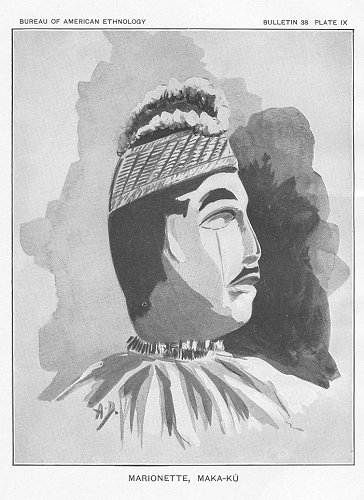
Click to enlarge
PLATE IX
MARIONETTE, MAKA-KÚ
Puapuakea, a man of genuine courage, hearing of the boastful achievements of Maka-kú, seeks him out and challenges him.
At the first contest they fought with javelins, ihe, each one taking his turn according to lot in casting his javelins to the full tale of the prescribed number; after which the other contestant did the same. Neither was victorious.
Next they fought with slings, each one having the right to sling forty stones at the other. In this conflict also neither one of them got the better of the other. The next trial was with stone-throwing. The result was still the same.
Now it was for them to try the classical Hawaiian game of lua. This was a strenuous form of contest that has many features in common with the panathlion of the ancient Hellenes, some points in common with boxing, and still more, perhaps, partakes of the character of the grand art of combat, wrestling. Since becoming acquainted with the fine Japanese art of jiu-jitsu, the author recognizes certain methods that were shared by them both. But to all of these it added the wild privileges of choking, bone-breaking, dislocating, eye-gouging, and the infliction of tortures and grips unmentionable and disreputable. At first the conflict was in suspense, victory favoring neither party; but as the contest went on Puapuakea showed a slight superiority, and at the finish he had bettered Maka-kú by three points, or ai, a as the Hawaiians uniquely term it.
The sisters, Maile-lau-lii and Maile-pakaha, who had been interested spectators of the contest, conceived passionate liking for the two warriors and laid their plans in concert to capture them for themselves. Fortunately their preferences were not in conflict. Maile-lau-lii set her affections on Maka-kú, while the younger sister devoted herself to Pua-pua-kea.
The two men had previously allowed their fancies to range abroad at pleasure; but from this time they centered their hearts on these two Mailes and settled down to regular married life.
Interest in the actual performance of the hula ki’i was stimulated by a resort to byplay and buffoonery. One of the marionettes, for instance, points to some one in the audience; whereupon one of the hoopaa asks, "What do you want?" The marionette persists in its pointing. At length the interlocutor, as if divining the marionette's wish, says: "Ah, you want So-and-so." At this the marionette nods assent, and the hoopaa asks again, "Do you wish him to come to you?" The marionette expresses its delight and approval by nods and gestures, to the immense satisfaction of the audience, who join in derisive laughter at the expense of the person held up to ridicule.
Besides the marionettes already named among the characters found in the different hula-plays of the hula ki’i, the author has heard
p. 94
mention of the following marionettes: Ku, Kini-ki’i, Hoo-lehelehe-ki’i, Ki’i-ki’i, and Nihi-aumoe.
Nihi-aumoe was a man without the incumbrance of a wife, an expert in the arts of intrigue and seduction. Nihi-aumoe is a word of very suggestive meaning, to walk softly at midnight. In Judge Andrews's dictionary are found the following pertinent Hawaiian verses apropos of the word nihi:
E hoopono ka hele i ka uka o Puna;
E nihi ka hele, mai hoolawehala,
Mai noho a ako i ka pua, o hewa,
O inaina ke Akua, paa ke alanui,
Aole ou ala e hiki aku ai.
E nihi ka hele, mai hoolawehala,
Mai noho a ako i ka pua, o hewa,
O inaina ke Akua, paa ke alanui,
Aole ou ala e hiki aku ai.
[Translation]
Look to your ways in upland Puna;
Walk softly, commit no offense;
Daily not, nor pluck the flower sin;
Lest God in anger bar the road,
And you find no way of escape.
Walk softly, commit no offense;
Daily not, nor pluck the flower sin;
Lest God in anger bar the road,
And you find no way of escape.
The marionette Ki’i-ki’i was a strenuous little fellow, an ilamuku, a marshal, or constable of the king. It was his duty to carry out with unrelenting rigor the commands of the alii, whether they bade him take possession of a taro patch, set fire to a house, or to steal upon a man at dead of night and dash out his brains while he slept.
Referring to the illustrations (pl. VIII), a judge of human nature can almost read the character of the libertine Nihi-aumoe written in his features--the flattened vertex, indicative of lacking reverence and fear, the ruffian strength of the broad face; and if one could observe the reverse of the picture he would note the flattened back-head, a feature that marks a large number of Hawaiian crania.
The songs that were cantillated to the hula ki’i express in some degree the peculiar libertinism of this hula, which differed from all others by many removes. They may be characterized as gossipy, sarcastic, ironical, scandal-mongering, dealing in satire, abuse, hitting right and left at social and personal vices--a cheese of rank flavor that is not to be partaken of too freely. It might be compared to the vaudeville in opera or to the genre picture in art.
p. 95
5 Oluna ka wa’a, a ke, ke!
O Lela wa’a, ke, ke!
O keia wa’a, ke, ke!
Ninau o Mawi, b ke, ke!
Nawai ka luau’i? c ke, ke!
10 Na Wewehi-loa, c ke, ke!
Ua make Wewehi, ke, ke!
Ua ku i ka ihe, ke, ke!
Ma ka puka kahiko, d ke, ke!
Ka puka a Mawi, ke, ke!
15 Ka lepe, ka lepe, la!
Ka lepe, ua hina a uwe!
Ninau ka lepe, la!
Mana-mana lii-lii,
Mana-mana heheiao,
20 Ke kumu o ka lepe?
Ka lepe hiolo, e?
O Lela wa’a, ke, ke!
O keia wa’a, ke, ke!
Ninau o Mawi, b ke, ke!
Nawai ka luau’i? c ke, ke!
10 Na Wewehi-loa, c ke, ke!
Ua make Wewehi, ke, ke!
Ua ku i ka ihe, ke, ke!
Ma ka puka kahiko, d ke, ke!
Ka puka a Mawi, ke, ke!
15 Ka lepe, ka lepe, la!
Ka lepe, ua hina a uwe!
Ninau ka lepe, la!
Mana-mana lii-lii,
Mana-mana heheiao,
20 Ke kumu o ka lepe?
Ka lepe hiolo, e?
[Translation]
Song
O Wewehi, la, la!
Wewehi, peerless form, la, la!
Encouched on the pola, la, la!
Bossing the paddlers, la, la!
5 Men of the canoe, la, la!
Of that canoe, la, la!
Of this canoe, la, la!
Mawi inquires, la, la!
Who was her grand-sire? la, la!
10 ’Twas Wewehi-loa, la, la!
Wewehi is dead, la, la!
Wounded with spear, la, la!
The same old wound, la, la!
Wound made by Mawi, la, la!
Wewehi, peerless form, la, la!
Encouched on the pola, la, la!
Bossing the paddlers, la, la!
5 Men of the canoe, la, la!
Of that canoe, la, la!
Of this canoe, la, la!
Mawi inquires, la, la!
Who was her grand-sire? la, la!
10 ’Twas Wewehi-loa, la, la!
Wewehi is dead, la, la!
Wounded with spear, la, la!
The same old wound, la, la!
Wound made by Mawi, la, la!
p. 96
15 The flag, to the flag!
The flag weeps at half-mast!
The flag, indeed, asks--
Many, many the flags,
A scandal for number.
20 Why are they overturned?
Why their banners cast down?
The flag weeps at half-mast!
The flag, indeed, asks--
Many, many the flags,
A scandal for number.
20 Why are they overturned?
Why their banners cast down?
The author has met with several variants to this mele, which do not greatly change its character. In one of these variants the following changes are to be noted:
Line 4. Pikaka a e ka luna, ke, ke!
Line 5. Ka luna o ka hale, Re, ke!
Line 8. Ka puka o ka hale, a ke, ke!
Line 9. E noho i anei, a ke, ke!
To attempt a translation of these lines which are unadulterated slang:
Line 4. The roof is a-dry, la, la!
Line 5. The roof of the house, la, la!
Line 8. The door of the house, la, la!
Line 9. Turn in this way, la, la!
The one who supplied the above lines expressed inability to understand their meaning, averring that they are "classical Hawaiian," meaning, doubtless, that they are archaic slang. As to the ninth line, the practice of "sitting in the door" seems to have been the fashion with such folk as far back as the time of Solomon.
Let us picture this princess of Maui, this granddaughter of Wahieloa, Wewehi, as a Helen, with all of Helen's frailty, a flirt-errant, luxurious in life, quickly deserting one lover for the arms of another; yet withal of such humanity and kindness of fascination that, at her death, or absence, all things mourned her--not as Lycidas was mourned:
"With cowslips wan that hang the pensive head.
* * * * *
And daffodillies fill their cups with tears,"
* * * * *
And daffodillies fill their cups with tears,"
but in some rude pagan fashion; all of which is wrought out and symbolized in the mele with such imagery as is native to the mind of the savage.
The attentive reader will not need be told that, as in many another piece out of Hawaii's old-time legends, the path through this song is beset with euphuistic stumbling blocks. The purpose of language, says Talleyrand, is to conceal thought. The veil in this case is quite gauzy.
The language of the following song for the marionette dance, hula ki’i, as in the one previously given, is mostly of that kind which the
p. 97
Hawaiians term olelo kapékepéke, or olelo huná, shifty talk, or secret talk. We might call it slang, though it is not slang in the exact sense in which we use that word, applying it to the improvised counters of thought that gain currency in our daily speech. until they find admission to the forum, the platform, and the dictionary. It is rather it cipher-speech, a method of concealing one's meaning from all but the initiated, of which the Hawaiian, whether alii or commoner, was very fond. The people of the hula were famous for this sort of accomplishment and prided themselves not a little in it as an effectual means of giving appropriate flavor and gusto to their performances.
Mele
Ele-ele kau-kau; a
Ka hala-le, b e kau-kau,
Na e-ele ihi,
Ele ihi, ele a,
5 Na e-ele ku-pou; c
Ku-pou.
Na hala, e! d
Ka hala-le, b e kau-kau,
Na e-ele ihi,
Ele ihi, ele a,
5 Na e-ele ku-pou; c
Ku-pou.
Na hala, e! d
[Translation]
Song
Point to a dark one,
Point to a dainty piece,
A delicate morsel she!
Very choice, very hot!
5 She that stoops over--
Aye stoops!
Lo, the hala fruit!
Point to a dainty piece,
A delicate morsel she!
Very choice, very hot!
5 She that stoops over--
Aye stoops!
Lo, the hala fruit!
The translation has to he based largely on conjecture. The author of this bit of fun-making, which is couched in old-time slang, died without making known the key to his cipher, and no one whom the present writer has met with is able to unravel its full meaning.
The following mele for the hula ki’i, in language colored by the same motive, was furnished by an accomplished practitioner who had traveled far and wide in the practice of her art, having been one of a company of hula dancers that attended the Columbian exposition in Chicago. It was her good fortune also to reach the antipodes
p. 98
in her travels, and it was at Berlin, she says, that she witnessed for the first time the European counterpart of the hula ki’i, the "Punch and Judy" show:
Mele no ka Hula Ki’i
E le’e kau-kau, kala le’e;
E le’e kau-kau.
E le’e kau-kau, kala le’e.
E lepe kau-kau.
5 E o-ku ana i kai;
E u-au ai aku;
E u-au ai aku;
E u-au ai aku!
E-he-he, e!
E le’e kau-kau.
E le’e kau-kau, kala le’e.
E lepe kau-kau.
5 E o-ku ana i kai;
E u-au ai aku;
E u-au ai aku;
E u-au ai aku!
E-he-he, e!
[Translation]
Song for the Hula Ki’i
Now for the dance, dance in accord;
Prepare for the dance.
Now for the dance, dance in time.
Up, now, with the flag!
5 Step out to the right;
Step out to the left!
Ha, ha, ha!
Prepare for the dance.
Now for the dance, dance in time.
Up, now, with the flag!
5 Step out to the right;
Step out to the left!
Ha, ha, ha!
This translation is the result of much research, yet its absolute accuracy can not be vouched for. The most learned authorities (kaka-olelo) in old Hawaiian lore that have been found by the writer express themselves as greatly puzzled at the exact meaning of the mele just given. Some scholars, no doubt, would dub these nonsense-lines. The author can not consent to any such view. The old Hawaiians were too much in earnest to permit themselves to juggle with words in such fashion. They were fond of mystery and concealment, appreciated a joke, given to slang, but to string a lot of words together without meaning, after the fashion of a college student who delights to relieve his mind by shouting "Upidee, upida," was not their way. "The people of the hula," said one man, "had ways of fun-making peculiar to themselves."
When the hula-dancer who communicated to the author the above song--a very accomplished and intelligent woman--was asked for information that would render possible its proper translation, she replied that her part was only that of a mouthpiece to repeat the words and to make appropriate gestures, he pono hula wale no, mere parrot-work. The language, she said, was such "classic" Hawaiian as to be beyond her understanding.
p. 99
Here, again, is another song in argot, a coin of the same mintage as those just given:
Mele
E kau-kau i hale manu, e!
Ike oe i ka lolo huluhulu, e?
I ka huluhulu a we’uwe’u, e?
I ka punohu, a e, a ka la e kau nei?
5 Walea ka manu i ka wai, e!
I ka wai lohi o ke kini, e!
Ike oe i ka lolo huluhulu, e?
I ka huluhulu a we’uwe’u, e?
I ka punohu, a e, a ka la e kau nei?
5 Walea ka manu i ka wai, e!
I ka wai lohi o ke kini, e!
[Translation]
Song
Let's worship now the bird-cage.
Seest thou the furzy woodland,
The shag of herb and forest.
The low earth-tinting rainbow.
5 Child of the Sun that swings above?
O, happy bird, to drink from the pool,
A bliss free to the million!
Seest thou the furzy woodland,
The shag of herb and forest.
The low earth-tinting rainbow.
5 Child of the Sun that swings above?
O, happy bird, to drink from the pool,
A bliss free to the million!
This is the language of symbolism. When Venus went about to ensnare Adonis, among her other wiles she warbled to him of mountains, dales, and pleasant fountains.
The mele now presented is of an entirely different character from those that have just preceded. It is said to have been the joint composition of the high chief Keiki-o-ewa of Kauai, at one time the kahu of Prince Moses, and of Kapihe, a distinguished poet--haku-mele--and prophet. (To Kapihe is ascribed the prophetic and oracular utterance, E iho ana o luna, e pii ana o lalo; e ku ana ka paia, e moe ana kaula; e kau ana kau-huhu--o lani iluna, o honua ilalo--"The high shall be brought low, the lowly uplifted; the defenses shall stand; the prophet shall lie low; the mountain walls shall abide--heaven above, earth beneath.")
This next poem may be regarded as an epithalamium, the celebration of the mystery and bliss of the wedding night, the hoáo ana of a high chief and his high-born kapu sister. The murmur of the breeze, the fury of the winds, the heat of the sun, the sacrificial ovens, all are symbols that set forth the emotions, experiences, and mysteries of the night:
p. 100
Mele
(Ko’ihonua)
O Wanahili a ka po loa ia Manu’a, b
O ka pu kau kama c i Hawaii akea;
O ka pu leina d kea a Kiha--
O Kiha nui a Pii-lani-- e
5 O Kauhi kalana-honu’-a-Kama; f
O ka maka iolena g ke hoohaulani i-ó!
O kela kanaka hoali mauna, h
O Ka Lani ku’i hono i ka moku. i
I waihona kapuahi kanaka ehá, j
10 Ai' i Kauai, i Oahu, i Maui.
I Hawaii kahiko o Keawe enaena, k
Ke a-á, mai la me ke o-koko,
Ke lapa-lapa la i ka makani,
Makani kua, he Naulu. l
15 Kua ka Waihoa i ka Mikioi,
O ka pu kau kama c i Hawaii akea;
O ka pu leina d kea a Kiha--
O Kiha nui a Pii-lani-- e
5 O Kauhi kalana-honu’-a-Kama; f
O ka maka iolena g ke hoohaulani i-ó!
O kela kanaka hoali mauna, h
O Ka Lani ku’i hono i ka moku. i
I waihona kapuahi kanaka ehá, j
10 Ai' i Kauai, i Oahu, i Maui.
I Hawaii kahiko o Keawe enaena, k
Ke a-á, mai la me ke o-koko,
Ke lapa-lapa la i ka makani,
Makani kua, he Naulu. l
15 Kua ka Waihoa i ka Mikioi,
p. 101
Pu-á ia lalo o Hala-li’i, a
Me he alii, alii, la no ka hele i Kekaha,
Ka hookiekie i ka li’u-la, b
Ka hele i ke alia-lia la, alia!
20 Alia-lia la’a-laau Kekaha.
Ke kaha o Kala-ihi, Wai-o-lono.
Ke olo la ke pihe a ka La, e!
Ke nu la paha i Honua-ula.
Me he alii, alii, la no ka hele i Kekaha,
Ka hookiekie i ka li’u-la, b
Ka hele i ke alia-lia la, alia!
20 Alia-lia la’a-laau Kekaha.
Ke kaha o Kala-ihi, Wai-o-lono.
Ke olo la ke pihe a ka La, e!
Ke nu la paha i Honua-ula.
[Translation]
Song
(Distinct utterance)
Wanahili bides the whole night with Manu’a,
By trumpet hailed through broad Hawaii,
By the white vaulting conch of Kiha--
Great Kiha, offspring of Pii-lani,
5 Father of eight-branched Kama-lala-walu.
The far-roaming eye now sparkles with joy,
Whose energy erstwhile shook mountains,
The king who firm-bound the isles in one state,
His glory, symboled by four human altars,
10 Reaches Kauai, Oahu, Maui,
Hawaii the eld of Keawe,
Whose tabu, burning with blood-red blaze,
Shoots flame-tongues that leap with the wind,
The breeze from the mountain, the Naulu.
15 Waihoa humps its back, while cold Mikioi
Blows fierce and swift across Hala-li’i.
It vaunts like a king at Kekaha,
Flaunting itself in the sun's heat,
And lifts itself up in mirage,
20 Ghost-forms of woods and trees in Kekaha--
Sweeping o’er waste Kala-ihi, Water-of-Lono;
While the sun shoots forth its fierce rays--
Its heat, perchance, reaches to Honua-ula.
By trumpet hailed through broad Hawaii,
By the white vaulting conch of Kiha--
Great Kiha, offspring of Pii-lani,
5 Father of eight-branched Kama-lala-walu.
The far-roaming eye now sparkles with joy,
Whose energy erstwhile shook mountains,
The king who firm-bound the isles in one state,
His glory, symboled by four human altars,
10 Reaches Kauai, Oahu, Maui,
Hawaii the eld of Keawe,
Whose tabu, burning with blood-red blaze,
Shoots flame-tongues that leap with the wind,
The breeze from the mountain, the Naulu.
15 Waihoa humps its back, while cold Mikioi
Blows fierce and swift across Hala-li’i.
It vaunts like a king at Kekaha,
Flaunting itself in the sun's heat,
And lifts itself up in mirage,
20 Ghost-forms of woods and trees in Kekaha--
Sweeping o’er waste Kala-ihi, Water-of-Lono;
While the sun shoots forth its fierce rays--
Its heat, perchance, reaches to Honua-ula.
The mele next given takes its local color from Kauai and brings vividly to mind the experiences of one who has climbed the mountain walls, pali, that buffet the winds of its northern coast.
Mele
Kalalau, pali eku i ka makani;
Pu ka Lawa-kua, c hoi mau i Kolo-kini;
Nu a anahulu ka pa ana i-uka--
Anahulu me na po keu elua.
Pu ka Lawa-kua, c hoi mau i Kolo-kini;
Nu a anahulu ka pa ana i-uka--
Anahulu me na po keu elua.
p. 102
5 Elua Hono-pu o ia kua kanaka;
Elua Ko’a-mano a me Wai-aloha.
Na pali waha iho, waha iho b me ke kua;
Ke keiki puu iloko o ka pali nui.
E hii an’ c e Makua i Kalalau.
Elua Ko’a-mano a me Wai-aloha.
Na pali waha iho, waha iho b me ke kua;
Ke keiki puu iloko o ka pali nui.
E hii an’ c e Makua i Kalalau.
[Translation]
Song
The mountain walls of Kalalau
Buffet the blasts of Lawa-kau.
That surge a decade of nights and twain:
Then, wearied, it veers to the north.
5 Two giant backs stand the cliffs Hono-pu;
The falls Wai-aloha mate with the sea:
An overhung pali--the climber's back swings in
Its mouth--to face it makes one a child--
Makua, whose arms embrace Kalalau.
Buffet the blasts of Lawa-kau.
That surge a decade of nights and twain:
Then, wearied, it veers to the north.
5 Two giant backs stand the cliffs Hono-pu;
The falls Wai-aloha mate with the sea:
An overhung pali--the climber's back swings in
Its mouth--to face it makes one a child--
Makua, whose arms embrace Kalalau.
The mind of the ancient bard was so narrowly centered on the small plot his imagination cultivated that he disregarded the outside world, forgetting that it could not gaze upon the scenes which filled his eyes.
The valley of Kalalau from its deep recess in the northwestern coast of Kauai looks out upon the heaving waters of the Pacific. The mountain walls of the valley are abrupt, often overhanging. Viewed from the ocean, the cliffs are piled one upon another like the buttresses of a Gothic cathedral. The ocean is often stormy, and during several months in the year forbids intercourse with other parts of the island, save as the hardy traveler makes his way along precipitous mountain trails.
The hula ala’a-papa, hula ipu, hula pa-ipu (or kuolo), the hula hoo-naná, and the hula ki’i were all performed to the accompaniment of the ipu or calabash, and, being the only ones that were so accompanied, if the author is correctly informed, they may be classed together under one head as the calabash hulas.
Footnotes
93:a Ai, literally a food, a course.94:a Punana. Literally a nest; here a raised couch on the pola, which was a sheltered platform in the waist of a double canoe, corresponding to our cabin, for the use of chiefs and other people of distinction.
94:b Kai-oa. The paddle-men; here a euphemism.
95:a Wa’a. A euphemism for the human body.
95:b Mawi. The hero of Polynesian mythology, whose name is usually spelled Maui, like the name of the island. Departure from the usual orthography is made in order to secure phonetic accuracy. The name of the hero is pronounced Máh-wee, not Mów-ee, as is the island. Sir George Gray, of New Zealand, following the usual orthography, has given a very full and interesting account of him in his Polynesian mythology.
95:c Wewehi-loa. Another name for Wahie-loa, who is said to have been the grandfather of Wewehi. The word luau’i in the previous verse, meaning real father, is an archaic form. Another form is kua-u’i.
95:d Puka kahiko. A strange story from Hawaiian mythology relates that originally the human anatomy was sadly deficient in that the terminal gate of the prima viæ was closed. Mawi applied his common-sense surgery to the repair of the defect and relieved the situation. Ua olelo ia i kinohi na hana ia kanaka me ka hemahema no ka nele i ka hou puka ole ia ka okole, a na Mawi i hoopau i keia pilikia mamuli o kana hana akamai. Ua kapa ia keia puka ka puka kahiko.
96:a Pikaka (full form pikakao). Dried up, juiceless.
97:a Kau-kau. Conjectural meaning to point out some one in the audience, as the marionettes often did. People were thus sometimes inveigled in behind the curtain.
97:b Hala-le. Said to mean a sop, with which one took tip the juice or gravy of food; a choice morsel.
97:c Ku-pou. To stoop over, from devotion to one's own pursuits, from modesty, or from shame.
97:d The meaning of this line has been matter for much conjecture. The author has finally adopted the suggestion embodied in the translation here given, which is a somewhat gross reference to the woman's physical charms.
99:a Punohu. A compact mass of clouds, generally lying low in the heavens; a cloud-omen; also a rainbow that lies close to the earth, such as is formed when the sun is high in the heavens.
100:a Wanahili. A princess of the mythological period belonging to Puna, Hawaii.
100:b Manu’a. A king of Hilo, the son of Kane-hili, famous for his skill in spear-throwing, maika-rolling, and all athletic exercises. He was united in marriage, ho-ao, to the lovely princess Wanahili. Tradition deals with Manua as a very lovable character.
100:c Pu kau kama. The conch (pu) is figured as the herald of fame. Kau is used in the sense of to set on high, in contrast with such a word as waiho, to set down. Kama is the word of dignity for children.
100:d Pu leina. It is asserted on good authority that the triton (pu), when approached in its ocean habitat, will often make sudden and extraordinary leaps in an effort to escape. There is special reference here to the famous conch known in Hawaiian story as Kiha-pu. It was credited with supernatural powers as a kupua. During the reign of Umi, son of Liloa, it was stolen from the heiau in Waipio valley and came into the hands of god Kane. In his wild awa-drinking revels the god terrified Umi and his people by sounding nightly blasts with the conch. The shell was finally restored to King Umi by the superhuman aid of the famous dog Puapua-lena-lena.
100:e Kiha-nui a Piilani. Son of Piilani, a king of Maui. He is credited with the formidable engineering work of making a paved road over the mountain palis of Koolau, Maui.
100:f Kauhi kalana-honu’-a-Kama. This Kauhi, as his long title indicates, was the son of the famous king, Kama-lala-walu, and succeeded his father in the kingship over Maui and, probably, Lanai. Kama-lala-walu had a long and prosperous reign, which ended, however, in disaster. Acting on the erroneous reports of his son Kauhi, whom he had sent to spy out the land, he invaded the kingdom of Lono-i-ka-makahiki on Hawaii, was wounded and defeated in battle, taken prisoner, and offered up as a sacrifice on the altar of Lono's god, preferring that death, it is said, to the ignominy of release.
100:g I-olena. Roving, shifty, lustful.
100:h Kanaka hoali mauna. Man who moved mountains; an epithet of compliment applied perhaps to Kiha, above mentioned, or to the king mentioned in the next verse. Kekaulike.
100:i Ku’i hono i ka moku. Who bound together into one (state) the islands Maui, Molokai, Lanai, and Kahoolawe. This was, it is said, Kekaulike, the fifth king of Maui after Kamalala-wale. At his death he was succeeded by Kamehameha-nui--to he distinguished from the Kamehameha of Hawaii and he in turn by the famous warrior-king Kahekili, who routed the invading array of Kalaniopuu, king of Hawaii, on the sand plains of Wailuku.
100:j I waihona kapuahi kanaka ehá. This verse presents grammatical difficulties. The word I implies the imperative, a form of request or demand, though that is probably not the intent. It seems to be a means, authorized by poetical license, of ascribing honor and tabu-glory to the name of the person eulogized, who, the context leads the author to think, was Kekaulike. The island names other than that of Maui seem to have been thrown in for poetical effect, as that king, in the opinion of the author, had no power over Kauai, Oahu, or Hawaii. The purpose may have been to assert that his glory reached to those islands.
100:k Keawe enaena. Keawe, whose tabu was hot as a burning oven. Presumably Keawe, the son of Umi, is the one meant.
100:l Naulu. The sea-breeze at Waimea, Kauai.
101:a Hale-lii. A sandy plain on Niihau, where grows a variety of sugar-cane that lies largely covered by the loose soil, ke ko eli o Hala-lii.
101:b Li’u-la. The mirage, a common phenomenon on Niihau, and especially at Mana, on Kauai.
101:c Lawa-kua. A wind in Kalalau that blows for a time from the mountains and then, it is said, veers to the north, so that it comes from the direction of a secondary valley, Kolo-kini, a branch of Kalalau. The bard describes it as continuing to blow for twelve nights before it shifts, an instance, probably, of poetic license.
102:a Ko’a-mano. A part of the ocean into which the stream Wai-aloha falls.
102:b Waha iho. With mouth that yawns downward, referring, doubtless. to the overarching of the pali, precipice. The same figure is applied to the back (kua) of the traveler who climbs it.
102:c Elision of the final a in ana.

No comments:
Post a Comment