XVI.--THE HULA ÍLI-ÍLI
The hula íli-íli, pebble-dance, was a performance of the classical times, in which, according to one who has witnessed it, the olapa alone took part. The dancers held in each hand a couple of pebbles, ili-ili, hence the name of the dance--which they managed to clash against each other, after the fashion of castanets, thus producing a rude music of much the same quality as that elicited from the "bones" in our minstrel performances. According to another witness, the drum also was sometimes used in connection with the pebbles as an accompaniment to this hula.The ili-ili was at times a hula of intensity--that is to say, was acted with that stress of voice and manner which the Hawaiians termed ai-ha’a; but it seems to have been more often performed in that quiet natural tone of voice and of manner termed ko’i-honua, which may be likened to utterance in low relief.
The author can present only the fragment of a song to illustrate this hula:
Mele
A lalo maua o Wai-pi’o,
Ike i ka nani o Hi’i-lawe.
E lawe mai a oki
I na hala o Naue i ke kai,
5 I na lehua lu-lu’u pali;
Noho ana lohe i ke kani o ka o-ó,
Hoolono aku i ka leo o ke kahuli.
Ike i ka nani o Hi’i-lawe.
E lawe mai a oki
I na hala o Naue i ke kai,
5 I na lehua lu-lu’u pali;
Noho ana lohe i ke kani o ka o-ó,
Hoolono aku i ka leo o ke kahuli.
[Translation]
Song
We twain were lodged in Wai-pi’o,
Beheld Hi’i-lawe, the grand.
We brought and cut for our love-wreath
The rich hala drupe from Naue's strand,
5 Tufted lehua that waves on the cliff;
Then sat and gave ear to song of o-ó,
Or harked the chirp of the tree-shell.
Beheld Hi’i-lawe, the grand.
We brought and cut for our love-wreath
The rich hala drupe from Naue's strand,
5 Tufted lehua that waves on the cliff;
Then sat and gave ear to song of o-ó,
Or harked the chirp of the tree-shell.
Wai-pi’o, the scene of this idyl, is a valley deep and broad which the elements have scooped out in the windward exposure of Hawaii, and scarce needs mention to Hawaiian tourists. Hi’i-lawe is one of

Click to enlarge
PLATE XII
PUPU-KANI-OE, POETICALLY STYLED KAHULI
HAWAIIAN TREE-SHELLS (ACHATINELLA * * *)
p. 121
several high waterfalls that leap from the world of clouds into the valley-basin.
Kahuli is a fanciful name applied to the beautiful and unique genus of tree-shells (Achatinella), plate XII, that inhabit the Hawaiian woods. The natives are persuaded that these shells have the power of chirping a song of their own, and the writer has often heard the note which they ascribe to them; but to his ear it was indistinguishable from the piping of the cricket. This is the song that the natives credit to the tree-shells:
Mele
[Translation]
Song of the Tree-shell
Trill a-far,
Trill a-near,
A dainty song wreath,
Wreath akolea.
5 Kolea, Kolea,
Fetch me some dew,
Dew from pink akolea.
Trill a-near,
A dainty song wreath,
Wreath akolea.
5 Kolea, Kolea,
Fetch me some dew,
Dew from pink akolea.
This little piece of rustic imagination is said to have been used in the hula, but in connection with what dance the author has not been able to learn.
Footnotes
121:a The akolea is a fern (by some classed as a Polypodium) which, according to Doctor Hillebrand (Flora of the Hawaiian Islands), "sustains its extraordinary length by the circinnate tips which twine round the branches of neighboring shrubs or trees."121:b Kolea. The red-breasted plover.
XVII.--THE HULA KÁ-ÉKE-ÉKE
The kaekeeke was a formal hula worthy of high consideration. Some authorities assert that the performers in this dance were chosen from the hoopaa alone, who, it will be remembered, maintained the kneeling position, while, according to another authority, the olapa also took part in it. There is no reason for doubting the sincerity of both these witnesses. The disagreement probably arose from hasty generalization. One is reminded of the wise Hawaiian saw, already noted, "Do not think that, your halau holds all the knowledge."This hula took its name from the simple instrument that formed its musical accompaniment. This consisted of a single division of the long-jointed bamboo indigenous to Hawaii, which was left open at one end. (The varieties of bamboo imported from China or the East Indies have shorter joints and thicker walls, and will not answer the purpose, being not sufficiently resonant.) The joints used in the kaekeeke were of different sizes and lengths, thus producing tones of various pitch. The performer held one in each hand and the tone was elicited by striking the base of the cylinder sharply against the floor or some firm, nonresonant body.
On making actual trial of the kaekeeke, in order to prove by experience its musical quality and capabilities, the writer's pleasure was as great as his surprise when he found it capable of producing musical tones of great purity and of the finest quality. Experiment soon satisfied him that for the best production of the tone it was necessary to strike the bamboo cylinder smartly upon some firm, inelastic substance, such as a bag of sand. The tone produced was of crystalline purity, and by varying the size and length of the cylinders it proved possible to represent a complete musical scale. The instrument was the germ of the modern organ.
The first mele to be presented partakes of the nature of the allegory. a form of composition not a little affected by the Hawaiians:
Mele
A Hamakua au.
Noho i ka ulu hala.
Malihini au i ka hiki ana.
I ka ua pe’epe’e i pohaku.
5 Noho oe a li’u-li’u,
A luli-luli malie iho. p. 123
He keiki akamai ko ia pali;
Elima no pua i ka lima.
Kui oe a lawa
10 I lei no ku’u aloha;
Malama malie oe i ka makemake,
I lei hooheno no ke aloha ole.
Moe oe a ala mai;
Nana iho oe i kou pono.
15 Hai'na ia ka puana:
Keiki noho pali o Hamakua;
A waka-waka, a waka-waka.
Noho i ka ulu hala.
Malihini au i ka hiki ana.
I ka ua pe’epe’e i pohaku.
5 Noho oe a li’u-li’u,
A luli-luli malie iho. p. 123
He keiki akamai ko ia pali;
Elima no pua i ka lima.
Kui oe a lawa
10 I lei no ku’u aloha;
Malama malie oe i ka makemake,
I lei hooheno no ke aloha ole.
Moe oe a ala mai;
Nana iho oe i kou pono.
15 Hai'na ia ka puana:
Keiki noho pali o Hamakua;
A waka-waka, a waka-waka.
[Translation]
Song
It was in Hamakua;
I sat in a grove of Pandanus,
A stranger at my arrival,
A rock was my shelter from rain.
5 I found it a wearisome wait,
Cautiously shifting about.
There's a canny son of the cliff
That has five buds to his hand.
You shall twine me a wreath of due length,
10 A wreath to encircle my love,
Whilst you hold desire in strong curb,
Till love-touch thaws the cold-hearted.
When you rise from sleep on the mat,
Look down, see the conquest of love.
15 The meaning of this short story?
What child fondly clings to the cliff?
Waka-waka, the shell-fish.
I sat in a grove of Pandanus,
A stranger at my arrival,
A rock was my shelter from rain.
5 I found it a wearisome wait,
Cautiously shifting about.
There's a canny son of the cliff
That has five buds to his hand.
You shall twine me a wreath of due length,
10 A wreath to encircle my love,
Whilst you hold desire in strong curb,
Till love-touch thaws the cold-hearted.
When you rise from sleep on the mat,
Look down, see the conquest of love.
15 The meaning of this short story?
What child fondly clings to the cliff?
Waka-waka, the shell-fish.
The scene of this idyl, this love-song, mele hoipoipo, is Hamakua, a district on the windward side of Hawaii, subject to rain-squalls. The poet in his allegory represents himself as a stranger sitting in a pandanus grove, ulu hala (verse 2); sheltering himself from a rain-squall by crouching behind a rock, ua pe’epe’e pohaku (verse 4); shifting about on account of the veering of the wind, luli-luli malie iho (verse 6). Interpreting this figuratively, Hamakua, no doubt, is the woman in the case; the grove an emblem of her personality and physical charms; the rain-squall, of her changeful moods and passions. The shifting about of the traveler to meet the veering of the wind would seem to mean the man's diplomatic efforts to deal with the woman's varying caprices and outbursts.
He now takes up a parable about some creature, a child of the cliff--Hamakua's ocean boundary is mostly a precipitous wall--which he represents as a hand with five buds. Addressing it as a servant, he bids this creature twine a wreath sufficient for his love, kui oe a
p. 124
lawa (verse 9), I lei no ku’u aloha (verse 10). This creature with five buds, what is it but the human hand, the errand-carrier of man's desire, makemake (verse 11)? The pali, by the way, is a figure often used by Hawaiian poets to mean the glory and dignity of the human body.
That is a fine imaginative touch in which the poet illustrates the power of the human hand to kindle love in one that is cold-hearted, as if he had declared the hand itself to be not only the wreath-maker, but the very wreath that is to encircle and warm into response the unresponsive loved one, I lei hooheno no ke aloha ole (verse 12).
Differences of physical environment, of social convention, of accepted moral and esthetic standards interpose seemingly impassable barriers between us and the savage mind, but at the touch of an all-pervading human sympathy these barriers dissolve into very thin air.
Mele
Kahiki-nui, auwahi a ka makani!
Nana aku au ia Kona,
Me he kua lei ahi b la ka moku;
Me he lawa uli e, la, no
5 Ku’u kai pa-ú hala-ká c
I ka lae o Hana-maló; d
Me he olohe ili polohiwa,
Ke ku a mauna,
Ma ka ewa lewa e Hawaii.
10 Me he ihu leiwi la, ka moku,
Kou mauna, kou palamoa: f
Kau a waha mai Mauna-kea g
A me Mauna-loa, g
Ke ku a Maile-hahéi. h
15 Uluna mai Mauna Kilohana i
I ka poohiwi o Hu'e-hu'e. i
Nana aku au ia Kona,
Me he kua lei ahi b la ka moku;
Me he lawa uli e, la, no
5 Ku’u kai pa-ú hala-ká c
I ka lae o Hana-maló; d
Me he olohe ili polohiwa,
Ke ku a mauna,
Ma ka ewa lewa e Hawaii.
10 Me he ihu leiwi la, ka moku,
Kou mauna, kou palamoa: f
Kau a waha mai Mauna-kea g
A me Mauna-loa, g
Ke ku a Maile-hahéi. h
15 Uluna mai Mauna Kilohana i
I ka poohiwi o Hu'e-hu'e. i
p. 125
[Translation]
Song
Kahiki-nui, land of wind-driven smoke!
Mine eyes gaze with longing on Kona;
A fire-wreath glows aback of the district,
And a robe of wonderful green
5 Lies the sea that has aproned my loins
Off the point of Hana-maló.
A dark burnished form is Hawaii,
To one who stands on the mount--
A hamper swung down from heaven,
10 A beautiful carven shape is the island--
Thy mountains, thy splendor of herbage:
Mauna-kea and Loa stand (in glory) apart,
To him who looks from Maile-hahei;
And Kilohana pillows for rest
15 On the shoulder of Hu'e-hu'e.
Mine eyes gaze with longing on Kona;
A fire-wreath glows aback of the district,
And a robe of wonderful green
5 Lies the sea that has aproned my loins
Off the point of Hana-maló.
A dark burnished form is Hawaii,
To one who stands on the mount--
A hamper swung down from heaven,
10 A beautiful carven shape is the island--
Thy mountains, thy splendor of herbage:
Mauna-kea and Loa stand (in glory) apart,
To him who looks from Maile-hahei;
And Kilohana pillows for rest
15 On the shoulder of Hu'e-hu'e.
This love-song--mele hoipoipo--which would be the despair of a strict literalist--what is it all about? A lover in Kahiki-nui of the softer sex, it would appear--looks across the wind-swept channel and sends her thoughts lovingly, yearningly, over to Kona of Hawaii, which district she personifies as her lover. The mountains and plains, valleys and capes of its landscapes, are to her the parts and features of her beloved. Even in the ocean that flows between her and him, and which has often covered her nakedness as with a robe, she finds a link in the chain of association.
Footnotes
124:a Auwahi (a word not found in any dictionary) is said by a scholarly Hawaiian to be au archaic form of the word uwahi, or uahi (milk of fire), smoke, Kahiki-nui is a dry region and the wind (makani) often fills the air with dust.124:b Kua lei ahi. No Hawaiian has been found who professes to know the true meaning of these words. The translation of them here given is, therefore, purely formal.
124:c Pa-ú halaká. An expression sometimes applied to the hand when used as a shield to one's modesty; here it is said of the ocean (hat) when one's body is immersed in it.
124:d Hana-maló. A cape that lies between Kawaihae and Kailua in north Kona.
124:e Ewa lewá. In this reading the author has followed the authoritative suggestion of a Hawaiian expert, substituting it for that first given by another, which was elewa. The latter was without discoverable meaning. Even as now given conjectures as to its meaning are at variance. The one followed presents the less difficulty.
124:f Palamoa. The name of a virulent kupua that acted as errand-carrier and agent for sorcerers (kahuna ánaaná); also the name of a beautiful grass found on Hawaii that has a pretty red seed. Following the line of least resistance, the latter meaning has been adopted; in it is found a generic expression for the leafy covering of the island.
124:g Mauna-kea and Mauna-loa. The two well-known mountains of the big island of Hawaii.
124:h Maile-hahei. Said to be a hill in Kona.
124:i Kilohana and Hu'e-hu'e. The names of two hills in Kona, Hawaii.
XVIII. AN INTERMISSION
During the performance of a hula the halau and all the people there assembled are under a tabu, the imposition of which was accomplished by the opening prayer that had been offered before the altar. This was a serious matter, and laid everyone present under the most formal obligations to commit no breach of divine etiquette; it even forbade the most innocent remarks and expressions of emotion. But when the performers, wearied of the strait-jacket, determined to unbend and indulge in social amenities, to lounge, gossip, and sing informal songs, to quaff a social bowl of awa, or to indulge in an informal dance, they secured the opportunity for this interlude by suspending the tabu. This was accomplished by the utterance of a pule hoo-noa, a tabu-lifting prayer. If the entire force of the tabu was not thus removed, it was at least so greatly mitigated that the ordinary conversations of life might be carried on without offense. The pule was uttered by the kumu or some person who represented the whole company:Pule Hoo-noa
Lehua a i-luna,
Lehua i-lalo,
A wawae,
A Ka-ulua, b
5 A o Haumea, c
Kou makua-kane, d
Manu o Kaáe; e
A-koa-koa,
O Pe-káu, f
10 O Pé-ka-naná. g
Lehua i-lalo,
A wawae,
A Ka-ulua, b
5 A o Haumea, c
Kou makua-kane, d
Manu o Kaáe; e
A-koa-koa,
O Pe-káu, f
10 O Pé-ka-naná. g
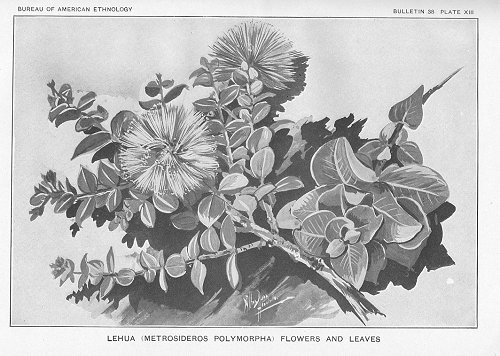
Click to enlarge
PLATE XIII
LEHUA (METROSIDEROS POLYMORPHA, FLOWERS AND LEAVES
p. 127
Papa pau.
Pau a’e iluna;
O Ku-mauna,
A me Laka,
15 A me Ku.
Ku i ka wao,
A me Hina,
Hina mele-lani.
A ua pan;
20 Pau kakou;
A ua noa;
Noa ke kahua;
Noa!
Pau a’e iluna;
O Ku-mauna,
A me Laka,
15 A me Ku.
Ku i ka wao,
A me Hina,
Hina mele-lani.
A ua pan;
20 Pau kakou;
A ua noa;
Noa ke kahua;
Noa!
[Translation]
Power to Remove Tabu
Bloom of lehua on altar piled,
Bloom of lehua below,
Bloom of lehua at altar's base,
In the month Ka-ulna.
5 Present here is Haumea,
And the father of thee,
And the goddess of eloquent speech;
Gather, now gather,
Ye ranks of gods,
10 And ye ranks of men,
Complete in array.
The heavenly service is done,
Service of Ku of the mount,
Service of Laka,
15 And the great god Ku,
Ku of the wilds,
And of Hina,
Hina, the heavenly singer.
Now it is done,
20 Our work is done;
The tabu is lifted,
Free is the place,
Tabu-free!
Bloom of lehua below,
Bloom of lehua at altar's base,
In the month Ka-ulna.
5 Present here is Haumea,
And the father of thee,
And the goddess of eloquent speech;
Gather, now gather,
Ye ranks of gods,
10 And ye ranks of men,
Complete in array.
The heavenly service is done,
Service of Ku of the mount,
Service of Laka,
15 And the great god Ku,
Ku of the wilds,
And of Hina,
Hina, the heavenly singer.
Now it is done,
20 Our work is done;
The tabu is lifted,
Free is the place,
Tabu-free!
Here also is another pule hoo-noa, a prayer-song addressed to Laka, an intercession for the lifting of the tabu. It will be noticed that the request is implied, not explicitly stated. All heads are lifted, all eyes are directed heavenward or to the altar, and the hands with a noiseless motion keep time as the voices of the company, led by the kumu, in solemn cantillation, utter the following prayer:
p. 128
Pule Hoo-noa no Laka
Pupu we’u-we’u a e, Láka e,
O kona we’u-we’u e ku-wá; b
O Ku-ka-ohia-Laká, c e;
Laua me Ku-pulu-pulu; d
5 Ka Lehua me ke Koa lau-lii;
O ka Lama me Moku-halii,
Kú-i-kú-i e me ka Hala-pepe;
Lakou me Lau-ka-ie-ie.
Ka Palaí me Maile-lau-lii.
10 Noa, noa i kou kuahu;
Noa, noa ia oe, Láka;
Pa-pá-lúa noa!
O kona we’u-we’u e ku-wá; b
O Ku-ka-ohia-Laká, c e;
Laua me Ku-pulu-pulu; d
5 Ka Lehua me ke Koa lau-lii;
O ka Lama me Moku-halii,
Kú-i-kú-i e me ka Hala-pepe;
Lakou me Lau-ka-ie-ie.
Ka Palaí me Maile-lau-lii.
10 Noa, noa i kou kuahu;
Noa, noa ia oe, Láka;
Pa-pá-lúa noa!
[Translation]
Tabu-lifting Prayer (to Laka)
Oh wildwood bouquet, O Láka!
Set her greenwood leaves in order due;
And Ku, god of Ohia-La-ká,
He and Ku, the shaggy.
5 Lehua with small-leafed Koa,
And Lama and Moku-hali’i,
Kú-i-kú-i and Hála-pé-pé;
And with these leafy I-e-i-e,
Fern and small-leafed Maile.
10 Free, the altar is free!
Free through you, Laka,
Doubly free!
Set her greenwood leaves in order due;
And Ku, god of Ohia-La-ká,
He and Ku, the shaggy.
5 Lehua with small-leafed Koa,
And Lama and Moku-hali’i,
Kú-i-kú-i and Hála-pé-pé;
And with these leafy I-e-i-e,
Fern and small-leafed Maile.
10 Free, the altar is free!
Free through you, Laka,
Doubly free!
But even now, when the tabu has been removed and the assembly is supposed to have assumed an informal character, before they may indulge themselves in informalities, there remains to be chanted a dismissing prayer, pule hooku’u, in which all voices, must join:
p. 129
Pule Hooku’u
Ku ka makaia a ka huaka’i moe ipo; a
Ku au, hele;
Noho oe, aloha!
Aloha na hale o makou i makamaka-ole,
5 Ke alanui hele mauka o Huli-wale, b la;
H-u-l-i.
E huli a’e ana i ka makana,
I ke alana ole e kanaenae aku ia oe.
Eia ke kanaenae, o ka leo.
Ku au, hele;
Noho oe, aloha!
Aloha na hale o makou i makamaka-ole,
5 Ke alanui hele mauka o Huli-wale, b la;
H-u-l-i.
E huli a’e ana i ka makana,
I ke alana ole e kanaenae aku ia oe.
Eia ke kanaenae, o ka leo.
[Translation]
Dismissing Prayer
Doomed sacrifice I in the love-quest,
I stand [loin-girt] c for the journey;
To you who remain, farewell!
Farewell to our homes forsaken.
5 On the road beyond In-decision,
I turn me about--
Turn me about, for lack of a gift,
An offering, intercession, for thee--
My sole intercession, the voice.
I stand [loin-girt] c for the journey;
To you who remain, farewell!
Farewell to our homes forsaken.
5 On the road beyond In-decision,
I turn me about--
Turn me about, for lack of a gift,
An offering, intercession, for thee--
My sole intercession, the voice.
This fragment--two fragments, in fact, pieced together--belongs to the epic of Pele. As her little sister, Hiiaka, is about to start on her adventurous journey to bring the handsome Prince Lohiau from the distant island of Kauai she is overcome by a premonition of Pele's jealousy and vengeance, and she utters this intercession.
The formalities just described speak for themselves. They mark better than any comments can do the superstitious devotion of the old-timers to formalism, their remoteness from that free touch of social and artistic pleasure, the lack of which we moderns often lament in our own lives and sigh for as a lost art, conceiving it to have been once the possession of "the children of nature."
The author has already hinted at the form and character of the entertainments with which hula-folk sometimes beguiled their professional interludes. Fortunately the author is able to illustrate by means of a song the very form of entertainment they provided for themselves on such an occasion. The following mele, cantillated with an accompaniment of expressive gesture, is one that was actually given at an awa-drinking bout indulged in by hula-folk. The author has an account of its recital at Kahuku, island of Oahu, so late as the year 1849, during a circuit of that island made by King Kamehameha
p. 130
[paragraph continues] III. This mele is reckoned as belonging to the ordinary repertory of the hula; but to which particular form of the dance it was devoted has not been learned:
Mele
Ua ona o Kane i awa;
Ua kau ke kéha a i ka uluna;
Ua hi’o-lani b i ka moena.
Kipú mai la i ke kapa o ka noe.
5 Noe-noe na hokú o ka lani--
Imo-imo mai la i ka po a’e-a’e.
Mahana-lua c na kukui a Lanikaula, d
He kaula no Kane. e
Meha na pali o Wai-pi’o
10 I ke kani mau o Kiha-pú;
A ono ole ka awa a ke alii
I ke kani mau o Kiha-pú;
Moe ole kona po o ka Hooilo;
Uluhua, a uluhua.
15 I ka mea nana e huli a loaa
I kela kupua ino i ka pali,
Olali la, a olali.
Ua kau ke kéha a i ka uluna;
Ua hi’o-lani b i ka moena.
Kipú mai la i ke kapa o ka noe.
5 Noe-noe na hokú o ka lani--
Imo-imo mai la i ka po a’e-a’e.
Mahana-lua c na kukui a Lanikaula, d
He kaula no Kane. e
Meha na pali o Wai-pi’o
10 I ke kani mau o Kiha-pú;
A ono ole ka awa a ke alii
I ke kani mau o Kiha-pú;
Moe ole kona po o ka Hooilo;
Uluhua, a uluhua.
15 I ka mea nana e huli a loaa
I kela kupua ino i ka pali,
Olali la, a olali.
[Translation]
Song
Kane is drunken with awa:
His head is laid on the pillow;
His body stretched on the neat.
A trumpet sounds through the fog,
5 Dimmed are the stars in the sky;
When the night is clear, how they twinkle!
Lani-kaula's torches look double,
The torches that burn for Kane.
Ghostly and drear the walls of Waipio
10 At the endless blasts of Kiha-pú.
The king's awa fails to console him:
’Tis the all-night conching of Kiha-pú.
Broken his sleep the whole winter;
Downcast and sad, sad and downcast,
15 At loss to find a brave hunter
Shall steal the dunned conch from the cliff.
Look, how it gleams [through the fog]!
His head is laid on the pillow;
His body stretched on the neat.
A trumpet sounds through the fog,
5 Dimmed are the stars in the sky;
When the night is clear, how they twinkle!
Lani-kaula's torches look double,
The torches that burn for Kane.
Ghostly and drear the walls of Waipio
10 At the endless blasts of Kiha-pú.
The king's awa fails to console him:
’Tis the all-night conching of Kiha-pú.
Broken his sleep the whole winter;
Downcast and sad, sad and downcast,
15 At loss to find a brave hunter
Shall steal the dunned conch from the cliff.
Look, how it gleams [through the fog]!
p. 131
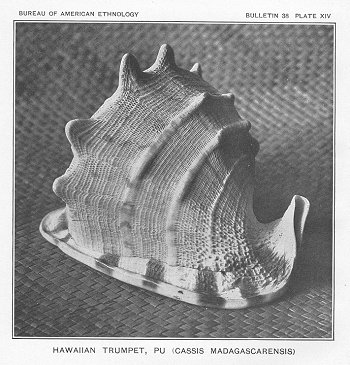
Click to enlarge
PLATE XIV
HAWAIIAN TRUMPET, PU (CASSIS MADAGASCARENSIS)
Kane, the chief god of the Hawaiian pantheon, in company with other immortals, his boon companions, met in revelry on the heights bounding Wai-pi’o valley. With each potation of awa they sounded a blast upon their conch-shells, and the racket was almost continuous from the setting of the sun until drowsiness overcame them or the coming of day put an end to their revels.
The tumult of sound made it impossible for the priests to perform acceptably the offices of religion, and the pious king, Liloa, was distressed beyond measure. The whole valley was disturbed and troubled with forebodings at the suspension of divine worship.
The chief offender was Kane himself. The trumpet which he held to his lips was a conch of extraordinary size (pl. XIV) and credited with a divine origin and the possession of supernatural power; its note was heard above all the others. This shell, the famed Kiha-pú, had been stolen from the heiau of Paka’a-lána, Liloa's temple in Waipi’o valley, and after many adventures had come into the hands of god Kane, who used it, as we see, for the interruption of the very services that were intended for his honor.
The relief from this novel and unprecedented situation came from an unexpected quarter. King Liloa's awa-patches were found to be suffering from the nocturnal visits of a thief. A watch was set; the thief proved to be a dog, Puapua-lenalena, whose master was a confirmed awa-toper. When master and dog were brought into the presence of King Liloa, the shrewd monarch divined the remarkable character of the animal, and at his suggestion the dog was sent on the errand which resulted in the recovery by stealth of the famed conch Kiha-pú. As a result of his loss of the conch, Kane put an end to his revels, and the valley of Wai-pi’o again had peace.
This mele is an admirable specimen of Hawaiian poetry, and may be taken as representative of the best product of Hawaii's classical period. The language is elegant and concise, free from the redundancies that so often load down Hawaiian compositions. No one, it is thought, will deny to the subject-matter of this mele an unusual degree of interest.
There is a historic side to the story of the conch-shell Kiha-pú. Not many years ago the Hawaiian Museum contained an ethnological specimen of great interest, the conch-shell Kiha-pú. It was fringed, after the fashion of a witch-doll, with strings, beads, and wampum-like bits of mother-of-pearl, and had great repute as a kupua or luck-bringer. King Kalakaua, who affected a sentimental leaning to the notions of his mother's race, took possession of this famous "curio" and it disappeared from public view.
Footnotes
126:a Lehua. See plate XIII.126:b Ka-ulua. The name of the third month of the Hawaiian year. corresponding to late January or February, a time when in the latitude of Hawaii nature does not refrain from leafing and flowering.
126:c Haumea. The name applied after her death and apotheosis to Papa, the wife of Wakea, and the ancestress of the Hawaiian race. (The Polynesian Race, A. Fornander, I, 205. London, 1878.)
126:d It is doubtful to whom the expression "makua-kane " refers, possibly to Wakea, the husband of Papa; and if so, very properly termed father, ancestor, of the people.
126:e Manu o Kaáe (Manu-o-Kaáe it might be written) is said to have been a goddess, one of the family of Pele, a sister of the sea nymph Moana-nui-ka-lehua, whose dominion was in the waters between Oahu and Kauai. She is said to have had the gift of eloquence.
126:f Pe-káu refers to the ranks and classes of the gods.
126:g Pé-ka-naná refers to men, their ranks and classes.
128:a Pupu we’u-we’u. A bouquet. The reference is to the wreaths and floral decorations that bedecked the altar, and that were not only offerings to the goddess, but symbols of the diverse forms in which she manifested herself. At the conclusion of a performance the players laid upon the altar the garlands they themselves had worn. These were in addition to those which were placed there before the play began.
128:b Ku-wá. It has cost much time and trouble to dig out the meaning of this word. The fundamental notion is that contained in its two parts, ku, to stand, and wa, an interval or space. the whole meaning to arrange or set in orderly intervals.
128:c La-ká. A Tahitian name for the tree which in Hawaii is called lehua, or ohia. In verse 3 the Hawaiian name ohia and the Tahitian Laká (accented on the final syllable, thus distinguishing it from the name of the goddess Láka, with which it has no discoverable connection) are combined in one form as an appellation of the god Ku--ku-ka-ohia-Laká. This is a notable instance of the survival of a word as a sacred epithet in a liturgy, which otherwise had been lost to the language.
128:d Ku-pulu-pulu. Ku, the fuzzy or shaggy, a deity much worshiped by canoe-makers, represented as having the figure of an old man with a long beard. In the sixth verse the full form of the god's name here given as Moku-ha-li’i would be Ku-moku-hali’i, the last part being an epithet applied to Ku working in another capacity. Moku-hali’i is the one who bedecks the island. His special emblem, as here implied, was the lama, a beautiful tree, whose wood was formerly used in making certain sacred inclosures. From this comes the proper name Palama, one of the districts of Honolulu.
128:e Kú-i-kú-i. The same as the tree now called ku-kú-i, the tree whose nuts were used as candles and flambeaus. The Samoan name of the same tree is tú-i-tú-i.
129:a A literal translation of the first line would be as follows: (Here) stands the doomed sacrifice for the journey in search of a bed-lover.
129:b Huli-wale. To turn about, here used as the name of a place, is evidently intended figuratively to stand for mental indecision.
129:c The bracketed phrase is not in the text of the original.
130:a Kéha is in elegant expression for the side of the head.
130:b Hi’o-lani, literally to turn the side to heaven, is a classic expression of refinement.
130:c Mahana-lua, literally to see double, was an accepted test of satisfactory drunkenness. It reminds the author of an expression he once heard used by the comedian Clarke in the play of Toddles. While in a maudlin state from liquor he spoke of the lighted candle that was in his hand as a "double-barreled candle."
130:d Lani-kaula was a prophet who lived on Molokai at a place that still bears his name. He had his residence in the midst of a grove of tine kukui trees, the remnants of which remain to this day. Torches made from the nuts of these trees were supposed to be of superior quality and they furnished the illumination for the revelries of Kane and his fellows.
130:e He kaula no Kane. A literal translation would be, a prophet of Kane.
XIX.--THE HULA NIAU-KANI
The hula niau-kani was one of the classic dances of the halau, and took its name from the musical instrument that was its accompaniment. This was a simple, almost extemporaneous, contrivance, constructed, like the jew's-harp, on the principle of a reed instrument. It was made of two parts, a broad piece of bamboo with a longitudinal slit at one end and a thin narrow piece of the same material, the reed, which was held firmly against the fenestra on the concave side of part number one. The convexity of the instrument was pressed against the lips and the sound was produced by projecting the breath through the slit in a speaking or singing tone in such a way as to cause vibrations in the reed. The manner of constructing and operating this reed instrument is suggestive of the jew's-harp. It is asserted by those who should know that the niau-kani was an instrument of purely Hawaiian invention.The performer did not depend simply upon the musical tone, but rather upon the modification it produced in the utterances that were strained through it. It would certainly require a quick ear, much practice, and a thorough acquaintance with the peculiarities of Hawaiian mele to enable one to distinguish the words of a song after being transformed by passage through the niau-kani.
As late as about thirty or forty years ago the niau-kani was often seen in the hands of the native Hawaiian youth, who used it as a means of romantic conversations and flirtation. Since the coming in of the Portuguese and their importation of the uku-lele, the taro-patch-fiddle, and other cheap stringed instruments, the niau-kani has left the field to them and disappeared.
The author's informant saw the niau-kani dance performed some years ago at Moana-lua, near Honolulu, and again on the island of Kauai. The dance in each case was the same. The kumu, aided by a pupil, stood and played on the niau-kani, straining the cantillations through the reed-protected aperture, while the olapa, girls, kept time to the music with the movements of their dancing.
p. 133
E pi’i ka wai ka nahele,
U'ina, nakolo i na Molo-kama; a
Ka ua lele mawaho o Mamala-hoa.
He manao no ko’u e ike
5 I na pua ohi’a o Kupa-koili, b
I hoa kaunu no Manu’a-kepa; c
Ua like laua me Naha-moku. d
Anapa i ke kai o Mono-lau. e
Lalau ka lima a noa ia ia la,
10 I hoa pili no Lani-huli. f
E huli oe i ku’u makemake,
A loa’a i Kau-ka-opua. g
Elua no pua kau
A la manao i makemake ai.
15 Hoohihi oe a hihi
I lei kohu no neia kino.
Ahea oe hiki mai?
A kau ka La i na pali; h
Ka huli a ka makani Wai-a-ma’o, i
20 Makemake e iki ia ka Hala-mapu-ana,
Ka wai halana i Wai-pá. j
U'ina, nakolo i na Molo-kama; a
Ka ua lele mawaho o Mamala-hoa.
He manao no ko’u e ike
5 I na pua ohi’a o Kupa-koili, b
I hoa kaunu no Manu’a-kepa; c
Ua like laua me Naha-moku. d
Anapa i ke kai o Mono-lau. e
Lalau ka lima a noa ia ia la,
10 I hoa pili no Lani-huli. f
E huli oe i ku’u makemake,
A loa’a i Kau-ka-opua. g
Elua no pua kau
A la manao i makemake ai.
15 Hoohihi oe a hihi
I lei kohu no neia kino.
Ahea oe hiki mai?
A kau ka La i na pali; h
Ka huli a ka makani Wai-a-ma’o, i
20 Makemake e iki ia ka Hala-mapu-ana,
Ka wai halana i Wai-pá. j
[Translation]
Song
Up to the streams in the wildwood,
Where rush the falls Molo-kama,
While the rain sweeps past Mala-hoa,
I had a passion to visit
5 The forest of bloom at Koili,
Where rush the falls Molo-kama,
While the rain sweeps past Mala-hoa,
I had a passion to visit
5 The forest of bloom at Koili,
p. 134
To give love-caress to Manu’a,
And her neighbor Maha-moku,
And see the waters flash at Mono-lau;
My hand would quiet their rage,
10 Would sidle and touch Lani-huli.
Grant me but this one entreaty,
Well meet ’neath the omens above.
Two flowers there are that bloom
In your garden of being;
15 Entwine them into a garland,
Fit emblem and crown of our love.
And what the hour of your coining?
When stands the Sun o’er the pali,
When turns the breeze of the land,
20 To breathe the perfume of hala,
While the currents swirl at War-pá.
And her neighbor Maha-moku,
And see the waters flash at Mono-lau;
My hand would quiet their rage,
10 Would sidle and touch Lani-huli.
Grant me but this one entreaty,
Well meet ’neath the omens above.
Two flowers there are that bloom
In your garden of being;
15 Entwine them into a garland,
Fit emblem and crown of our love.
And what the hour of your coining?
When stands the Sun o’er the pali,
When turns the breeze of the land,
20 To breathe the perfume of hala,
While the currents swirl at War-pá.
This mele is the language of passion, a song in which the lover frankly pours into the ear of his inamorata the story of his love up to the time of his last enthrallment. Verses 11, 12, and 17 are the language of the woman. The scene is laid in the rainy valley of Hanalei, Kauai, a broad and deep basin, to the finishing of which the elements have contributed their share. The rush and roar of the waters that unite to form the river Wai-oli, from their wild tumbling in the falls of Molo-kama till they pass the river's mouth and mingle with the flashing waves of the ocean at Mono-lau, Anapa i ke kai o Mono-lau (verse 8), are emblematic of the man's passion and his finest for satisfaction.
Footnotes
133:a NOTE.--The proper names belong to localities along the course of the Wai-oli stream.Molokama (more often given as Na Molo-kama). The name applied to a succession of falls made by the stream far up in the mountains. The author has here used a versifier's privilege, compressing this long word into somewhat less refractory shape.
133:b Kupa-koili. A grove of mountain-apples, ohia ai, that stand on the bank of the stream not far from the public road.
133:c Manu’a-kepa. A sandy, grass-covered meadow on the opposite side of the river from Kupa-koili.
133:d Maha-moku. A sandy beach near the mouth of the river, on the same bank as Manu’a-kepa.
133:e Monu-lau. That part of the bay into which the river flows, that is used as an anchorage for vessels.
133:f Lani-huli. The side of the valley Kilauea of Wai-oli toward which the river makes a bend before it enters the ocean.
133:g Kau-ka-opua. Originally a phrase meaning "the cloud-omen hangs," has come to be used as the proper name of a place. It is an instance of a form of personification often employed by the Hawaiians, in which words having a specific meaning--such, for instance, as our "jack-in-the-box"--have come to be used as a noun for the sake of the meaning wrapped up in the etymology. This figure of speech is, no doubt, common to all languages, markedly so in the Hawaiian. It may be further illustrated by the Hebrew name Ichahod--"his glory has departed."
133:h A kau ka La, i na pali. When stands the sun o’er the pali, evening or late in the afternoon. On this part of Kauai the sun sets behind the mountains.
133:i Wai-a-ma’o. The land-breeze, which sometimes springs up at night.
133:j Wai-pú. A spot on the bank of the stream where grew a pandanus tree, hala, styled Ka-hala-mapu-ana, the hala-breathing-out-its-Fragrance.
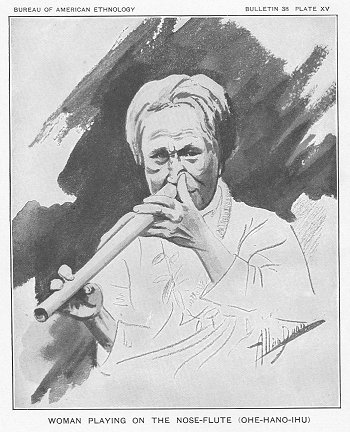
Click to enlarge
PLATE XV
WOMAN PLAYING ON THE NOSE FLUTE (OHE-HANO-IHU)
XX.--THE HULA OHE
The action of the hula ohe had some resemblance to one of the figures of the Virginia reel. The dancers, ranged in two parallel rows, moved forward with an accompaniment of gestures until the head of each row had reached the limit in that direction, and then, turning outward to right and left, countermarched in the same manner to the point of starting, and so continued to do. They kept step and timed their gestures and movements to the music of the bamboo nose-flute, the ohe.In a performance of this hula witnessed by an informant the chorus of dancers was composed entirely of girls, while the kumu operated the nose-flute and at the same time led the cantillation of the mele. This seemed an extraordinary statement, and the author challenged the possibility of a person blowing with the nose into a flute and at the same time uttering words with the mouth. The Hawaiian asserted, nevertheless, that the leader of the hula, the kumu, did accomplish these two functions; yet his answer did not remove doubt that they were accomplished jointly and at the same time. The author is inclined to think that the kumu performed the two actions alternately.
The musical range of the nose-flute was very limited; it had but two or, at the most, three stops. The player with his left hand held the flute to the nostril, at the same time applying a finger of the same hand to keep the other nostril closed. With the fingers of his right hand he operated the stops (pl. XV).
Mele
p. 136
I kela manu hulu ma’e-ma’e, a
5 Noho pu me Ka-hale-lehua,
Punahele ia Kaua-kahi-alii. b
E Kaili, c e Kaili, e!
E Kaili, lau o ke koa,
E Kaili, lau o ke koa,
10 Moopuna a Hooipo-i-ka-Malanai, d
Hiwa-hiwa a ka Lehua-wehe! e
Aia ka nani i Wai-ehu,
I ka wai kaili puuwai o ka makemake.
Makemake au i ke kalukalu o Kewá, f
15 E he’e ana i ka nalu o Maka-iwa.
He iwa-iwa oe na ke aloha,
I Wai-lua nui hoano.
Ano-ano ka hale, aohe kanaka,
Ua la’i oe no ke one o Ali-ó.
20 Aia ka ipo i ka nahele.
5 Noho pu me Ka-hale-lehua,
Punahele ia Kaua-kahi-alii. b
E Kaili, c e Kaili, e!
E Kaili, lau o ke koa,
E Kaili, lau o ke koa,
10 Moopuna a Hooipo-i-ka-Malanai, d
Hiwa-hiwa a ka Lehua-wehe! e
Aia ka nani i Wai-ehu,
I ka wai kaili puuwai o ka makemake.
Makemake au i ke kalukalu o Kewá, f
15 E he’e ana i ka nalu o Maka-iwa.
He iwa-iwa oe na ke aloha,
I Wai-lua nui hoano.
Ano-ano ka hale, aohe kanaka,
Ua la’i oe no ke one o Ali-ó.
20 Aia ka ipo i ka nahele.
[Translation]
Song
Come up to the wildwood, come;
Let us visit Wai-kini,
And gaze on Pihana-ka-lani,
Let us visit Wai-kini,
And gaze on Pihana-ka-lani,
p. 137
Its birds of plumage so fine;
5 Be comrade to Hale-lehua,
Soul-mate to Kau’kahi-alii.
O, Kaili, Kaili!
Kaili, leaf of the koa,
Graceful as leaf of the koa,
10 Granddaughter of goddess,
Whose name is the breath of love,
Darling of blooming Lehua.
My lady rides with the gray foam,
On the surge that enthralls the desire.
15 I pine for the sylph robed in gauze,
Who rides on the surf Maka-iwa--
Aye, cynosure thou of all hearts,
In all of sacred Wailua.
Forlorn and soul-empty the house;
20 You pleasure on the beach Ali-ó;
Your love is up here in the wildwood.
5 Be comrade to Hale-lehua,
Soul-mate to Kau’kahi-alii.
O, Kaili, Kaili!
Kaili, leaf of the koa,
Graceful as leaf of the koa,
10 Granddaughter of goddess,
Whose name is the breath of love,
Darling of blooming Lehua.
My lady rides with the gray foam,
On the surge that enthralls the desire.
15 I pine for the sylph robed in gauze,
Who rides on the surf Maka-iwa--
Aye, cynosure thou of all hearts,
In all of sacred Wailua.
Forlorn and soul-empty the house;
20 You pleasure on the beach Ali-ó;
Your love is up here in the wildwood.
This mele hoipoipo, love-song, like the one previously given, is from Kauai. The proper names that abound in it, whether of places, of persons, or of winds, seem to have been mostly of Kauaian origin, furnished by its topography, its myths and legends. They have, however, become the common property of the whole group through having been interwoven in the national songs that pass current from island to island.
Footnotes
135:a Ida-wai-kini. The name of a rocky bluff that stands on the side of Mount Wai-ale-ale, looking to Wailua. It is said to divide the flow from the great morass, the natural reservoir formed by the hollow at the top of the mountain, turning a part of it in the direction of Wai-niha, a valley not far from Hanalei, which otherwise would, it is said by Hawaiians, go to swell the stream that forms the Wailua river. This rock, in the old times, was regarded as a demigod, a kupua, and had a lover who resided in Wai-lua, also another who resided in the mountains. The words in the first two or three verses may be taken as if they were the utterance of this Wai-lua lover, saying "I will go up and see my sweetheart Ida-wai-kini."135:b Pihana-ka-lani. Literally, the fullness of heaven. This was a forest largely of lehua that covered the mountain slope below Ka-wai-kini. It seems as if the purpose of its mention was to represent the beauties and charms of the human body. In this romantic region lived the famous mythological princes--alii kupua the Hawaiians called them--p. 136 named Kaua-kahi-alii and Aiwohi-kupua, with their princess sister Ka-hale-lehua. The second name mentioned was the one who married the famous heroine of the romantic story of Laie-i-ka-wai.
136:a Manu hulu ma’ema’e. An allusion to the great number of plumage birds that were reputed to be found in this place.
136:b Puna-hale ia Kaua-kahi-alii. The birds of the region are said to have been on very intimate and friendly terms with Kaua-kahi-alii. (See note b, p. 135.)
136:c Kaili. The full form is said to be Ka-ili-lau-o-he-koa--Skin-like-the-leaf-of-the-koa. In the text of the mele this name is analyzed into its parts and written as if the phrase at the end were an appellative and not an integral part of the name itself. This was a mythical character of unusual beauty, a person of superhuman power, kupua, a mistress of the art of surf-riding, which passion she indulged in the waters about Wai-lua.
136:d Hooipo-i-ha-Malanai. A mythical princess of Wailua, the grandmother of Kaili. This oft-quoted phrase, literally meaning to make love in the (gently-blowing) trade-wind, has become almost a stock expression, standing for romantic love, or love-making.
136:e Lehua-wehe. The piece of ocean near the mouth of the Wailua river in which Kaili indulged her passion for surf-riding.
136:f Kalu-kalu o Kewá. Kalu-kalu may mean a species of soft, smooth grass specially fitted for sliding upon, which flourished on the inclined plain of Kewá, Kauai. One would sit upon a mat, the butt end of a coconut leaf, or a sled, while another dragged it along. The Hawaiian name for this sport is pahe’e. Kalu-kalu is also the name applied to "a very thin gauze-like kapa." (See Andrews's Hawaiian Dictionary.) If we suppose the poet to have clearly intended the first meaning, the figure does not tally with the following verse, the fifteenth. Verses 14 and 15 would thus be made to read
I desire the kalu-kalu (grass) of Kewá,
That is riding the surf of Maka-iwa.
That is riding the surf of Maka-iwa.
[paragraph continues] This is an impossible figure and makes no sense. If, on the other hand, we take another version and conceive that the bard had in mind the gauze-like robe of kalu-kalu --using this, of course, as a figure for the person clad in such a robe--the rendering I have given,
I pine for the sylph robed in gauze,
who rides the surf Maka-iwa,
who rides the surf Maka-iwa,
would not only make a possible, but a poetic, picture. Let the critical reader judge which of these two versions hits closer to common sense and probability.
XXI.--THE MUSIC AND MUSICAL INSTRUMENTS OF THE HAWAIIANS
A bird is easier captured than the notes of a song. The mele and oli of Hawaii's olden time have been preserved for us; but the music to which they were chanted, a less perdurable essence, has mostly exhaled. In the sudden transition from the tabu system to the new order of things that came in with the death of Kamehameha in 1819, the old fashion of song soon found itself antiquated and outdistanced. Its survival, so far as it did survive, was rather as a memorial and remembrance of the past than as a register of the living emotions of the present.The new music, with its pa, ko, li--answering to our do, re, mi a--was soon in everybody's mouth. From the first it was evidently destined to enact a role different from that of the old cantillation; none the less the musical ideas that came in with it, the air of freedom from tabu and priestcraft it breathed, and the diatonic scale, the highway along which it marched to conquest, soon produced a noticeable reaction in all the musical efforts of the people. This new seed, when it had become a vigorous plant, began to push aside the old indigenous stock, to cover it with new growths, and, incredible as it may seem, to inoculate it with its own pollen, thus producing a cross which to-day is accepted in certain quarters as the genuine article of Hawaiian song. Even now. the people of northwestern America are listening with demonstrative interest to songs which they suppose to be those of the old hula, but which in reality have no more connection with that institution than our negro minstrelsy has to do with the dark continent.
The one regrettable fact, from a historical point of view, is that a record was not made of indigenous Hawaiian song before this process of substitution and adulteration had begun. It is no easy matter now to obtain the data for definite knowledge of the subject.
While the central purpose of this chapter will be a study of the music native to old Hawaii, and especially of that produced in the halau, Hawaiian music of later times and of the present day can not be entirely neglected; nor will it be without its value for the indirect light it will shed on ancient conditions and on racial characteristics. The reaction that has taken place in Hawaii within historic times in
p. 139
response to the stimulus from abroad can not fail to be of interest in itself.
There is a peculiarity of the Hawaiian speech which can not but have its effect in determining the lyric tone-quality of Hawaiian music; this is the predominance of vowel and labial sounds in the language. The phonics of Hawaiian speech, we must remember, lack the sounds represented by our alphabetic symbols b, c or s, d, f, g, j, q, x, and z--a poverty for which no richness in vowel sounds can make amends. The Hawaiian speech, therefore, does not call into full play the uppermost vocal cavities to modify and strengthen, or refine, the throat and month tones of the speaker and to give reach and emphasis to his utterances. When he strove for dramatic and passional effect, he did not make his voice resound in the topmost cavities of the voice-trumpet, but left it to rumble and mutter low down in the throat-pipe, thus producing a feature that colors Hawaiian musical recitation.
This feature, or mannerism, as it might be called, specially marks Hawaiian music of the bombastic bravura sort in modern times, imparting to it in its strife for emphasis a sensual barbaric quality. It can be described further only as a gurgling throatiness, suggestive at times of ventriloquism, as if the singer were gloating over some wild physical sensation, glutting his appetite of savagery, the meaning of which is almost as foreign to us and as primitive as are the mewing of a cat, the gurgling of an infant, and the snarl of a mother-tiger. At the very opposite pole of development from this throat-talk of the Hawaiian must we reckon the highly-specialized tones of the French speech, in which we find the nasal cavities are called upon to do their full share in modifying the voice-sounds.
The vocal execution of Hawaiian music, like the recitation of much of their poetry, showed a surprising mastery of a certain kind of technique, the peculiarity of which was a sustained and continuous outpouring of the breath to the end of a certain period, when the lungs again drank their fill. This seems to have been an inheritance from the old religious style of prayer-recitation, which required the priest to repeat the whole incantation to its finish with the outpour of one lungful of breath. Satisfactory utterance of those old prayer-songs of the Aryans, the mantras, was conditioned likewise on its being a one-breath performance. A logical analogy may be seen between all this and that unwritten law, or superstition, which made it imperative for the heroes and demigods, kupua, of Hawaii's mythologic age to discontinue any unfinished work on the coming of daylight. a
p. 140
When one listens for the first time to the musical utterance of a Hawaiian poem, it may seem only a monotonous onflow of sounds faintly punctuated by the primary rhythm that belongs to accent, but lacking those milestones of secondary rhythm which set a period to such broader divisions as distinguish rhetorical and musical phrasing. Further attention will correct this impression and show that the Hawaiians paid strict attention not only to the lesser rhythm which deals with the time and accent of the syllable, but also to that more comprehensive form which puts a limit to the verse.
With the Hawaiians musical phrasing was arranged to fit the verse of the mele, not to express a musical idea. The cadencing of a musical phrase in Hawaiian song was marked by a peculiarity all its own. It consisted of a prolonged trilling or fluctuating movement called i’i, in which the voice went up and down in a weaving manner, touching the main note that formed the framework of the melody, then springing away from it for some short interval--a half of a step, or even some shorter interval--like an electrified pith-ball, only to return and then spring away again and again until the impulse ceased. This was more extensively employed in the oli proper, the verses of which were longer drawn out, than in the mele such as formed the stock pieces of the hula. These latter were generally divided into shorter verses.
MUSICAL INSTRUMENTS
The musical instruments of the Hawaiians included many classes, and their study can not fail to furnish substantial data for any attempt to estimate the musical performances, attainments, and genius of the people.Of drums, or drum-like instruments of percussion, the Hawaiians had four:
1. The pahu, or pahu-hula (pl. X), was a section of hollowed log. Bread-fruit and coconut were the woods generally used for this purpose. The tough skin of the shark was the choice for the drumhead, which was held in place and kept tense by tightening cords of coconut fiber, that passed down the side of the cylinder.
The workmanship of the pahu, though rude, was of tasteful design. So far as the author has studied them, each pahu was constructed with a diaphragm placed about two-thirds the distance from the head, obtained by leaving in place a cross section of the log, thus making a closed chamber of the drum-cavity proper, after the fashion of the kettledrum. The lower part of the drum also was hollowed out and carved, as will be seen in the illustration. In the carving of all the specimens examined the artists have shown a notable fondness for a fenestrated design representing a series of arches, after the fashion of
p. 141
a two-storied arcade, the haunch of the superimposed arch resting directly on the crown of that below. In one case the lower arcade was composed of Roman, while the upper was of Gothic, arches. The grace of the design and the manner of its execution are highly pleasing, and suggest the inquiry, Whence came the opportunity for this intimate study of the arch?
The tone of the palm was produced by striking its head with the finger-tips, or with the palm of the hand; never with a stick, so far as the writer has been able to learn. Being both heavy and unwieldly, it was allowed to rest upon the ground, and, if used alone, was placed to the front of the operator; if sounded in connection with the instrument next to be mentioned, it stood at his left side.
The pahu, if not the most original, was the most important instrument used in connection with the hula. The drum, with its deep and solemn tones, is an instrument of recognized efficiency in its power to stir the heart to more vigorous pulsations, and in all ages it has been relied upon as a means of inspiring emotions of mystery, awe, terror, sublimity, or martial enthusiasm.
Tradition of the most direct sort ascribes the introduction of the pahu to La’a--generally known as La’a-mai-Kahiki (La’a-from-Kahiki)--a prince who flourished about six centuries ago. He was of a volatile, adventurous disposition, a navigator of some renown, having made the long voyage between Hawaii and the archipelagoes in the southern Pacific--Kahiki--not less than twice in each direction. On his second arrival from the South he brought with him the big drum, the pahu, which he sounded as he skirted the coast quite out to sea, to the wonder and admiration of the natives on the land. La’a, being of an artistic temperament and an ardent patron of the hula, at once gave the divine art of Laka the benefit of this newly imported instrument. He traveled from place to place, instructing the teachers and inspiring them with new ideals. It was he also who introduced into the hula the kaékeéke as an instrument of music.
2. The pu-niu (pl. XVI) was a small drum made from the shell of a coconut. The top part, that containing the eyes, was removed, and the shell having been smoothed and polished, the opening was tightly covered with the skin of some scaleless fish--that of the kala (Acanthurus unicornis) was preferred. A venerable kumu-hula states that it was his practice to use only the skin taken from the right side of the fish, because he found that it produced a finer quality of sound than that of the other side. The Hawaiian mind was very insistent on little matters of this sort--the mint, anise, and cummin of their system. The drumhead was stretched and placed in position while moist and flexible, and was then made fast to a ring-shaped cushion--poahu--of fiber or tapa that hugged the base of the shell.
p. 142
The Hawaiians sometimes made use of the clear gum of the kukui tree to aid in fixing the drumhead in place.
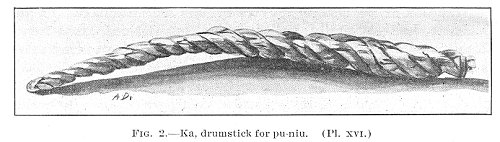
When in use the pu-niu was lashed to the right thigh for the convenience of the performer, who played upon it with a thong of braided fibers held in his right hand (), his left thus being free to manipulate the big drum that stood on the other side.
Of three pu-niu in the author's collection, one, when struck, gives off the sound of c+1 below the staff; another that of c+1♯ below the staff, and a third that of c+2♯ in the staff.
While the grand vibrations of the palm filled the air with their solemn tremor, the lighter and sharper tones of the pu-niu gave a piquancy to the effect, adding a feature which may be likened to the sparkling ripples which the breeze carves in the ocean's swell.
3. The ipu, or ipu-hula (pl. VII), though not strictly a drum, was a drumlike instrument. It was made by joining closely together two pear-shaped gourds of large size in such fashion as to make a body shaped like a figure 8. An opening was made in the upper end of
the smaller gourd to give exit to the sound. The cavities of the two gourds were thrown into one, thus making a single column of air, which, in vibration, gave off a note of clear bass pitch. An ipu of large size in the author's collection emits the tone of c in the bass. Though of large volume, the tone is of low intensity and has small carrying power.
For ease in handling, the ipu is provided about its waist with a loop of cord or tapa, by which device the performer was enabled to manipulate this bulky instrument with one hand. The instrument was sounded by dropping or striking it with well-adjusted force against the padded earth-floor of the Hawaiian house.
The manner and style of performing on the ipu varied with the sentiment of the mele, a light and caressing action when the feeling was sentimental or pathetic, wild and emphatic when the subject was such as to stir the feelings with enthusiasm and passion.
Musicians inform us that the drum--exception is made in the case of the snare and the kettle drum--is an instrument in which the pitch is a matter of comparative indifference, its function being to mark the time and emphasize the rhythm. There are other elements, it

Click to enlarge
PLATE XVI
PU-NIU, A DRUM
p. 143
would seem, that must be taken into the account in estimating the value of the drum. Attention may be directed first to its tone-character, the quality of its note which touches the heart in its own peculiar way, moving it to enthusiasm or bringing it within the easy reach of awe, fear, and courage. Again, while, except in the orchestra, the drum and other instruments of percussion may require no exact pitch, still this does not necessarily determine their effectiveness. The very depth and gravity of its pitch, made pervasive by its wealth of overtones, give to this primitive instrument a weird hold on the emotions.
This combination of qualities we find well illustrated in the pahu and the ipu, the tones of which range in the lower registers of the human voice. The tone-character of the pu-niu, on the other hand, is more subdued, yet lively and cheerful, by reason in part of the very sharpness of its pitch, and thus affords an agreeable offset to the solemnity of the other two.
Ethnologically the palm is of more world-wide interest than any other member of its class, being one of many varieties of the kettle-drum that are to be found scattered among the tribes of the Pacific, all of them, perhaps, harking back to Asiatic forbears, such as the tom-tom of the Hindus.
The sound of the pahu carries one back in imagination to the dread sacrificial drum of the Aztec teocallis and the wild kettles of the Tartar hordes. The drum has cruel and bloody associations. When listening to its tones one can hardly put away a thought of the many times they have been used to drown the screams of some agonized creature.
For more purely local interest, inventive, originality, and simplicity, the round-bellied ipu takes the palm, a contrivance of strictly Hawaiian, or at least Polynesian, ingenuity. It is an instrument of fascinating interest, and when its crisp rind puts forth its volume of sound one finds his imagination winging itself back to the mysterious caverns of Hawaiian mythology.
The gourd, of which the ipu is made, is a clean vegetable product of the fields and the garden, the gift of Lono-wahine--unrecognized daughter of mother Ceres--and is free from all cruel alliances. No bleating lamb was sacrificed to furnish parchment for its drumhead. Its associations are as innocent as the pipes of Pan.
4. The Ka-éke-éke, though not drumlike in form, must be classed as an instrument of percussion from the manner of eliciting its note. It was a simple joint of bamboo, open at one end, the other end being left closed with the diaphragm provided by nature. The tone is produced by striking the closed end of the cylinder, while held in a vertical position, with a sharp blow against some solid, nonresonant body, such as the matted earth floor of the old Hawaiian house. In
p. 144
the author's experiments with the kaékeéke an excellent substitute was found in a bag filled with sand or earth.
In choosing bamboo for the kaékeéke it is best to use a variety which is thin-walled and long-jointed, like the indigenous Hawaiian varieties, in preference to such as come from the Orient, all of which are thick-walled and short-jointed, and therefore less resonant than the Hawaiian.
The performer held a joint in each hand, the two being of different sizes and lengths, thus producing tones of diverse pitch. By making a proper selection of joints it would be possible to obtain a set capable of producing a perfect musical scale. The tone of the kaékeéke is of the utmost purity and lacks only sustained force and carrying power to be capable of the best effects.
An old Hawaiian once informed the writer that about the year 1850, in the reign of Kamehameha III, he was present at a hula kaékeéke given in the royal palace in Honolulu. The instrumentalists numbered six, each one of whom held two bamboo joints. The old man became enthusiastic as he described the effect produced by their performance, declaring it to have been the most charming hula he ever witnessed.
5. The úli-ulí () consisted of a small gourd of the size of one's two fists, into which were introduced shotlike seeds, such as those of the canna. In character it was a rattle, a noise-instrument pure and simple, but of a tone by no means disagreeable to the ear, even as the note produced by a woodpecker drumming on a log is not without its pleasurable effect on the imagination.
The illustration of the úliulí faithfully pictured by the artist reproduces a specimen that retains the original simplicity of the, instrument before the meretricious taste of modern times tricked it out with silks and feathers. (For a further description of this instrument, see p. 107.)
6. The pu-íli was also a variety of the rattle, made by splitting a long joint of bamboo for half its length into slivers, every alternate sliver being removed to give the remaining ones greater freedom and to make their play the one upon the other more lively, The tone is a murmurous breezy rustle that resembles the notes of twigs, leaves, or reeds struck against one another by the wind--not at all an unworthy imitation of nature-tones familiar to the Hawaiian ear.
The performers sat in two rows facing each other, a position that favored mutual action, in which each row of actors struck their instruments against those of the other side, or tossed them back and forth. (For further account of the manner in which the puili was used in the hula of the same name, see p. 113.)
7. The laau was one of the noise-instruments used in the hula. It consisted of two sticks of hard resonant wood, the smaller of which
p. 145
was struck against the larger, producing a clear xylophonic note. While the pitch of this instrument is capable of exact determination, it does not seem that there was any attempt made at adjustment. A man in the author's collection, when struck, emits tones the predominant one of which is d+1 (below the staff).
8. The ohe, or ohe-hano-ihu (), is an instrument of undoubted antiquity. In every instance that has come under the author's observation the material has been, as its name--ohe--signifies, a simple joint of bamboo, with an embouchure placed about half an inch from the closed end, thus enabling the player to supply the instrument with air from his right nostril. In every nose-flute examined there have been two holes, one 2 or 3 inches away from the embouchure, the older about a third of the distance from the open end of the flute.
The musician with his left hand holds the end of the pipe squarely against his lip, so that the right nostril slightly overlaps the edge of the embouchure. The breath is projected into the embouchure with modulated force. A nose-flute in the author's collection with the lower hole open produces the sound of f+1♯; with both holes unstopped
it emits the sound a+2; and when both holes are stopped it produces the sound of c+2♯, a series of notes which are the tonic, mediant, and dominant of the chord of F♯ minor.

An ohe played by an old Hawaiian named Keaonaloa, an inmate of the Lunalilo Home, when both holes were stopped sounded f+1; with the lower hole open it sounded a+2, and when both holes were open it sounded c+3.
The music made by Keaonaloa with his ohe was curious, but not soul-filling. We must bear in mind, however, that it was intended only as an accompaniment to a poetical recitation.
Some fifty or sixty years ago it was not uncommon to see bamboo flutes of native manufacture in the hands of Hawaiian musicians of the younger generation. These instruments were avowedly imitations of the D-flute imported from abroad. The idea of using bamboo for this purpose must have been suggested by its previous use in the nose-flute.
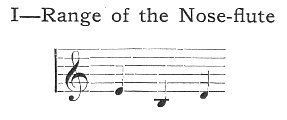
"The tonal capacity of the Hawaiian nose-flute," says Miss Jennie Elsner, "which has nothing harsh and strident about it, embraces five tones, f+1 and g+2 in the middle register, and f+2, g+1, and a+2 an
p. 146
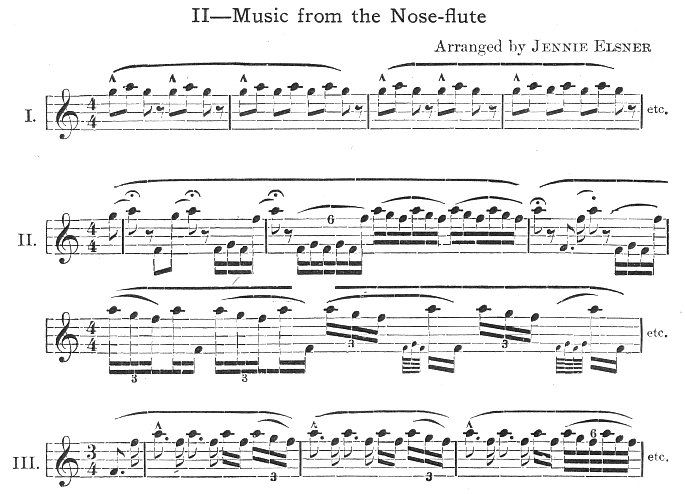
octave above. These flutes are not always pitched to the same key, varying half a tone or so." On inquiring of the native who kindly furnished the following illustrations, he stated that he had bored the holes of his ohe without much measurement, trusting to his intuitions and judgment.
Click to enlarge
I--Range of the Nose-flute
A peculiar effect, as of several instruments being used at the same time, was produced by the two lower tones being thrown in in wild profusion, often apparently simultaneously with one of the upper tones. As the tempo in any one of these increased, the rhythm was lost sight of and a peculiar syncopated effect resulted. a
Click to enlarge
II--Music from the Nose-flute
p. 147
the others were controlled by the fingers. This instrument has been compared to the Italian ocarina.
10. The íli-íli was a noise-instrument pure and simple. It consisted of two pebbles that were held in the hand and smitten together, after the manner of castanets, in time to the music of the voices. (See p. 120.)
11. The niau-kani--singing splinter--was a reed-instrument of a rude sort, made by holding a reed of thin bamboo against a slit cut out in a larger piece of bamboo. This was applied to the mouth, and the voice being projected against it produced an effect similar to that of the jew's harp. (See p. 132.)
12. Even still more extemporaneous and rustic than any of these is a modest contrivance called by the Hawaiians pú-la-í. It is nothing more than a ribbon torn from the green leaf of the ti plant, say three-quarters of an inch to an inch in width by 5 or 6 inches long, and rolled up somewhat after the manner of a lamplighter, so as to form a squat cylinder an inch or more in length. This was compressed to flatten it. Placed between the lips and blown into with proper force, it emits a tone of pure reedlike quality, that varies in pitch, according to the size of the whistle, from G in the middle register to a shrill piping note more than an octave above.
The hula girl who showed this simple device offered it in answer to reiterated inquiries as to what other instruments, besides those of more formal make already described, the Hawaiians were wont to use in connection with their informal rustic dances. "This," said she, "was sometimes used as an accompaniment to such informal dancing as was indulged in outside the halau." This little rustic pipe, quickly improvised from the leaf that every Hawaiian garden supplies, would at once convert any skeptic to a belief in the pipes of god Pan.
13. The ukeké, the one Hawaiian instrument of its class, is a mere strip of wood bent into the shape of a bow that its elastic force may keep tense the strings that are stretched upon it. These strings, three in number, were originally of sinnet, later after the arrival of the white man, of horsehair. At the present time it is the fashion to use the ordinary gut designed for the violin or the taro-patch guitar. Every ukeké seen followed closely a conventional pattern, which argues for the instrument a historic age sufficient to have gathered about itself some degree of traditional reverence. One end of the stick is notched or provided with holes to hold the strings, while the other end is wrought into a conventional figure resembling the tail of a fish and serves as an attachment about which to wind the free ends of the strings.
No ukeké seen by the author was furnished with pins, pegs, or any similar device to facilitate tuning. Nevertheless, the musician does
p. 148
tune his ukeké as the writer can testify from his own observation. This Hawaiian musician was the one whose performances on the nose-flute are elsewhere spoken of. When asked to give a sample of his playing on the ukeké, he first gave heed to his instrument as if testing whether it was in tune. He was evidently dissatisfied and pulled at one string as if to loosen it; then, pressing one end of the bow against his lips, he talked to it in a singing tone, at the same time plucking the strings with a delicate rib of grass. The effect was most pleasing. The open cavity of the mouth, acting as a resonator, reenforced the sounds and gave them a volume and dignity that was a revelation. The lifeless strings allied themselves to a human voice and became animated by a living soul.
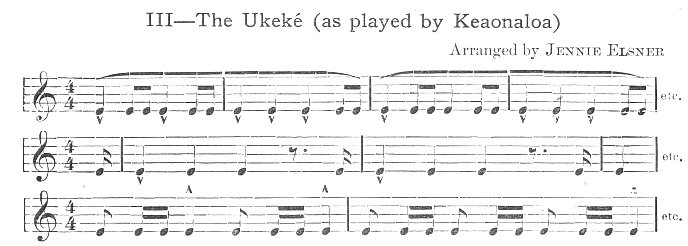
With the assistance of a musical friend it was found that the old Hawaiian tuned his strings with approximate correctness to the tonic, the third and the fifth. We may surmise that this self-trained musician had instinctively followed the principle or rule proposed by Aristoxenus, who directed a singer to sing his most convenient note, and then, taking this as a starting point, to time the remainder of his strings--the Greek kithara, no doubt--in the usual manner from this one.
While the ukeké was used to accompany the mele and the oli, its chief employment was in serenading and serving the young folk in breathing their extemporized songs and uttering their love-talk--hoipoipo. By using a peculiar lingo or secret talk of their own invention, two lovers could hold private conversation in public and pour their loves and longings into each other's ears without fear of detection--a thing most reprehensible in savages. This display of ingenuity has been the occasion for outpouring many vials of wrath upon the sinful ukeké.
Experiment with the ukeké impresses one with the wonderful change in the tone of the instrument that takes place when its lifeless strings are brought into close relation with the cavity of the mouth. Let anyone having normal organs of speech contract his lips into the shape of an O, make his cheeks tense, and then, with the pulp of his finger as a plectrum, slap the center of his cheek and mark the tone that is produced. Practice will soon enable him to render a full octave with fair accuracy and to perform a simple melody that shall be recognizable at a short distance. The power and range this acquired will, of course, be limited by the skill of the operator. One secret of the performance lies in a proper management of the tongue. This function of the mouth to serve as a resonant cavity for a musical instrument is familiarly illustrated in the jew's-harp.
p. 149
The author is again indebted to Miss Elsner for the following comments on the ukeké:
The strings of this ukeké, the Hawaiian fiddle, are tuned to e+1, to b and to d+1. These three strings are struck nearly simultaneously, but the sound being very feeble, it is only the first which, receiving the sharp impact of the blow, gives out enough volume to make a decided impression.
Click to enlarge
III--The Ukeké (as played by Keaonaloa)
We know that in ancient times the voices of the men as well as of the women were heard at the same time in the songs of the hula. One of the first questions that naturally arises is, Did the men and the women sing in parts or merely in unison?
It is highly gratifying to find clear historical testimony on this point from a competent authority. The quotation that follows is from the pen of Capt. James King, who was with Capt. James Cook on the latter's last voyage, in which he discovered the Hawaiian islands (January 18, 1778). The words were evidently penned after the death of Captain Cook, when the writer of them, it is inferred, must have succeeded to the command of the expedition. The fact that Captain King weighs his words, as evidenced in the footnote, and that he appreciates the bearing and significance of his testimony, added to the fact that he was a man of distinguished learning, gives unusual weight to his statements. The subject is one of so great interest and importance, that the whole passage is here quoted. a It adds not a little to its value that the writer thereof did not confine his remarks to the music, but enters into a general description of the hula. The only regret is that he did not go still further into details.
Their dances have a much nearer resemblance to those of the New Zealanders than of the Otaheitians or Friendly Islanders. They are prefaced with a slow, solemn song, in which all the party join, moving their legs, and gently striking their breasts in a manner and with attitudes that are perfectly easy and graceful; and so far they are the same with the dances of the Society Islands. When this has lasted about ten minutes, both the tune and the motions gradually quicken, and end only by their inability to support the fatigue, which
p. 150
part of the performance is the exact counterpart of that of the New Zealanders; and (as it is among them) the person who uses the most violent action and holds out the longest is applauded as the best dancer. It is to be observed that in this dance the women only took part and that the dancing of the men is nearly of the same kind with what we saw at the Friendly Islands; and which may, perhaps, with more propriety, be called the accompaniment of the songs, with corresponding and graceful motions of the whole body. Yet as we were spectators of boxing exhibitions of the same kind with those we were entertained with at the Friendly Islands, it is probable that they had likewise their grand ceremonious dances, in which numbers of both sexes assisted.
Their music is also of a ruder kind, having neither flutes nor reeds, nor instruments of any other sort, that we saw, except drums of various sizes. But their songs, which they sing in parts, and accompany with a gentle motion of the arms, in the same manner as the Friendly Islanders, had a very pleasing effect.
To the above Captain King adds this footnote:
As this circumstance of their singing in parts has been much doubted by persons eminently skilled in music, and would be exceedingly curious if it was clearly ascertained, it is to be lamented that it can not be more positively authenticated.
Captain Burney and Captain Phillips of the Marines, who have both a tolerable knowledge of music, have given it as their opinion they did sing in parts; that is to say, that they sang together in different notes, which formed a pleasing harmony.
These gentlemen have fully testified that the Friendly Islanders undoubtedly studied their performances before they were exhibited public; that they had an idea of different notes being useful in harmony; and also that they rehearsed their compositions in private and threw out the inferior voices before they ventured to appear before those who were supposed to be judges of their skill in music.
In their regular concerts each man had a bamboo a which was of a different length and gave a different tone. These they beat against the ground, and each performer, assisted by the note given by this instrument, repeated the same note, accompanying it with words, by which means it was rendered sometimes short and sometimes long. In this manner they sang in chorus, and not only produced octaves to pitch other, according to their species of voice, but fell on concords such as were not disagreeable to the ear.
Now, to overturn this fact, by the reasoning of persons who did not hear these performances, is rather an arduous task. And yet there is great improbability that any uncivilized people should by accident arrive at this perfection in the art of music, which we imagine can only be attained by dint of study and knowledge of the system and the theory on which musical composition is founded. Such miserable jargon as our country psalm-singers practice, which may be justly deemed the lowest class of counterpoint, or singing in several parts, can not be acquired in the coarse manner in which it is performed in the churches without considerable time and practice. It is, therefore, scarcely credible that a people, semibarbarous, should naturally arrive at any perfection in that art which it is much doubted whether the Greeks and Romans, with all their refinements in music, ever attained, and which the Chinese, who have been longer civilized than any people on the globe, have not yet found out.
p. 151
If Captain Burney (who, by the testimony of his father, perhaps the greatest musical theorist of this or any other age, was able to have done it) has written down in European notes the concords that these people sung, and if these concords had been such as European ears could tolerate, there would have been no longer doubt of the fact; but, as it is, it would, in my opinion, be a rash judgment to venture to affirm that they did or did not understand counterpoint; and therefore I fear that this curious matter must be considered as still remaining undecided. (A Voyage to the Pacific Ocean, undertaken by the command of His Majesty, for making discoveries in the Northern Hemisphere. Performed under the direction of Captains Cook, Clerke, and Gore, in His Majesty's ships the Resolution and Discovery, in the years 1776, 1777, 1778, and 1780, 3 volumes, London, 1784, III, 2d ed., 142, 143, 144.)
While we can not but regret that Captain King did not go into detail and inform us specifically what were the concords those old-time people "fell on," whether their songs were in the major or minor key, and many other points of information, he has, nevertheless, put science under obligations to him by his clear and unmistakable testimony to the fact that they did arrange their music in parts. His testimony is decisive: "In this manner they sang in chorus, and not only produced octaves to each other, according to their species of voice, but fell on concords such as were not disagreeable to the ear." When the learned doctor argues that to overturn this fact would be an arduous task, we have to agree with him--an arduous task indeed. He well knew that one proven fact can overthrow a thousand improbabilities. "What man has done man can do" is a true saying; but it does not thence follow that what man has not done man can not do.
If the contention were that the Hawaiians understood counter-point as a science and a theory, the author would unhesitatingly admit the improbability with a readiness akin to that with which he would admit the improbability that the wild Australian understood the theory of the boomerang. But that a musical people, accustomed to pitch their voices to the clear and unmistakable notes of bamboo pipes cut to various lengths, a people whose posterity one generation later appropriated the diatonic scale as their own with the greatest avidity and readiness, that this people should recognize the natural harmonies of sound, when they had chanced upon them, and should imitate them in their songs--the improbability of this the author fails to see.
The clear and explicit statement of Captain King leaves little to be desired so far as this sort of evidence can go. There are, however, other lines of inquiry that must be developed:
1. The testimony of the Hawaiians themselves on this matter. This is vague. No one of whom inquiry has been made is able to affirm positively the existence of part-singing in the olden times. Most of those with whom the writer has talked are inclined to the view that the ancient cantillation was not in any sense part-singing as now practised. One must not, however, rely too much on such
p. 152
testimony as this, which at the best is only negative. In many cases it is evident the witnesses do not understand the true meaning and bearing of the question. The Hawaiians have no word or expression synonymous with our expression "musical chord." In all inquiries the writer has found it necessary to use periphrasis or to appeal to some illustration. The fact must be borne in mind, however, that people often do a thing, or possess a thing, for which they have no name.
2. As to the practice among Hawaiians at the present time, no satisfactory proof has been found of the existence of any case in which in the cantillations of their own songs the Hawaiians--those uninfluenced by foreign music--have given an illustration of what can properly be termed part-singing; nor can anyone be found who can testify affirmatively to the same effect. Search for it has thus far been as fruitless as pursuit of the will-o’-the-wisp.
3. The light that is thrown on this question by the study of the old Hawaiian musical instruments is singularly inconclusive. If it were possible, for instance, to bring together a complete set of kaekeeke bamboos which were positively known to have been used together at one performance, the argument from the fact of their forming a musical harmony, if such were found to be the case--or, on the other hand, of their producing only a haphazard series of unrelated sounds, if such were the fact--would bring to the decision of the question the overwhelming force of indirect evidence. Put such an assortment the author has not been able to find. Bamboo is a frail and perishable material. Of the two specimens of kaekeeke tubes found by him in the Bernice Pauahi Bishop Museum one was cracked and voiceless; and so the testimony of its surviving partner was of no avail.
The Hawaiians of the present day are so keenly alive to musical harmony that it is hardly conceivable that their ancestors two or three generations ago perpetrated discords in their music. They must either have sung in unison or hit on "concords such as were not disagreeable to the ear." If the music heard in the halau to-day in any close degree resembles that of ancient times--it must be assumed that it does--no male voice of ordinary range need have found any difficulty in sounding the notes, nor do they scale so low that a female voice would not easily reach them.
Granting, then, as we must, the accuracy of Captain King's statement, the conclusion to which the author of this paper feels forced is that since the time of the learned doctor's visit to these shores, more than one hundred and twenty-eight years ago, the art and practice of singing or cantillating after the old fashion has declined among the Hawaiians. The hula of the old times, in spite of all the efforts to maintain it, is becoming more and more difficult of procurement
p. 153
every day. Almost none of the singing that one hears at the so-called hula performances gotten up for the delectation of sight-seers is Hawaiian music of the old sort. It belongs rather to the second or third rattoon-crop, which has sprung up under the influence of foreign stimuli. Take the published hula songs, such as "Tomi-tomi," "Wahine Poupou" and a dozen others that might be mentioned, to say nothing about the words--the music is no more related to the genuine Hawaiian article of the old times than is "ragtime" to a Gregorian chant.
The bare score of a hula song, stripped of all embellishments and reduced by the logic of our musical science to the merest skeleton of notes, certainly makes a poor showing and gives but a feeble notion of the song itself--its rhythm, its multitudinous grace-notes, its weird tone-color. The notes given below offer such a skeletal presentation of a song which the author heard cantillated by a skilled hula-master. They were taken down at the author's request by Capt. H. Berger, conductor of the Royal Hawaiian Baud:
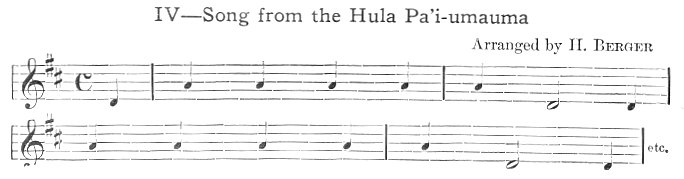
Click to enlarge
IV--Song from the Hula Pa’i-umauma
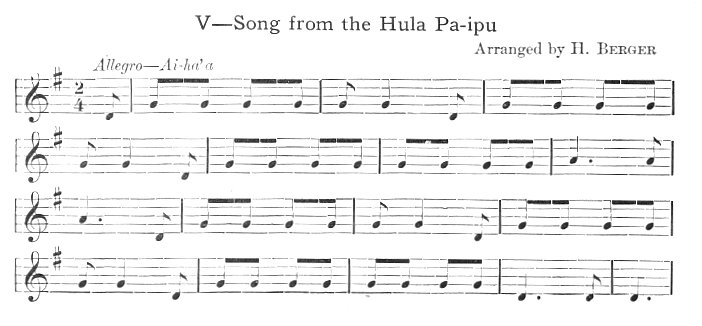
Click to enlarge
V--Song from the Hula Pa-ipu
Here, again, is a piece of song that to the author's ear bears much the same resemblance to the original that an oiled ocean in calm would bear to the same ocean when stirred by a breeze. The fine dimples which gave the ocean its diamond-flash have been wiped out.

Click to enlarge
VI--Song for the Hula Pele
None of the illustrations thus far given have caught that fluctuating trilling movement of the voice which most. musicians inter-viewed on the subject declare to be impossible of representation, while some flout the assertion that it represents a change of pitch. One is reminded by this of a remark made by Pietro Mascagni: a
The feeling that a people displays in its character, its habits, its nature, and thus creates an overprivileged type of music, may be apprehended by a foreign spirit which has become accustomed to the usages and expressions common from that particular people. But popular music, [being] void of any scientific basis, will always remain incomprehensible to the foreigner who seeks to study it technically.
When we consider that the Chinese find pleasure in musical performances on instruments that divide the scale into intervals less than half a step, and that the Arabian musical scale included quarter-steps, we shall be obliged to admit that this statement of Mascagni is not merely a fling at our musical science.
Here are introduced the words and notes of a musical recitation done after the manner of the hula by a Hawaiian professional and his wife. Acquaintance with the Hawaiian language and a feeling for the allusions connoted in the text of the song would, of course, be a great aid in enabling one to enter into the spirit of the performance. As these adjuncts will be available to only a very few
p. 155
of those who will read these words, in the beginning are given the words of the oli with which he prefaced the song, with a translation of the same, and then the mele which formed the bulk of the song, also with a translation, together with such notes and comments as are necessary to bring one into intellectual and sympathetic relation with the performance, so far as that is possible under the circumstances. It is especially necessary to familiarize the imagination with the language, meaning, and atmosphere of a mele, because the Hawaiian approached song from the side of the. poet and elocutionist. Further discussion of this point must, however, be deferred to another division of the subject:
He Oli
Halau a Hanalei i ka nini a ka ua;
Kumano b ke po’o-wai a ka liko; c
Nahá ka opi-wai d a Wai-aloha;
O ke kahi koe a hiki i Wai-oli. e
Ua ike ’a.
Kumano b ke po’o-wai a ka liko; c
Nahá ka opi-wai d a Wai-aloha;
O ke kahi koe a hiki i Wai-oli. e
Ua ike ’a.
[Translation]
A Song
Hanalei is a hall for the dance in the pouring rain;
The stream-head is turned from its bed of fresh green;
Broken the dam that peat the water of love--
Naught now to hinder its rush to the vale of delight.
You've seen it.
The stream-head is turned from its bed of fresh green;
Broken the dam that peat the water of love--
Naught now to hinder its rush to the vale of delight.
You've seen it.
The mele to which the above oli was prelude is as follows:
Mele
Noluna ha hale kai, e ka ma’a-lewa,
Nana ka maka ia Moana-nui-ka-Lehúa.
Noi au i ke kai e mali’o.
Ane ku a’e la he lehúa ilaila--
5 Hopoe Lehúa ki'eki'e.
Maka’u ka Lehúa i ke kanáka,
Lilo ilalo e hele ai, ilalo, e.
Keaau iliili nehe; olelo ke kai o Puna
I ka ulu hala la, e, kaiko’o Puna.
10 Ia hoone’ene’e ia pili mai kaua,
Nana ka maka ia Moana-nui-ka-Lehúa.
Noi au i ke kai e mali’o.
Ane ku a’e la he lehúa ilaila--
5 Hopoe Lehúa ki'eki'e.
Maka’u ka Lehúa i ke kanáka,
Lilo ilalo e hele ai, ilalo, e.
Keaau iliili nehe; olelo ke kai o Puna
I ka ulu hala la, e, kaiko’o Puna.
10 Ia hoone’ene’e ia pili mai kaua,
p. 156
E he koa, ke waiho e mai la oe;
Eia ka mea ino, he anu, e.
Aohe anu e!
Me he mea la iwaho kaua, e ke hoa,
15 Me he wai la ko kaua ili, e.
Eia ka mea ino, he anu, e.
Aohe anu e!
Me he mea la iwaho kaua, e ke hoa,
15 Me he wai la ko kaua ili, e.
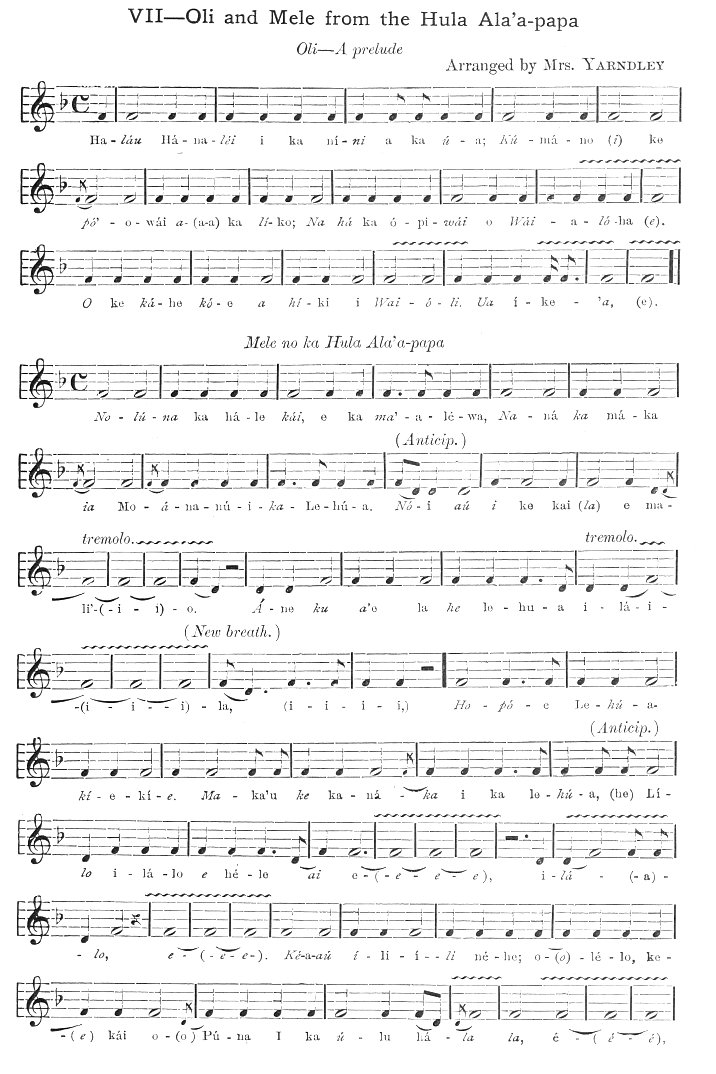
Click to enlarge
VII--Oli and Mele from the Hula Ala’a-papa
p. 157
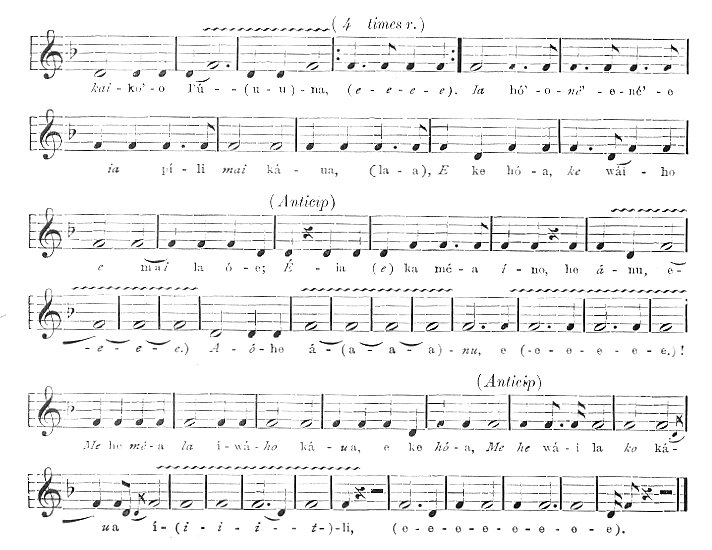
Click to enlarge
VII--Oli and Mele from the Hula Ala’a-papa
[Translation]
Song from the Hula Ala’apapa
From mountain-retreat and root-woven ladder
Mine eye looks down on goddess Moana-Lehúa.
Then I pray to the Sea, be thou calm;
Would there might stand on thy shore a lehúa--
5 Lehúa tree tall of Hopoe.
The Lehúa is fearful of man,
Leaves him to walk on the ground below,
To walk on the ground far below.
The pebbles at Keaau grind in the surf;
10 The sea at Keaau shouts to Puna's palms,
"Fierce is the sea of Puna."
Move hither, snug close, companion mine;
You lie so aloof over there.
Oh what a bad fellow is Cold!
15 Not cold, do you say?
It's as if we were out in the wold,
Our bodies so clammy and chill, friend.
Mine eye looks down on goddess Moana-Lehúa.
Then I pray to the Sea, be thou calm;
Would there might stand on thy shore a lehúa--
5 Lehúa tree tall of Hopoe.
The Lehúa is fearful of man,
Leaves him to walk on the ground below,
To walk on the ground far below.
The pebbles at Keaau grind in the surf;
10 The sea at Keaau shouts to Puna's palms,
"Fierce is the sea of Puna."
Move hither, snug close, companion mine;
You lie so aloof over there.
Oh what a bad fellow is Cold!
15 Not cold, do you say?
It's as if we were out in the wold,
Our bodies so clammy and chill, friend.
EXPLANATORY REMARKS
The acute or stress accent is placed over syllables that take the accent in ordinary speech.A word or syllable italicized indicates drum-down-beat.
p. 158
It will be noticed that the stress-accent and the rhythmic accent, marked by the down-beat, very frequently do not coincide. The time marked by the drum-down-beat was strictly accurate throughout.
The tune was often pitched on some other key than that in which it is here recorded. This fact was noted when, from time to time, it was found necessary to have the singer repeat certain passages.
The number of measures devoted to the i’i, or fluctuation, which is indicated by the wavering line
 , varied from time to time, even when the singer repeated the same passage. (See remarks on the i’i, p. 140.)
Redundancies of speech (interpolations) which are in disagreement with the present writer's text (pp. 155-156) are inclosed in brackets. It will be seen that in the fifth verse he gives the version Maka’u ke kanaka i ka lehua instead of the one given by the author, which is Maka’u ka Lehua i ke kanaka. Each version has its advocates, and good arguments are made in favor of each.
On reaching the end of a measure that coincided with the close of a rhetorical phrase the singer, Kualii, made haste to snatch, as it were, at the first word or syllable of the succeeding phrase. This is indicated by the word "anticipating," or "anticipatory "--written anticip.--placed over the syllable or word thus snatched.
It was somewhat puzzling to determine whether the tones which this man sang were related to each other as five and three of the major key, or as three and one of the minor key. Continued and strained attention finally made it seem evident that it was the major key which he intended, i. e., it was f+1 and d+1 in the key of B♭, rather than f+1 and d+1 in the key of D minor.
ELOCUTION AND RHYTHMIC ACCENT IN HAWAIIAN SONG
In their ordinary speech the Hawaiians were good elocutionists--none better. Did they adhere to this same system of accentuation in their poetry, or did they punctuate their phrases and words according to the notions of the song-maker and the conceived exigencies of poetical composition? After hearing and studying this recitation of Kualii the author is compelled to say that he does depart in a great measure from the accent of common speech and charge his words with intonations and stresses peculiar to the mele. What artificial influence has come in to produce this result? Is it from some demand of poetic or of musical rhythm? Which? It was observed that he substituted the soft sound of t for the stronger sound of k, "because," as he explained, "the sound of the t is lighter." Thus he said te tanata instead of ke kanaka, the man. The Hawaiian ear has always a delicate feeling for tone-color.p. 159
In all our discussions and conclusions we must bear in mind that the Hawaiian did not approach song merely for its own sake; the song did not sing of itself. First in order came the poem, then the rhythm of song keeping time to the rhythm of the poetry. The Hawaiian sang not from a mere bubbling up of indefinable emotion, but because he had something to say for which he could find no other adequate form of expression. The Hawaiian boy, as he walks the woods, never whistles to keep his courage up. When he paces the dim aisles of Kaliuwa’a, he sets up an altar and heaps on it a sacrifice of fruit and flowers and green leaves, but he keeps as silent as a mouse.
During his performance Kualii cantillated his song while handling a round wooden tray in place of a drum; his wife meanwhile performed the dance. This she did very gracefully and in perfect time. In marking the accent the left foot was, if anything, the favorite, yet each foot in general took two measures; that is, the left marked the down-beat in measures 1 and 2, 5 and 6, and so on, while the right, in turn, marked the rhythmic accent that comes with the down-beat in measures 3 and 4, 7 and 8, and so on. During the four steps taken by the left foot, covering the time of two measures, the body was gracefully poised on the other foot. Then a shift was made, the position was reversed, and during two measures the emphasis came on the right foot.
The motions of the hands, arms, and of the whole body, including the pelvis--which has its own peculiar orbital and sidelong swing were in perfect sympathy one part with another. The movements were so fascinating that one was at first almost hypnotized and disqualified for criticism and analytic judgment. Not to derogate from the propriety and modesty of the woman's motions, under the influence of her Delsartian grace one gained new appreciation of "the charm of woven paces and of waving hands."
Throughout the whole performance of Kualii and his wife Abigaila it was noticed that, while he was the reciter, she took the part of the olapa (see p. 28) and performed the dance; but to this rôle she added that of prompter, repeating to him in advance the words of the next verse, which he then took up. Her verbal memory, it was evident, was superior to his.
Experience with Kualii and his partner, as well as with others, emphasizes the fact that one of the great difficulties encountered in the attempt to write out the slender thread of music (leo) of a Hawaiian mele and fit to it the words as uttered by the singer arises from the constant interweaving of meaningless vowel sounds. This, which the Hawaiians call i’i, is a phenomenon comparable to the weaving of a vine about a framework, or to the pen-flourishes that
p. 160
illuminate old German text. It consists of the repetition of a vowel sound--generally i (= ee) or e (= a, as in fate), or a rapid interchange of these two. To the ear of the author the pitch varies through an interval somewhat less than a half-step. Exactly what is the interval he can not say. The musicians to whom appeal for aid in determining this point has been made have either dismissed it for the most part as a matter of little or no consequence or have claimed the seeming variation in pitch was due simply to a changeful stress of voice or of accent. But the author can not admit that the report of his senses is here mistaken.
A further embarrassment comes from the fact that this tone-embroidery found in the i’i is not a fixed quantity. It varies seemingly with the mood of the singer, so that not unfrequently, when one asks for the repetition of a phrase, it will, quite likely, be given with a somewhat different wording, calling for a readjustment of the rhythm on the part of the musician who is recording the score. But it must be acknowledged that the singer sticks to his rhythm, which, so far as observed, is in common time.
In justice to the Hawaiian singer who performs the accommodating task just mentioned it must be said that, under the circumstances in which he is placed, it is no wonder that at times he departs front the prearranged formula of song. His is the difficult task of pitching his voice and maintaining the same rhythm and tempo unaided by instrumental accompaniment or the stimulating movements of the dance. Let any stage-singer make the attempt to perform an aria, or even a simple recitative, off the stage, and without the support--real or imaginary--afforded by the wonted orchestral accompaniment as well as the customary stage-surroundings, and he will be apt to find himself embarrassed. The very fact of being compelled to repeat is of itself alone enough to disconcert almost anyone. The men and women who to-day attempt the forlorn task of reproducing for us a hula mele or an oli under what are to them entirely unsympathetic and novel surroundings are, as a rule, past the prime of life, and not unfrequently acknowledge themselves to be failing in memory.
After making all of these allowances we must, it would seem, make still another allowance, which regards the intrinsic nature and purpose of Hawaiian song. It was not intended, nor was it possible under the circumstances of the case, that a Hawaiian song should be sung to an unvarying tempo or to the same key; and even in the words or sounds that make up its fringework a certain range of individual choice was allowed or even expected of the singer. This privilege of exercising individuality might even extend to the solid framework of the mele or oli and not merely to the filigree, the i’i, that enwreathed it.
p. 161
It would follow from this, if the author is correct, that the musical critic of to-day must be content to generalize somewhat and must not be put out if the key is changed on repetition and if tempo and rhythm depart at times from their standard gait. It is questionable if even the experts in the palmy days of the hula attained such a degree of skill as to be faultless and logical in these matters.
It has been said that modern music has molded and developed it-self under the influence of three causes, (1) a comprehension of the nature of music itself, (2) a feeling or inspiration, and (3) the influence of poetry. Guided by this generalization, it may be said that Hawaiian poetry was the nurse and pedagogue of that stammering infant, Hawaiian music; that the words of the mele came before its rhythmic utterance in song; and that the first singers were the priests and the eulogists. Hawaiian poetry is far ahead of Hawaiian song in the power to move the feelings. A few words suffice the poet with which to set the picture before one's eyes, and one picture quickly follows another; whereas the musical attachment remains weak and colorless, reminding one of the nursery pictures, in which a few skeletal lines represent the human frame.
Let us now for refreshment and in continued pursuit of our subject listen to a song in the language and spirit of old-time Hawaii, composed, however, in the middle of the nineteenth century. It is given as arranged by Miss Lillian Byington, who took it down as she heard it sung by an old Hawaiian woman in the train of Queen Liliuokalani, and as the author has since heard it sung by Miss Byington's pupils of the Kamehameha School for Girls. The song has been slightly idealized, perhaps, by trimming away some of the superfluous i’i, but not more than is necessary to make it highly acceptable to our ears and not so much as to take from it the plaintive bewitching tone that pervades the folk-music of Hawaii. The song, the mele, is not in itself much--a hint, a sketch, a sweep of the brush, a lilt of the imagination, a connotation of multiple images which no jugglery of literary art can transfer into any foreign speech. Its charm, like that of all folk-songs and of all romance, lies in its mysterious tug at the heartstrings.
p. 162
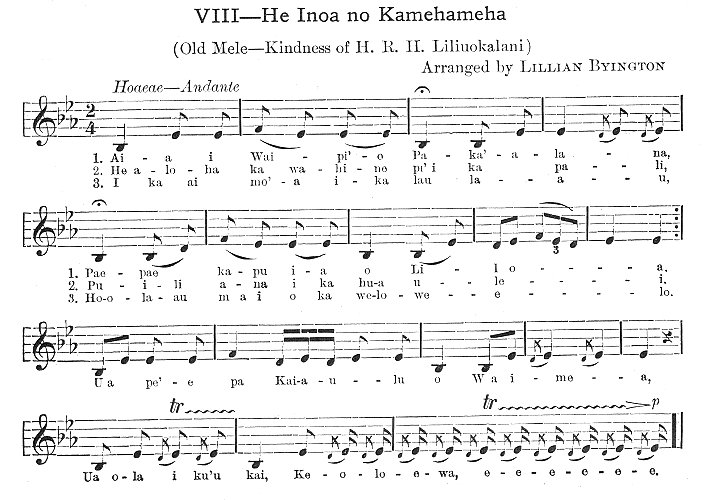
Click to enlarge
VIII--He Inoa no Kamehameha
(Old Mele--Kindness of H. R. H. Liliuokalani)
He Inoa no Kamehameha
Aia i Waipi’o a Paka’alana, b,
Paepae c kapu ia o Liloa. d
He aloha ka wahine pi’i ka pali, e
Puili ana i ka hua ulei,
5 I ka ai mo’a i ka lau laau. f
Hoolaau g mai o ka welowelo.
Ua pe’e pa Kai-a-ulu o Waimea, h
Ua ola i ku’u kai, i Keoloewa, j e.
Paepae c kapu ia o Liloa. d
He aloha ka wahine pi’i ka pali, e
Puili ana i ka hua ulei,
5 I ka ai mo’a i ka lau laau. f
Hoolaau g mai o ka welowelo.
Ua pe’e pa Kai-a-ulu o Waimea, h
Ua ola i ku’u kai, i Keoloewa, j e.
p. 163
[Translation]
A Name-song of Kamehameha
In Waipi’o stands Paka’alana,
The sacred shrine of Liloa.
Love to the woman climbing the steep,
Who gathered the ulei berries,
5 Who ate of the uncooked herbs of the wild,
Craving the swaying fruit like a hungry child.
A covert I found from the storm,
Life in my sea of delight.
The sacred shrine of Liloa.
Love to the woman climbing the steep,
Who gathered the ulei berries,
5 Who ate of the uncooked herbs of the wild,
Craving the swaying fruit like a hungry child.
A covert I found from the storm,
Life in my sea of delight.
The text of this mele--said to be a name-song of Kamehameha V--as first secured had undergone some corruption which obscured the meaning. By calling to his aid an old Hawaiian in whose memory the song had long been stored the author was able to correct it. Hawaiian authorities are at variance as to its meaning. One party reads in it an exclusive allusion to characters that have flitted across the stage within the memory of people now living, while another, taking a more romantic and traditional view, finds in it a reference to an old-time myth--that of Ke-anini-ula-o-ka-lani--the chief character in which was Haina-kolo. (See note e.) After carefully considering both sides of the question it seems to the author that, while the principle of double allusion, so common in Hawaiian poetry, may here prevail, one is justified in giving prominence to the historico-mythological interpretation that is inwoven in the poem. It is a comforting thought that adhesion to this decision will suffer certain unstaged actions of crowned heads to remain in charitable oblivion.
The music of this song is an admirable and faithful interpretation of the old Hawaiian manner of cantillation, having received at the hands of the foreign musician only so much trimming as was necessary to idealize it and make it reducible to our system of notation.
EXPLANATORY NOTE
Hoaeae.--This term calls for a quiet, sentimental style of recitation, in which the fluctuating trill i’i, if it occurs at all, is not made prominent. It is contrasted with the olioli, in which the style is warmer and the fluctuations of the i’i are carried to the extreme.Thus far we have been considering the traditional indigenous music of the land. To come now to that which has been and is being produced in Hawaii by Hawaiians to-day, under influences from abroad, it will not be possible to mistake the presence in it of two strains: The foreign, showing its hand in the lopping away of much redundant foliage, has brought it largely within the compass of scientific and technical expression; the native element reveals itself, now in
p. 164
plaintive reminiscence and now in a riotous bonhommie, a rollicking love of the sensuous, and in a style of delivery and vocal technique which demands a voluptuous throatiness, and which must be heard to be appreciated.
The foreign influence has repressed and well-nigh driven from the field the monotonous fluctuations of the i’i, has lifted the starveling melodies of Hawaii out of the old ruts and enriched them with new notes, thus giving them a spring and élan that appeal alike to the cultivated ear and to the popular taste of the day. It has, moreover, tapped the springs of folk-song that lay hidden in the Hawaiian nature. This same influence has also caused to germinate a Hawaiian appreciation of harmony and has endowed its music with new chords, the tonic and dominant, as well as with those of the subdominant and various minor chords.
The persistence of the Hawaiian quality is, however, most apparent in the language and imagery of the song-poetry. This will be seen in the text of the various mele and oli now to be given. Every musician will also note for himself the peculiar intervals and shadings of these melodies as well as the odd effects produced by rhythmic syncopation.
The songs must speak for themselves. The first song to be given, though dating from no longer ago than about the sixth decade of the last century, has already scattered its wind-borne seed and reproduced its kind in many variants, after the manner of other folklore. This love-lyric represents a type, very popular in Hawaii, that has continued to grow more and more personal and subjective in contrast with the objective epic style of the earliest Hawaiian mele.
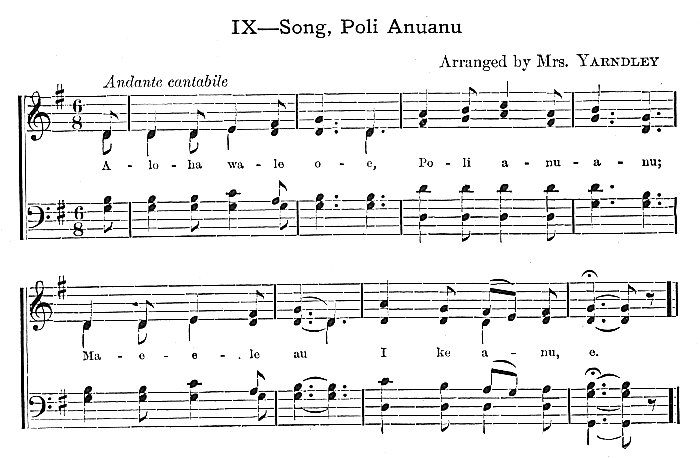
Click to enlarge
IX--Song, Poli Anuanu
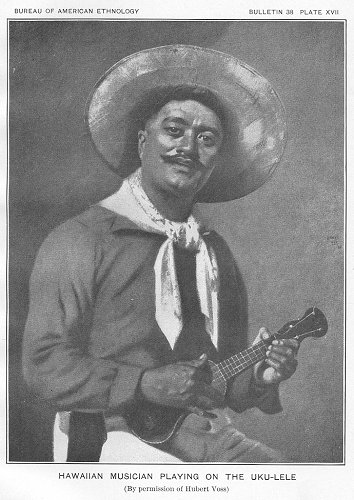
Click to enlarge
PLATE XVII
HAWAIIAN MUSICIAN PLAYING ON THE UKU-LELE
(By permission of Hubert Voss
p. 165
Poli Anuanu
1. Aloha wale oe,
Poli anuanu;
Máeéle au
I ke ánu, e.
2. He anu e ka ua,
He anu e ka wai,
Li’a kuu ili
I ke anu, e.
3. Ina paha,
Ooe a owau
Ka i pu-kukú’i,
I ke anu, e.
Poli anuanu;
Máeéle au
I ke ánu, e.
2. He anu e ka ua,
He anu e ka wai,
Li’a kuu ili
I ke anu, e.
3. Ina paha,
Ooe a owau
Ka i pu-kukú’i,
I ke anu, e.
He who would translate this love-lyric for the ear as well as for the mind finds himself handicapped by the limitations of our English speech--its scant supply of those orotund vowel sounds which flow forth with their full freight of breath in such words as a-ló-ha, pó-li, and á-nu-á-nu. These vocables belong to the very genius of the Hawaiian tongue.
[Translation]
Cold Breast
1. Love fain compels to greet thee,
Breast so cold, so cold.
Chilled, benumbed am I
With the pinching cold.
2. How bitter cold the rainfall,
Bitter cold the stream,
Body all a-shiver,
From the pinching cold.
3. Pray, what think you?
What if you and I
Should our arms enfold,
Just to keep off the cold?
Breast so cold, so cold.
Chilled, benumbed am I
With the pinching cold.
2. How bitter cold the rainfall,
Bitter cold the stream,
Body all a-shiver,
From the pinching cold.
3. Pray, what think you?
What if you and I
Should our arms enfold,
Just to keep off the cold?
The song next given, dating from a period only a few years subsequent, is of the same class and general character as Poli Anuanu. Both words and music are peculiarly Hawaiian, though one may easily detect the foreign influence that presided over the shaping of the melody.
p. 166
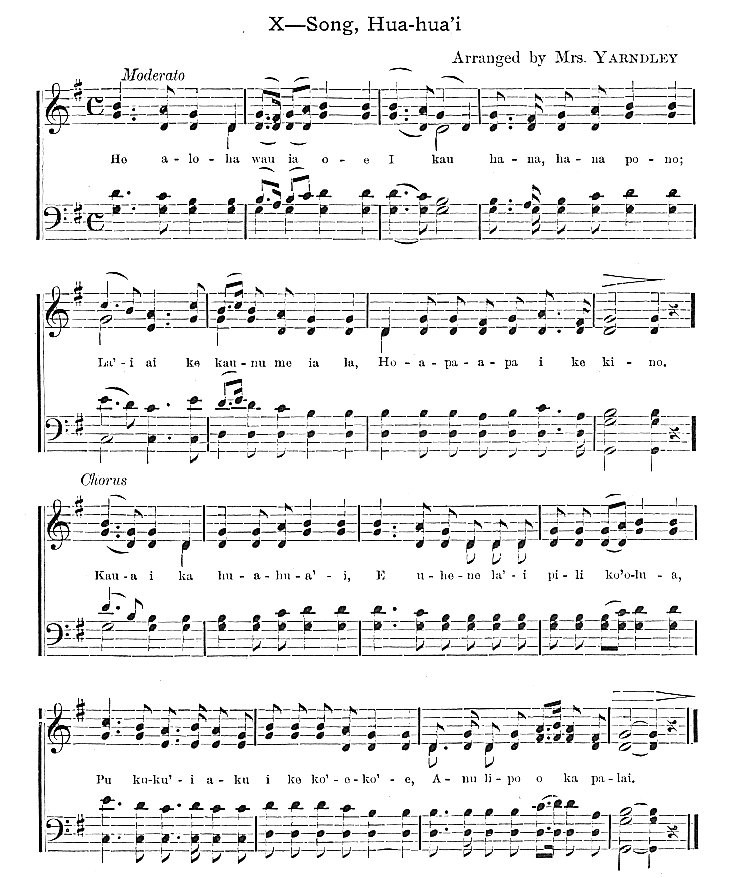
Click to enlarge
X--Song, Hua-hua’i
Huahua’i
He aloha wau ia oe.
I kau hana, hana pono;
La’i ai ke kaunu me ia la,
Hoapaapa i ke kino.
Chorus:
Kaua i ka huahua’i,
E uhene la’i pili koolua,
Pu-kuku’i aku i ke koekoe,
Anu lipo i ka palai.
I kau hana, hana pono;
La’i ai ke kaunu me ia la,
Hoapaapa i ke kino.
Chorus:
Kaua i ka huahua’i,
E uhene la’i pili koolua,
Pu-kuku’i aku i ke koekoe,
Anu lipo i ka palai.
p. 167
[Translation]
Outburst
O my love goes out to thee,
For thy goodness and thy kindness.
Fancy kindles at that other,
Stirs, with her arts, my blood.
Chorus:
You and I, then, for an outburst!
Sing the joy of love's encounter,
Join arms against the invading damp,
Deep chill of embowering ferns.
For thy goodness and thy kindness.
Fancy kindles at that other,
Stirs, with her arts, my blood.
Chorus:
You and I, then, for an outburst!
Sing the joy of love's encounter,
Join arms against the invading damp,
Deep chill of embowering ferns.
The following is given, not for its poetical value and significance, but rather as an example of a song which the trained Hawaiian singer delights to roll out with an unctuous gusto that bids defiance to all description:
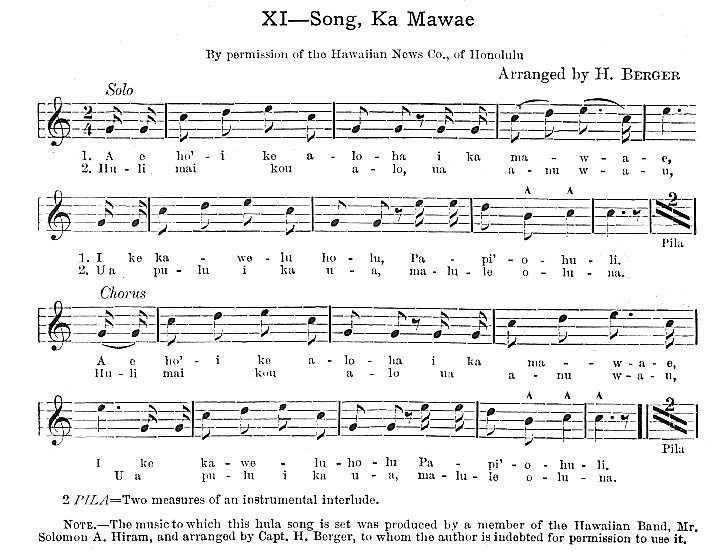
Click to enlarge
XI--Song, Ka Mawae
NOTE.--The music to which this hula song is set was produced by a member of the Hawaiian Band, Mr. Solomon A. Hiram, and arranged by Capt. H. Berger, to whom the author is indebted for permission to use it.
Ka Mawae
A e ho’i ke aloha i ka mawae,
I ke Kawelu-holu, Papi’ohúli. a
Huli mai kou alo, ua anu wau,
Ua pulu i ka ua, malule o-luna.
I ke Kawelu-holu, Papi’ohúli. a
Huli mai kou alo, ua anu wau,
Ua pulu i ka ua, malule o-luna.
p. 168
[Translation]
The Refuge
Return, O love, to the refuge,
The wind-tossed covert of Papi’ohúli.
Face now to my face; I'm smitten with cold,
Soaked with the rain and benumbed.
The wind-tossed covert of Papi’ohúli.
Face now to my face; I'm smitten with cold,
Soaked with the rain and benumbed.
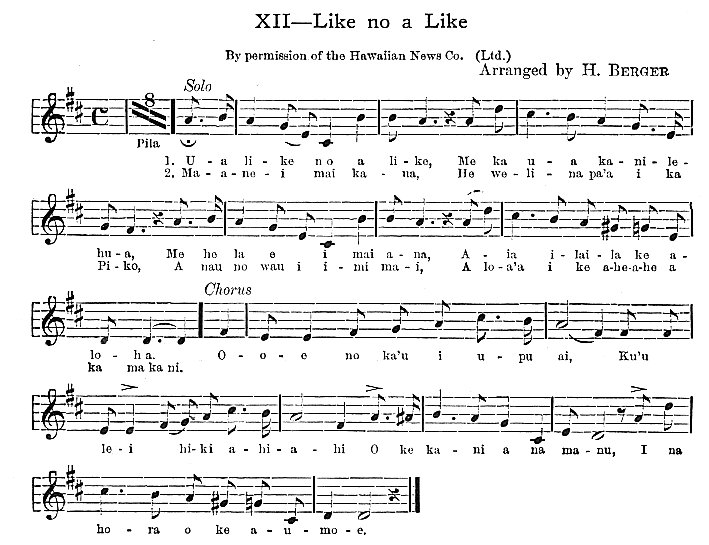
Click to enlarge
XII--Like no a Like
Like no a Like
1. Ua like no a like
Me ka ua kani-lehua;
Me he la e i mai ana,
Aia ilaila ke aloha.
Chorus:
Ooe no ka’u i upu ai,
Ku’u lei hiki ahiahi,
O ke kani o na manu,
I na hora o ke aumoe.
2. Maanei mai kaua,
He welina pa’a i ka piko,
A nau no wau i imi mai.
A loaa i ke aheahe a ka makani.
Chorus.
Me ka ua kani-lehua;
Me he la e i mai ana,
Aia ilaila ke aloha.
Chorus:
Ooe no ka’u i upu ai,
Ku’u lei hiki ahiahi,
O ke kani o na manu,
I na hora o ke aumoe.
2. Maanei mai kaua,
He welina pa’a i ka piko,
A nau no wau i imi mai.
A loaa i ke aheahe a ka makani.
Chorus.
p. 169
[Translation]
Resemblance
1. When the rain drums loud on the leaf,
It makes me think of my love:
It whispers into my ear,
Your love, your love--she is near.
Chorus:
Thou art the end of my longing,
The crown of evening's delight,
When I hear the cock blithe crowing,
In the middle watch of the night.
2. This way is the path for thee and me,
A welcome warm at the end.
I waited long for thy coming,
And found thee in waft of the breeze.
Chorus.
It makes me think of my love:
It whispers into my ear,
Your love, your love--she is near.
Chorus:
Thou art the end of my longing,
The crown of evening's delight,
When I hear the cock blithe crowing,
In the middle watch of the night.
2. This way is the path for thee and me,
A welcome warm at the end.
I waited long for thy coming,
And found thee in waft of the breeze.
Chorus.
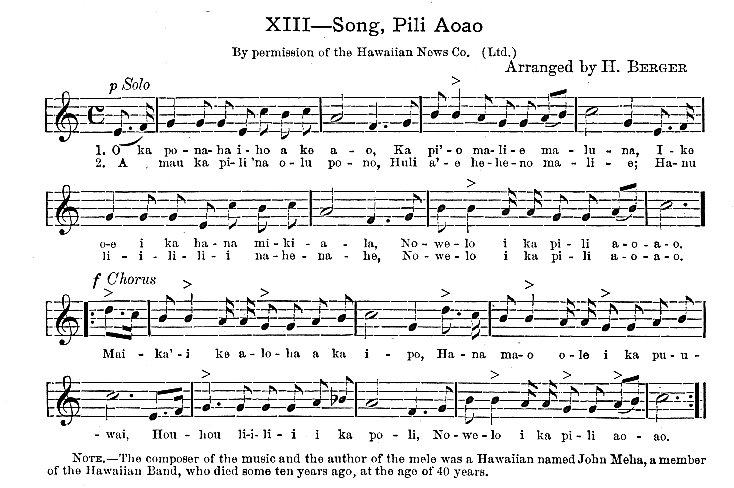
Click to enlarge
XIII--Song, Pili Aoao
1. O ka ponaha iho a ke ao.
Ka pipi’o malie maluna,
Ike oe i ka hana mikiala,
Nowelo i ka pili aoao.
Chorus:
Maikai ke aloha a ka ipo--
Hana mao ole i ka puuwai,
Houhou liilii i ka poli--
Nowelo i ka pili aoao.
2. A mau ka pili’na olu pono;
Huli a’e, hooheno malie,
Hanu liilii nahenahe,
Nowelo i ka pili aoao.
Chorus.
Ka pipi’o malie maluna,
Ike oe i ka hana mikiala,
Nowelo i ka pili aoao.
Chorus:
Maikai ke aloha a ka ipo--
Hana mao ole i ka puuwai,
Houhou liilii i ka poli--
Nowelo i ka pili aoao.
2. A mau ka pili’na olu pono;
Huli a’e, hooheno malie,
Hanu liilii nahenahe,
Nowelo i ka pili aoao.
Chorus.
p. 170
The author of the mele was a Hawaiian named John Meha, who died some years ago. He was for many years a member of the Hawaiian Band and set the words to the music given below, which has since been arranged by Captain Berger.
[Translation]
Side by side
1. Outspreads now the dawn,
Arching itself on high--
But look! a wondrous thing,
A thrill at touch of the side.
Chorus:
Most dear to the soul is a love-touch;
Its pulse stirs ever the heart
And gently throbs iii the breast--
At thrill from the touch of the side.
2. In time awakes a new charm
As you turn and gently caress;
Short comes to breath--at
The thrill from the touch of the side.
Chorus.
Arching itself on high--
But look! a wondrous thing,
A thrill at touch of the side.
Chorus:
Most dear to the soul is a love-touch;
Its pulse stirs ever the heart
And gently throbs iii the breast--
At thrill from the touch of the side.
2. In time awakes a new charm
As you turn and gently caress;
Short comes to breath--at
The thrill from the touch of the side.
Chorus.
The fragments of Hawaiian music that have drifted down to us no doubt remain true to the ancient type, however much they may have changed in quality. They show the characteristics that stamp all primitive music--plaintiveness to the degree almost of sadness, monotony, lack of acquaintance with the full range of intervals that make up our diatonic scale, and therefore a measurable absence of that ear-charm we call melody. These are among its deficiencies.
If, on the other hand, we set down the positive qualities by the possession of which it makes good its claim to be classed as music, we shall find that it has a firm hold on rhythm. This is indeed one of the special excellencies of Hawaiian music. Added to this, we find that it makes a limited use of such intervals as the third, fifth, fourth, and at the same time resorts extravagantly, as if in compensation, to a fine tone-carving that divides up the tone-interval into fractions so much less than the semitone that our ears are almost indifferent to them, and are at first inclined to deny their existence. This minute division of the tone, or step, and neglect at the same time of the broader harmonic intervals, reminds one of work in which the artist charges his picture with unimportant detail, while failing in attention to the strong outlines. Among its merits we must not forget to mention a certain quality of tone-color which inheres in the Hawaiian tongue and which greatly tends to the enhancement of Hawaiian music, especially when thrown into rhythmic forms.
The first thing, then, to repeat, that will strike the auditor on listening to this primitive music will be its lack of melody. The voice goes wavering and lilting along like a canoe on a rippling ocean.
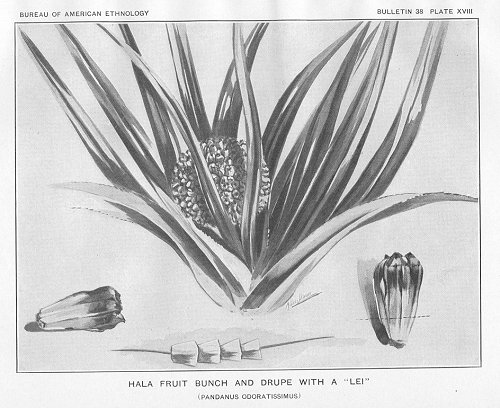
Click to enlarge
PLATE XVIII
HALA FRUIT BUNCH AND DRUPE WITH A ''LEI''
(PANDANUS ODORATISSIMUS)
p. 171
[paragraph continues] Then, of a sudden, it swells upward, as if lifted by some wave of emotion; and there for a time it travels with the same fluctuating movement, soon descending to its old monotone, until again moved to rise on the breast of some fresh impulse. The intervals sounded may be, as already said, a third, or a fifth, or a fourth; but the whole movement leads nowhere; it is an unfinished sentence. Yet, in spite of all these drawbacks and of this childish immaturity, the amateur and enthusiast finds himself charmed and held as if in the clutch of some Old-World spell, and this at what others will call the dreary and monotonous intoning of the savage.
In matters that concern the emotions it is rarely possible to trace with certainty the lines that lead up from effect to cause. Such is the nature of art. If we would touch the cause which lends attractiveness to Hawaiian music, we must look elsewhere than to melody. In the belief of the author the two elements that conspire for this end are rhythm and tone-color, which comes of a delicate feeling for vowel-values.
The hall-mark of Hawaiian music is rhythm, for the Hawaiians be-long to that class of people who can not move hand or foot or perform any action except they do it rhythmically. Not alone in poetry and music and the dance do we find this recurring accent of pleasure, but in every action of life it seems to enter as a timekeeper and regulator, whether it be the movement of a fingerful of poi to the mouth or the swing of a kahili through the incense-laden air at the burial of a chief.
The typical Hawaiian rhythm is a measure of four beats, varied at times by a 2-rhythm, or changed by syncopation into a 3-rhythm.
These people have an emotional susceptibility and a sympathy with environment that belongs to the artistic temperament; but their feelings, though easily stirred, are not persistent and ideally centered; they readily wander away from any example or pattern. In this way may be explained their inclination to lapse from their own standard of rhythm into inexplicable syncopations.
As an instance of sympathy with environment, an experience with a hula dancer may be mentioned. Wishing to observe the movement of the dance in time with the singing of the mele, the author asked him to perform the two at one time. He made the attempt, but failed. At length, bethinking himself, he drew off his coat and bound it about his loins after the fashion of a pa-ú, such as is worn by hula dancers. He at once caught inspiration, and was thus enabled to perform the double rule of dancer and singer.
It has been often remarked by musical teachers who have had experience with these islanders that as singers they are prone to flat the tone and to drag the time, yet under the stimulus of emotion they show the ability to acquit themselves in these respects with great credit. The native inertia of their being demands the spur of excitement
p. 172
to keep them up to the mark. While human nature everywhere shares in this weakness, the tendency seems to be greater in the Hawaiian than in some other races of no higher intellectual and esthetic advancement.
Another quality of the Hawaiian character which reenforces this tendency is their spirit of communal sympathy. That is but another way of saying that they need the stimulus of the crowd, as well as of the occasion, even to make them keep step to the rhythm of their own music. In all of these points they are but an epitome of humanity.
Before closing this special subject, the treatment of which has grown to an unexpected length, the author feels constrained to add one more illustration of Hawaii's musical productions. The Hawaiian national hymn on its poetical side may be called the last appeal of royalty to the nation's feeling of race-pride. The music, though by a foreigner, is well suited to the words and is colored by the environment in which the composer has spent the best years of his life. The whole production seems well fitted to serve as the clarion of a people that need every help which art and imagination can offer.
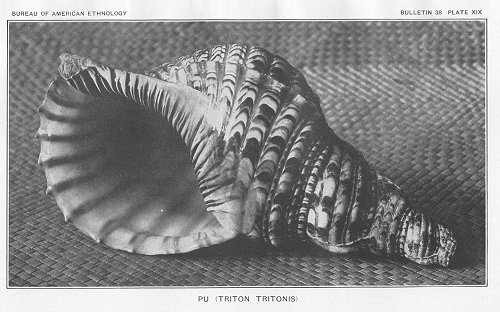
Click to enlarge
PLATE XIX
PU (TRITON TRITONIS)
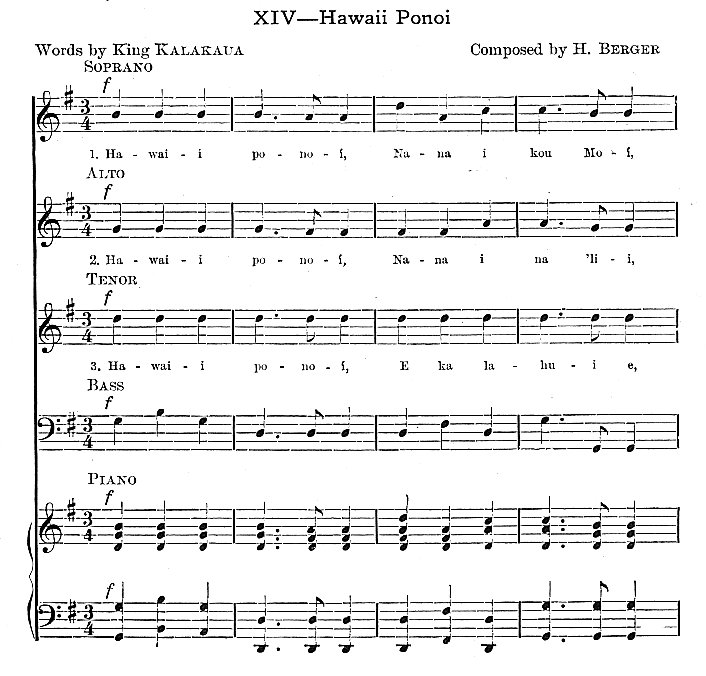
Click to enlarge
XIV--Hawaii Ponoi
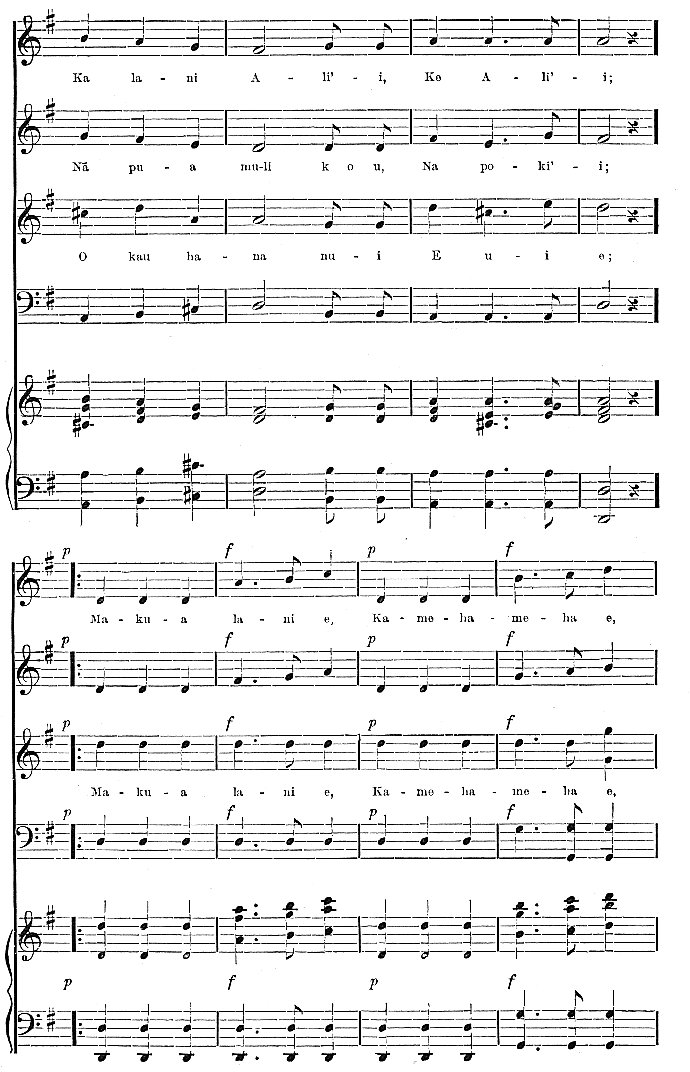
Click to enlarge
XIV--Hawaii Ponoi
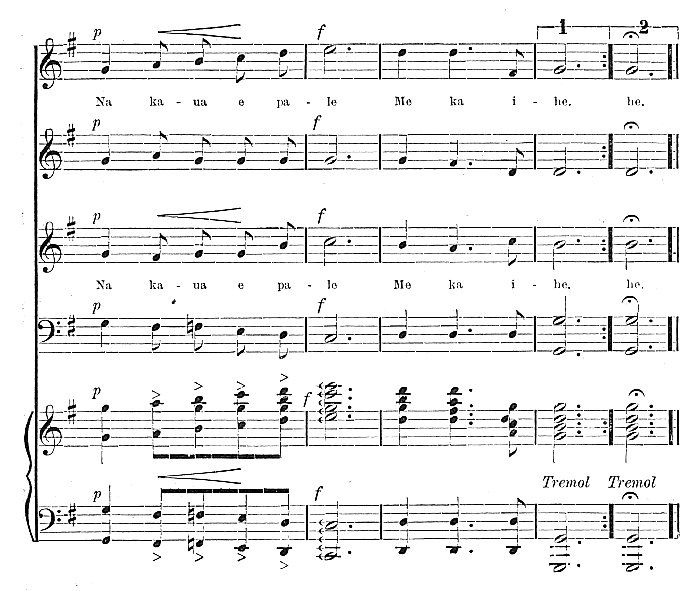
Click to enlarge
XIV--Hawaii Ponoi
HAWAI'I PONOI
1. Hawai’i ponoí,
Nana I kou Moí,
Ka lani Ali’i
Ke Ali’i.
Refrain:
Makua lani, e,
Kamehameha, e,
Na kaua e pale,
Me ka ihe.
2. Hawai’i ponoí,
Nana i na ’li’i,
Na kaua muli kou,
Na poki’i.
Refrain:
3. Hawai’i ponoí
E ka lahui, e,
O kau hana nui
E ui, e.
Refrain.
Nana I kou Moí,
Ka lani Ali’i
Ke Ali’i.
Refrain:
Makua lani, e,
Kamehameha, e,
Na kaua e pale,
Me ka ihe.
2. Hawai’i ponoí,
Nana i na ’li’i,
Na kaua muli kou,
Na poki’i.
Refrain:
3. Hawai’i ponoí
E ka lahui, e,
O kau hana nui
E ui, e.
Refrain.
p. 175
[Translation]
Hawaii Ponoi
1. Hawaii's very own,
Look to your sovran Lord,
Your chief that's heaven-born,
Who is your King.
Refrain:
Protector, heaven-sent,
Kamehameha great,
To vanquish every foe,
With conquering spear.
2. Men of Hawaii's land,
Look to your native chiefs,
Your sole surviving lords,
The nation's pride.
Refrain:
3. Men of Hawaiian stock,
My nation ever dear,
With loins begirt for work,
Strive with your might.
Refrain.
Look to your sovran Lord,
Your chief that's heaven-born,
Who is your King.
Refrain:
Protector, heaven-sent,
Kamehameha great,
To vanquish every foe,
With conquering spear.
2. Men of Hawaii's land,
Look to your native chiefs,
Your sole surviving lords,
The nation's pride.
Refrain:
3. Men of Hawaiian stock,
My nation ever dear,
With loins begirt for work,
Strive with your might.
Refrain.
Footnotes
138:a The early American missionaries to Hawaii named the musical notes of the scale pa, ko, li, ha, no, la, mi.139:a The author can see no reason for supposing that this prolonged utterance had anything to do with that Hindoo practice belonging to the yoga, the exercise of which consists in regulating the breath.
146:a The writer is indebted to Miss Elsner not only for the above comments but for the following score which she has cleverly arranged as a sample of nose-flute music produced by Keaonaloa.
149:a Italics used are those of the present author.
150:a These bamboos were, no doubt, the same as the kaékeéke, elsewhere described. (See p. 122.)
154:a The Evolution of Music from the Italian Standpoint, in the Century Library of Music, xvi, 521.
155:a Halau. The rainy valley of Hanalei, on Kauai, is here compared to a halau, a dance-hall, apparently because the rain-columns seem to draw together and inclose the valley within walls, while the dark foreshortened vault of heaven covers it as with a roof.
155:b Kumano. A water-source, or, as here, perhaps, a sort of dam or loose stone wall that was run out into a stream for the purpose of diverting a portion of it into a new channel.
155:c Like. A bud; fresh verdure; a word much used in modern Hawaiian poetry.
155:d Opiwai. A watershed. In Hawaii a knife-edged ridge as narrow as the back of a horse will often decide the course of a stream, turning its direction from one to the other side of the island.
155:e Waioli (wai, water; oli, joyful). The name given to a part of the valley of Hanalei, also the name of a river.
162:a Waipi’o. A deep valley on the windward side of Hawaii.
162:b Paka’alana. A temple and the residence of King Liloa in Waipi’o.
162:c Paepae. The doorsill (of this temple), always an object of superstitious regard, but especially so in the case of this temple. Here it stands for the whole temple.
162:d Liloa. A famous king of Hawaii who had his seat in Waipi’o.
162:e Wahine pii ka pali. Haina-kolo, a mythical character. is probably the one alluded to. She married a king of Kukulu o Kahiki, and. being deserted by him, swam back to Hawaii. Arrived at Waipi’o in a famishing state, she climbed the heights and ate of the ulei berries without first propitiating the local deity with a sacrifice. As an infliction of the offended deity, she became distraught and wandered away into the wilderness. Her husband repented of his neglect and after long search found her. Under kind treatment she regained her reason and the family was happily reunited.
162:f Lau laau. Leaves of plants.
162:g Hoolaau. The last part of this word, laau, taken in connection with the last word of the previous verse, form a capital instance of word repetition. This was an artifice much used in Hawaiian poetry, both as a means of imparting tone-color and for the punning wit it was supposed to exhibit.
162:h Ua pe’e pa Kai-a-ulu a Waimea. Kai-a-ulu is a fierce rain-squall such as arises suddenly in the uplands of Waimea, Hawaii. The traveler, to protect himself, crouches (pe’e) behind a hummock of grass, or builds up in all haste a barricade (pa) of light stuff as a partial shelter against the oncoming storm.
162:i Kai. Taken in connection with Kai-a-ulu in the preceding verse, this is another instance of verse repetition. This word, the primary meaning of which is sea, or ocean, is used figuratively to represent a source of comfort or life.
162:j Keoloewa. The name of one of the old gods belonging to the class called akua noho, a class of deities that were sent by the necromancers on errands of demoniacal possession.
167:a Papi’o-huli. A slope in the western valley-side at the head of Nuuanu, where the tall grass (kawelu) waves (holu) in the wind.
XXII.--GESTURE
Gesture is a voiceless speech, a short-hand dramatic picture. The Hawaiians were adepts in this sort of art. Hand and foot, face and eye, and those convolutions of gray matter which are linked to the organs of speech, all worked in such harmony that, when the man spoke, he spoke not alone with his vocal organs, but all over, from head to foot, every part adding its emphasis to the utterance. Von Moltke could be reticent in six languages; the Hawaiian found it impossible to be reticent in one.The hands of the hula dancer are ever going out in gesture, her body swaying and pivoting itself in attitudes of expression. Her whole physique is a living and moving picture of feeling, sentiment, and passion. If the range of thought is not always deep or high, it is not the fault of her art, but the limitations of her original endowment, limitations of hereditary environment, the universal limitations imposed on the translation from spirit into matter.
The art of gesture was one of the most important branches taught by the kumu. When the hula expert, the olohe, who has entered the halau as a visitor, utters the prayer (p. 47), "O Laka, give grace to the feet of Pohaku, and to her bracelets and anklets; give comeliness to the figure and skirt of Luukia. To each one give gesture and voice. O Laka, make beautiful the lei; inspire the dancers to stand before the assembly," his meaning was clear and unmistakable, and showed his high valuation of this method of expression. We are not, however, to suppose that the kumu-hula, whatever his artistic attainments, followed any set of formulated doctrines in his teaching. His science was implicit, unformulated, still enfolded in the silence of unconsciousness, wrapped like a babe in its mother's womb. To apply a scientific name to his method, it might be calk inductive, for he led his pupils along the plain road of practical illustration, adding example to example, without the confusing aid of preliminary rule or abstract proposition, until his pupils had traveled over the whole ground covered by his own experience.
Each teacher went according to the light that was in him, not forgetting the instructions of his own kumu, but using them as a starting point, a basis on which to build as best he knew. There were no books, no manuals of instruction, to pass from hand to hand and thus secure uniformity of instruction. Then, again, it was a long journey from Hawaii to Kauai, or even from one island to
p. 177
another. The different islands, as a rule, were not harnessed to one another under the same political yoke; even districts of the same island were not unfrequently under the independent sway of warring chiefs; so that for long periods the separation, even the isolation, in matters of dramatic art and practice was as complete as in politics.
The method pursued by the kumu may be summarized as follows: Having labored to fix the song, the mele or oli, in the minds of his pupils, the haumana, he appointed some one to recite the words of the piece, while the class, standing with close attention to the motions of the kumu and with ears open at the same time to the words of the leader, were required to repeat the kumu's gestures in pantomime until he judged them to have arrived at a sufficient degree of perfection. That done, the class took up the double task of recitation joined to that of gesture. In his attempt to translate his concepts into physical signs the Hawaiian was favored not only by his vivid power of imagination, but by his implicit philosophy, for the Hawaiian looked at things from a physical plane--a safe ground to stand upon--albeit he had glimpses at times far into the depths of ether. When he talked about spirit, he still had in mind a form of matter. A god was to him but an amplified human being.
It is not the purpose to attempt a scientific classification of gesture as displayed in the halau. The most that can be done will be to give a few familiar generic illustrations which are typical and representative of a large class.
The pali, the precipice, stands for any difficulty or obstacle of magnitude. The Hawaiian represents this in his dramatic, pictorial manner with the hand vertically posed on the outstretched arm, the palm of the hand looking away. If it is desired to represent this wall of obstacle as being surmounted, the hand is pushed forward, and at the same time somewhat inclined, perhaps, from its rigid perpendicularity, the action being accompanied by a series of slight lifting or waving movements as of climbing.
Another way of dramatically picturing this same concept, that of the pali as a wall of obstacle, is by holding the forearm and hand vertically posed with the palmar aspect facing the speaker. This method of expression, while perhaps bolder and more graphic than that before mentioned, seems more purely oratorical and less graceful, less subtly pictorial and elegant than the one previously described, and therefore less adapted to the hula. For it must be borne in mind that the hula demanded the subordination of strength to grace and elegance. We may at the same time be sure that the halau showed individuality in its choice of methods, that it varied its technique and manner of expression at different times and places, according to the different conception of one or another kumu.
p. 178
Progression, as in walking or traveling, is represented by means of a forward undulatory movement of the outstretched arm and hand, palm downward, in a horizontal plane. This gesture is rhythmic and beautifully pictorial. If the other hand also is made a partner in the gesture, the significance would seem to be extended, making it include, perhaps, a larger number in the traveling company. The mere extension of the arm, the back-hand advanced, would serve the purpose of indicating removal, travel, but in a manner less gracious and caressing.
To represent an open level space, as of a sand-beach or of the earth-plain, the Hawaiian very naturally extended his arms and open hands--palms downward, of course--the degree of his reaching effort being in a sense a measure of the scope intended.
To represent the act of covering or protecting oneself with clothing, the Hawaiian placed the hollow of each hand over the opposite shoulder with a sort of hugging action. But here, again, one can lay down no hard and fast rule. There was differentiation; the pictorial action might well vary according to the actor's conception of the three or more generic forms that constituted the varieties of Hawaiian dress, which were the málo of the man, the pa-ú of the woman, and the decent kiheí, a togalike robe, which, like the blanket of the North American Indian, was common to both sexes. Still another gesture, a sweeping of the hands from the shoulder down toward the ground, would be used to indicate that costly feather robe, the ahuula, which was the regalia and prerogative of kings and chiefs.
The Hawaiian places his hands, palms up, edge to edge, so that the little finger of one hand touches its fellow of the other hand. By this action he means union or similarity. He turns one palm down, so that the little finger and thumb of opposite hands touch each other. The significance of the action is now wholly reversed; he now means disunion, contrariety.
To indicate death, the death of a person, the finger-tips, placed in apposition, are drawn away from each other with a sweeping gesture and at the same time lowered till the palms face the ground. In this case also we find diversity. One old man, well acquainted with hula matters, being asked to signify inn pantomimic fashion "the king is sick," went through the following motions: He first pointed upward, to indicate the heaven-born one, the king; then he brought his hands to his body and threw his face into a painful grimace. To indicate the death of the king he threw his hands upward toward the sky, as if to signify a removal by flight. He admitted the accuracy of the gesture, previously described, in which the hands are moved toward the ground.
There are, of course, imitative and mimetic gestures galore, as of paddling, swimming, diving, angling, and the like, which one sees
p. 179
every day of his life and which are to be regarded as parts of that universal shorthand vocabulary of unvocalized speech that is used the world over from Naples to Honolulu, rather than stage-conventions of the halau. It will suffice to mention one motion or gesture of this sort which the author has seen used with dramatic effect. An old man was describing the action of Hiiaka (the little sister of Pele) while clearing a passage for herself and her female companion with a great slaughter of the reptilian demon-horde of mo’o that came out in swarms to oppose the progress of the goddess through their territory while she was on her way to fetch Prince Lohiau. The goddess, a delicate piece of humanity in her real self, made short work of the little devils who covered the earth and filled the air. Seizing one after another, she bit its life out, or swallowed it as if it had been a shrimp. The old man represented the action most vividly: pressing his thumb, forefinger, and middle finger into a cone, he brought them quickly to his mouth, while he snapped his jaws together like a dog seizing a morsel, an action that pictured the story better than any words.
It might seem at first blush that facial expression, important as it is, owing to its short range of effectiveness, should hardly be put in the same category with what may be called the major stage-gestures that were in vogue in the halau. But such a judgment would certainly be mistaken. The Greek use of masks on the stage for their "carrying power" testified to their valuation of the countenance as a semaphore of emotion; at the same time their resort to this artifice was an implicit recognition of the desirability of bringing the window of the soul nearer to the audience. The Hawaiians, though they made no use of masks in the halau, valued facial expression no less than the Greeks. The means for the study of this division of the subject, from the nature of the case, is somewhat restricted and the pursuit of illustrations makes it necessary to go outside of the halau.
The Hawaiian language was one of hospitality and invitation. The expression mai, or komo mai, this way, or come in, was the most common of salutations. The Hawaiian sat down to meat before an open door; he ate his food in the sight of all men, and it was only one who dared being denounced as a churl who would fail to invite with word and gesture the passer-by to come in and share with him. This gesture might be a sweeping, downward, or sidewise motion of the hand in which the palm faced and drew toward the speaker. This seems to have been the usual form when the two parties were near to each other; if they were separated by any considerable distance, the fingers would perhaps more likely be turned upward, thus making the signal more distinctly visible and at the same time more emphatic.
p. 180
In the expression of unvoiced assent and dissent the Hawaiian practised refinements that went beyond our ordinary conventions. To give assent he did not find it necessary so much as to nod the head; a lifting of the eyebrows sufficed. On the other hand, the expression of dissent was no less simple as well as decisive, being attained by a mere grimace of the nose. This manner of indicating dissent was not, perhaps, without some admixture of disdain or even scorn; but that feeling, if predominant, would call for a reenforcement of the gesture by some additional token, such as a pouting of the lips accompanied by an upward toss of the chin. A more impersonal and coldly businesslike way of manifesting a negative was by an outward sweep of the hand, the back of the hand being turned to the applicant. Such a gesture, when addressed to a huckster or a beggar--a rare bird, by the way, in old Hawaii--was accepted as final.
There was another method of signifying a most emphatic, even contemptuous, no. In this the tongue is protruded and allowed to hang down fiat and wide like the flaming banner of a panting bound. A friend states that the Maoris made great use of gestures with the tongue in their dances, especially in the war-dance, sometimes letting it hang down broad, fiat, and long, directly in front, some-times curving it to right or left, and sometimes stuffing it into the hollow of the cheek and puffing out one side of the face. This manner--these methods it might be said--of facial expression, so far as observed and so far as can be learned, were chiefly of feminine practice. The very last gesture--that of the protruded tongue--is not mentioned as one likely to be employed on the stage in the halau, certainly not in the performance of what one would call the serious hulas. But it might well have been employed in the hula ki’i (see p. 91), which was devoted, as we have seen, to the portrayal of the lighter and more comic aspects of daily life.
It is somewhat difficult to interpret the meaning of the various attitudes and movements of the feet and legs. Their remoteness from the centers of emotional control, their detachment from the vortices of excitement, and their seeming restriction to mechanical functions make them seem but slightly sympathetic with those tides of emotion that speed through the vital parts of the frame. But, though somewhat aloof from, they are still under the dominion of, the same emotional laws that govern the more central parts.
Man is all sympathy one part with another;
For head with heart hath joyful amity,
And both with moon and tides.
For head with heart hath joyful amity,
And both with moon and tides.
The illustrations brought to illuminate this division of the subject will necessarily be of the most general application and will seem to belong rather to the domain of oratory than to that of dramatic or
p. 181
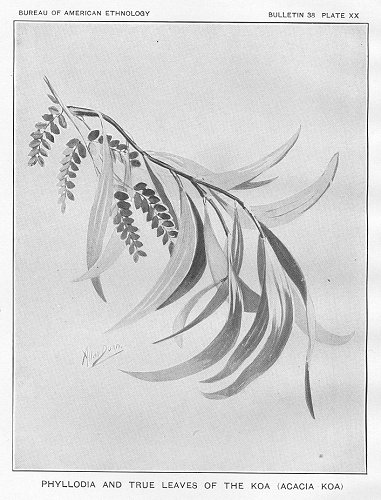
Click to enlarge
PLATE XX
PHYLLODIA AND TRUE LEAVES OF THE KOA (ACACIA KOA)
stage expression, by which is meant expression fitted for the purposes of the halau.
To begin with a general proposition, the attitude of the feet and legs must be sympathetic with that of the other parts of the body. When standing squarely on both feet and looking directly forward, the action may be called noncommittal, general; but if the address is specialized and directed to a part of the audience, or if attention is called to some particular region, the face will naturally turn in that direction. To attain this end, while the leg and arm of the corresponding side will be drawn back, the leg and arm of the opposite side will be advanced, thus causing the speaker to face the point of address. If the speaker or the actor addresses himself, then, to persons, or to an object, on his right, the left leg will be the one more in advance and the left arm will be the one on which the burden of gesture will fall, and vice versa.
It would be a mistake to suppose that every motion or gesture displayed by the actors on the stage of the halau was significant of a purpose. To do that would be to ascribe to them a flawless perfection and strength that no body of artists have ever attained. Many of their gestures, like the rhetoric of a popular orator, were mere flourishes and ornaments. With a language so full of seemingly superfluous parts, it could not well be otherwise than that their rhetoric of gesture should be overloaded with flourishes.
The whole subject of gesture, including facial expression, is worthy of profound study, for it is linked to the basic elements of psychology. The illustrations adduced touch only the skirts of the subject; but they must suffice. An exhaustive analysis, the author believes, would show an intimate and causal relation between these facial expressions and the muscular movements that are the necessary accompaniments or resultants of actual speech. To illustrate, the pronunciation of the Hawaiian word ae (pronounced like our aye), meaning "yes," involves the opening of the mouth to its full extent; and this action, when accomplished, results in a sympathetic lifting of the eyebrows. It is this ultimate and completing part of the action which the Hawaiian woman adopts as her semaphore of assent.
One of the puzzling things about gesture comes when we try to think of it as a science rooted in psychology. It is then we discover variations presented by different peoples in different lands, which force us to the conviction that in only a part. of its domain does it base itself on the strict principles of psychology. Gesture, like language, seems to be made up in good measure of an opportunist. growth that springs lip in answer to man's varying needs and conditions. The writer hopes he will not be charged with begging the question in suggesting that another element which we must reckon
p. 182
with as influential in fashioning and stereotyping gesture is tradition and convention. To illustrate--the actor who took the role of Lord Dundreary in the first performance of the play of the same name accidentally made a fantastic misstep while crossing the stage. The audience was amused, and the actor, quick to avail himself of any open door, followed the lead thus hinted at. The result is that he won great applause and gave birth to a mannerism which has well-nigh become a stage convention.
XXIII.--THE HULA PA-HUA
The hula pa-hua was a dance of the classical times that has long been obsolete. Its last exhibition, so far as ascertained, was in the year 1846, on the island of Oahu. In this performance both the olapa and the hoopaa cantillated the mele, while the latter squatted on the floor. Each one was armed with a sharp stick of wood fashioned like a javelin, or a Hawaiian spade, the o-ó; and with this he made motions, thrusting to right and to left; whether in imitation of the motions of a soldier or of a farmer could not be learned. The gestures of these actors were in perfect time with the rhythm of the mele.The dance-movements performed by the olapa, as the author has heard them described, were peculiar, not an actual rotation, but a sort of half-turn to one side and then to the other, an advance followed by a retreat. While doing this the olapa, who were in two divisions, marked the time of the movement by clinking together two pebbles which they held in each hand.
The use of the pebbles after the manner of castanets, the division of the dancers into two sets, their advance and retreat toward and away from each other are all suggestive of the Spanish bolero or fandango. The resemblance went deeper than the surface. The prime motive of the song, the mele, also is the same, love in its different phases even to its most frenzied manifestations.
Mele
Pa au i ka ihe a Kane; a
Nana ka maka ia Koolau; b
Kau ka opua c ma ka moana.
Lu’u a e-a, lu’u a e-a, d
5 Hiki i Wai-ko-loa.
Aole loa ke kula
I ka pai-lani a Kane. e
Ke kane e ia no hoi ia
Ka hula pe-pe’e
Nana ka maka ia Koolau; b
Kau ka opua c ma ka moana.
Lu’u a e-a, lu’u a e-a, d
5 Hiki i Wai-ko-loa.
Aole loa ke kula
I ka pai-lani a Kane. e
Ke kane e ia no hoi ia
Ka hula pe-pe’e
p. 184
10 A ka hale ku’i.
Ku’i oe a lono Kahiki-nui;
Hoolei ia iluna o Kaua-loa,
Ka lihilihi pua o ka makemake.
Mao ole ke Koolau i ka lihilihi.
15 He lihi kuleana ia no Puna.
O ko’u puni no ia o ka ike maka.
Aohe makamaka o ka hale, ua hele oe;
Nawai la au e hookipa
I keia mahaoi ana mai nei o ka loa?
20 He makemake no au e ike maka;
I hookahi no po, le’a ke kaunu,
Ka hana mao ole a ke anu.
He anu mawaho, a he hu’i ma-loko.
A ilaila laua la, la’i pono iho.
25 Ua pono oe o kaua, ua alu ka moena;
Ka hana mau a ka Inu-wai:
Mao ole i ka nui kino.
Ku’u kino keia mauna ia ha’i.
E Ku, e hoolei la!
30 A ua noa!
Ku’i oe a lono Kahiki-nui;
Hoolei ia iluna o Kaua-loa,
Ka lihilihi pua o ka makemake.
Mao ole ke Koolau i ka lihilihi.
15 He lihi kuleana ia no Puna.
O ko’u puni no ia o ka ike maka.
Aohe makamaka o ka hale, ua hele oe;
Nawai la au e hookipa
I keia mahaoi ana mai nei o ka loa?
20 He makemake no au e ike maka;
I hookahi no po, le’a ke kaunu,
Ka hana mao ole a ke anu.
He anu mawaho, a he hu’i ma-loko.
A ilaila laua la, la’i pono iho.
25 Ua pono oe o kaua, ua alu ka moena;
Ka hana mau a ka Inu-wai:
Mao ole i ka nui kino.
Ku’u kino keia mauna ia ha’i.
E Ku, e hoolei la!
30 A ua noa!
[Translation]
Song
I am smitten with spear of Kane:
Mine eyes with longing scan Koolau;
Behold the love-omen hang o’er the sea.
I dive and come up, dive and come up;
5 Thus I reach my goal Wai-ko-loa.
The width of plain is a trifle
To the joyful spirit of Kane.
Aye, a husband, and patron is he
To the dance of the bended knee,
10 In the hall of the stamping feet.
Stamp, till the echo reaches Kahiki;
Still pluck you a wreath by the way
To crown your fondest ambition:
A wreath not marred by the salt wind
15 That plays with the skirts of Puna.
I long to look eye into eye.
Friendless the house, you away;
Pray who will receive, who welcome,
This guest uninvited from far?
20 I long for one (soul-deep) gaze,
One night of precious communion;
Such a flower wilts not in the cold--
Cold without, a tumult within.
What bliss, if we two were together!
25 You are the blest of us twain:
The mat bends under your form.
The thirsty wind, it still rages,p. 185
Appeased not with her whole body.
My body is pledged to another.
30 Crown it, Ku, crown it.
Now the service is free!
Mine eyes with longing scan Koolau;
Behold the love-omen hang o’er the sea.
I dive and come up, dive and come up;
5 Thus I reach my goal Wai-ko-loa.
The width of plain is a trifle
To the joyful spirit of Kane.
Aye, a husband, and patron is he
To the dance of the bended knee,
10 In the hall of the stamping feet.
Stamp, till the echo reaches Kahiki;
Still pluck you a wreath by the way
To crown your fondest ambition:
A wreath not marred by the salt wind
15 That plays with the skirts of Puna.
I long to look eye into eye.
Friendless the house, you away;
Pray who will receive, who welcome,
This guest uninvited from far?
20 I long for one (soul-deep) gaze,
One night of precious communion;
Such a flower wilts not in the cold--
Cold without, a tumult within.
What bliss, if we two were together!
25 You are the blest of us twain:
The mat bends under your form.
The thirsty wind, it still rages,p. 185
Appeased not with her whole body.
My body is pledged to another.
30 Crown it, Ku, crown it.
Now the service is free!
Some parts of this mele, which is a love-song, have defied the author's most strenuous efforts to penetrate their deeper meaning. No Hawaiian consulted has made a pretense of understanding it wholly. The Philistines of the middle of the nineteenth century, into whose hands it fell, have not helped matters by the emendations and interpolations with which they slyly interlarded the text, as if to set before us in a strong light the stigmata of degeneracy from which they were suffering.
The author has discarded from the text two verses which followed verse 28:
Hai'na ia mai ka puana:
Ka wai anapa i ke kula.
Ka wai anapa i ke kula.
[Translation]
Declare to me now the riddle:
The waters that flash on the plain.
The waters that flash on the plain.
The author has refrained from casting out the last two verses, though in his judgment they are entirely out of place and were not in the mele originally.
Footnotes
183:a Ihe a Kane. The spear of Kane. What else can this be than that old enemy to man's peace and comfort, love, passion?183:b Koolau. The name applied to the weather side of an island; the direction in which one would naturally turn first to judge of the weather.
183:c Opua. A bunch of clouds; a cloud-omen; a heavenly phenomenon; a portent. In this case it probably means a lover. The present translation is founded on this view.
183:d Lu’u a e-a. To dive and then come up to take breath, as one does in swimming out to sea against the incoming breakers, or as one might do in escaping from a pursuer, or in avoiding detection, after the manner of a loon.
183:e A Kane and Ke kane. Instances of word-repetition, previously mentioned as a fashion much used in Hawaiian poetry. See instances also of the same figure in lines 13 and 14 and in lines 16 and 17.
XXIV.--THE HULA PELE
The Hawaiian drama could lay hold of no worthier theme than that offered by the story of Pele. In this epic we find the natural and the supernatural, the everyday events of nature and the sublime phenomena of nature's wonderland, so interwoven as to make a story rich in strong human and deific coloring. It is true that the genius of the Hawaiian was not equal to the task of assembling the dissevered parts and of combining into artistic unity the materials his own imagination had spun. This very fact, however, brings us so much nearer to the inner workshop of the Hawaiian mind.The story of Pele is so long and complicated that only a brief abstract of it can be offered now:
Pele, the goddess of the volcano, in her dreams and wanderings in spirit-form, met and loved the handsome Prince Lohiau. She would not be satisfied with mere spiritual intercourse; she demanded the sacrament of bodily presence. Who should be the embassador to bring the youth from his distant home on Kauai? She begged her grown-up sisters to attempt the task. They foresaw the peril and declined the thankless undertaking. Hiiaka, the youngest and most. affectionate, accepted the mission; but, knowing her sister's evil temper, strove. to obtain from Pele a guaranty that her own forests and the life of her bosom friend Hopoe should be safeguarded during her absence.
Hiiaka was accompanied by Wahine-oma’o--the woman in green--a woman as beautiful as herself. After many adventures they arrived at Haena and found Lohiau dead and in his sepulchre, a sacrifice to the jealousy of Pele. They entered the cave, and after ten days of prayer and incantation Hiiaka had the satisfaction of seeing the body of Lohiau warmed and animated by the reentrance of the spirit; and the company, now of three, soon started on the return to Kilauea.
The time consumed by Hiiaka in her going and doing and returning had been so long that Pele was moved to unreasonable jealousy and, regardless of her promise to her faithful sister, she devastated with fire the forest parks of Hiiaka and sacrificed the life of Hiiaka's bosom friend, the innocent and beautiful Hopoe.
Hiiaka and Lohiau, on their arrival at Kilauea, seated themselves on its ferny brink, and there, in the open view of Pele's court, Hiiaka, in resentment at the broken faith of her sister and in defiance of her power, invited and received from Lohiau the kisses and dalliance
p. 187
which up to that time she had repelled. Pele, in a frenzy of passion, overwhelmed her errant lover, Lohiau, with fire, turned his body into a pillar of rock, and convulsed earth and sea. Only through the intervention of the benevolent peacemaking god Kane was the order of the world saved from utter ruin.
The ancient Hawaiians naturally regarded the Pele hula with special reverence by reason of its mythological importance, and they selected it for performance on occasions of gravity as a means of honoring the kings and alii of the land. They would have considered its presentation on common occasions, or in a spirit of levity, as a great impropriety.
In ancient times the performance of the hula Pele, like that of all other plays, was prefaced with prayer and sacrifice. The offering customarily used in the service of this hula consisted of salt crystals and of luau made from the delicate unrolled taro leaf. This was the gift demanded of every pupil seeking admission to the school of the hula, being looked upon as an offering specially acceptable to Pele, the patron of this hula. In the performance of the sacrifice teacher and pupil approached and stood reverently before the kuahu while the former recited a mele, which was a prayer to the goddess. The pupil ate the luau, the teacher placed the package of salt on the altar, and the service was complete.
Both olapa and hoopaa took part in the performance of this hula. There was little or no moving about, but the olapa did at times sink down to a kneeling position. The performance was without instrumental accompaniment, but with abundant appropriate gestures. The subjects treated of were of such dignity and interest as to require no extraneous embellishment.
Perusal of the mele which follows will show that the story of Pele dated back of her arrival in this group:
He Oli--O ka mele mua keia o ka hula Pele
Mai Kahiki ka wahine, o Pele,
Mai ka aina i Pola-pola,
Mai ka punohu ula a Kane,
Mai ke ao lalapa i ka lani,
5 Mai ka opua lapa i Kahiki.
Lapa-ku i Hawaii ka wahine, o Pele;
Kalai i ka wa’a Houna-i-a-kea,
Kou wa’a, e Ka-moho-alii.
I apo’a ka moku i pa’a;
10 Ua hoa ka wa’a o ke Akua,
Ka wa’a o Kane-kalai-honua.
Holo mai ke au, a’ea’e Pele-honua-mea;
A’ea’e ka Lani, ai-puni’a i ka moku;
A’ea’e Kini o ke Akua, p. 188
15 Noho a’e o Malau.
Ua ka ia ka liu o ka wa’a.
Ia wai ka hope, ka uli o ka wa’a, e ne hoa ’lii?
Ia Pele-honua-mea.
A’ea’e kai hoe oluna o ka wa’a.
20 O Ku ma, laua o Lono,
Noho i ka honua aina,
Kau aku i hoolewa moku.
Hiiaka, noiau, he akua,
Ku ae, hele a noho i ka hale o Pele.
25 Huahua’i Kahiki, lapa uila, e Pele.
E hua’i, e!
Mai ka aina i Pola-pola,
Mai ka punohu ula a Kane,
Mai ke ao lalapa i ka lani,
5 Mai ka opua lapa i Kahiki.
Lapa-ku i Hawaii ka wahine, o Pele;
Kalai i ka wa’a Houna-i-a-kea,
Kou wa’a, e Ka-moho-alii.
I apo’a ka moku i pa’a;
10 Ua hoa ka wa’a o ke Akua,
Ka wa’a o Kane-kalai-honua.
Holo mai ke au, a’ea’e Pele-honua-mea;
A’ea’e ka Lani, ai-puni’a i ka moku;
A’ea’e Kini o ke Akua, p. 188
15 Noho a’e o Malau.
Ua ka ia ka liu o ka wa’a.
Ia wai ka hope, ka uli o ka wa’a, e ne hoa ’lii?
Ia Pele-honua-mea.
A’ea’e kai hoe oluna o ka wa’a.
20 O Ku ma, laua o Lono,
Noho i ka honua aina,
Kau aku i hoolewa moku.
Hiiaka, noiau, he akua,
Ku ae, hele a noho i ka hale o Pele.
25 Huahua’i Kahiki, lapa uila, e Pele.
E hua’i, e!
[Translation]
A Song--The first song of the hula Pele
From Kahiki came the woman, Pele,
From the land of Pola-pola,
From the red cloud of Kane,
Cloud blazing in the heavens,
5 Fiery cloud-pile in Kahiki.
Eager desire for Hawaii seized the woman, Pele;
She carved the canoe, Honua-i-a-kea,
Your canoe, O Ka-moho-alii.
They push the work on the craft to completion.
10 The lashings of the god's canoe are done.
The canoe of Kane, the world-maker.
The tides swirl, Pele-honua-mea o’ermounts them;
The god rides the waves, sails about the island;
The host of little gods ride the billows;
15 Malau takes his seat;
One bales out the bilge of the craft.
Who shall sit astern, be steersman, O, princes?
Pele of the yellow earth.
The splash of the paddles dashes o’er the canoe.
20 Ku and his fellow, Lono,
Disembark on solid land;
They alight on a shoal.
Hiiaka, the wise one, a god,
Stands up, goes to stay at the house of Pele.
25 Lo, an eruption in Kahiki!
A flashing of lightning, O Pele!
Belch forth. O Pele!
From the land of Pola-pola,
From the red cloud of Kane,
Cloud blazing in the heavens,
5 Fiery cloud-pile in Kahiki.
Eager desire for Hawaii seized the woman, Pele;
She carved the canoe, Honua-i-a-kea,
Your canoe, O Ka-moho-alii.
They push the work on the craft to completion.
10 The lashings of the god's canoe are done.
The canoe of Kane, the world-maker.
The tides swirl, Pele-honua-mea o’ermounts them;
The god rides the waves, sails about the island;
The host of little gods ride the billows;
15 Malau takes his seat;
One bales out the bilge of the craft.
Who shall sit astern, be steersman, O, princes?
Pele of the yellow earth.
The splash of the paddles dashes o’er the canoe.
20 Ku and his fellow, Lono,
Disembark on solid land;
They alight on a shoal.
Hiiaka, the wise one, a god,
Stands up, goes to stay at the house of Pele.
25 Lo, an eruption in Kahiki!
A flashing of lightning, O Pele!
Belch forth. O Pele!
Tradition has it that Pele was expelled from Kahiki by her brothers because of insubordination, disobedience, and disrespect to their mother, Honua-mea, sacred land. (If Pele in Kahiki conducted herself as she has done in Hawaii, rending and scorching the bosom of mother earth--Honua-Mea--it is not to be wondered that her brothers were anxious to get rid of her.) She voyaged north. Her
p. 189
first stop was at the little island of Ka-ula, belonging to the Hawaiian group. She tunneled into the earth, but the ocean poured in and put a stop to her work. She had the same experience on Lehua, on Niihau, and on the large island of Kauai. She then moved on to Oahu, hoping for better results; but though she tried both sides of the island, first mount Ka-ala--the fragrant--and then Konahuanui, she still found the conditions unsatisfactory. She passed on to Molokai, thence to Lanai, and to West Maui, and East Maui, at which last place she dug the immense pit of Hale-a-ka-la; but every-where she was unsuccessful. Still journeying east and south, she crossed the wide Ale-nui-haha channel and came to Hawaii, and, after exploring in all directions, she was satisfied to make her home at Kilauea. Here is (ka piko o ka honua) the navel of the earth. Apropos of this effort of Pele to make a fire-pit for herself, see the song for the hula kuolo (p. 86), "A pit lies (far) to the east."
Mele
A Kauai, a ke olewa a iluna,
Ka pua lana i kai o Wailua;
Nana mai Pele ilaila;
E waiho aku ana o Ahu. b
5 Aloha i ka wai niu o ka aina;
E ala mai ana mokihana,
Wai auau o Hiiaka.
Hoo-paapaa Pele ilaila;
Aohe Kau c e ulu ai.
10 Keehi aku Pele c i ka ale kua-loloa,
He onohi no Pele, ka oaka o ka lani, la.
Eli-eli, kau mai!
Ka pua lana i kai o Wailua;
Nana mai Pele ilaila;
E waiho aku ana o Ahu. b
5 Aloha i ka wai niu o ka aina;
E ala mai ana mokihana,
Wai auau o Hiiaka.
Hoo-paapaa Pele ilaila;
Aohe Kau c e ulu ai.
10 Keehi aku Pele c i ka ale kua-loloa,
He onohi no Pele, ka oaka o ka lani, la.
Eli-eli, kau mai!
[Translation]
Song
To Kauai, lifted in ether,
A floating flower at sea of Wailua--
That way Pele turns her gaze,
She's bidding adieu to Oahu,
5 Loved land of new wine of the palm.
There comes a perfumed waft--mokihana--
The bath of the maid Hiiaka.
Scene it was once of Pele's contention,
Put by for future attention.
10 Her foot now spurns the long-backed wave;
The phosphor burns like Pele's eye,
Or a meteor-flash in the sky.
Finished the prayer, enter, possess!
A floating flower at sea of Wailua--
That way Pele turns her gaze,
She's bidding adieu to Oahu,
5 Loved land of new wine of the palm.
There comes a perfumed waft--mokihana--
The bath of the maid Hiiaka.
Scene it was once of Pele's contention,
Put by for future attention.
10 Her foot now spurns the long-backed wave;
The phosphor burns like Pele's eye,
Or a meteor-flash in the sky.
Finished the prayer, enter, possess!
p. 190
The incidents and allusions in this mele belong to the story of Pele's journey in search of Lohiau, the lover she met in her dreams, and describe her as about to take flight from Oahu to Kauai (verse 4).
Hiiaka's bath, Wai ai auau o Hiiaka (verse 7), which was the subject of Pele's contention (verse 8), was a spring of water which Pele had planted at Huleia on her arrival from Kahiki. The ones with whom Pele had the contention were Kukui-lau-manienie and Kukui-lau-hanahana, the daughters of Lima-loa, the god of the mirage. These two women lived at Huleia near the spring. Kamapuaa, the swine-god, their accepted lover, had taken the liberty to remove the spring from the rocky bed where Pele had planted it to a neighboring hill. Pele was offended and demanded of the two women:
"Where is my spring of water?"
"Where, indeed, is your spring? You belong to Hawaii. What have you to do with any spring on Kauai?" was their answer.
"I planted a clean spring here on this rock," said Pele.
"You have no water here," they insisted; "your springs are on Hawaii."
"If I were not going in search of my husband Lohiau," said Pele, "I would set that spring back again in its old place."
"You haven't the power to do that," said they. "The son of Kahikiula (Kama-puaa) moved it over there, and you can't undo his action."
The eye of Pele, He onohi no Pele (verse 11), is the phosphorescence which Pele's footfall stirs to activity in the ocean.
The formal ending of this mele, Elieli, kau mai, is often found at the close of a mele in the hula Pele, and marks it as to all intents and purposes a prayer.
E waiho aku ana o Ahu (verse 4). This is an instance of the separation of the article o from the substantive Ahu, to which it becomes joined to form the proper name of the island now called Oahu.
Mele
Ke amo la ke ko’i ke akua la i-uka;
Haki nu’a-nu’a mai ka nalu mai Kahiki,
Po-po’i aku la i ke alo o Kilauea. a
Kanaka hea i ka lakou puaa kanu;
5 He wahine kui lei lehua i uka o Olaa,
Ku’u moku lehua i ke alo o He-eia.
O Kuku-ena b wahine,
Komo i ka lau-ki,
Haki nu’a-nu’a mai ka nalu mai Kahiki,
Po-po’i aku la i ke alo o Kilauea. a
Kanaka hea i ka lakou puaa kanu;
5 He wahine kui lei lehua i uka o Olaa,
Ku’u moku lehua i ke alo o He-eia.
O Kuku-ena b wahine,
Komo i ka lau-ki,
p. 191
A’e-a’e a noho.
10 Eia makou, kou lau kaula la.
Eli-eli, kau mai!
10 Eia makou, kou lau kaula la.
Eli-eli, kau mai!
[Translation]
Song
They bear the god's ax up the mountain;
Trampling the mire, like waves from Kahiki
That beat on the front of Kilauea.
The people with offerings lift up a prayer;
5 A woman strings wreaths in Olaa--
Lehua grove mine bord’ring He-eia.
And now Kukuena, mother god,
Covers her loins with a pa-ú of ti leaf;
She mounts the altar; she sits.
10 Behold us, your conclave of priests.
Enter in, possess us!
Trampling the mire, like waves from Kahiki
That beat on the front of Kilauea.
The people with offerings lift up a prayer;
5 A woman strings wreaths in Olaa--
Lehua grove mine bord’ring He-eia.
And now Kukuena, mother god,
Covers her loins with a pa-ú of ti leaf;
She mounts the altar; she sits.
10 Behold us, your conclave of priests.
Enter in, possess us!
This has the marks of a Hawaiian prayer, and as such it is said to have been used in old times by canoe-builders when going up into the mountains in search of timber. Or it may have been recited by the priests and people who went up to fell the lehua tree from which to carve the Makahiki a idol; or, again, may it possibly have been recited by the company of hula folk who climbed the mountain in search of a tree to be set up in the halau as a representation of the god whom they wished to honor? This is a question the author can not settle. That it was used by hula folk is indisputable, but that would not preclude its use for other purposes.
Mele
Ku i Wailua ka pou hale, b
Ka ipu hoolono i ka uwalo,
Ka wawa nui, e Ulupo.
Aole uwalo mai, e.
5 Aloha nui o Ikuwa, Mahoena.
Ke lele la ka makawao o ka hinalo.
Aia i Maná ka oka’i o ka ua o Eleao;
Ke holu la ka a’ahu o Ka-ú c i ka makani;
Ke puhi a’e la ka ale kumupali o Ka-ú, Honuapo;
10 Ke hakoko ka niu o Paiaha’a i ka makani.
Uki-uki oukou:
Ke lele la ke kai;
Lele iao, d lele!
O ka makani Koolau-wahine,
Ka ipu hoolono i ka uwalo,
Ka wawa nui, e Ulupo.
Aole uwalo mai, e.
5 Aloha nui o Ikuwa, Mahoena.
Ke lele la ka makawao o ka hinalo.
Aia i Maná ka oka’i o ka ua o Eleao;
Ke holu la ka a’ahu o Ka-ú c i ka makani;
Ke puhi a’e la ka ale kumupali o Ka-ú, Honuapo;
10 Ke hakoko ka niu o Paiaha’a i ka makani.
Uki-uki oukou:
Ke lele la ke kai;
Lele iao, d lele!
O ka makani Koolau-wahine,
p. 192
15 O ka Moa’e-ku.
Lele ua, lele kawa! a
Lele aku, lele mai!
Lele o-ó, b, o-ó lele; c
Lele opuhi, d lele;
20 Lele u Kauná, e kaha oe.
E Hiiaka e, ku!
Lele ua, lele kawa! a
Lele aku, lele mai!
Lele o-ó, b, o-ó lele; c
Lele opuhi, d lele;
20 Lele u Kauná, e kaha oe.
E Hiiaka e, ku!
[Translation]
Song
At Wailua stands the main house-post;
This oracle harks to wild voices,
Tumult and clamor, O Ulu-po;
It utters no voice to entreaty.
5 Alas for the prophet that's dumb!
But there drifts the incense of hala.
Maná sees the rain-whirl of Eleao.
The robe of Ka-ú sways in the wind,
That dashes the waves ’gainst the sea-wall,
10 At Honu-apo, windy Ka-ú;
The Pai-ha’a palms strive with the gale.
Such weather is grievous to you:
The sea-scud is flying.
Fly little i-ao, O fly
15 With the breeze Koolau!
Fly with the Moa’e-ku!
Look at the rain-mist fly!
Leap with the cataract, leap!
Plunge, now here, now there!
20 Feet foremost, head foremost;
Leap with a glance and a glide!
Kauná opens the dance; you win.
Rise, Hiiaka, arise!
This oracle harks to wild voices,
Tumult and clamor, O Ulu-po;
It utters no voice to entreaty.
5 Alas for the prophet that's dumb!
But there drifts the incense of hala.
Maná sees the rain-whirl of Eleao.
The robe of Ka-ú sways in the wind,
That dashes the waves ’gainst the sea-wall,
10 At Honu-apo, windy Ka-ú;
The Pai-ha’a palms strive with the gale.
Such weather is grievous to you:
The sea-scud is flying.
Fly little i-ao, O fly
15 With the breeze Koolau!
Fly with the Moa’e-ku!
Look at the rain-mist fly!
Leap with the cataract, leap!
Plunge, now here, now there!
20 Feet foremost, head foremost;
Leap with a glance and a glide!
Kauná opens the dance; you win.
Rise, Hiiaka, arise!
The meaning of this mele centers about a phenomenon that is said to have been observed at Pa-ipu-ha’a, near Wailua, on Kauai. To one standing on a knoll near the two cliffs Ikuwa and Mahoena (verse 5) there came, it is said, an echo from the murmur and clamor of the ocean and the moan of the wind, a confused mingling of nature's voices. The listener, however, got no echoing answer to his own call.
The mele does not stick to the unities as we understand them. The poets of old Hawaii felt at liberty to run to the ends of their earth; and the auditor must allow his imagination to be transported suddenly from one island to another; in this case, first from Wailua to
p. 193
[paragraph continues] Maná on the same island, where he is shown the procession of whirling rain clouds of Eleao (verse 7). Thence the poet carries him to Honuapo, Hawaii, and shows him the waves dashing against the ocean-walls and the clashing of the palm-fronds of Paiaha’a in the wind.
The scene shifts back to Kauai, and one stands with the poet looking down on a piece of ocean where the people are wont to disport themselves. (Maka-iwa, not far from Ka-ipu-ha’a, is said to be such a place.) Verses 12 to 19 in the Hawaiian (13 to 21 in the translation) describe the spirited scene.
It is somewhat difficult to determine whether the Kauná mentioned in the next poem is the name of the woman or of the stormy cape. In the mind of a Hawaiian poet the inanimate and the animate are often tied so closely together in thought and in speech as to make it hard to decide which is intended.
Mele
Ike ia Kauná-wahine, Makani Ka-ú,
He umauma i pa ia e ka Moa’e,
E ka makani o-maka o Unulau.
Lau ka wahine kaili-pua o Paía,
5 Alualu puhala o ka Milo-pae-kanáka, e-e-e-e!
He kanáka ke koa no ka ehu ahiahi,
O ia nei ko ka ehu kakahiaka--
O maua no, me ka makua o makou.
Ua ike ’a!
He umauma i pa ia e ka Moa’e,
E ka makani o-maka o Unulau.
Lau ka wahine kaili-pua o Paía,
5 Alualu puhala o ka Milo-pae-kanáka, e-e-e-e!
He kanáka ke koa no ka ehu ahiahi,
O ia nei ko ka ehu kakahiaka--
O maua no, me ka makua o makou.
Ua ike ’a!
[Translation]
Song
Behold Kauná, that sprite of windy Ka-ú,
Whose bosom is slapped by the Moa’e-kú,
And that eye-smiting wind Unulaú--
Women by hundreds filch the bloom
5 Of Paía, hunt fruit of the hala, a-ha!
That one was the gallant, at evening,
This one the hero of love, in the morning--
’Twas our guardian I had for companion.
Now you see it, a-ha!
Whose bosom is slapped by the Moa’e-kú,
And that eye-smiting wind Unulaú--
Women by hundreds filch the bloom
5 Of Paía, hunt fruit of the hala, a-ha!
That one was the gallant, at evening,
This one the hero of love, in the morning--
’Twas our guardian I had for companion.
Now you see it, a-ha!
This mele, based on a story of amorous rivalry, relates to a contest which arose between two young women of rank regarding the favors of that famous warrior and general of Kamehameha, Kalaimoku, whom the successful intrigante described as ka makua o makua (verse 8), our father, i. e., our guardian. The point of view is that of the victorious intrigante, and in speaking of her defeated rival she uses the ironical language of the sixth verse, He kanáka ke koa no ka ehu ahiahi, meaning that her opponent's chance of success faded with the evening twilight, whereas her own success was crowned with the
p. 194
glow of morning, O ia nei ko ka ehu kakahiaka (verse 7). The epithet kanáka hints ironically that her rival is of lower rank than herself, though in reality the rank of her rival may have been superior to her own.
The language, as pointed out by the author's informant, is marked with an elegance that stamps it as the product of a courtly circle.
Mele
E oe mauna i ka ohu,
Kahá ka leo o ka ohi’a;
Auwe! make au i ke ahi a mau
A ka luahine a moe naná,
5 A papa enaena, wai hau,
A wa’a kau-hí. b
Haila pepe c mua me pepe waena,
O pepe ka muimui:
O kiele c i na ulu c
10 Ka makahá kai kea
O Niheu d kolohe;
Ka makaha kai kea!
Eli-eli, kau mai.
Kahá ka leo o ka ohi’a;
Auwe! make au i ke ahi a mau
A ka luahine a moe naná,
5 A papa enaena, wai hau,
A wa’a kau-hí. b
Haila pepe c mua me pepe waena,
O pepe ka muimui:
O kiele c i na ulu c
10 Ka makahá kai kea
O Niheu d kolohe;
Ka makaha kai kea!
Eli-eli, kau mai.
[Translation]
Song
Ho! mountain of vapor-puffs,
Now groans the mountain-apple tree.
Alas! I burn in this deathless flame,
That is fed by the woman who snores
5 On a lava plate, now hot, now cold;
Now ’tis a canoe full-rigged for sea:
There are seats at the bow, amidships, abaft;
Baggage and men--all is aboard.
Now groans the mountain-apple tree.
Alas! I burn in this deathless flame,
That is fed by the woman who snores
5 On a lava plate, now hot, now cold;
Now ’tis a canoe full-rigged for sea:
There are seats at the bow, amidships, abaft;
Baggage and men--all is aboard.
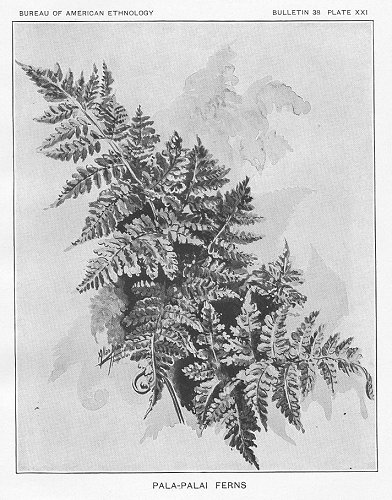
Click to enlarge
PLATE XXI
PALA-PALAI FERNS
p. 195
And now the powerful thrust of the paddle,
10 Making mighty swirl of wat’ry yeast,
As of Nihéu, the mischief-maker
A mighty swirl of the yeasty wave.
In heaven's name, come aboard!
10 Making mighty swirl of wat’ry yeast,
As of Nihéu, the mischief-maker
A mighty swirl of the yeasty wave.
In heaven's name, come aboard!
After the death of Lohiau, his best friend, Paoa, came before Pele determined to invite death by pouring out the vials of his wrath on the head of the goddess. The sisters of Pele sought to avert the impending tragedy and persuaded him to soften his language and to forego mere abuse. Paoa, a consummate actor, by his dancing, which has been perpetuated in the hula Pele, and by his skillfully-worded prayer-songs, one of which is given above, not only appeased Pele, but won her.
The piece next appearing is also a song that was a prayer, and seems to have been uttered by the same mouth that groaned forth the one given above.
It does not seem necessary to take the language of the mele literally. The sufferings that the person in the mele describes in the first person, it seems to the author, may be those of his friend Lohiau; and the first person is used for literary effect.
Mele a
Aole e mao ka ohu:
Auwe! make au i ke ahi a mau
A ka wahine moe naná,
A papa ena-ena,
5 A wa’a kau-hí.
Ilaila pepe mua me pepe waena,
O pepe ka mu’imu’i,
O lei'na kiele,
Kau-meli-eli; b
10 Ka maka kakahi kea
O Niheu kolohe--
Ka maka kaha-kai kea.
Eli-eli, kau mai!
Auwe! make au i ke ahi a mau
A ka wahine moe naná,
A papa ena-ena,
5 A wa’a kau-hí.
Ilaila pepe mua me pepe waena,
O pepe ka mu’imu’i,
O lei'na kiele,
Kau-meli-eli; b
10 Ka maka kakahi kea
O Niheu kolohe--
Ka maka kaha-kai kea.
Eli-eli, kau mai!
[Translation]
Song
Alas, there's no stay to the smoke:
I must die mid the quenchless flame--
Deed of the hag who snores in her sleep,
Bedded on lava plate oven-hot.
5 Now it takes the shape of canoe;
I must die mid the quenchless flame--
Deed of the hag who snores in her sleep,
Bedded on lava plate oven-hot.
5 Now it takes the shape of canoe;
p. 196
Seats at the bow and amidships,
And the steersman sitting astern;
Their stroke stirs the ocean to foam--
The myth-craft, Kau-meli-eli!
10 Now look, the white gleam of an eye--
It is Nihéu, the turbulent one--
An eye like the white sandy shore.
Amen, possess me!
And the steersman sitting astern;
Their stroke stirs the ocean to foam--
The myth-craft, Kau-meli-eli!
10 Now look, the white gleam of an eye--
It is Nihéu, the turbulent one--
An eye like the white sandy shore.
Amen, possess me!
The mele now to be given has the form of a serenade. Etiquette forbade anyone to wake the king by rude touch, but it was permissible for a near relative to touch his feet. When the exigencies of business made it necessary for a messenger, a herald, or a courtier to disturb the sleeping monarch, he took his station at the king's feet and recited a serenade such as this:
Mele Koala (no ka Hula Pele)
E ala, e Kahiki-ku; a
E ala, e Kahiki-moe; a
E ala, e ke apapa nu’u: b
E ala, e ke apapa lani. b
5 Eia ka hoala nou, e ka lani c la, e-e!
E ala oe!
E ala, ua ao, ua malamalama.
Aia o Kape’a ma, d la, i-luna;
Ua hiki mai ka maka o Unulau: e
E ala, e Kahiki-moe; a
E ala, e ke apapa nu’u: b
E ala, e ke apapa lani. b
5 Eia ka hoala nou, e ka lani c la, e-e!
E ala oe!
E ala, ua ao, ua malamalama.
Aia o Kape’a ma, d la, i-luna;
Ua hiki mai ka maka o Unulau: e
p. 197
10 Ke hoolale mai la ke kupa holowa’a o Ukumehame, a
Ka lae makani kaohi-wa’a o Papawai, b
Ka lae makani o Anahenahe la, e-e!
E ala oe!
E ala, ua no, ua malamalama;
15 Ke o a’e la ke kukuna o ka La i ka ili o ke kai;
Ke hahai a’e la, e like me Kumukahi c
E hoaikane ana me Makanoni;
Ka papa o Apua, ua lohi i ka La.
E ala oe!
20 E ala, ua ao, ua malamalama;
Ke kau aku la ka La i Kawaihoa
Ke kolii aku la ka La i ka ili o ke kai;
Ke anai mai la ka iwa anai-maka o Lei-no-ai,
I ka luna o Maka-iki-olea,
25 I ka poli wale o Lehua la.
E ala oe!
Ka lae makani kaohi-wa’a o Papawai, b
Ka lae makani o Anahenahe la, e-e!
E ala oe!
E ala, ua no, ua malamalama;
15 Ke o a’e la ke kukuna o ka La i ka ili o ke kai;
Ke hahai a’e la, e like me Kumukahi c
E hoaikane ana me Makanoni;
Ka papa o Apua, ua lohi i ka La.
E ala oe!
20 E ala, ua ao, ua malamalama;
Ke kau aku la ka La i Kawaihoa
Ke kolii aku la ka La i ka ili o ke kai;
Ke anai mai la ka iwa anai-maka o Lei-no-ai,
I ka luna o Maka-iki-olea,
25 I ka poli wale o Lehua la.
E ala oe!
p. 198
[Translation]
Song
Awake now, Kahiki-ku;
Awake now, Kahiki-moe;
Awake, ye gods of lower grade;
Awake, ye gods of heavenly rank.
5 A serenade to thee, O king.
Awake thee!
Awake, it is day, it is light;
The Day-god his arrows is shooting,
Unulau his eye far-flashing,
10 Canoe-men from Uku-me-hame
Are astir to weather the windy cape,
The boat-baffling cape, Papa-wai,
And the boisterous A-nahe-nahe.
Awake thee!
15 Awake, day is come and the light;
The sun-rays stab the skin of the deep;
It pursues, as did god Kumu-kahi
To companion with god Maka-noni;
The plain of Apua quivers with heat.
20 Awake thee!
Awake, ’tis day, ’tis light;
The sun stands over Waihoa,
Afloat on the breast of ocean;
The iwa of Leinoai is preening
25 On the cliff Maka-iki-olea,
On the breast of naked Lehua.
Awake thee! awake!
Awake now, Kahiki-moe;
Awake, ye gods of lower grade;
Awake, ye gods of heavenly rank.
5 A serenade to thee, O king.
Awake thee!
Awake, it is day, it is light;
The Day-god his arrows is shooting,
Unulau his eye far-flashing,
10 Canoe-men from Uku-me-hame
Are astir to weather the windy cape,
The boat-baffling cape, Papa-wai,
And the boisterous A-nahe-nahe.
Awake thee!
15 Awake, day is come and the light;
The sun-rays stab the skin of the deep;
It pursues, as did god Kumu-kahi
To companion with god Maka-noni;
The plain of Apua quivers with heat.
20 Awake thee!
Awake, ’tis day, ’tis light;
The sun stands over Waihoa,
Afloat on the breast of ocean;
The iwa of Leinoai is preening
25 On the cliff Maka-iki-olea,
On the breast of naked Lehua.
Awake thee! awake!
The following is a prayer said to have been used at the time of awa-drinking. When given in the hula, the author is informed, its recitation was accompanied by the sound of the drum.
He Pule no Pele
PALE I
O Pele la ko’u akua:
Miha ka lani, miha ka honua.
Awa iku, awa lani;
Kai awaawa, ka awa nui a Hiiaka,
5 I kua i Mauli-ola; a p. 199
He awa kapu no na wahine.
E kapu!
Ka’i kapu kou awa, e Pele a Honua-mea;
E kala, e Haumea wahine,
10 O ka wahine i Kilauea,
Nana i eli a hohonu ka lua
O Mau-wahine, o Kupu-ena,
O na wahine i ka inu-hana awa.
E ola na ’kua malihini! a
Miha ka lani, miha ka honua.
Awa iku, awa lani;
Kai awaawa, ka awa nui a Hiiaka,
5 I kua i Mauli-ola; a p. 199
He awa kapu no na wahine.
E kapu!
Ka’i kapu kou awa, e Pele a Honua-mea;
E kala, e Haumea wahine,
10 O ka wahine i Kilauea,
Nana i eli a hohonu ka lua
O Mau-wahine, o Kupu-ena,
O na wahine i ka inu-hana awa.
E ola na ’kua malihini! a
PALE II
15 I kama’a-ma’a la i ka pua-lei;
E loa ka wai apua,
Ka pii’na i Ku-ka-la-ula; b
Hoopuka aku i Puu-lena,
Aina a ke Akua i noho ai.
20 Kanaenae a ke Akua malihini; a
O ka’u wale iho la no la, o ka leo,
He leo wale no, e-e!
E ho-i!
Eia ka ai!
E loa ka wai apua,
Ka pii’na i Ku-ka-la-ula; b
Hoopuka aku i Puu-lena,
Aina a ke Akua i noho ai.
20 Kanaenae a ke Akua malihini; a
O ka’u wale iho la no la, o ka leo,
He leo wale no, e-e!
E ho-i!
Eia ka ai!
[Translation]
A Prayer to Pele
CANTO I
Lo, Pele's the god of my choice:
Let heaven and earth in silence wait
Here is awa, potent, sacred,
Bitter sea, great Hiiaka's root;
5 'Twas cut at Mauli-ola
Awa to the women forbidden,
Let it tabu be!
Exact be the rite of your awa,
O Pele of the sacred land.
Let heaven and earth in silence wait
Here is awa, potent, sacred,
Bitter sea, great Hiiaka's root;
5 'Twas cut at Mauli-ola
Awa to the women forbidden,
Let it tabu be!
Exact be the rite of your awa,
O Pele of the sacred land.
p. 200
10 Proclaim it, mother, Haumea,
Of the goddess of Kilauea;
She who dug the pit world-deep,
And Mau-wahine and Kupu-ena,
Who prepare the awa for drink.
15 A health to the stranger gods?
Of the goddess of Kilauea;
She who dug the pit world-deep,
And Mau-wahine and Kupu-ena,
Who prepare the awa for drink.
15 A health to the stranger gods?
CANTO II
Bedeck now the board for the feast;
Fill up the last bowl to the brim;
Then pour a draught in the sun-cave
Shall flow to the mellow haze,
20 That tints the land of the gods.
All hail to the stranger gods!
This my offering, simply a voice,
Only a welcoming voice.
Turn in!
25 Lo, the feast!
Fill up the last bowl to the brim;
Then pour a draught in the sun-cave
Shall flow to the mellow haze,
20 That tints the land of the gods.
All hail to the stranger gods!
This my offering, simply a voice,
Only a welcoming voice.
Turn in!
25 Lo, the feast!
This prayer, though presented in two parts or cantos, is really one, its purpose being to offer a welcome, kanaenae, to the feast and ceremony to the gods who had a right to expect that courtesy.
One more mele of the number specially used in the hula Pele:
Mele
Nou paha e, ka inoa
E ka’i-ka’i ku ana,
A kau i ka nuku.
E hapa-hapai a’e,
5 A pa i ke kihi
O Ki-lau-é-a.
Ilaila ku’u kama,
O Ku-nui-akea. a
Hookomo a’e iloko
10 A o Hale-ma’u-ma’u; b
A ma-ú na pu’u
E óla-olá nei.
E kulipe’e nui ai-ahua. c
E Pele, e Pele!
15 E Pele, e Pele!
Huai'na! huai'na!
Ku ia ka lani,
Pue a huila!
E ka’i-ka’i ku ana,
A kau i ka nuku.
E hapa-hapai a’e,
5 A pa i ke kihi
O Ki-lau-é-a.
Ilaila ku’u kama,
O Ku-nui-akea. a
Hookomo a’e iloko
10 A o Hale-ma’u-ma’u; b
A ma-ú na pu’u
E óla-olá nei.
E kulipe’e nui ai-ahua. c
E Pele, e Pele!
15 E Pele, e Pele!
Huai'na! huai'na!
Ku ia ka lani,
Pue a huila!
p. 201
[Translation]
Song
Yours, doubtless, this name,
Which people are toasting
With loudest acclaim.
Now raise it, aye raise it,
5 Till it reaches the niches
Of Kí-lau-é-a.
Enshrined is there my kinsman,
Kú-núi-akéa.
Then give it a place
10 In the temple of Pele;
And a bowl for the throats
That are croaking with thirst.
Knock-kneed eater of land,
O Pele, god Pele!
15 O Pele, god Pele!
Burst forth now! burst forth!
Launch a bolt from the sky!
Let thy lightnings fly!
Which people are toasting
With loudest acclaim.
Now raise it, aye raise it,
5 Till it reaches the niches
Of Kí-lau-é-a.
Enshrined is there my kinsman,
Kú-núi-akéa.
Then give it a place
10 In the temple of Pele;
And a bowl for the throats
That are croaking with thirst.
Knock-kneed eater of land,
O Pele, god Pele!
15 O Pele, god Pele!
Burst forth now! burst forth!
Launch a bolt from the sky!
Let thy lightnings fly!
When this poem a first came into the author's hands, though attracted by its classic form and vigorous style, he could not avoid being repelled by an evident grossness. An old Hawaiian, to whom he stated his objections, assured him that the mele was innocent of all bad intent, and when the offensive word was pointed out he protested that it was an interloper. The substitution of the right word showed that the man was correct. The offense was at once removed. This set the whole poem in a new light and it is presented with satisfaction. The mele is properly a name-song, mele-inoa. The poet represents some one as lifting a name to his mouth for praise and adulation. He tells him to take it to Kilauea--that it may reecho, doubtless, from the walls of the crater.
Footnotes
189:a Olewa. Said to be the name of a wooded region high up on the mountain of Kauai. It is here treated as if it meant the heavens or the blue ether. Its origin is the same with the word lewa, the upper regions of the air.189:b O Ahu. In this instance the article still finds itself disunited from its substantive. To-day we have Oahu and Ola’a.
189:c Kau. The summer; time of warm weather; the growing season.
190:a The figure in the second and third verses, of waves from Kahiki (nalu mai Kahiki) beating against the front of Kilauea (Po-po’i aku la i ke alo o Kilauea), seems to picture the trampling of the multitude splashing the mire as if it were, waves of ocean.
190:b Kukuena. There is some uncertainty as to who this character was; probably the same as Haumea, the mother of Pele.
191:a For an account of the Makahiki idol see Hawaiian Antiquities, p. 159, by David Maio; translated by N. B. Emerson, A. M., M. D., Honolulu, Hawaiian Gazette Company (Limited), 1903.
191:b Pou hale. The main post of a house, which is here intended, was the pou-haná; it was regarded with a superstitious reverence.
191:c A’hu o Ka-u. A reference, doubtless, to the long grass that once covered Ka-ú.
191:d I-áo. A small fish that took short flights in the air.
192:a Lele kawa. To jump in sport from a height into the water.
192:b Lele o-ó. To leap feet first into the water.
192:c O-ó lele. To dive head first into the water.
192:d Lele opuhi. The same as pahi’a, to leap obliquely into the water from a height, bending oneself so that the feet come first to the surface.
192:e Kauná. A woman of Ka-ú celebrated for her skill in the hula, also the name of a cape that reaches out into the stormy ocean.
194:a Pele is often spoken of as ka luahine, the old woman: but she frequently used her power of transformation to appear as a young woman of alluring beauty.
194:b Lava poured out in plates and folds and coils resembles may diverse things, among others the canoe, wa’a, here characterized as complete in its appointments and ready for launching, kauhí. The words are subtly intended, no doubt, to convey the thought of Pele's readiness to launch on the voyage of matrimony.
194:c Pepe, a seat; kiele, to paddle; and ulu, a shortened form of the old word oulu, meaning a paddle, are archaisms now obsolete.
194:d Nihéu. One of the mythological heroes of an old-time adventure, in which his elder brother Kana, who had the form of a long rope, played the principal part. This one enterprise of their life in which they joined forces was for the rescue of their mother, Hina, who had been kidnapped by a marauding chief and carried from her home in Hilo to the bold headland of Haupu, Molokai. Niheu is generally stigmatized as kolohe (verse 11), mischievous, for no other reason apparently than that he was an active spirit, full of courage, given to adventure and heaven-defying audacities, such as put the Polynesian Mawi and the Greek Prometheus in had odor with the gods of their times. One of these offensive actions was Nihéu's theft of a certain ulu, breadfruit, which one of the gods rolled with a noise like that of thunder in the underground caverns of the southern regions of the world. Nihéu is represented as a great sport, an athlete, skilled in all the games of his people. The worst that could be said of him was that he had small regard for other people's rights and that he was slow to pay his debts of honor.
195:a The remarks on pp. 194 and 195 regarding the mele on p. 194 are mostly applicable to this mele.
195:b Kau-meli-eli. The name of the double canoe which brought a company of the gods from the lands of the South--Kukulo o Kahiki--to Hawaii. Hawaiian myths refer to several migrations of the gods to Hawaii; one of them is that described in the mele given on p. 187, the first mele in this chapter.
196:a Hawaiians conceived of the dome of heaven as a solid structure supported by walls that rested on the earth's plain. Different names were given to different sections of the wall. Kahiki-ku and Kahiki-moe were names applied to certain of these sections. It would, however, be too much to expect any Hawaiian, however intelligent and well versed in old lore, to indicate the location of these regions.
196:b The words apapa nu’u and apapa lani, which convey to the mind of the author the picture of a series of terraced plains or steppes--no doubt the original meaning--here mean a family or order of gods, not of the highest rank, at or near the head of which stood Pele. Apropos of this subject the following lines have been quoted:
Hanau ke apapa nu’u:
Hanau ke apapa lani;
Hanau Pele, ka hihi’o na lani.
Hanau ke apapa lani;
Hanau Pele, ka hihi’o na lani.
[Translation]
Begotten were the gods of graded rank;
Begotten were the gods of heavenly rank;
Begotten was Pele, quintessence of heaven.
Begotten were the gods of heavenly rank;
Begotten was Pele, quintessence of heaven.
This same expression was sometimes used to mean an order of chiefs, alii. Apapa lani was also used to mean the highest order of gods, Ku, Kane, Kanaloa, Lono. The kings also were gods, for which reason this expression at times applied to the alii of highest rank, those, for instance, who inherited the rank of niau-pi’o or of wohi.
196:c Lani. Originally the heavens, came to mean king. chief, alii.
196:d There is a difference of opinion as to the meaning of Kape’a ma. After hearing diverse opinions the author concludes that it refers to the rays of the sun that precede its rising--a Greek idea.
196:e Unulau. A name for the trade-wind which, owing to the conformation of the land, often sweeps down with great force through the deep valleys that seam the mountains of west Maui between Lahaina and Maalaea bay; such a wind squall was called a mumuku.
197:a Ukumehame. The name of a deep valley on west Maui in the region above described.
197:b Papawai. The principal cape on west Maui between Lahaina and Maalaea bay.
197:c Kumu-kahi. A cape in Puna, the easternmost part of Hawaii; by some said to be the sun's wife, and the object of his eager pursuit after coming out of his eastern gate Ha’eha’e. The name was also applied to a pillar of stone that was planted on the northern border of this cape. Standing opposite to it, on the southern side, was the monolith Makanoni. In summer the sun in its northern excursion inclined, as the Hawaiians noted, to the side of Kumukahi, while in the season of cool weather, called Makalii, it swung in the opposite direction and passed over to Makanoni. The people of Puna accordingly said, "The sun has passed over to Makanoni," or "The sun has passed over to Kumukahi," as the case might be. These two pillars are said to be of such a form as to suggest the thought that they are phallic emblems, and this conjecture is strengthened by consideration of the tabus connected with them and of the religious ceremonies performed before them. The Hawaiians speak of them as pohaku eho, which, the author believes, is the name given to a phallus, and describe them as plain uncarved pillars.
These stones were set up in very ancient times and are said to have been tabu to women at the times of their infirmity. If a woman climbed upon them at such a period or even set foot upon the platform on which one of them stood she was put to death. Another stringent tabu forbade anyone to perform an office of nature while his face was turned toward one of these pillars.
The language of the mele, Ke hahai ae la e like me Kumukahi (verse 16), implies that the sun chased after Kumukahi. Apropos of this is the following quotation from an article on the phallus in Chambers's Encyclopedia: "The common myth concerning it [the phallus] was the story of some god deprived of his power of generation--an allusion to the sun, which in autumn loses its fructifying influence."
In modern times there seems to have grown up a curious mixture of traditions about these two stones, in which the old have become overlaid with new superstitions; and these last in turn seem to be dying out. They are now vaguely remembered as relics of old demigods, petrified forms of ancient kupua. 1 Fishermen, it is said, not long ago offered sacrifices to them, hoping thus to purchase good luck. Any offense against them, such as that by women, above mentioned, or by men, was atoned for by offering before these ancient monuments the first fish that came to the fisherman's hook or net.
Mention of the name Kumu-kahi to a Hawaiian versed in ancient lore called up to his memory the name of Pala-moa as his associate. The account this old man gave of them was that they were demigods much worshiped and feared for their power and malignity. They were reputed to be cannibals on the sly, and, though generally appearing in human form, were capable of various metamorphoses, thus eluding detection. They were believed to have the power of taking possession of men through spiritual obsession, as a result of which the obsessed ones were enabled to heal sickness as well as to cause it, to reveal secrets, and to inflict death, thus terrifying people beyond measure. The names of these two demigods, especially that of Palamoa, are to this day appealed to by practitioners of the black arts.
197:1 The Hawaiian alphabet had no letter s. The Hawaiians indicated the plural by prefixing the particle na.
198:a Mauli-ola. A god of health; perhaps also the name of a place. The same word also was applied to the breath of life, or to the physician's power of healing. In the Maori tongue the word mauri, corresponding to mauli, means life. the seat of life. In Samoan the word mauli means heart. "Sneeze, living heart " (Tihe mauri ora), says the Maori mother to her infant when it sneezes. For this bit of Maori lore acknowledgment is due to Mr. S. Percy Smith, of New Zealand.
199:a According to one authority, at the close of the first canto the stranger gods--akua malihini--who consisted of that multitude of godlings called the Kini Akua, took their departure from the ceremony, since they did not belong to the Pele family. Internal evidence, however, the study of the prayer itself in its two parts, leads the writer to disagree with this authority. Other Hawaiians of equally deliberate judgment support him in this opinion. The etiquette connected with ceremonious awa-drinking, which the Samoans of to-day still maintain in full form, long ago died out in Hawaii. This etiquette may never have been cultivated here to the same degree as in its home, Samoa; but this poem is evidence that the ancient Hawaiians paid greater attention to it than they of modern times. The reason for this decline of ceremony must be sought for in the mental and esthetic make-up of the Hawaiian people; it was not due to any lack of fondness in the Hawaiian for awa as a beverage or as an intoxicant. It is no help to beg the question by ascribing the decline of this etiquette to the influence of social custom. To do so would but add one more link to the chain that binds cause to effect. The Hawaiian mind was not favorable to the observance of this sort of etiquette; it did not afford a soil fitted to nourish such an artificial growth.
199:b The meaning of the word Ku-ka-la-ula presented great difficulty and defied all attempts at translation until the suggestion was made by a bright Hawaiian, which was adopted with satisfaction, that it probably referred to that state of dreamy mental exaltation which comes with awa-intoxication. This condition, like that of frenzy, of madness, and of idiocy, the Hawaiian regarded as a divine possession.
200:a Kalakaua, for whom all these fine words are intended, could no more claim kinship with Ku-nui-akea, the son of Kau-i-ke-aouli, than with Julius Caesar.
200:b Hale-mau-mau. Used figuratively of the mouth, whose hairy fringe--moustache and beard--gives it a fancied resemblance to the rough lava pit where Pele dwelt. The figure, to us no doubt obscure, conveyed to the Hawaiian the idea of trumpeting the name and making it famous.
200:c E kuli-pe’e nui ai-ahua. Pele is here figured as an old, infirm woman, crouching and crawling along; a character and attitude ascribed to her, no doubt, from the fancied resemblance of a lava flow, which, when in the form of a-á, rolls and tumbles along over the surface of the ground in a manner suggestive of the motions and attitude of a palsied crone.
201:a It is said to be the work of a hula-master, now some years dead, by the name of Namakeelua.

No comments:
Post a Comment