Finding Aid for
Ko‘olau, a cowboy, trainer of horses, and expert marksman, was born in Kekaha, Kaua‘i in 1862. Ko‘olau and Pi‘ilani, who were childhood sweethearts, married. Together they had a son, Kaleimanu. Then Ko‘olau contracted leprosy -- the dread disease for which there was no cure.
In 1893, a Provisional Government army of thirty-five men traveled to Kaua‘i to capture lepers who resisted being sent to the hated Moloka‘i settlement -- Hawaiians called it "the grave of living death." They captured twenty-seven but Ko‘olau escaped. The authorities, who earlier had told Ko‘olau that his wife could accompany him into exile on Moloka‘i as a kokua, a helper, then told him she couldn’t. Ko‘olau refused to be parted from Pi‘ilani and vowed he would never be taken alive.
The little family -- husband, wife, child -- took refuge in the remote and rugged Kalalau Valley. Resisting the men sent to capture him, Ko‘olau shot and killed Deputy Sheriff Louis Stolz and two soldiers. The "P.G" army gave up the search. The family hid out for four years, living off the land and assistance from the few Hawaiian families in the region. Kaleimanu contracted leprosy and died, and Ko‘olau and Pi‘ilani buried him. Then Ko‘olau died.
Now alone, Pi‘ilani buried her husband. She emerged from the valley in 1897, sure that the government would punish or even jail her. But they didn’t. Pi‘ilani composed a long poem in Hawaiian of this event. Others tried to tell the story, but hers is the only "True Account." A translation by Francis N. Frazier of Kaua‘i was published in the 1987 Hawaiian Journal of History. At the end of the poem, Pi‘ilani wrote of Ko‘olau and Kaleimanu, "They sleep in the bosom of Kalalau but will live again in living memories."
Journalist Kahikina Sheldon recorded Pi‘ilani's story and published it, in Hawaiian, in 1906. The lament referred to above serves, in fact, as an introduction to the detailed prose account that Pi‘ilani shared with Sheldon. Their 1906 puke is long out of print, but readers interested in the complete story are directed to the Kaua‘i Historical Society's recent republication of that work: The True Story of Kaluaikoolau as Told by his Wife, Piilani: Translated from the Hawaiian Language by Frances N. Frazier.
 Mele that were written for Ko‘olau and published in Buke Mele Lahui include "Koolau Ki Pololei" and "Ai-Manu Koolau."
The choice of a site was a matter of prime importance. A formidable code enunciated the principles governing the selection. But a matter of great solicitude--there were omens to be heeded, snares and pitfalls devised by the superstitious mind for its own entanglement. The untimely sneeze, the ophthalmic eye, the hunched back were omens to be shunned.
Within historic times, since the abrogation of the tabu system and the loosening of the old polytheistic ideas, there has been in the hula a lowering of former standards, in some respects a degeneration. The old gods, however, were not entirely dethroned; the people of the hula still continued to maintain the form of divine service and still appealed to them for good luck; but the soul of worship had exhaled, the main study now was to make of the hula a pecuniary success.
In an important sense the old way was in sympathy with the thought, "Except God be with the workmen, they labor in vain that build the house." The means for gaining divine favor and averting the frown of the gods were those practised by all religionists in the infantile state of the human mind-the observance of fasts and tabus, the offering of special prayers and sacrifices. The ceremonial purification of the site, or of the building if it had been used for profane purposes, was accomplished by aspersions with sea water mixed with turmeric or red earth.
p. 15
When one considers the tenacious hold which all rites and ceremonies growing out of what we are accustomed to call superstitions had on the mind of the primitive Hawaiian, it puzzles one to account for the entire dropping out from modern memory of the prayers which were recited during the erection of a hall for the shelter of an institution so festive and so popular as the hula, while the prayers and gloomy ritual of the temple service have survived. The explanation may be found, perhaps, in the fact that the priests of the temple held position by the sovereign's appointment; they formed a hierarchy by themselves, whereas the position of the kumu-hula, who was also a priest, was open to anyone who fitted himself for it by training and study and bypassing successfully the ai-lolo a ordeal. After that he had the right to approach the altar of the hula god with the prescribed offerings and to present the prayers and petitions of the company to Laka or Kapo.
In pleasing contrast to the worship of the heiau, the service of the hula was not marred by the presence of groaning victims and bloody sacrifices. Instead we find the offerings to have been mostly rustic tokens, things entirely consistent with light-heartedness, joy, and ecstasy of devotion, as if to celebrate the fact that heaven had come down to earth and Pan, with all the nymphs, was dancing.
During the time the halau was building the tabus and rules that regulated conduct were enforced with the utmost strictness. The members of the company were required to maintain the greatest propriety of demeanor, to suppress all rudeness of speech and manner, to abstain from all carnal indulgence, to deny themselves specified articles of food, and above all to avoid contact with a corpse. If anyone, even by accident, suffered such defilement, before being received again into fellowship or permitted to enter the halau and take part in the exercises he must have ceremonial cleansing (huikala). The kumu offered up prayers, sprinkled the offender with salt water and turmeric, commanded him to bathe in the ocean, and he was clean. If the breach of discipline was gross and willful, an act of outrageous violence or the neglect of tabu, the offender could be restored only after penitence and confession.
p. 16
assemblage of wild youth who might see fit to take the work in hand. There were formalities that must be observed, songs to be chanted, prayers to be recited. It was necessary to bear in mind that when one deflowered the woods of their fronds of íe-íe and fern or tore the trailing lengths of maile--albeit in honor of Laka herself--the body of the goddess was being despoiled, and the despoiling must be done with all tactful grace and etiquette.
It must not be gathered from this that the occasion was made solemn and oppressive with weight of ceremony, as when a temple was erected or as when a tabu chief walked abroad, and all men lay with their mouths in the dust. On the contrary, it was a time of joy and decorous exultation, a time when in prayer-songs and ascriptions of praise the poet ransacked all nature for figures and allusions to be used in caressing the deity.
The following adulatory prayer (kánaenáe) in adoration of Laka was recited while gathering the woodland decorations for the altar. It is worthy of preservation for its intrinsic beauty, for the spirit of trustfulness it breathes. We remark the petitions it utters for the growth of tree and shrub, as if Laka had been the alma mater under whose influence all nature budded and rejoiced.
It would seem as if the physical ecstasy of the dance and the sensuous joy of all nature's finery had breathed their spirit into the aspiration and that the beauty of leaf and flower, all of them familiar forms of the god's metamorphosis--accessible to their touch and for the regalement of their senses--had brought such nearness and dearness of affection between goddess and worshiper that all fear was removed.
p. 17
p. 18
The cult of god Lono was milder, more humane, than that of Kane and the other major gods. No human sacrifices were offered on his altars. The statement in verse 26 accords with the general belief of the Hawaiians that Lono dwelt in foreign parts, Kukulu o Kahiki, and that he would some time come to them from across the waters. When Captain Cook arrived in his ships, the Hawaiians worshiped him as the god Lono.
The following song-prayer also is one that was used at the gathering of the greenery in the mountains and during the building of the altar in the halau. When recited in the halau all the pupils took part, and the chorus was a response in which the whole assembly in the halau were expected to join:
p. 19
Click to enlarge
PLATE II
ÍE-ÍE (FREYCINETIA ARNOTTI) LEAVES AND FRUIT
The wildwoods of Hawaii furnished in great abundance and variety small poles for the framework of the kuahu, the altar, the holy place of the halau, and sweet-scented leaves and flowers suitable for its decoration. A spirit of fitness, however, limited choice among these to certain species that were deemed acceptable to the goddess because they were reckoned as among her favorite forms of metamorphosis. To go outside this ordained and traditional range would have been an offense, a sacrilege. This critical spirit would have looked with the greatest disfavor on the practice that in modern times has crept in, of bedecking the dancers with garlands of roses, pinks, jessamine, and other nonindigenous flowers, as being utterly repugnant to the traditional spirit of the hula.
Among decorations approved and most highly esteemed stood preeminent the fragrant maile (pl. IV) and the star-like fronds and ruddy drupe of the íe-íe (pl. II) and its kindred, the hála-pépe (pl. III); the scarlet pompons of the lehúa (pl. XIII) and ohi’a, with the fruit of the latter (the mountain-apple); many varieties of fern, including that splendid parasite, the "bird's nest fern" (ekáha), hailed by
p. 20
the Hawaiians as Mawi's paddle; to which must be added the commoner leaves and lemon-colored flowers of the native hibiscus, the hau, the breadfruit, the native banana and the dracæna (ti), plate V; and lastly, richest of all, in the color that became Hawaii's favorite, the royal yellow ilíma (pl. VI), a flower familiar to the eves of the tourist to Honolulu.
While deft hands are building and weaving the light framework of the kuahu, binding its parts with strong vines and decorating it with nature's sumptuous embroidery, the kumu, or teacher, under the inspiration of the deity for whose residence he has prepared himself by long vigil and fasting with fleshly abstinence, having spent the previous night alone in the halau, is chanting or cantillating his adulatory prayers, kanaenae--songs of praise they seem to be--to the glorification of the gods and goddesses who are invited to bless the occasion with their presence and inspiration, but especially of that one, Laka, whose bodily presence is symbolized by a rude block of wood arrayed in yellow tapa that is set up on the altar itself. Thus does the kumu sing:
p. 21
The prayers which the hula folk of old times chanted while gathering the material in the woods or while weaving it into shape in the halau for the construction of a shrine did not form a rigid liturgy; they formed rather a repertory as elastic as the sighing of the breeze, or the songs of the birds whose notes embroidered the pure mountain air. There were many altar-prayers, so that if a prayer came to an end before the work was done the priest had but to begin the recitation of another prayer, or, if the spirit of the occasion so moved him, he would take up again a prayer already repeated, for until the work was entirely accomplished the voice of prayer must continue to be heard.
The pule now to be given seems to be specially suited to that portion of the service which took place in the woods at the gathering of the poles and greenery. It was designed specially for the placating of the little god-folk who front their number were addressed as Kini o ke Akua, the multitude of the little gods, and who were the counterparts in old Hawaii of our brownies, elfins, sprites, kobolds, gnomes, and other woodland imps. These creatures, though dwarfish and insignificant in person, were in such numbers--four thousand, forty thousand, four hundred thousand--and were so impatient of any invasion of their territory, so jealous of their prerogatives, so spiteful and revengeful when injured, that it was policy always to keep on the right side of them.
p. 22
From one point of view these pule are not to be regarded as prayers in the ordinary sense of the word, but rather as song-offerings, verbal bouquets, affectionate sacrifices to the gods.
16:a Wao-kéle. That portion of the mountain forest where grew the monarch trees was called wao-kele or wao-maukele.
16:b Na Kane. Why was the offering, the black roast porkling, said to be for Kane, who was not a special patron, au-makúa, of the hula? The only answer the author has been able to obtain from any Hawaiian is that, though Kane was not a god of the hula, he was a near relative. On reflection, the author can see a propriety in devoting the reeking flesh of the swine to god Kane, while to the sylvan deity, Laka, goddess of the peaceful hula, were devoted the rustic offerings that were the embodiment of her charms. Her Image, or token--an uncarved block of wood--was set up in a prominent part of the kuahu, and at the close of a performance the wreaths that had been worn by the actors were draped about the image. Thus viewed, there is a delicate propriety and significance In such disposal of the pig.
17:a Maka-li’i (Small eyes). The Pleiades; also the period of six months, including the rainy season, that began some time in October or November and was reckoned from the date when the Pleiades appeared in the East at sunset. Maka-li’i was also the name of a month, by some reckoned as the first month of the year.
17:b Maka-léi. The name of a famous mythological tree which had the power of attracting fish. It did not poison, but only bewitched or fascinated them. There were two trees bearing this name, one a male, the other a female, which both grew at a place in Hilo called Pali-uli. One of these, the female, was, according to tradition, carried from its root home to the fish ponds in Kailua, Oahu, for the purpose of attracting fish to the neighboring waters. The enterprise was eminently successful.
17:c Po. Literally night; the period in cosmogony when darkness and chaos reigned, before the affairs on earth had become settled under the rule of the gods. Here the word is used to indicate a period of remote mythologic antiquity. The use of the word Po in the following verse reminds one of the French adage, "La nuit porte conseil."
17:d Kokúa. Another form for kakúa, to gird on, the pa-ú. (See Pa-ú song, pp. 51-53.)
17:e Uníki, A word not given in the dictionary. The debut of an actor at the hula, after passing the ai-lolo test and graduating from the school of the halau, a critical event.
17:f Ha-íke-íke. Equivalent to ho-íke-íke, an exhibition, to exhibit.
17:g Ou-alii. The Hawaiians seem to have lost the meaning of this word. The author has been at some pains to work it out somewhat conjecturally.
17:h E Lono, e hu’ ia mai, etc. The unelided form of the word hu’ would be hui. The final i is dropped before the similar vowel of ia.
17:i Kukúlu o Kahíki. The pillars of Kahiki. The ancient Hawaiians supposed the starry heavens to be a solid dome supported by a wall or vertical construction--kukulu--set up along the horizon. That section of the wall that stood over against Kahiki they termed Kukulu o Kahiki. Our geographical name Tahiti is of course from Kahiki, though it does not apply to the same region. After the close of what has been termed "the period of intercourse," which came probably during the twelfth and thirteenth centuries, and during which the ancient Hawaiians voyaged to and fro between Hawaii and the lands of the South, geographical ideas became hazy and the term Kahiki came to be applied to any foreign country.
17:j Áno-ái. An old form of salutation, answering In general to the more modern word aloha, much used at the present time. Ano-ai seems to have had a shade of meaning more nearly answering to our word "welcome." This is the first instance the author has met with of its use in poetry.
19:a Hoo-ulu. This word has a considerable range of meaning, well illustrated in this mele. In its simplest form, ulu, it means to grow, to become strong. Joined with the causative hoo, as here, it takes on the spiritual meaning of causing to prosper, of inspiring. The word "collect," used in the translation, has been chosen to express the double sense of gathering the garlands and of devoting them to the goddess as a religious offering. In the fourth verse this word, hooulu, is used in the sense of to heal. Compare note c.
19:b Hiiaka. The youngest sister of Pele, often spoken of as Hiiaka-i-ka-poli-o-Pele, Hiiaka-of-the-bosom-of-Pele. Why she should be spoken of as capable of healing diseases is not at all clear.
19:c Ulu. Here we have the word ulu in its simple, uncombined form, meaning to enter into and inspire.
20:a Ilio nana e hae. The barking of a dog, the crowing of a cock, the grunting of a pig, the hooting of an owl, or any such sound occurring at the time of a religious solemnity, aha, broke the spell of the incantation and vitiated the ceremony. Such an untimely accident was as much deprecated as were the Turk, the Comet, and the Devil by pious Christian souls during the Middle Ages.
20:b Lau-ki. The leaf of the ti plant--the same as the ki--(Dracæna terminalis), much used as an emblem of divine power, a charm or defense against malign spiritual Influences. The kahuna often wore about his neck a fillet of this leaf. The ti leaf was a special emblem of Ha’i-wahine, or of Li’a-wahine. It was much used as a decoration about the halau.
20:c Ha’i-ka-manawa. It is conjectured that this is the same as Ha’i-wahine. She was a mythological character, about whom there is a long and tragic story.
21:a Kini o ke Akua. See note d, p. 24.
Next: III.--The Gods of the Hula
Translated from the Hawaiian Language by
FRANCES N. FRAZIER
Kaua’i Historical Society
MS 40 Kaluaikoolau p.2
MS40
True Story of Kaluaikoolau as Told by his Wife, Piilani
.75 cubic feet (2 boxes)
Abstract
This collection is comprised of the working papers of the Kaua’i Historical Society’s Publications Committee in obtaining all necessary grants, permissions, copyright information, contracts with the University of Hawaii Press, and arrangements for publishing the manuscript entitled The True Story of Kaluaikoolau as Told by his
This publication is translated from the Hawaiian language by Frances N. Frazier. It includes both the original Hawaiian language version, followed by the English translation. Ms. Frazier, author and Hawaiian scholar, had previously published the English translation in the
Wife, Piilani.
Hawaiian Journal of History (1987 v.21, p.1-41). Historical Background
In 1892, after being diagnosed with Leprosy, Kaluaikoolau fled into the Kalalau Valley of Kaua’i with his son, also a leper. This remote valley was a refuge for several dozen afflicted with Leprosy who choose to live in the valley with the aid of family and friends, rather than be confined to the Leper colony on Molokai.
In 1893, Kaluaikoolau killed a sheriff and two soldiers who had been sent to capture all the lepers for not submitting to exile on Molokai. Later attempts to capture Kaluaikoolau also failed. His son died in 1896, and he died two months later. Piilani, his wife, buried Kaluaikoolau with his rifle, and lived in the valley herself for several years, later returning to the residence of her mother-in-law, Kukui, in Kekaha. Piilani died on September 14, 1914, in Waimea, Kauai.
Piilani told the story to John Kahikina Sheldon, who published it in 1906, in the Hawaiian language.
The story of Kaluaikoolau (who is also referred to as "Kauai" and "Kaluai") has been told by several well-known authors over the years. C.B. Hofgaard’s "The Story of Piilani" was presented to the Kauai Historical Society in 1916 – Hofgaard had hunted, fished and been a paniolo with Kaluaikoolau; this paper was later published in KHS’s Kaluaikoolau p.3
publication Kauai Papers. Jack London’s version of the story is perhaps the most widely known, detailing the shooting and cannonading that occurred.
Scope and Content
Robert J. Schleck, then Chairman of the Publications Committee of the Kauai Historical Society, and other members of the committee worked on this project from conception until publication. Dr. John M. Lydgate, then the Society’s President, secured the necessary grants, and sent letters of thanks with advance copies to donors who helped fund the project. Mary Requilman, Executive Director of KHS, provided support for the project, along with several volunteers.
Materials included in this manuscript also include news releases, corrections, additions, price estimates, and the printout of the final text, final corrections, and dust jacket.
Kaua’i Historical Society Accession no. 2004.029
Processed in 2007 by Robert D. Stevens
Technical support by Rhea Palma Kaluaikoolau p.4
CONTAINER LIST
Box Folder
1 1 Publication grants -- requests and acknowledgements
2 Contract: Frances N. Frazier and Kaua’i Historical Society
3 Contract: Kaua’i Historical Society and U. of Hawaii Press
4 Copies: original work, translation, photos; floppy discs
5 Correspondence with Lucille Aono, corrections, cost estimates
6 Printout of final text and dust jacket, final corrections
7 Miscellaneous working papers
8 Frances N. Frazier biographical material
9 Press release, luncheon, Lucille Aono advance copies
10 Frances N. Frazier – copyright
11 Photos and slides
Ko‘olau and Pi‘ilani: A Leper and his Wife
|
| Mele that were written for Ko‘olau and published in Buke Mele Lahui include "Koolau Ki Pololei" and "Ai-Manu Koolau." |
In 1893, a Provisional Government army of thirty-five men traveled to Kaua‘i to capture lepers who resisted being sent to the hated Moloka‘i settlement -- Hawaiians called it "the grave of living death." They captured twenty-seven but Ko‘olau escaped. The authorities, who earlier had told Ko‘olau that his wife could accompany him into exile on Moloka‘i as a kokua, a helper, then told him she couldn’t. Ko‘olau refused to be parted from Pi‘ilani and vowed he would never be taken alive.
The little family -- husband, wife, child -- took refuge in the remote and rugged Kalalau Valley. Resisting the men sent to capture him, Ko‘olau shot and killed Deputy Sheriff Louis Stolz and two soldiers. The "P.G" army gave up the search. The family hid out for four years, living off the land and assistance from the few Hawaiian families in the region. Kaleimanu contracted leprosy and died, and Ko‘olau and Pi‘ilani buried him. Then Ko‘olau died.
Now alone, Pi‘ilani buried her husband. She emerged from the valley in 1897, sure that the government would punish or even jail her. But they didn’t. Pi‘ilani composed a long poem in Hawaiian of this event. Others tried to tell the story, but hers is the only "True Account." A translation by Francis N. Frazier of Kaua‘i was published in the 1987 Hawaiian Journal of History. At the end of the poem, Pi‘ilani wrote of Ko‘olau and Kaleimanu, "They sleep in the bosom of Kalalau but will live again in living memories."
Journalist Kahikina Sheldon recorded Pi‘ilani's story and published it, in Hawaiian, in 1906. The lament referred to above serves, in fact, as an introduction to the detailed prose account that Pi‘ilani shared with Sheldon. Their 1906 puke is long out of print, but readers interested in the complete story are directed to the Kaua‘i Historical Society's recent republication of that work: The True Story of Kaluaikoolau as Told by his Wife, Piilani: Translated from the Hawaiian Language by Frances N. Frazier.
Mele that were written for Ko‘olau and published in Buke Mele Lahui include "Koolau Ki Pololei" and "Ai-Manu Koolau."II.--THE HALAU; THE KUAHU--THEIR DECORATION AND CONSECRATION
THE HALAU
In building a halau, or hall, in which to perform the hula a Hawaiian of the old, old time was making a temple for his god. In later and degenerate ages almost any structure would serve the purpose; it might be a flimsy shed or an extemporaneous lanai such as is used to shelter that al fresco entertainment, the luau. But in the old times of strict tabu and rigorous etiquette, when the chief had but to lift his hand and the entire population of a district ransacked plain, valley, and mountain to collect the poles, beams, thatch, and cord stuff; when the workers were so numerous that the structure grew and took shape in a day, we may well believe that ambitious and punctilious patrons of the hula, such as La’a, Liloa, or Lono-i-ka-makahiki, did not allow the divine art of Laka to house in a barn.The choice of a site was a matter of prime importance. A formidable code enunciated the principles governing the selection. But a matter of great solicitude--there were omens to be heeded, snares and pitfalls devised by the superstitious mind for its own entanglement. The untimely sneeze, the ophthalmic eye, the hunched back were omens to be shunned.
Within historic times, since the abrogation of the tabu system and the loosening of the old polytheistic ideas, there has been in the hula a lowering of former standards, in some respects a degeneration. The old gods, however, were not entirely dethroned; the people of the hula still continued to maintain the form of divine service and still appealed to them for good luck; but the soul of worship had exhaled, the main study now was to make of the hula a pecuniary success.
In an important sense the old way was in sympathy with the thought, "Except God be with the workmen, they labor in vain that build the house." The means for gaining divine favor and averting the frown of the gods were those practised by all religionists in the infantile state of the human mind-the observance of fasts and tabus, the offering of special prayers and sacrifices. The ceremonial purification of the site, or of the building if it had been used for profane purposes, was accomplished by aspersions with sea water mixed with turmeric or red earth.
p. 15
When one considers the tenacious hold which all rites and ceremonies growing out of what we are accustomed to call superstitions had on the mind of the primitive Hawaiian, it puzzles one to account for the entire dropping out from modern memory of the prayers which were recited during the erection of a hall for the shelter of an institution so festive and so popular as the hula, while the prayers and gloomy ritual of the temple service have survived. The explanation may be found, perhaps, in the fact that the priests of the temple held position by the sovereign's appointment; they formed a hierarchy by themselves, whereas the position of the kumu-hula, who was also a priest, was open to anyone who fitted himself for it by training and study and bypassing successfully the ai-lolo a ordeal. After that he had the right to approach the altar of the hula god with the prescribed offerings and to present the prayers and petitions of the company to Laka or Kapo.
In pleasing contrast to the worship of the heiau, the service of the hula was not marred by the presence of groaning victims and bloody sacrifices. Instead we find the offerings to have been mostly rustic tokens, things entirely consistent with light-heartedness, joy, and ecstasy of devotion, as if to celebrate the fact that heaven had come down to earth and Pan, with all the nymphs, was dancing.
During the time the halau was building the tabus and rules that regulated conduct were enforced with the utmost strictness. The members of the company were required to maintain the greatest propriety of demeanor, to suppress all rudeness of speech and manner, to abstain from all carnal indulgence, to deny themselves specified articles of food, and above all to avoid contact with a corpse. If anyone, even by accident, suffered such defilement, before being received again into fellowship or permitted to enter the halau and take part in the exercises he must have ceremonial cleansing (huikala). The kumu offered up prayers, sprinkled the offender with salt water and turmeric, commanded him to bathe in the ocean, and he was clean. If the breach of discipline was gross and willful, an act of outrageous violence or the neglect of tabu, the offender could be restored only after penitence and confession.
THE KUAHU
In every halau stood the kuahu, or altar, as the visible temporary abode of the deity, whose presence was at once the inspiration of the performance and the luck-bringer of the enterprise--a rustic frame embowered in greenery. The gathering of the green leaves and other sweet finery of nature for its construction and decoration was a matter of so great importance that it could not be intrusted to any chancep. 16
assemblage of wild youth who might see fit to take the work in hand. There were formalities that must be observed, songs to be chanted, prayers to be recited. It was necessary to bear in mind that when one deflowered the woods of their fronds of íe-íe and fern or tore the trailing lengths of maile--albeit in honor of Laka herself--the body of the goddess was being despoiled, and the despoiling must be done with all tactful grace and etiquette.
It must not be gathered from this that the occasion was made solemn and oppressive with weight of ceremony, as when a temple was erected or as when a tabu chief walked abroad, and all men lay with their mouths in the dust. On the contrary, it was a time of joy and decorous exultation, a time when in prayer-songs and ascriptions of praise the poet ransacked all nature for figures and allusions to be used in caressing the deity.
The following adulatory prayer (kánaenáe) in adoration of Laka was recited while gathering the woodland decorations for the altar. It is worthy of preservation for its intrinsic beauty, for the spirit of trustfulness it breathes. We remark the petitions it utters for the growth of tree and shrub, as if Laka had been the alma mater under whose influence all nature budded and rejoiced.
It would seem as if the physical ecstasy of the dance and the sensuous joy of all nature's finery had breathed their spirit into the aspiration and that the beauty of leaf and flower, all of them familiar forms of the god's metamorphosis--accessible to their touch and for the regalement of their senses--had brought such nearness and dearness of affection between goddess and worshiper that all fear was removed.
He kánaenáe no Laka
A ke kua-hiwi, i ke kua-lono,
Ku ana o Laka i ka mauna;
Noho ana o Laka i ke po’o o ka ohu.
O Laka kumu hula,
5 Nana i a’e ka wao-kele, a
Kahi, kahi i moli’a i ka pua’a,
I ke po’o pua’a,
He pua’a hiwa na Kane. b
Ku ana o Laka i ka mauna;
Noho ana o Laka i ke po’o o ka ohu.
O Laka kumu hula,
5 Nana i a’e ka wao-kele, a
Kahi, kahi i moli’a i ka pua’a,
I ke po’o pua’a,
He pua’a hiwa na Kane. b
p. 17
He kane na Laka,
10 Na ka wahine i oni a kelakela i ka lani:
I kupu ke a’a i ke kumu,
I lau a puka ka mu’o,
Ka liko, ka ao i-luna.
Kupu ka lala, hua ma ka Hikina;
15 Kupu ka lala ona a Maka-li’i, a
O Maka-lei, b laau kaulana mai ka Po mai. c
Mai ka Po mai ka oiaio--
I ho-i’o i-luna, i o’o i-luna.
He luna au e ki’i mai nei ia oe, e Laka,
20 E ho’i ke ko-kua d pa-ú;
He la uniki e e no kaua;
Ha-ike-ike f o ke Akua;
Hoike ka mana o ka Wahine,
O Laka, kaikuahine,
25 Wahine a Lono, i ka ou-alii. g
E Lono, e hu’ h ia mai ka lani me ka honua.
Nou okoa Kukulu o Kahiki. i
Me ke ano-ai j aloha, e!
E ola, e!
10 Na ka wahine i oni a kelakela i ka lani:
I kupu ke a’a i ke kumu,
I lau a puka ka mu’o,
Ka liko, ka ao i-luna.
Kupu ka lala, hua ma ka Hikina;
15 Kupu ka lala ona a Maka-li’i, a
O Maka-lei, b laau kaulana mai ka Po mai. c
Mai ka Po mai ka oiaio--
I ho-i’o i-luna, i o’o i-luna.
He luna au e ki’i mai nei ia oe, e Laka,
20 E ho’i ke ko-kua d pa-ú;
He la uniki e e no kaua;
Ha-ike-ike f o ke Akua;
Hoike ka mana o ka Wahine,
O Laka, kaikuahine,
25 Wahine a Lono, i ka ou-alii. g
E Lono, e hu’ h ia mai ka lani me ka honua.
Nou okoa Kukulu o Kahiki. i
Me ke ano-ai j aloha, e!
E ola, e!
p. 18
[Translation]
A Prayer of Adulation to Laka
In the forests, on the ridges
Of the mountains stands Laka;
Dwelling In the source of the mists.
Laka, mistress of the hula,
5 Has climbed the wooded haunts of the gods,
Altars hallowed by the sacrificial swine,
The head of the boar, the black boar of Kane.
A partner he with Laka;
Woman, she by strife gained rank in heaven.
10 That the root may grow from the stem,
That the young shoot may put forth and leaf,
Pushing up the fresh enfolded bud,
The scion-thrust bud and fruit toward the East,
Like the tree that bewitches the winter fish,
15 Maka-lei, tree famed from the age of night.
Truth is the counsel of night--
May it fruit and ripen above.
A messenger I bring you, O Laka,
To the girding of paú.
20 An opening festa this for thee and me;
To show the might of the god,
The power of the goddess,
Of Laka, the sister,
To Lono a wife in the heavenly courts.
25 O Lono, join heaven and earth!
Thine alone are the pillars of Kahiki.
Warm greeting, beloved one,
We hail thee!
In the forests, on the ridges
Of the mountains stands Laka;
Dwelling In the source of the mists.
Laka, mistress of the hula,
5 Has climbed the wooded haunts of the gods,
Altars hallowed by the sacrificial swine,
The head of the boar, the black boar of Kane.
A partner he with Laka;
Woman, she by strife gained rank in heaven.
10 That the root may grow from the stem,
That the young shoot may put forth and leaf,
Pushing up the fresh enfolded bud,
The scion-thrust bud and fruit toward the East,
Like the tree that bewitches the winter fish,
15 Maka-lei, tree famed from the age of night.
Truth is the counsel of night--
May it fruit and ripen above.
A messenger I bring you, O Laka,
To the girding of paú.
20 An opening festa this for thee and me;
To show the might of the god,
The power of the goddess,
Of Laka, the sister,
To Lono a wife in the heavenly courts.
25 O Lono, join heaven and earth!
Thine alone are the pillars of Kahiki.
Warm greeting, beloved one,
We hail thee!
The cult of god Lono was milder, more humane, than that of Kane and the other major gods. No human sacrifices were offered on his altars. The statement in verse 26 accords with the general belief of the Hawaiians that Lono dwelt in foreign parts, Kukulu o Kahiki, and that he would some time come to them from across the waters. When Captain Cook arrived in his ships, the Hawaiians worshiped him as the god Lono.
The following song-prayer also is one that was used at the gathering of the greenery in the mountains and during the building of the altar in the halau. When recited in the halau all the pupils took part, and the chorus was a response in which the whole assembly in the halau were expected to join:
Pule Kuahu no Laka
Haki pu o ka nahelehele,
Haki hana maile o ka wao,
Haki hana maile o ka wao,
p. 19
Click to enlarge
PLATE II
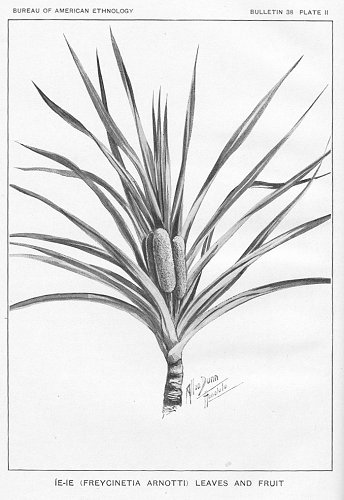
ÍE-ÍE (FREYCINETIA ARNOTTI) LEAVES AND FRUIT
[paragraph continues] Hooulu a lei ou, o Laka, e!
O Hiiaka b ke kaula nana e hooulu na ma’i,
5 A aeae a ulu c a noho i kou kuahu,
Eia ka pule la, he pule ola,
He noi ola nou, e-e!
Chorus:
E ola ia makou, aohe hala!
O Hiiaka b ke kaula nana e hooulu na ma’i,
5 A aeae a ulu c a noho i kou kuahu,
Eia ka pule la, he pule ola,
He noi ola nou, e-e!
Chorus:
E ola ia makou, aohe hala!
[Translation]
Altar-Prayer to Laka
This spoil and rape of the wildwood,
This plucking of wilderness maile--
Collect of garlands, Laka, for you.
Hiiaka, the prophet, heals our diseases.
5 Enter, possess, inspire your altar;
Heed our prayer, ’tis for life;
Our petition to you is for life.
Chorus:
Give us life, save from transgression!
This plucking of wilderness maile--
Collect of garlands, Laka, for you.
Hiiaka, the prophet, heals our diseases.
5 Enter, possess, inspire your altar;
Heed our prayer, ’tis for life;
Our petition to you is for life.
Chorus:
Give us life, save from transgression!
The wildwoods of Hawaii furnished in great abundance and variety small poles for the framework of the kuahu, the altar, the holy place of the halau, and sweet-scented leaves and flowers suitable for its decoration. A spirit of fitness, however, limited choice among these to certain species that were deemed acceptable to the goddess because they were reckoned as among her favorite forms of metamorphosis. To go outside this ordained and traditional range would have been an offense, a sacrilege. This critical spirit would have looked with the greatest disfavor on the practice that in modern times has crept in, of bedecking the dancers with garlands of roses, pinks, jessamine, and other nonindigenous flowers, as being utterly repugnant to the traditional spirit of the hula.
Among decorations approved and most highly esteemed stood preeminent the fragrant maile (pl. IV) and the star-like fronds and ruddy drupe of the íe-íe (pl. II) and its kindred, the hála-pépe (pl. III); the scarlet pompons of the lehúa (pl. XIII) and ohi’a, with the fruit of the latter (the mountain-apple); many varieties of fern, including that splendid parasite, the "bird's nest fern" (ekáha), hailed by
p. 20
the Hawaiians as Mawi's paddle; to which must be added the commoner leaves and lemon-colored flowers of the native hibiscus, the hau, the breadfruit, the native banana and the dracæna (ti), plate V; and lastly, richest of all, in the color that became Hawaii's favorite, the royal yellow ilíma (pl. VI), a flower familiar to the eves of the tourist to Honolulu.
While deft hands are building and weaving the light framework of the kuahu, binding its parts with strong vines and decorating it with nature's sumptuous embroidery, the kumu, or teacher, under the inspiration of the deity for whose residence he has prepared himself by long vigil and fasting with fleshly abstinence, having spent the previous night alone in the halau, is chanting or cantillating his adulatory prayers, kanaenae--songs of praise they seem to be--to the glorification of the gods and goddesses who are invited to bless the occasion with their presence and inspiration, but especially of that one, Laka, whose bodily presence is symbolized by a rude block of wood arrayed in yellow tapa that is set up on the altar itself. Thus does the kumu sing:
Pule Kuahu
Ei’ au, e Laka mai uka,
E Laka mai kai;
O hooulu
O ka ilio a nana e hae,
5 O ka maile hihi i ka wao,
O ka lau-ki b lei o ke akua,
O na ku’i hauoli
O Ha’i-ka-manawa, c
O Laka oe,
10 O ke akua i ke kuahu nei, la;
E ho’i, ho’i mai a noho i kou kuahu!
E Laka mai kai;
O hooulu
O ka ilio a nana e hae,
5 O ka maile hihi i ka wao,
O ka lau-ki b lei o ke akua,
O na ku’i hauoli
O Ha’i-ka-manawa, c
O Laka oe,
10 O ke akua i ke kuahu nei, la;
E ho’i, ho’i mai a noho i kou kuahu!
[Translation]
Altar Prayer (to Laka)
Here am I, oh Laka from the mountains,
Oh Laka from the shore;
Protect us
Against the dog that barks:
Oh Laka from the shore;
Protect us
Against the dog that barks:
p. 21
5 Reside in the wild-twining maile
And the goddess-enwreathing ti.
All, the joyful pulses
Of the woman Ha’i-ka-manawa!
Thou art Laka,
10 The god of this altar;
Return, return, abide in thy shrine!
And the goddess-enwreathing ti.
All, the joyful pulses
Of the woman Ha’i-ka-manawa!
Thou art Laka,
10 The god of this altar;
Return, return, abide in thy shrine!
The prayers which the hula folk of old times chanted while gathering the material in the woods or while weaving it into shape in the halau for the construction of a shrine did not form a rigid liturgy; they formed rather a repertory as elastic as the sighing of the breeze, or the songs of the birds whose notes embroidered the pure mountain air. There were many altar-prayers, so that if a prayer came to an end before the work was done the priest had but to begin the recitation of another prayer, or, if the spirit of the occasion so moved him, he would take up again a prayer already repeated, for until the work was entirely accomplished the voice of prayer must continue to be heard.
The pule now to be given seems to be specially suited to that portion of the service which took place in the woods at the gathering of the poles and greenery. It was designed specially for the placating of the little god-folk who front their number were addressed as Kini o ke Akua, the multitude of the little gods, and who were the counterparts in old Hawaii of our brownies, elfins, sprites, kobolds, gnomes, and other woodland imps. These creatures, though dwarfish and insignificant in person, were in such numbers--four thousand, forty thousand, four hundred thousand--and were so impatient of any invasion of their territory, so jealous of their prerogatives, so spiteful and revengeful when injured, that it was policy always to keep on the right side of them.
Pule Kuahu
E hooulu ana i Kini a o ke Akua,
Ka lehu o ke Akua,
Ka mano o ke Akua,
I ka pu-ku’i o ke Akua,
5 I ka lalani Akua,
Ia ulu mai o Kane,
Ulu o Kanaloa;
Ulu ka ohia, lau ka ie-ie;
Ulu ke Akua, noho i ke kahua,
10 A a’ea’e, a ulu, a noho kou kuahu.
Eia ka pule la, he pule ola.
Chorus:
E ola ana oe!
Ka lehu o ke Akua,
Ka mano o ke Akua,
I ka pu-ku’i o ke Akua,
5 I ka lalani Akua,
Ia ulu mai o Kane,
Ulu o Kanaloa;
Ulu ka ohia, lau ka ie-ie;
Ulu ke Akua, noho i ke kahua,
10 A a’ea’e, a ulu, a noho kou kuahu.
Eia ka pule la, he pule ola.
Chorus:
E ola ana oe!
p. 22
[Translation]
Altar-Prayer
Invoke we now the four thousand,
The myriads four of the nimble,
The four hundred thousand elves,
The countless host of sprites,
5 Rank upon rank of woodland gods.
Pray, Kane, also inspire us;
Kanaloa, too, join the assembly.
Now grows the ohi’a, now leafs ie-ie;
God enters, resides in the place;
10 He mounts, inspires, abides in the shrine.
This Is our prayer, our plea this for life!
Chorus:
Life shall be thine!
The myriads four of the nimble,
The four hundred thousand elves,
The countless host of sprites,
5 Rank upon rank of woodland gods.
Pray, Kane, also inspire us;
Kanaloa, too, join the assembly.
Now grows the ohi’a, now leafs ie-ie;
God enters, resides in the place;
10 He mounts, inspires, abides in the shrine.
This Is our prayer, our plea this for life!
Chorus:
Life shall be thine!
From one point of view these pule are not to be regarded as prayers in the ordinary sense of the word, but rather as song-offerings, verbal bouquets, affectionate sacrifices to the gods.
Footnotes
15:a Ai-lolo. See pp. 32, 34, 36.16:a Wao-kéle. That portion of the mountain forest where grew the monarch trees was called wao-kele or wao-maukele.
16:b Na Kane. Why was the offering, the black roast porkling, said to be for Kane, who was not a special patron, au-makúa, of the hula? The only answer the author has been able to obtain from any Hawaiian is that, though Kane was not a god of the hula, he was a near relative. On reflection, the author can see a propriety in devoting the reeking flesh of the swine to god Kane, while to the sylvan deity, Laka, goddess of the peaceful hula, were devoted the rustic offerings that were the embodiment of her charms. Her Image, or token--an uncarved block of wood--was set up in a prominent part of the kuahu, and at the close of a performance the wreaths that had been worn by the actors were draped about the image. Thus viewed, there is a delicate propriety and significance In such disposal of the pig.
17:a Maka-li’i (Small eyes). The Pleiades; also the period of six months, including the rainy season, that began some time in October or November and was reckoned from the date when the Pleiades appeared in the East at sunset. Maka-li’i was also the name of a month, by some reckoned as the first month of the year.
17:b Maka-léi. The name of a famous mythological tree which had the power of attracting fish. It did not poison, but only bewitched or fascinated them. There were two trees bearing this name, one a male, the other a female, which both grew at a place in Hilo called Pali-uli. One of these, the female, was, according to tradition, carried from its root home to the fish ponds in Kailua, Oahu, for the purpose of attracting fish to the neighboring waters. The enterprise was eminently successful.
17:c Po. Literally night; the period in cosmogony when darkness and chaos reigned, before the affairs on earth had become settled under the rule of the gods. Here the word is used to indicate a period of remote mythologic antiquity. The use of the word Po in the following verse reminds one of the French adage, "La nuit porte conseil."
17:d Kokúa. Another form for kakúa, to gird on, the pa-ú. (See Pa-ú song, pp. 51-53.)
17:e Uníki, A word not given in the dictionary. The debut of an actor at the hula, after passing the ai-lolo test and graduating from the school of the halau, a critical event.
17:f Ha-íke-íke. Equivalent to ho-íke-íke, an exhibition, to exhibit.
17:g Ou-alii. The Hawaiians seem to have lost the meaning of this word. The author has been at some pains to work it out somewhat conjecturally.
17:h E Lono, e hu’ ia mai, etc. The unelided form of the word hu’ would be hui. The final i is dropped before the similar vowel of ia.
17:i Kukúlu o Kahíki. The pillars of Kahiki. The ancient Hawaiians supposed the starry heavens to be a solid dome supported by a wall or vertical construction--kukulu--set up along the horizon. That section of the wall that stood over against Kahiki they termed Kukulu o Kahiki. Our geographical name Tahiti is of course from Kahiki, though it does not apply to the same region. After the close of what has been termed "the period of intercourse," which came probably during the twelfth and thirteenth centuries, and during which the ancient Hawaiians voyaged to and fro between Hawaii and the lands of the South, geographical ideas became hazy and the term Kahiki came to be applied to any foreign country.
17:j Áno-ái. An old form of salutation, answering In general to the more modern word aloha, much used at the present time. Ano-ai seems to have had a shade of meaning more nearly answering to our word "welcome." This is the first instance the author has met with of its use in poetry.
19:a Hoo-ulu. This word has a considerable range of meaning, well illustrated in this mele. In its simplest form, ulu, it means to grow, to become strong. Joined with the causative hoo, as here, it takes on the spiritual meaning of causing to prosper, of inspiring. The word "collect," used in the translation, has been chosen to express the double sense of gathering the garlands and of devoting them to the goddess as a religious offering. In the fourth verse this word, hooulu, is used in the sense of to heal. Compare note c.
19:b Hiiaka. The youngest sister of Pele, often spoken of as Hiiaka-i-ka-poli-o-Pele, Hiiaka-of-the-bosom-of-Pele. Why she should be spoken of as capable of healing diseases is not at all clear.
19:c Ulu. Here we have the word ulu in its simple, uncombined form, meaning to enter into and inspire.
20:a Ilio nana e hae. The barking of a dog, the crowing of a cock, the grunting of a pig, the hooting of an owl, or any such sound occurring at the time of a religious solemnity, aha, broke the spell of the incantation and vitiated the ceremony. Such an untimely accident was as much deprecated as were the Turk, the Comet, and the Devil by pious Christian souls during the Middle Ages.
20:b Lau-ki. The leaf of the ti plant--the same as the ki--(Dracæna terminalis), much used as an emblem of divine power, a charm or defense against malign spiritual Influences. The kahuna often wore about his neck a fillet of this leaf. The ti leaf was a special emblem of Ha’i-wahine, or of Li’a-wahine. It was much used as a decoration about the halau.
20:c Ha’i-ka-manawa. It is conjectured that this is the same as Ha’i-wahine. She was a mythological character, about whom there is a long and tragic story.
21:a Kini o ke Akua. See note d, p. 24.
THE TRUE STORY OF
KALUAIKOOLAU
AS TOLD BY HIS WIFE, PIILANI

No comments:
Post a Comment