Click to enlarge
PLATE X
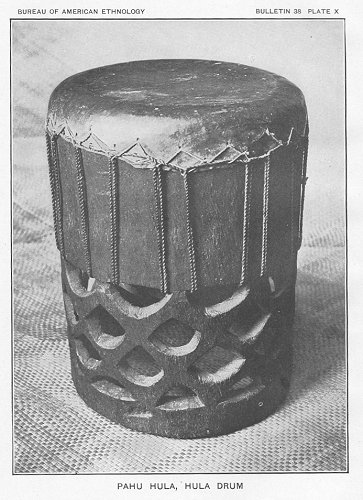
PAHU HULA, HULA DRUM
XII.--THE HULA PAHU
The hula pahu was so named from the pahu, a or drum, that was its chief instrument of musical accompaniment (pl. X).It is not often that the story of an institution can be so closely fitted to the landmarks of history as in the case of this hula; and this comes about through our knowledge of the history of the pahu itself. Tradition, direct and reliable, informs us that the credit of introducing the big drum belongs to La’a. This chief flourished between five and six centuries ago, and from having spent most of his life in the lands to the south, which the ancient Hawaiians called Kahiki, was himself generally styled La’a-mai-Kahiki (La’a-from-Kahiki). The young man was of a volatile disposition, given to pleasure, and it is evident that the big drum he brought with him to Hawaii on one of his voyages from Kahiki was in his eyes by no means the least important piece of baggage that freighted his canoes. On nearing the land he waked the echoes with the stirring tones of his drum, which so astonished the people that they followed him from point to point along the coast and heaped favors upon him whenever he came ashore.
La’a was an enthusiastic patron of the hula and is said to have made a tour of the islands, in which he instructed the natives in new forms of this seductive pastime, one of which was the hula ka-eke.
There is reason to believe, it seems, that the original use of the pahu way in connection with the services of the temple, and that its adaptation to the halau was simply a transference from one to another religious use.
The hula pahu was preeminently a performance of formal and dignified character, not such as would be extemporized for the amusement of an irreverent company. Like all the formal hulas, it was tabu, by which the Hawaiians meant that it was a religious service, or so closely associated with the notion of worship as to make it an irreverence to trifle with it. For this reason as well as for its intrinsic dignity its performance was reserved for the most distinguished guests and the most notable occasions.
Both classes of actors took part in the performance of the hula pahu, the olapa contributing the mele as they stood and went through the motions of the dance, while the hoopaa maintained the kneeling position and operated the big drum with the left hand. While his left hand was thus engaged, the musician with a thong held in his
p. 104
right hand struck a tiny drum, the pu-niu, that was conveniently strapped to the thigh of the same side. As its name signifies, the pu-niu was made from coconut shell, being headed with fish-skin.
The harmonious and rhythmic timing of these two instruments called for strict attention on the part of the performer. The pahu, having a tone of lower pitch and greater volume than the other, was naturally sounded at longer intervals, while the pu-niu delivered its, sharp crisp tones in closer order.
Mele
(Ko’i-honua)
O Hilo oe, Hilo, muliwai a ka ua i ka lani,
I hana ia Hilo, ko-í ana e ka ua.
E haló ko Hilo ma i-o, i-anei;
Lenalena Hilo e, panopano i ka ua.
5 Ua lono Pili-keko o Hilo i ka wai;
O-kakala ka hulu o Hilo i ke anu;
Ua ku o ka paka a ka ua i ke one;
Ua moe oni ole Hilo i-luna ke alo;
Ua hana ka uluna lehu o Hana-kahi.
10 Haule ka onohi Hilo o ka ua i ke one;
Loku kapa ka hi-hilo kai o Pai-kaka.
Ha, e!
I hana ia Hilo, ko-í ana e ka ua.
E haló ko Hilo ma i-o, i-anei;
Lenalena Hilo e, panopano i ka ua.
5 Ua lono Pili-keko o Hilo i ka wai;
O-kakala ka hulu o Hilo i ke anu;
Ua ku o ka paka a ka ua i ke one;
Ua moe oni ole Hilo i-luna ke alo;
Ua hana ka uluna lehu o Hana-kahi.
10 Haule ka onohi Hilo o ka ua i ke one;
Loku kapa ka hi-hilo kai o Pai-kaka.
Ha, e!
2
A Puna au, i Kuki’i au, i Ha’eha’e,
Ike au i ke a kino-lau lehua.
He laau malalo o ia pohaku.
Hanohano Puna e, kehakeha i ka ua,
5 Kahiko mau no ia no-laila.
He aina haaheo loa no Puna;
I haaheo i ka hala me ka lehua;
He maikai maluna, he a malalo;
He kelekele ka papa o Mau-kele.
10 Kahuli Apua e, kele ana i Mau-kele.
Ike au i ke a kino-lau lehua.
He laau malalo o ia pohaku.
Hanohano Puna e, kehakeha i ka ua,
5 Kahiko mau no ia no-laila.
He aina haaheo loa no Puna;
I haaheo i ka hala me ka lehua;
He maikai maluna, he a malalo;
He kelekele ka papa o Mau-kele.
10 Kahuli Apua e, kele ana i Mau-kele.
[Translation]
Song
(Bombastic style)
Thou art Hilo, Hilo, flood-gate of heaven.
Hilo has power to wring out the rain.
Let Hilo turn here and turn there;
Hilo's kept from employ, somber with rain;
5 Pili-keko roars with full stream;
The feathers of Hilo bristle with cold,
And her hail-stones smite on the sand.
She lies without motion, with upturned face,
The fire-places pillowed with ashes;
10 The bullets of rain are slapping the land,
Pitiless rain turmoiling Pai-kaka.
So, indeed.
Hilo has power to wring out the rain.
Let Hilo turn here and turn there;
Hilo's kept from employ, somber with rain;
5 Pili-keko roars with full stream;
The feathers of Hilo bristle with cold,
And her hail-stones smite on the sand.
She lies without motion, with upturned face,
The fire-places pillowed with ashes;
10 The bullets of rain are slapping the land,
Pitiless rain turmoiling Pai-kaka.
So, indeed.
p. 105
2
In Puna was I, in Ku-ki’i, in Ha’e-ha’e,
I saw a wraith of lehua, a burning bush,
A fire-tree beneath the lava plate.
Magnificent Puna, fertile from rain,
5 At all times weaving its mantle.
Aye Puna's a land of splendor,
Proudly bedight with palm and lehua;
Beauteous above, but horrid below,
And miry the plain of Mau-kele.
10 Apua upturned, plod on to Mau-kele.
I saw a wraith of lehua, a burning bush,
A fire-tree beneath the lava plate.
Magnificent Puna, fertile from rain,
5 At all times weaving its mantle.
Aye Puna's a land of splendor,
Proudly bedight with palm and lehua;
Beauteous above, but horrid below,
And miry the plain of Mau-kele.
10 Apua upturned, plod on to Mau-kele.
Mele
Kau lilua i ke anu Wai-aleale;
He maka halalo ka lehua makanoe; a
He lihilihi kuku ia no Aipo, b e;
O ka hulu a’a ia o Hau-a-iliki: c
5 Ua pehi ’a e ka na a éha ka nahele,
Maui ka pua, uwe éha i ke anu,
I ke kukuna la-wai o Mokihana. d
Ua hana ia aka ka pono a ua pololei;
Ua hai ’na ia aku no ia oe:
10 O ke ola no ia.
O kia’i loko, kia’i Na-ula, e
Nana i ka makani, hoolono ka leo,
Ka halulu o ka Malua-kele: f
Kiei, halo i Maka-ike-ole.
15 Kamau ke ea i ka halau g a ola;
He kula lima ia no Wawae-noho, h
Me he puko’a hakahaka la i Waahila
Na momoku a ka unu-lehua o Lehua.
A lehulehu ka hale pono ka noho ana,
20 Loaa kou haawina--o ke aloha,
Ike hauna i mai nei ka puka o ka hale.
Ea!
He maka halalo ka lehua makanoe; a
He lihilihi kuku ia no Aipo, b e;
O ka hulu a’a ia o Hau-a-iliki: c
5 Ua pehi ’a e ka na a éha ka nahele,
Maui ka pua, uwe éha i ke anu,
I ke kukuna la-wai o Mokihana. d
Ua hana ia aka ka pono a ua pololei;
Ua hai ’na ia aku no ia oe:
10 O ke ola no ia.
O kia’i loko, kia’i Na-ula, e
Nana i ka makani, hoolono ka leo,
Ka halulu o ka Malua-kele: f
Kiei, halo i Maka-ike-ole.
15 Kamau ke ea i ka halau g a ola;
He kula lima ia no Wawae-noho, h
Me he puko’a hakahaka la i Waahila
Na momoku a ka unu-lehua o Lehua.
A lehulehu ka hale pono ka noho ana,
20 Loaa kou haawina--o ke aloha,
Ike hauna i mai nei ka puka o ka hale.
Ea!
p. 106
[Translation]
Song
Wai-aleale stands haughty and cold,
Her lehua bloom, fog-soaked, droops pensive;
The thorn-fringe set about swampy Ai-po is
A feather that flaunts in spite of the pinching frost.
5 Her herbage is pelted, stung by the rain;
Bruised all her petals, and moaning in cold
Mokihana's sun, his wat’ry beams.
I have acted in good faith and honor,
My complaint is only to you--
10 A matter that touches my life.
Best watch within and toward Ka-ula;
Question each breeze, note every rumor,
Even the whisper of Malua-kele.
Search high and search low, unobservant.
15 There is life in the breath from her body,
Fond caress by a hand not inconstant.
Like fissured groves of coral
Stand the ragged clumps of lehua.
Many the houses, easy the life.
20 You have your portion--of love;
Humanity smells at the door.
Aye, indeed.
Her lehua bloom, fog-soaked, droops pensive;
The thorn-fringe set about swampy Ai-po is
A feather that flaunts in spite of the pinching frost.
5 Her herbage is pelted, stung by the rain;
Bruised all her petals, and moaning in cold
Mokihana's sun, his wat’ry beams.
I have acted in good faith and honor,
My complaint is only to you--
10 A matter that touches my life.
Best watch within and toward Ka-ula;
Question each breeze, note every rumor,
Even the whisper of Malua-kele.
Search high and search low, unobservant.
15 There is life in the breath from her body,
Fond caress by a hand not inconstant.
Like fissured groves of coral
Stand the ragged clumps of lehua.
Many the houses, easy the life.
20 You have your portion--of love;
Humanity smells at the door.
Aye, indeed.
The imagery of this poem is peculiarly obscure and the meaning difficult of translation. The allusions are so local and special that their meaning does not carry to a distance.
Wai-aleale is the central mountain mass of Kauai, about 6,000 feet high. Its summit, a cold, fog-swept wilderness of swamp and lake beset with dwarfish growths of lehua, is used as the symbol of a woman, impulsively kind, yet in turn passionate and disdainful. The physical attributes of the mountain are ascribed to her, its spells of frosty coldness, its gloom and distance, its fickleness of weather, the repellant hirsuteness of the stunted vegetation that fringes the central swamp--these things are described as symbols of her temper, character, and physical make-up. The bloom and herbage of the wilderness, much pelted by the storm, are figures to represent her physical charms. But spite of all these faults and imperfections, a perennial fragrance, as of mokihana, clings to her person, and she is the object of devoted love, capable of weaving the spell of fascination about her victims.
This poem furnishes a good example of a peculiarity that often is an obstacle to the understanding of Hawaiian poetry. It is the breaking up of the composition into a number of parts that have but a loose seeming connection the one with the other.
Footnotes
103:a Full form, pahu-hula.105:a Lehua makanoe. The lehua trees that grow on the top of Wai-aleale, the mountain mass of Kauai, are of peculiar form, low, stunted, and so furzy as to be almost thorny, kuku, as mentioned in the next line.
105:b Ai-po. A swamp that occupies the summit basin of the mountain, in and about which the thorny lehua trees above mentioned stand as a fringe.
105:c Hau-a-iliki. A word made up of hau, dew or frost, and iliki, to smite. The a is merely a connective.
105:d Mokihana. The name of a region on the flank of Wai-aleale, also a plant that grows there, whose berry is fragrant and is used in making wreaths.
105:e Ka-ula. A small rocky island visible from Kauai.
105:f Malua-kele. A wind.
105:g Halau. The shed or house which sheltered the canoe, wa’a, which latter, as we have seen, was often used figuratively to mean the human body, especially the body of a woman. Kamau ke ea i ka halau might be translated "persistent the breath from her body." "There's kames o’ hinny ’tween my luve's lips."
105:h Wawae-noho. Literally the foot that abides; it is the name of a place. Here it is to be understood as meaning constancy. It is an instance in which the concrete stands for the abstract.
105:i Hauna. An odor. In this connection it means the odor that hangs about a human habitation. The hidden allusion, it is needless to say, is to sexual attractiveness.
XIII.--THE HULA ÚLI-ULÍ
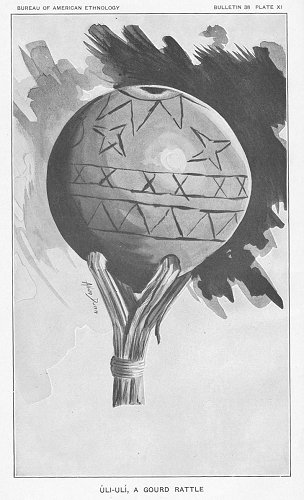
The hula úli-ulí was so called from the rattle which was its sole instrument of accompaniment. This consisted of a small gourd about, the size of a large orange, into the cavity of which were put shot-like seeds, like those of the canna; a handle was then attached (The actors who took part in this hula belonged, it is said, to the class termed hoopaa, and went through with the performance while kneeling or squatting, as has been described. While cantillating the mele they held the rattle, úli-ulí, in the right hand, shaking it against the palm of the other hand or the thigh, or making excursions in one direction and another. In some performances of this hula which the author has witnessed the olapa also took part, in one case a woman, who stood and cantillated the song with movement and gesture, while the hoopaa devoted themselves exclusively to handling the úli-ulí rattles.
The sacrificial offerings that preceded the old-time performances of this hula are said to have been awa and a roast porkling, in honor of the goddess Laka.
If the dignity and quality of the meles now used, or reported to have been used, in the hula úli-ulí are to be taken as any criterion of the quality and dignity of this hula, one has to conclude that it must be assigned to a rank below that of some others, such, for instance, as the ala’a-papa, pa-ipu, Pele, and others.
David Malo, the Hawaiian historian, author of Ka Moolelo Hawaii,
himself conscience-bound to set himself in opposition to the amusements, sports, and games of his people, and he was unable, apparently, to see in them any good whatsoever. Malo was a man of uncompromising honesty and rigidity of principles. His nature, acting under the new influences that surrounded him after the introduction of Christianity, made it impossible for him to discriminate calmly between the good and the pernicious, between the purely human and poetic and the depraved elements in the sports practised by his people during their period of heathenism. There was nothing halfway about Malo. Having abandoned a system, his nature compelled him to denounce it root and branch.
The first mele here offered as an accompaniment to this hula can boast of no great antiquity; it belongs to the middle of the nineteenth century, and was the product of some gallant at a time when princes and princesses abounded in Hawaii:
Mele
Aole i manao ia
Kahi wai a o Alekoki.
Hookohu ka ua i uka,
Noho mai la i Nuuanu.
5 Anu-anu, makehewa au
Ke kali ana i-laila.
Ka ino’ paha ua paa
Kou manao i ane’i,
Au i hoomalu ai.
10 Hoomalu oe a malu;
Ha malu keia kino
Mamuli a o kou leo.
Kau nui aku ka manao
Kahi wai a o Kapena.
15 Pani’a paa ia mai
Na manowai a o uka;
Ahu wale na ki’owai,
Na papa-hale o luna.
Maluna a’e no wau,
20 Ma ke kuono liilii.
A waho, a o Mamala,
Hao mai nei ehu-ehu;
Pulu au i ka huna-kai,
Kai heahea i ka ili.
25 Hookahi no koa nui,
Nana e alo ia ino.
Ino-ino mai nei luna,
I ka hao a ka makani.
He makani ahai-lono;
30 Lohe ka luna i Pelekane.
O ia pouli nui
Mea ole i ku’u manao.
I o, i a-ne’i au,
Ka piina la o Ma’ema’e,
Kahi wai a o Alekoki.
Hookohu ka ua i uka,
Noho mai la i Nuuanu.
5 Anu-anu, makehewa au
Ke kali ana i-laila.
Ka ino’ paha ua paa
Kou manao i ane’i,
Au i hoomalu ai.
10 Hoomalu oe a malu;
Ha malu keia kino
Mamuli a o kou leo.
Kau nui aku ka manao
Kahi wai a o Kapena.
15 Pani’a paa ia mai
Na manowai a o uka;
Ahu wale na ki’owai,
Na papa-hale o luna.
Maluna a’e no wau,
20 Ma ke kuono liilii.
A waho, a o Mamala,
Hao mai nei ehu-ehu;
Pulu au i ka huna-kai,
Kai heahea i ka ili.
25 Hookahi no koa nui,
Nana e alo ia ino.
Ino-ino mai nei luna,
I ka hao a ka makani.
He makani ahai-lono;
30 Lohe ka luna i Pelekane.
O ia pouli nui
Mea ole i ku’u manao.
I o, i a-ne’i au,
Ka piina la o Ma’ema’e,
[Translation]
Song
I spurn the thought with disdain
Of that pool Alekoki:
On the upland lingers the rain
And fondly haunts Nuuanu.
5 Sharp was the cold, bootless
My waiting up there.
1 thought thou wert true,
Wert loyal to me,
Whom thou laids’t under bonds.
10 Take oath now and keep it;
This body is sacred to thee,
Bound by the word of thy month.
My heart leaps up at thought
Of the pool, pool of Kapena;
15 To me it is fenced, shut oft,
The water-heads tightly sealed up.
The fountains must be a-hoarding,
For skies are ever down-pouring;
The while I am lodged up aloft,
20 Bestowed in the cleft of a rock.
Now, tossed by sea at Mamala,
The wind drives wildly the surf;
I'm soaked with the scud of the ocean,
My body is rough with the rime.
25 But one stout hero and soldier,
With heart to face such a storm.
Wild scud the clouds,
Hurled by the tempest,
A tale-bearing wind,
30 That gossips afar.
The darkness and storm
Are nothing to me.
This way and that am I turning,
Climbing the hill Ma’e-ma’e,
35 To look on thy charms, dear one,
The fragrant buds of the mountain.
What perfume breathes from thy body,
Such time as to thee I come close,
My scarlet bloom of lehua
40 Yields nectar sought by the birds.
Of that pool Alekoki:
On the upland lingers the rain
And fondly haunts Nuuanu.
5 Sharp was the cold, bootless
My waiting up there.
1 thought thou wert true,
Wert loyal to me,
Whom thou laids’t under bonds.
10 Take oath now and keep it;
This body is sacred to thee,
Bound by the word of thy month.
My heart leaps up at thought
Of the pool, pool of Kapena;
15 To me it is fenced, shut oft,
The water-heads tightly sealed up.
The fountains must be a-hoarding,
For skies are ever down-pouring;
The while I am lodged up aloft,
20 Bestowed in the cleft of a rock.
Now, tossed by sea at Mamala,
The wind drives wildly the surf;
I'm soaked with the scud of the ocean,
My body is rough with the rime.
25 But one stout hero and soldier,
With heart to face such a storm.
Wild scud the clouds,
Hurled by the tempest,
A tale-bearing wind,
30 That gossips afar.
The darkness and storm
Are nothing to me.
This way and that am I turning,
Climbing the hill Ma’e-ma’e,
35 To look on thy charms, dear one,
The fragrant buds of the mountain.
What perfume breathes from thy body,
Such time as to thee I come close,
My scarlet bloom of lehua
40 Yields nectar sought by the birds.
This mele is said to have been the production of Prince William Lunalilo--afterward king of the Hawaiian islands--and to have been
addressed to the Princess Victoria Kamamalu, whom he sought in marriage. Both of them inherited high chief rank, and their off-spring, according to Hawaiian usage, would have outranked her brothers, kings Kamehameha IV and V. Selfish and political considerations, therefore, forbade the match, and thereby hangs a tale, the shadow of which darkens this song. Every lover is one part poet; and Lunalilo, even without the love-flame, was more than one part poet.
The poem shows the influence of foreign ways and teachings and the pressure of the new environment that had entered Hawaii, in its form, in the moderation of its language and imagery, and in the coherence of its parts: at the same time the spirit of the song and the color of its native imagery mark it as the product of a Polynesian mind.
According to the author's interpretation of the song, Alekoki (verse 2), a name applied to a portion of the Nuuanu stream lower down than the basin and falls of Kapena (Kahi wai a o Kapena--verse 14), symbolizes a flame that may once have warmed the singer's imagination, but which he discards in favor of his new love, the pool of Kapena. The rain, which prefers to linger in the upland regions of Nuuanu (verses 3 and 4) and which often reaches not the lower levels, typifies his brooding affection. The cold, the storm, and the tempest that rage at Mamala (verse 21)--a name given to the ocean just outside Honolulu harbor--and that fill the heavens with driving scud (verses 27 and 28) represent the violent opposition in high quarters to the love-match. The tale-bearing wind, makani ahai-lono (verse 29), refers, no doubt, to the storm of scandal. The use of the place-names Ma’ema’e and Mauna-ala seem to indicate Nuuanu as the residence of the princess.
Mele
PALE I
Auhea wale oe, e ka Makani Inu-wai?
Pa kolonahe i ka ili-kai,
Hoohui me ka Naulu,
Na ulu ua i ka hapapa.
5 Anó au ike i ke ko Hala-li’i,
I keia wa nana in Lehua.
Pa kolonahe i ka ili-kai,
Hoohui me ka Naulu,
Na ulu ua i ka hapapa.
5 Anó au ike i ke ko Hala-li’i,
I keia wa nana in Lehua.
PALE II
Aia i Waimea ku’u haku-lei;
Hui pu me ka wai ula ili-ahi,
Mohala ka pua i ke one o Pawehe;
10 Ka lawe a ke Koolau
Noho pu me ka ua punonohu ula i ka nahele,
Ike i ka wai kea o Makaweli:
Hui pu me ka wai ula ili-ahi,
Mohala ka pua i ke one o Pawehe;
10 Ka lawe a ke Koolau
Noho pu me ka ua punonohu ula i ka nahele,
Ike i ka wai kea o Makaweli:
[Translation]
Song
CANTO I
Whence art thou, thirsty wind,
That gently kissest the sea,
Then, wed to the ocean breeze,
Playest fan with the bread-fruit tree?
5 Here sprawl Hala-lii's canes,
There stands bird-haunted Lehua.
That gently kissest the sea,
Then, wed to the ocean breeze,
Playest fan with the bread-fruit tree?
5 Here sprawl Hala-lii's canes,
There stands bird-haunted Lehua.
CANTO II
My wreath-maker dwells at Waimea.
Partnered is she to the swirling river;
They plant with flowers the sandy lea,
10 While the bearded surf, tossed by the breeze,
Vaunts on the hills as the sun-bow.
Looks on the crystal stream Makaweli,
And in the wildwood makes her abode
With Hinahina of silvern wreaths.
15 Koaea's a speck to the eye,
Under the low-hanging rain-cloud,
Woodland home of the plaintive o-ó.
From frost-bitten Pa-ie-ie
I bid you, guess me the fable:
20 Paddle-maker on Pele's mount.
Partnered is she to the swirling river;
They plant with flowers the sandy lea,
10 While the bearded surf, tossed by the breeze,
Vaunts on the hills as the sun-bow.
Looks on the crystal stream Makaweli,
And in the wildwood makes her abode
With Hinahina of silvern wreaths.
15 Koaea's a speck to the eye,
Under the low-hanging rain-cloud,
Woodland home of the plaintive o-ó.
From frost-bitten Pa-ie-ie
I bid you, guess me the fable:
20 Paddle-maker on Pele's mount.
This mele comes from Kauai, an island in many respects individualized from the other parts of the group and that seems to have been the nurse of a more delicate imagination than was went to flourish elsewhere. Its tone is archaic, and it has the rare merit of not transfusing the more crudely erotic human emotions into the romantic sentiments inspired by nature.
The Hawaiians dearly loved fable and allegory. Argument or truth, dressed out in such fanciful garb, gained double force and acceptance. We may not be able to follow a poet in his wanderings; his local allusions may obscure to us much of his meaning; the doctrine of his allegory may be to us largely a riddle; and the connection between the body of its thought and illustration and the application, or solution, of the poetical conundrum may be past our comprehension; but the play of the poet's fancy, whether childish or mature, is
an interesting study, and brings us closer in human sympathy to the people who took pleasure in such things.
In translating this poem, while not following literally the language of the poet, the aim has been to hit the
The Makani Inu-wai (verse 1)--known to all the islands--is a wind that dries up vegetation, literally a water-drinking wind.
The Naulu (verse 3) is the ordinary sea-breeze at Waimea, Kauai, sometimes accompanied by showers.
Hala-li’i (verse r) is a sandy plain on Niihau, and the peculiarity of its canes is that they sprawl along on the ground, and are often to a considerable extent covered by the loose soil.
Lehua (verse (6) is the well-known bird-island, lying north of Niihau and visible from the Waimea side of Kauai.
The wreath-maker, hake-lei (verse 7), who dwells at Waimea, is perhaps the ocean-vapor, or the moist sea-breeze, or, it may be, some figment of the poet's imagination--the author can not make out exactly what.
The hinahina (verse 14), a native geranium, is a mountain shrub that stands about 3 feet high, with silver-gray leaves.
Maka-weli, Maka-li’i, Koae’a, and Pa-ie-ie are names of places on Kauai.
Puu-ka-Pele (verse 20) as the name indicates, is a volcanic hill, situated near Waimea.
The key or answer (puana), to the allegory given in verse 20, Ke kahuna kalai-hoe o Puu-ka-Pele, the paddle-making kahuna of Pele's mount, when declared by the poet (haku-mele), is not very informing to the foreign mind; but to the Hawaiian auditor it, no doubt, took the place of our haec fabula docet, and it at least showed that the poet was not without an intelligent motive. In the poem in point the author acknowledges his inability to make connection between it and the body of the song.
One merit we must concede to Hawaiian poetry, it wastes no time in slow approach. The first stroke of the artist places the auditor in medias res.
Footnotes
Click to enlarge
PLATE XI
ULI-ULI, A GOURD RATTLEpl. xi).a in the short chapter that he devotes to the hula, mentions only ten hulas by name, the ka-laau, pa’i-umauma, pahu, pahu’a, ala’a-papa, pa’i-pa’i, pa-ipu, ulili, and the kielei. Ulili is but another form of the word úli-ulí. Any utterance of Malo is to be received seriously; but it seems doubtful if he deliberately selected for mention the ten hulas that were really the most important. It seems more probable that he set down the first ten that stood forth prominent in his memory. It was not Malo's habit, nor part of his education, to make an exhaustive list of sports and games, or in fact of anything. He spoke of what occurred to him. It must also be remembered that, being an ardent convert to Christianity, Malo feltp. 108p. 109
35 E kilohi au o ka nani
Na pua i Mauna-ala.
He ala ona-ona kou,
Ke pili mai i ane’i,
O a’u lehua ula i-luna,
40 Ai ono a na manu.p. 110p. 111
Ua noho pu i ka nahele
Me ka lei hinahina o Maka-li’i.
15 Liilii ka uka o Koae’a;
Nana i ka ua lani-pili,
Ka o-ó, mane le’a o ka nahele.
I Pa-ie-ie au, noho pu me ke anu.
E ha’i a’e oe i ka puana:
20 Ke kahuna kalai-hoe o Puu-ka-Pele.p. 112target of his deeper meaning, without hopelessly involving the reader in the complexities of Hawaiian color and local topography. A few words of explanation must suffice.107:a Translated by V. B. Emerson, M. D., under the title "Hawaiian Antiquities," and published by the B. P. Bishop Museum. Hawaiian Gazette Company (Limited), Honolulu, 1903.Next: XIV.--The Hula Puíli
XIV.--THE HULA PUÍLI
The character of a hula was determined to some extent by the nature of the musical instrument that was its accompaniment. In the hula puíli it certainly seems as if one could discern the influence of the rude, but effective, instrument that was its musical adjunct. This instrument, the puíli (fig. 1), consisted of a section of bamboo from which one node with its diaphragm had been removed and the hollow joint at that end split up for a considerable distance into fine divisions, which gave forth a breezy rustling when the instrument was struck or shaken.The performers, all of them hoopaa, were often placed in two rows, seated or kneeling and facing one another, thus favoring a responsive action in the use of the puili as well as in the cantillation of the song. One division would sometimes shake and brandish their instruments, while the others remained quiet, or both divisions would perform
at once, each individual clashing one puíli against the other one held by himself, or against that of his vis-a-vis; or they might toss them back and forth to each other, one bamboo passing another in slid air.

While the hula puíli is undeniably a performance of classical antiquity, it is not to be regarded as of great dignity or importance as compared with many other hulas. Its character, like that of the metes associated with it, is light and trivial.
The mele next presented is by no means a modern production. It seems to be the work of some unknown author, a fragment of folklore, it might be called by some, that has drifted down to the present generation and then been put to service in the hula. If hitherto the word folklore has not been used it is not from any prejudice against it, but rather from a feeling that there exists an inclination to stretch the application of it beyond its true limits and to make it include popular songs, stories, myths, and the like, regardless of its fitness of application. Some writers, no doubt, would apply this vague term to a large part of the poetical pieces which are given in this book.
p. 114
[paragraph continues] On the same principle, why should they not apply the term folklore to the myths and stories that make up the body of Roman and Greek mythology? The present author reserves the term folklore for application to those unappropriated scraps of popular song, story, myth, and superstition that have drifted down the stream of antiquity and that reach us in the scrap-bag of popular memory, often bearing in their battered forms the evidence of long use.
Mele
Hiki mai, hiki mai ka La, e.
Aloha wale ka La e kau nei,
Aia malalo o Ka-wai-hoa, a
A ka lalo o Kauai, o Lehua.
5 A Kauai au, ike i ka pali;
A Milo-ili b pale ka pali loloa.
E kolo ana ka pali o Makua-iki; c
Kolo o Pu-á, he keiki,
He keiki makua-ole ke uwe nei.
Aloha wale ka La e kau nei,
Aia malalo o Ka-wai-hoa, a
A ka lalo o Kauai, o Lehua.
5 A Kauai au, ike i ka pali;
A Milo-ili b pale ka pali loloa.
E kolo ana ka pali o Makua-iki; c
Kolo o Pu-á, he keiki,
He keiki makua-ole ke uwe nei.
[Translation]
Song
It has come, it has come; to the Sun!
How I love the Sun that's on high;
Below it swims Ka-wai-hoa,
On the slope inclined from Lehua.
5 On Kauai met I a pali,
A beetling cliff that bounds Milo-lii,
And climbing up Makua-iki,
Crawling up was Pua, the child,
An orphan that weeps out its tale.
How I love the Sun that's on high;
Below it swims Ka-wai-hoa,
On the slope inclined from Lehua.
5 On Kauai met I a pali,
A beetling cliff that bounds Milo-lii,
And climbing up Makua-iki,
Crawling up was Pua, the child,
An orphan that weeps out its tale.
The writer has rescued the following fragment from the waste-basket of Hawaiian song. A lean-to of modern verse has been omitted; it was evidently added within a generation:
Mele
Malua, d ki’i wai ke aloha,
Hoopulu i ka liko mamane.
Ueuleu mai na manu,
Inu wai lehua o Panaewa, e
5 E walea ana i ke onaona,
Ke one wali o Ohele.
Hoopulu i ka liko mamane.
Ueuleu mai na manu,
Inu wai lehua o Panaewa, e
5 E walea ana i ke onaona,
Ke one wali o Ohele.
p. 115
Hele mai lei kou aloha
A lalawe i ko’u nui kino,
Au i hookohu ai,
10 E kuko i ka manao.
Kuhi no paha oe no Hopoe a
Nei lehua au i ka hana ohi ai.
A lalawe i ko’u nui kino,
Au i hookohu ai,
10 E kuko i ka manao.
Kuhi no paha oe no Hopoe a
Nei lehua au i ka hana ohi ai.
[Translation]
Song
Malua, fetch water of love.
Give drink to this mamane bud.
The birds, they are singing ecstatic,
Sipping Panaewa's nectared lehua,
5 Beside themselves with the fragrance
Exhaled from the garden Ohele.
Your love comes to me a tornado;
It has rapt away my whole body,
The heart you once sealed as your own,
10 There planted the seed of desire.
Thought you ’twas the tree of Hopoe,
This tree, whose bloom you would pluck?
Give drink to this mamane bud.
The birds, they are singing ecstatic,
Sipping Panaewa's nectared lehua,
5 Beside themselves with the fragrance
Exhaled from the garden Ohele.
Your love comes to me a tornado;
It has rapt away my whole body,
The heart you once sealed as your own,
10 There planted the seed of desire.
Thought you ’twas the tree of Hopoe,
This tree, whose bloom you would pluck?
What is the argument of this poem? A passion-stricken swain, or perhaps a woman, cries to Malua to bring relief to his love-smart, to give drink to the parched mamane buds--emblems of human feeling. In contrast to his own distress, he points to the birds caroling in the trees, reveling in the nectar of lehua bloom, intoxicated with the scent of nature's garden. What answer does the lovelorn swain receive from the nymph he adores? In lines 11 and 12 she banteringly asks him if he took her to be like the traditional lehua tree of Hopoe, of which men stood in awe as a sort of divinity, not daring to pluck its flowers? It is as if the woman had asked--if the poet's meaning is rightly interpreted--"Did you really think me plighted to vestal vows, a tree whose bloom man was forbidden to pluck?"
Footnotes
114:a Kawaihoa. The southern point of Niihau. which is to the west of Kauai, the evident standpoint of the poet, and therefore "below" Kauai.114:b Milo-ili. A valley on the northwestern angle of Kauai, a precipitous region, in which travel from one point to another by land is almost impossible.
114:c Makua-iki. Literally "little father," a name given to an overhanging pali, where was provided a hanging ladder to make travel possible. The series of palis in this region comes to an end at Milo-lii.
114:d The Malua was a wind, often so dry that it sucked up the moisture from the land and destroyed the tender vegetation.
114:e Panaewa was a woodland region much talked of in poetry and song.
115:a Hopoe was a beautiful young woman, a friend of Hiiaka, and was persecuted by Pele, lowing to jealousy. One of the forms in which she as a divinity showed herself was as a lehua tree in full bloom.
XV.--THE HULA KA-LAAU
The hula ka-laau (ka, to strike; laau, wood) was named from the instruments of wood used in producing the accompaniment, a sort of xylophone, in which one piece of resonant wood was struck against another. Both divisions of the performers, the hoopaa and the olapa, took part and each division was provided with the instruments. The cantillation was done sometimes by one division alone, sometimes by both divisions in unison, or one division would answer the other, a responsive chanting that was termed haawe aku, haawe mai--"to give, to return."Ellis gives a quotable description of this hula, which he calls the "hura ka raau:"
Five musicians advanced first, each with a staff in his left hand, five or six feet long, about three or four inches in diameter at one end, and tapering off to a point at the other. In his right hand he held a small stick of hard wood, six or nine inches long, with which he commenced his music by striking the small stick on the larger one, beating time all the while with his right foot on a stone placed on the ground beside him for that purpose. Six women, fantastically dressed in yellow tapas, crowned with garlands of flowers, having also wreaths of native manufacture, of the sweet-scented flowers of the gardenia, on their necks, and branches of the fragrant mairi (another native plant.) bound round their ankles, now made their way by couples through the crowd, and, arriving at the area, on one side of which the musicians stood, began their dance. Their movements were slow, and, though not always graceful, exhibited nothing offensive to modest propriety. Both musicians and dancers alternately chanted songs in honor of former gods and chiefs of the islands, apparently much to the gratification of the spectators. (Polynesian Researches, by William Ellis, IV, 78-79, London, 1836.)
The mele here first presented is said to be an ancient mele that has been modified and adapted to the glorification of that astute politician, genial companion, and pleasure-loving king, Kalakaua.
It was not an uncommon thing for one chief to appropriate the mele inoa of another chief. By substituting one name for another, by changing a genealogy, or some such trifle, the skin of the lion, so to speak, could be made to cover with more or less grace and to serve as an apparel of masquerade for the ass, and without interruption so long as there was no lion, or lion's whelp, to do the unmasking.
The poets who composed the mele for a king have been spoken of as "the king's washtubs." Mele inoa were not crown-jewels to be
p. 117
passed from one incumbent of the throne to another. The practice of appropriating the mele inoa composed in honor of another king and of another line was one that grew up with the decadence of honor in times of degeneracy.
Mele
O Kalakaua, he inoa,
O ka pua mae ole i ka la;
Ke pua mai la i ka mauna,
I ke kuahiwi o Mauna-kea;
5 Ke a la i Ki-lau-e-a,
Malamalama i Wahine-kapu,
I ka luna o Uwe-kahuna,
I ka pali kapu o Ka-au-e-a.
E a mai ke alii kia-manu;
10 Ua Wahí i ka hula o ka mamo,
Ka pua nani o Hawaii;
O Ka-la-kaua, he inoa!
O ka pua mae ole i ka la;
Ke pua mai la i ka mauna,
I ke kuahiwi o Mauna-kea;
5 Ke a la i Ki-lau-e-a,
Malamalama i Wahine-kapu,
I ka luna o Uwe-kahuna,
I ka pali kapu o Ka-au-e-a.
E a mai ke alii kia-manu;
10 Ua Wahí i ka hula o ka mamo,
Ka pua nani o Hawaii;
O Ka-la-kaua, he inoa!
[Translation]
Song
Ka-la-kaua, a great name,
A flower not wilted by the sun;
It blooms on the mountains,
In the forests of Manna-ken;
5 It burns in Ki-lau-e-a,
Illumines the cliff Wahine-kapu,
The heights of Uwe-kahuna,
The sacred pali of Ka-au-e-a.
Shine forth, king of bird-hunters,
10 Resplendent in plumage of maim,
Bright flower of Hawaii:
Ka-la-kaua, the illustrious!
A flower not wilted by the sun;
It blooms on the mountains,
In the forests of Manna-ken;
5 It burns in Ki-lau-e-a,
Illumines the cliff Wahine-kapu,
The heights of Uwe-kahuna,
The sacred pali of Ka-au-e-a.
Shine forth, king of bird-hunters,
10 Resplendent in plumage of maim,
Bright flower of Hawaii:
Ka-la-kaua, the illustrious!
The proper names Wahine-kapu, Uwe-kahuna, and Ka-au-e-a in the sixth, seventh, and eighth verses are localities, cliffs, bluffs, precipices, etc., in and about, the great caldera of Kilauea, following up the mention (in the fifth verse) of that giant among the world's active volcanoes.
The purpose of the poem seems to be to magnify the prowess of this once famous king as a captivator of the hearts and loving attentions of the fair sex.
Kona kai opua a i kala i ka la’i;
Opua hinano ua i ka malie;
Hiolo na wai naoa a ke kehau, p. 118
Ke’ na-ú a la na kamalii,
5 Ke kaohi la i ke kukuna o ka la;
Ku’u la koili i ke kai--
Pumehana wale ia aina!
Aloha wale ke kini o Hoolulu,
Aohe lua ia oe ke aloha,
10 O ku’u puni, o ka me’ owá.
Opua hinano ua i ka malie;
Hiolo na wai naoa a ke kehau, p. 118
Ke’ na-ú a la na kamalii,
5 Ke kaohi la i ke kukuna o ka la;
Ku’u la koili i ke kai--
Pumehana wale ia aina!
Aloha wale ke kini o Hoolulu,
Aohe lua ia oe ke aloha,
10 O ku’u puni, o ka me’ owá.
[Translation]
Song
The cloud-piles o’er Kona's sea whet my joy,
Clouds that drop rain in fair weather.
The clustered dew-pearls shake to the ground;
The boys drone out the na-ú to the West,
5 Eager for Sol to sink to his rest.
This my day for a plunge in the sea--
The Sun will be warming other shores--
Happy the tribes of that land of calm!
Fathomless, deep is my love
10 To thee, my passion, my mate.
Clouds that drop rain in fair weather.
The clustered dew-pearls shake to the ground;
The boys drone out the na-ú to the West,
5 Eager for Sol to sink to his rest.
This my day for a plunge in the sea--
The Sun will be warming other shores--
Happy the tribes of that land of calm!
Fathomless, deep is my love
10 To thee, my passion, my mate.
The author of this love-song, mele ipo, is said to have been Kalola, a widow of Kamehameha I, at a time when she was an old woman; the place was Lahaina, and the occasion an amour between Liholiho (Kamehameha II) and a woman of rank. The last two verses of the poem have been omitted from the present somewhat free, yet faithful translation, as they do not seem to be of interest or pertinent from our point of view, and there is internal evidence that they were added as an afterthought.
The hulas on the various islands differed somewhat from one another. In general, it may be said that on Kauai they were presented with more spirit and in greater variety than in other parts of the group. The following account will illustrate this fact:
About the year 1870 the late Queen Emma made the tour of the island of Kauai, and at some places the hula was performed as a recreation in her honor. The hula ka-laau was thus presented; it was marked, however, by such peculiarities as to make it hardly recognizable as being the same performance as the one elsewhere known by that name. As given on Kauai, both the olapa and the hoopaa took part, as they do on the other islands, but iii the Kauai
p. 119
performance the olapa alone handled the two sticks of the xylophone, which in other parts formed the sole instrument of musical accompaniment to this hula. Other striking novelties also were introduced. The olapa held between their toes small sticks with which they beat upon a resonant, beam of wood that lay on the floor, thus producing tones of a low pitch. Another departure from the usual style of this hula was that the hoopaa, at the same time, devoted themselves with the right hand to playing upon the pu-niu, the small drum, while with the left they developed the deep bass of the pahu. The result of this outré combination must have been truly remarkable.
It is a matter of observation that on the island of Kauai both the special features of its spoken language and the character of its myths and legends indicate a closer relationship to the groups of the southern Pacific, to which the Hawaiian people owe their origin, than do those of the other islands of the Hawaiian group.
Footnotes
117:a Opua means a distinct cloud-pile, an omen, a weather-sign.118:a The word nu-ú refers to a sportive contest involving a trial of lung-power, that was practised by the youth of Kona, Hawaii, as well as of other places. They stood on the shore at sunset, and as the lower limb of the sun touched the ocean horizon each one, having filled his lungs to the utmost, began the utterance of the sound na-u-a-u-u, which he must, according to the rules of the game, maintain continuously until the sun had disappeared, a lapse of about two minutes' time. This must be done without taking fresh breath. Anyone inhaling more air into his lungs or intermitting the utterance of the sound was compelled by the umpire to withdraw from the contest and to sit down, while anyone who maintained the droning utterance during the prescribed time was declared victor. It was no mean trial.

No comments:
Post a Comment