The way of life
The Hawaiians are descendants of Polynesians who migrated to Hawai'i in two waves: the first from the Marquesas Islands, probably about AD 400; the second from Tahiti in the 9th or 10th century. They numbered about 300,000 at the time of Captain James Cook's arrival at the islands in 1778. The Hawaiians were a brown-skinned people with straight or wavy black hair. They were large and of fine physique, like the New Zealand Maori, whose language resembled theirs.
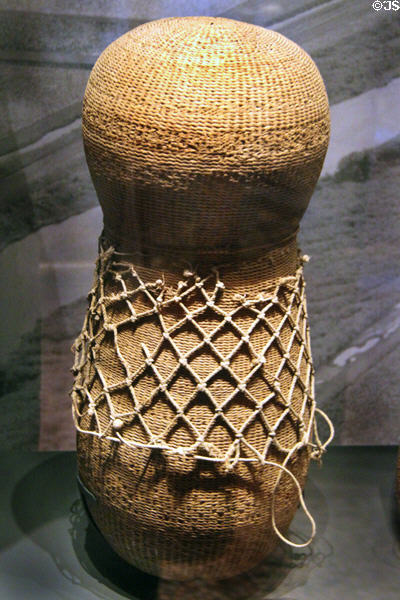
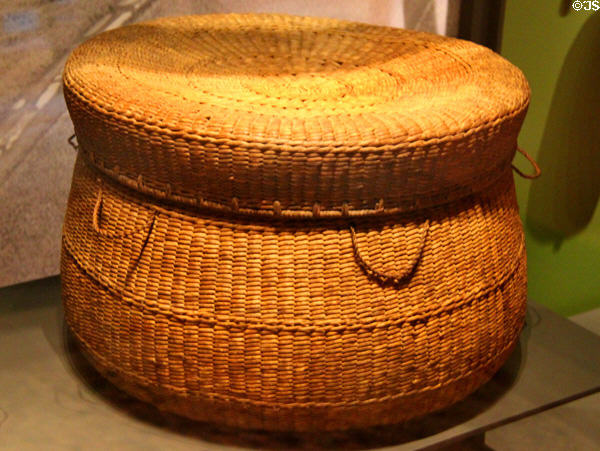
Without metals, pottery, or beasts of burden, the people made implements, weapons, and utensils of stone, wood, shell, teeth, and bone, and great skill was displayed in arts and industries. Houses were of wood frames and thatched, with stone floors covered with mats. The finest mats and tapas were high valuables, suitable for use only by chiefs and gods. In 1820 missionary Lucia Holman writes: "The floor of the houses of the nobility are first paved with small pebble stones, then a layer of hay, next a coarse mat made of the cocoa nut leaf .. next a finer mat made of the rush .. Next a straw mat, and so on. The richer and higher the chief, the more mats he sits and sleeps upon. I have counted 20 or 30 on one floor."
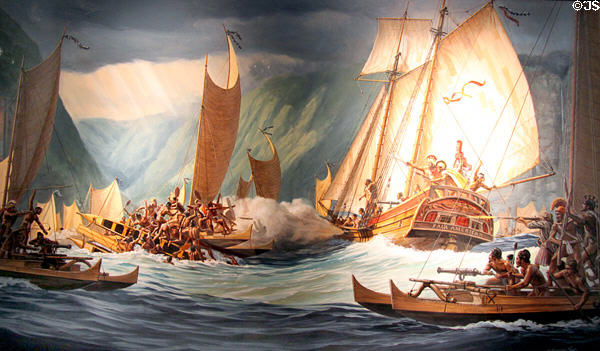
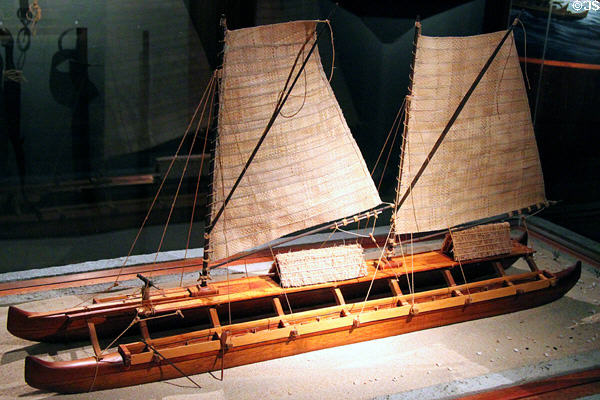
The people were excellent sailors, fishermen, and swimmers. Canoes were outrigger or double, sometimes 30 m long. Fish was caught from the sea or raised in the ponds. Their principal food was taro, and they cultivated also sweet potatoes, coconuts, yams, and bananas. They made narcotic and fermented drinks of the awa (kava) or ti roots. They loved flowers, which they wore in leis around their necks and hats.
TOP
Clash of cultures and the "lazy women"
The missionaries from New England arrived to Hawai'i in 1820s. They were shocked by what they perceived as the idleness of women. Women were advantaged by the usual division of labour: men undertook the bulk of heavy labour in building, fishing and agriculture, and also cooked the meals. Women made mats and barkcloth, collected shellfish, and were more closely involved than men in care of infants. People did not wear much clothing and houses had no furniture. But, as mentioned above, the mats made by women were highly valued, and accumulated in numbers in noble residences. Young women had little duties. Hawaiians did not appear to the missionaries to have enough work to do. Their free time was spent in swimming and surfing, in cardplaying, boxing matches, games, cockfights, hulas and other traditional games of skill or chance. In a missionary school, surfboards were used as tables for women to study.
The protestant upbringing made it difficult for the missionaries to understand the values of the native culture, or their family system. One of the missionaries complained about the difficulty to translate the Seventh Commandment to the Hawaiian language, because, according to him, the Hawaiians had about twenty forms of illicit intercourse, with as many different names in the language. If he uses one word, the natives may think that the other 19 are still allowed!
Family life
Absence of nuclear family life troubled the missionaries. "The children were growing up like wild goats in the field." According to them, there was entire lack of discipline. If children got angry at the parent, they just took their sleeping-mat and went to stay with other relatives. The large kin group looked after children, and adoption was common to tighten family ties. Children were often left to relatives, and people did not make difference between biological children and other kin. Birth of a child was an important ceremonial occasion. In Hawaiian thought grandchildren 'mo`opuna' replace their grandparents 'kupuna'. Grandparents had the right to ask for their mo`opuna for adoption, and they reared children born to young adults. Infanticide and abortions were sometimes practiced. After contact 1778 there was a high mortality in infectious diseases.
Marriage of commoners was unmarked and casual, attachments were easily broken. A Hawaiian testifying in the court 1854: In the old days, before the custom of marriage became general, it was 'moe aku, moe mai' = sleep here, sleep there. Usually a commoner had one spouse at a time, but instances of sororal polygyny (sisters shared a husband), fraternal polyandry (brothers shared a wife), the sororate (widower married sister of his wife) and levirate (widow married a brother of the husband) occured in nineteenth century family histories. There were no distinct terms for 'husband' and 'wife' but words used were 'kane' = man and 'wahine' = woman. Ho`ao pa`a, formal marriage, was used to form a tie between families, the custom of the chiefs and first-born children of prominent people.
There was hypogamy as well as hypergamy, wife-capture as well as husband-capture, homosexuality as well as heterosexuality. Certain young people were expected to be virgins, some others were granted much liberties. "Children (at least aristocratic) were socialized in the arts of love. .. Girls were taught the 'amo'amo the wink-wink of the vulva, and the other techniques that make the thighs rejoice. Young chiefs were sexually initiated by older women, preparing them thus for sexual conquests that singularly mark a political career: the capture of a senior ancestry. And all this, of course, was celebrated not only in the flesh, but in the dance, poetry and song."
An ule, an ule to be enjoyed, ("ule"=penis).On Samoa, the missionary Williams had witnessed how "a young Englishman first went on shore among (Samoans) the females in great numbers gathered around him & some took off their mats before him exposing their persons as much as possible to his view. This they call Faa Samoa" = the Samoan way. The mat was the only piece of clothing women used to wear, a skirt of fibres or leaves. Taking it off could mean sexual proposal or sign of contempt.
Don't stand still, come gently,
That way, all will be here,
Shoot off your arrow.
Menstruating women were secluded in a separate house, the hale pe`a. A man was also prohibited from consorting with any other women during his wife's menses, on pain of death, according to one informant. There was some ambiguity about menstruation: after a taboo period of three to five days a woman ritually cleansed herself and was able to have intercourse, even if she was still bleeding; in fact the conception was believed to be most probable during that time. So the blood was not bad as such.
TOP
Kapu
Kapu or taboo classified some foods and acts as forbidden. Normally, many priviledges of high rank people were kapu to commoners, and strictly punished. Kapu forbade men and women from eating together. As elsewhere in Polynesia, cooking was men's work. Customarily, men's meals were taken in communion with ancestral gods, and these very food were the sacrifice, hence at all times prohibited to women.
Men and women had separate eating houses but common sleeping house; women were forbidden from entering heiau temples or the men's house. There was a great number of kapu foods which only high ranking men were allowed to eat: pork, coconut, shark, sea turtle, whale, most varieties of banana; women ate primarily fish and taro. However, women seemed to eat forbidden foods when men could not see them and they could escape punishment. The risk was high as the punishment could be putting out an eye or putting to death. Women of high kapu rank were not punished themselves but, at least in one instance, a surrogate, a boy servant was put to death as an offering. Similarly, when chiefly women were caught in liaisons with commoner men or lesser chiefs, the man would be punished but not the chiefess. The kapu system was an arena for gender politics, and gender relations were altered several times since the first contact.
Some words were also heavily endowed with mana, sacred power, and therefore kapu to those without the status to speak them. Hawaiian proverb about the power of words says: "In the word is life; in the word is death."
TOP
Aristocracy
The Hawaiian society was highly stratified: there were classes of chiefs, lower chiefs and commoners. Chiefs of highest tabus - those who are called gods, fire, heat and raging blazes - cannot be gazed directly upon without injury. The lowly commoner prostrates before them face to the ground, the position assumed by victims on the platforms of human sacrifice. .. When a commoner, having violated the tabu, is destined for sacrifice, his eyes are first put out by the king's executioners; but when the great chief Keoua in historic times resigned himself to the altars of his victorious rival Kamehameha, he first cut off the end of his penis.
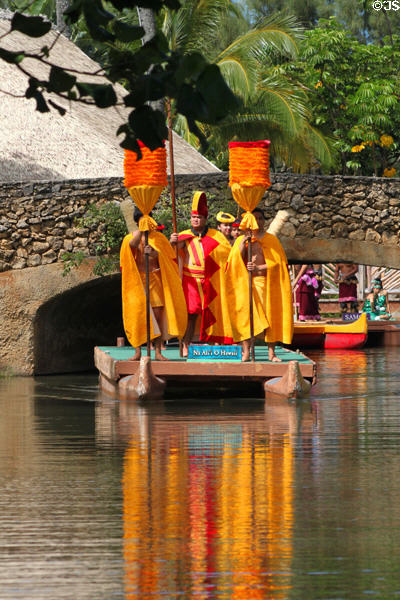
High chiefs, alii nui, held absolute power. When a missionary went to remonstrate with the royally drunk king in Hawaii, and told him that God was not pleased with such conduct, the king Liholiho replied "I am god myself. What the hell! Get out of my house."
Classificatory sister-brother-unions produced the highest-ranking offspring among high chiefs, belonging to the p`io and niaupio ranks. There was a high frequency of consanguineous marriages among the ruling chiefs - male chiefs with their classificatory 'sisters' (usually half-sisters) and 'daughters' (siblings' daughters). Sahlins states "Hawaiians .. do not trace descent so much as ascent, selectively choosing their way upward, by a path that notably includes female ancestors, to a connection with some ancient ruling line."
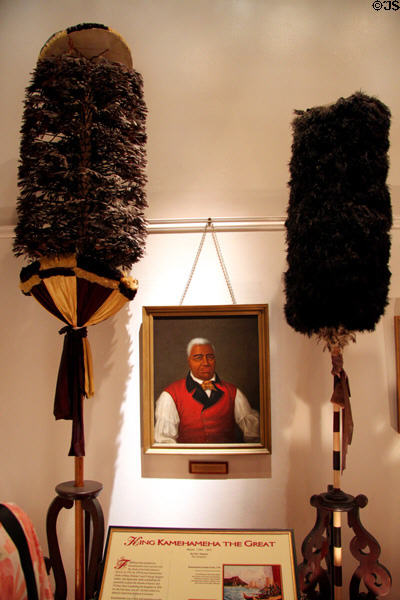
When the usurper lower ranking wohi chief Kamehameha defeated his rival, he asked his rival's wife's mother Kalola Pupuka to give her 'daughters' (in fact hers and her sisters') and granddaughters as his wives. He married a bunch of sisters' daughters and their daughters. One refused herself and committed suicide. Thus, the highest ranking person in the kingdom in 1819 was Keopuolani, a ni`aupi`o chiefess and the mother of heirs to the throne, like Kamehameha's son Liholiho. She was of such high rank that Kamehameha had to remove his loincloths in her presence, and he also had to avoid her shadow and could not be in her presence if she did not so wish. .
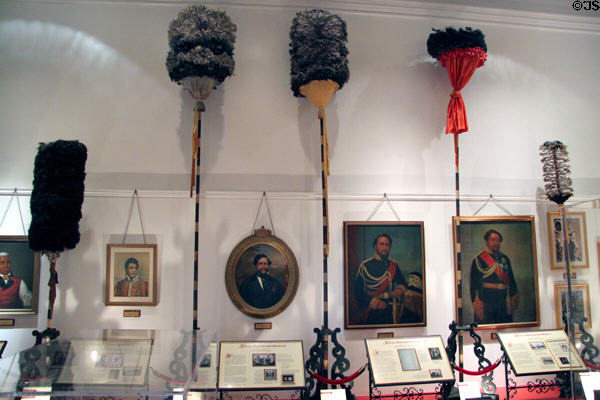
The ideal beauty and potency of the chiefs was huge, fattened, skin lightened by the protection from the sun, body glistening with perfumed oil, bedecked in the dazzling feather cape that is the treasure of his/her kingdom. Kaahumanu, the queen regent (around 1830), was so enormous that she could hold any of the missionaries on her lap, which she often took the liberty of doing. Chants for the chiefs were sung at their birth, praising his/hers precious parts. King Kalakaua was celebrated with this song:
Your lively ma'i (=genitals)A secondary wife of Kalaniopu'u, king of the Hawaii in Cook's time, informed that she has had during her lifetime not less than 40 husbands, she usually had several of them at one time.
That you are hiding -
Show the big thing,
Halala, to the many birds.
TOP
Society and religion
Traditionally, the haku`aina carried the inheritance rights to the land in the family, other siblings were allowed to stay in the land.
Traditionally the land belonged to the highest king who distributed it among his vassals and they among the commoners; but there were inherited tenure rights to use the land. Private ownership, mahele, was introduced in 1840s because of external pressures, and it brought a disaster because people were not able to adopt the idea of selling away land, and indeed losing rights to it. The last indigenous ruler, Queen Liliuokalani opened a bank for women to protect their possesions against husbands, non-Hawaiian in particular, because the bulk of Hawaiian money acquired through inheritance of land was owned and controlled by women.
Hale o Papa, the house of the goddesses, was only for women. Women were reputed to have a privileged relationship with the female deities of sorcery, primarily Pele and her sisters, who are kino (forms) of Haumea, goddess of childbirth and reproduction. Women were particularly likely to be kaula, seers or prophets. To this day Hawaiian women are particularly vulnerable to spirit possession.
The hula dances were done for the purpose of carrying on tradition, honoring gods, and keeping the history alive. Hula dance symbolized its patron goddess Laka and it would arouse the returning god Lono of cosmic reproduction. Lono's yearly return by the sea and regeneration of nature was central in the Hawaiian religion. Traditionally hula was performed daily, and missionaries took great pains in trying to prevent it on Sundays.
TOP
Questions for reflection
At the present time, Hawai'an society experiences a revival of traditional values which were largely destroyed by the missionaries and occupation by the U.S. (See the Web-links below). Many aspects of the traditional Hawaiian way of life differ from Western values, for example. Compare your own society to the Hawaiian world-view. Would there be something worth of changing?
Sources of information:
Buck, Elizabeth. 1993. Paradise remade. The politics of culture and history in Hawai'i. Philadelphia: Temple University Press.
Grimshaw, Patricia. 1989. New England missionary wives, Hawaiian women and 'the cult of womanhood'. in Jolly and Macintyre (eds): p 19-44
Jolly, Margaret and Martha Macintyre, editors. 1989. Family and gender in the Pacific. Domestic contradictions and the colonial impact. Cambridge: Cambridge Un Press. 296 p
Linnekin, Jocelyn. 1990.Sacred queens and women of consequence: rank, gender, and colonialism in the Hawaiian Islands. Ann Arbor: Un of Michigan Press. 276 p.
Sahlins, Marshall. 1985. Islands of history. Chicago Un. Press. 180 p.
Weiner, Annette. 1992. Inalienable possesions: the paradox of keeping-while-giving. New York. 232 p
On the Web:
PAPA KUHIKUHI - Maui Nui Cultural Links Directory
Hawaiian Independence and Cultural Links






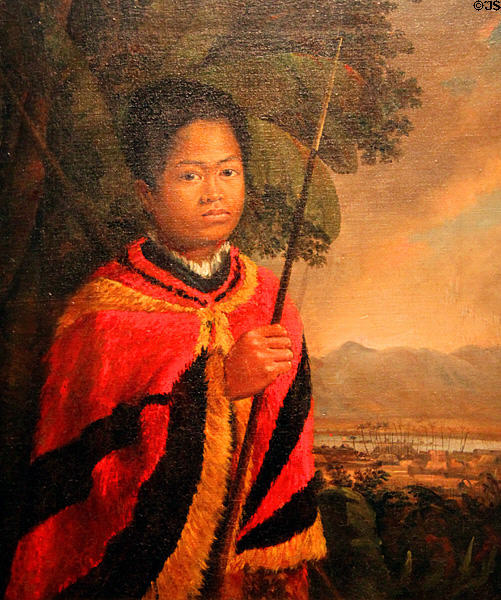
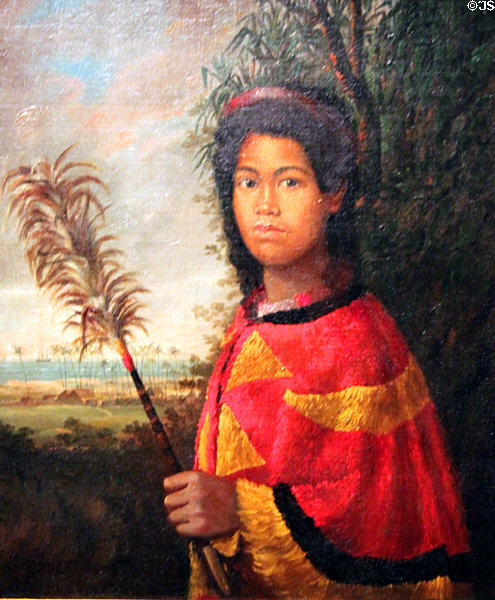
 prince gorge kaumualii


![[IMAGE: ]](http://www.hawaiialive.org/resources/image/475.jpg) i keep telling everyone the whole long hai9r hula thing not so in in the pre pocontact era, it was smore short hair with lime action going on but no one ever listens to me so i give up haha but heres the evidence i am soooooo pololei oh well haha
i keep telling everyone the whole long hai9r hula thing not so in in the pre pocontact era, it was smore short hair with lime action going on but no one ever listens to me so i give up haha but heres the evidence i am soooooo pololei oh well haha![[IMAGE: ]](http://www.hawaiialive.org/resources/image/476.jpg) entittloed wpomen at the sacred falls. well lets see now, pau skirts hawaiian alii faces, and retainers, hmmm. pilgrimage to a sacred wahine site associated with water anyone n o no? well i ma pololei ya know. take archeology up a notch what how DARE!!! proves all what i always say but no one ever listens so i give up but heres some good evidence tho. hey check out the pau dresses, rode over horses. da mothah hubbards are to die for peeps lol.
entittloed wpomen at the sacred falls. well lets see now, pau skirts hawaiian alii faces, and retainers, hmmm. pilgrimage to a sacred wahine site associated with water anyone n o no? well i ma pololei ya know. take archeology up a notch what how DARE!!! proves all what i always say but no one ever listens so i give up but heres some good evidence tho. hey check out the pau dresses, rode over horses. da mothah hubbards are to die for peeps lol.![[IMAGE: ]](http://www.hawaiialive.org/resources/image/477.jpg) so much guys make so much money of this pic in the tourism trade. true story of braddah uncle tutu man check out his stance, and his look. loyal royal retainer, royal fisdherman. ie he work for Da MAN the canoe is made of hardwoo9d and has an alii design to it. betcha couldnt figgah that out in archeology 101 huh? hah u know i pololei lo
so much guys make so much money of this pic in the tourism trade. true story of braddah uncle tutu man check out his stance, and his look. loyal royal retainer, royal fisdherman. ie he work for Da MAN the canoe is made of hardwoo9d and has an alii design to it. betcha couldnt figgah that out in archeology 101 huh? hah u know i pololei lo![[IMAGE: ]](http://www.hawaiialive.org/resources/image/290.jpg)
![[IMAGE: ]](http://www.hawaiialive.org/resources/image/272.jpg)
![[IMAGE: ]](http://www.hawaiialive.org/resources/image/269.jpg)
![[IMAGE: ]](http://www.hawaiialive.org/resources/image/87.jpg) this dress liliu wore to kalakauas coronation. the next pic is a mother hubbard made of tapa11111...pretty amazing and shows the amazing adaptable skills of the poeple
this dress liliu wore to kalakauas coronation. the next pic is a mother hubbard made of tapa11111...pretty amazing and shows the amazing adaptable skills of the poeple![[IMAGE: ]](http://www.hawaiialive.org/resources/image/141.jpg)
![[IMAGE: ]](http://www.hawaiialive.org/resources/image/212.jpg) ie kuku
ie kuku![[IMAGE: ]](http://www.hawaiialive.org/resources/image/216.jpg)
![[IMAGE: ]](http://www.hawaiialive.org/resources/image/260.jpg)
![[IMAGE: ]](http://www.hawaiialive.org/resources/image/479.jpg)
 this is from grove farm homestead kauai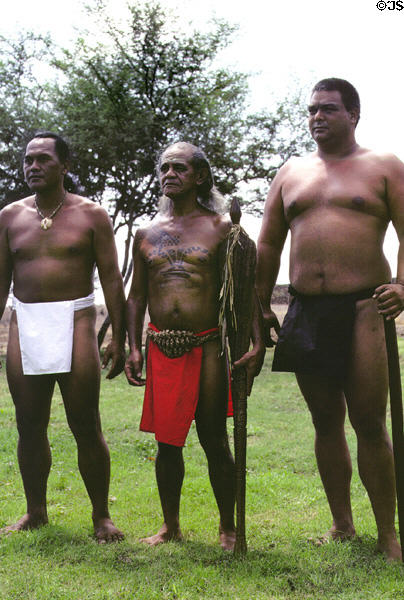
 all from nualolo kai
 n ualolo kai. the stone was put in a bowl and fitted perfectly then filled with water to make a mirror. smaaaaaahhhhhht huh? hehe
 why do they ALWAYS forget to say that these were used by women, ha ha haaaaaaaaahhhhhhhh////// sheesh.
 eh u know what dis one is older then the other one know why cuz poeple were caring less having less tinme and less knowledge on how to do it thas why ge4t it? sheesh and women held this one not men. sometimes they make poi from sweet poitato (uala) and ulu on da north shore thas why. different needs in poi pounders and only women and children atit so the women made it. see men cant figgah that stuff out ya know haha
 i love hbow they say finding this stuff "suggests habitation in the area. what a laugh haha like duh yeah. make u shame no moah there now huh jus hippies
![[IMAGE] A Man of the Sandwich Islands, Half Face Tattooed](http://www.hawaiialive.org/resources/treasures/display/351.jpg "A Man of the Sandwich Islands, Half Face Tattooed")
![[IMAGE] The Pā‘ū of Kamāmalu](http://www.hawaiialive.org/resources/treasures/originals/366.jpg)
![[IMAGE] The Pā‘ū of Kamāmalu](http://www.hawaiialive.org/resources/treasures/display/366.jpg "The Pā‘ū of Kamāmalu")


